Skip to Main Content
Subscribe to Newsletters
Global X Logo
Search
Content loaded

Subscribe to our newsletter

Get the latest news and updates from our team.

Subscribe

Explore

Our ETFs

Investment Insights

Product ResearchCharting DisruptionMidyear Outlook 2026

Investor Resources

EducationHow to InvestTax Resources

About Us

About Global XNewsroomCareersContact Us

Follow Us

socaial media icon for LinkedInLinkedInSocial media icon for X (twitter)XSocial media icon for FacebookFacebookSocial media icon for InstagramInstagramSocial media icon for YoutubeYouTube

Copyright © 2026 Global X. All rights reserved.

Privacy PolicyAccessibility Statement

SEI Investments Distribution Co. (1 Freedom Valley Drive, Oaks, PA, 19456) is the distributor for the Global X Funds.

Check the background of SIDCO and Global X's Registered Representatives on FINRA's BrokerCheck.

Content
Product ResearchFactor-Based InvestingCore

3 Questions on the Adaptive Wealth Strategies U.S. Factor Index

x
G
Global X ResearchGlobal X Research Team
Feb 28, 2019·3 min read
190227-AUSF

Related articles

1of2
Product ResearchFactor-Based InvestingCore

Introducing the Adaptive U.S. Factor ETF (AUSF)

On August 28, the Global X Adaptive U.S. Factor ETF (AUSF) began trading on the NYSE. We interviewed Kris Carroll of AWS to discuss AUSF's index.

G

Global X Research

Aug 28, 20185 min read
Product ResearchFactor-Based InvestingCore

The Strategy Behind Our Adaptive U.S. Factor ETF (AUSF)

Product ResearchFactor-Based InvestingCore

Introducing the Adaptive U.S. Factor ETF (AUSF)

On August 28, the Global X Adaptive U.S. Factor ETF (AUSF) began trading on the NYSE. We interviewed Kris Carroll of AWS to discuss AUSF's index.

Related funds
Core
AUSFAdaptive U.S. Factor ETF
Explore All ETFs

In this post, we interviewed Patrick Bobbins, Investment Manager at Adaptive Wealth Strategies, about the Adaptive Wealth Strategies U.S. Factor index (AWSUSF), which is tracked by the Global X Adaptive U.S. Factor ETF (AUSF). 

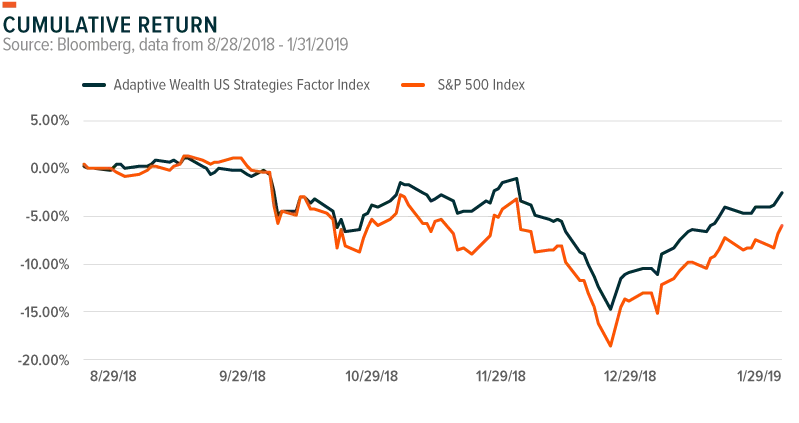
1. How has the AWSUSF Index performed since inception?

While its history is short, the AWSUSF Index, which is tracked by the Global X Adaptive U.S. Factor ETF (AUSF), has performed in line with expectations, particularly versus the S&P 500 index.  The drawdown numbers are the ones that we like to look at most.  When the S&P 500 fell by roughly 19% from October to December in 2018, the AWSUSF Index was down only about 15%.  Looking to 2019, through January the S&P 500 was up about 8% and the AWSUSF index is up about 9%, so the index didn’t decline as much as the S&P 500 in Q4, and increased by more in January, showing strong upside/downside capture statistics.


For actual Fund performance, please visit www.globalxetfs.com/funds/ausf or request a prospectus by calling 1-888-GX-FUND-1 (1.888.493.8631).

2. What are the main drivers of this performance?

The two main drivers were the index’s exposure to the minimum volatility factor and avoidance of the momentum factor. When there is a risk-off event, such as what we saw in the fourth quarter of 2018 (Q4), having exposure to the minimum volatility factor can serve as a ballast to the portfolio.  This is what took place in Q4, as many of the larger S&P 500 index constituents sold off, but minimum volatility stocks, such as those in utilities and consumer staples, fared relatively better.  In addition, the index’s mean-reversion process meant that it was not targeting momentum factor stocks, which began to perform poorly. While one can never perfectly time buys or sells in a portfolio, building a methodology that is disciplined in exiting a factor that recently experienced a large upward run, may be a good place to start.

3. Why is the index in the Minimum Volatility & Value factors?

We think it is always important to remind ourselves of the investment process behind AUSF.  The process is designed around the mean-reversion of the three factors: momentum, minimum volatility, and value.  The best performing factor, will not always be the best performing factor indefinitely and the same goes for the worst performing factor - it will not always be the worst performing factor indefinitely.  So the investment process behind the index is to own two factors that have trailed on a two-year basis, and avoid the factor that has been the leader on a two-year basis.  This not only helps to keep the index diversified, but also it helps to limit some behavioral trends that are common among investors, such as chasing recent high-fliers or holding onto winners for too long.  Alternatively, investors also tend to ignore the losers, thereby creating an opportunity to own cheaper-valued equities.  This process tries to capture the mean reversion of the three factors, which may go against the behavioral grain certain investors possess.  In the fourth quarter of 2018, the momentum factor experienced strong selling pressure and which in our opinion started the mean-reversion process downward.  Since the index had removed momentum early in 2018, it did not experience the same force of selling pressure.
 

Related ETFs

AUSF: The Global X Adaptive U.S. Factor ETF tracks an index which seeks to outperform traditional cap-weighted indexes by employing a dynamic multi-factor investment strategy that allocates across three factors: minimum volatility, value, and momentum.

P

Pedro Palandrani

Aug 28, 20230 min read
G

Global X Research

Aug 28, 20185 min read
Product ResearchFactor-Based InvestingCore

The Strategy Behind Our Adaptive U.S. Factor ETF (AUSF)

P

Pedro Palandrani

Aug 28, 20230 min read