Investors focused on growth often allocate significant capital to the Information Technology sector, a segment of the market that tends to experience wider peaks and valleys than others, according to historical implied volatility metrics.1 That said, as a function of long-term economic growth, the peaks tend to come about with greater frequency, and they often represent primary reasons why some investors can outperform their respective portfolio benchmarks.
After these peaks occur, employing a strategy that can help investors protect their assets or generate returns can be a material differentiator in a portfolio. For example, strategies that systematically write covered call options may be able to create a stream of premium distributions when capital appreciation potential may be limited. The premiums that they receive can also be reinvested to support future growth and help cushion against market declines. The Global X Information Technology Covered Call & Growth ETF (TYLG) is one such strategy that writes call options on 50% of its notional holdings monthly and distributes the lower of half its premium received or 1% of its NAV, while reinvesting the balance of the premium back into the fund.
Key Takeaways
The Information Technology sector was one of the primary drivers of U.S. economic growth in 2023. However, with many of its leaders recently establishing new 52-week high stock prices, investors might be somewhat concerned over how far valuations can stretch.
Option premiums are more than just a potential source from which distributions are derived. The opportunity to reinvest a portion of this acquired capital adds dimensions to the fund's total return potential and could help support growth-oriented accounts.
Investors interested in covered call option strategies are not strictly required to cap price appreciation potential entirely. Writing calls on half the notional balance of an investment can generate premiums and keep long exposure intact.
Market Valuations Suggest Tech’s Recent Momentum Could Cool
In 2023, the Nasdaq 100 Index gained 54% in market value and the S&P 500 Index gained 24%.2 As was the case with many other bull markets of the past, the Information Technology sector led the way, while the Communication Services and Consumer Discretionary sectors were significant contributors, as well.
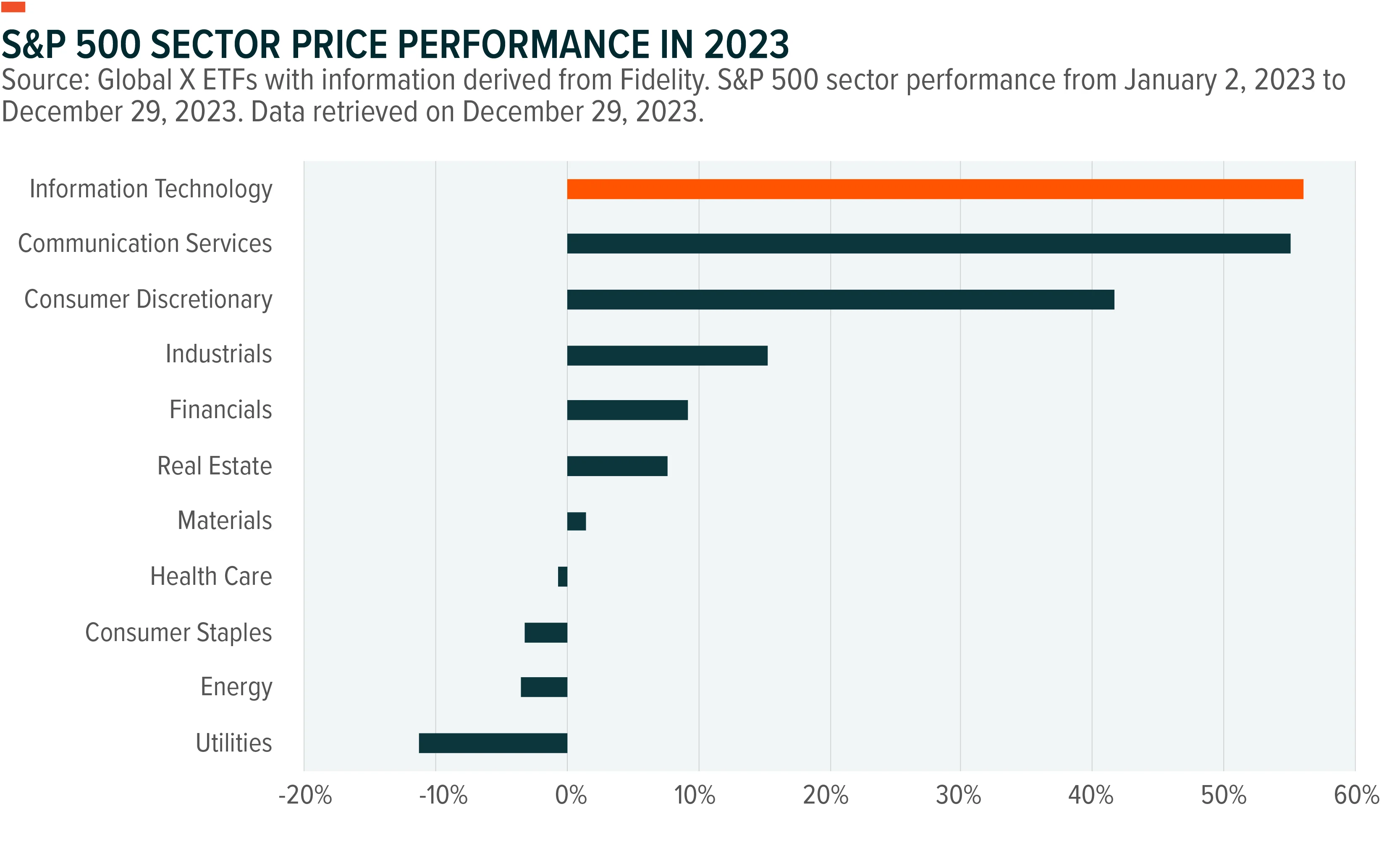
Past performance is not a guarantee of future results.
The increase in market value stemmed from investors’ enthusiasm over artificial intelligence technology, enhancements in cloud computing, and the growth of the Internet of Things. Additionally, developments in blockchain, cybersecurity, and robotics contributed to the tech sector’s vigorous expansion. Many of these ground-breaking technologies have the potential to drive meaningful earnings growth for major players in the space. Ongoing capital investment activity also lends confidence to investors that future sales and earnings targets might be achieved.
Despite these potential catalysts, however, some investors may still be hesitant to consider Information Technology positions because of the sector’s wide fluctuations in price or the belief that its recent growth trajectory may not be sustainable. In that vein, based on a variety of historical performance ratios, the stocks of several leading companies seem to be trading at premiums. The chart below illustrates a few of the relative measures that suggest these stocks may be due for a price correction.
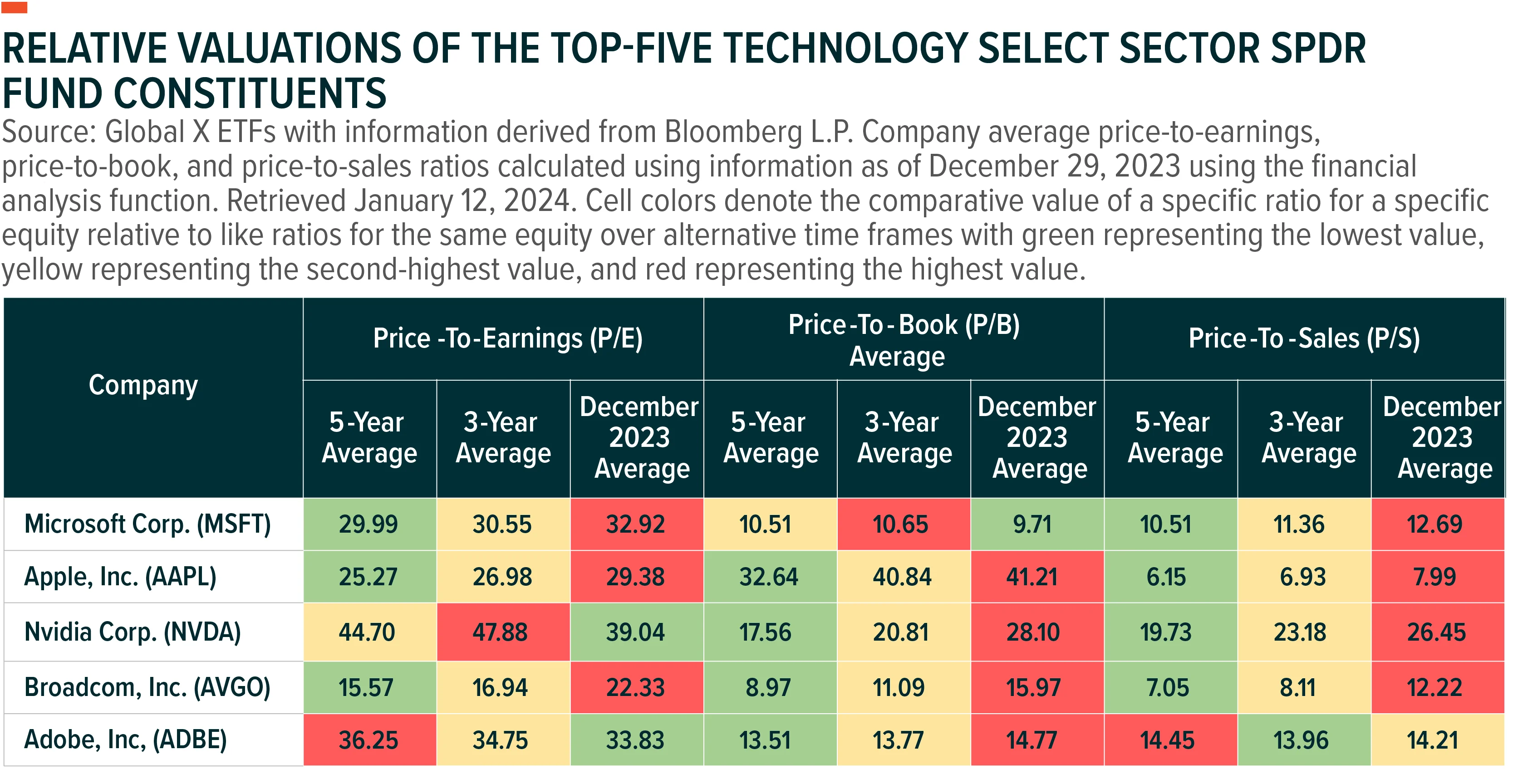
Additionally, three of the top five constituents in the S&P 500 Information Technology Index are forecast to deliver lower earnings growth in 2024.3 Forecasts like these don’t necessarily indicate immediate mean reversion, particularly given the long-term earnings potential presented by the innovative technologies that these companies deliver. Share earnings are still projected to increase for these top firms at what could be considered a healthy clip. However, traditional market metrics may support an investor potentially taking their foot off the gas pedal.
Call Options Could Offer Diversified Risk Exposures and Create Investable Premia
Writing call options might not be the most intuitive strategy for a growth-minded investor. In fact, substituting a reference asset’s price appreciation potential for the premiums received for writing the calls goes against the growth mentality almost completely. However, when managing investments in relatively volatile spaces, it’s important to be aware of the potential benefits that alternative forms of diversification can provide.
Writing call options against existing holdings places an effective cap on the upside price appreciation potential that can be realized by taking a long position in the reference asset, depending upon the strike price of the option. That said, adding covered call premium income to a portfolio can create an opportunity to limit the variability experienced in a basket of holdings to the downside, as well. Although there is limited historical data surrounding covered call option writing strategies on technology sector investments specifically, by charting monthly returns associated with S&P 500 alongside the returns produced by the Cboe S&P 500 BuyWrite Index, which is an index designed to track the performance of a hypothetical covered call strategy on the S&P 500, across various intervals, it can be noted how incorporation of the covered call strategy might help narrow both positive and negative tails associated with the distribution.
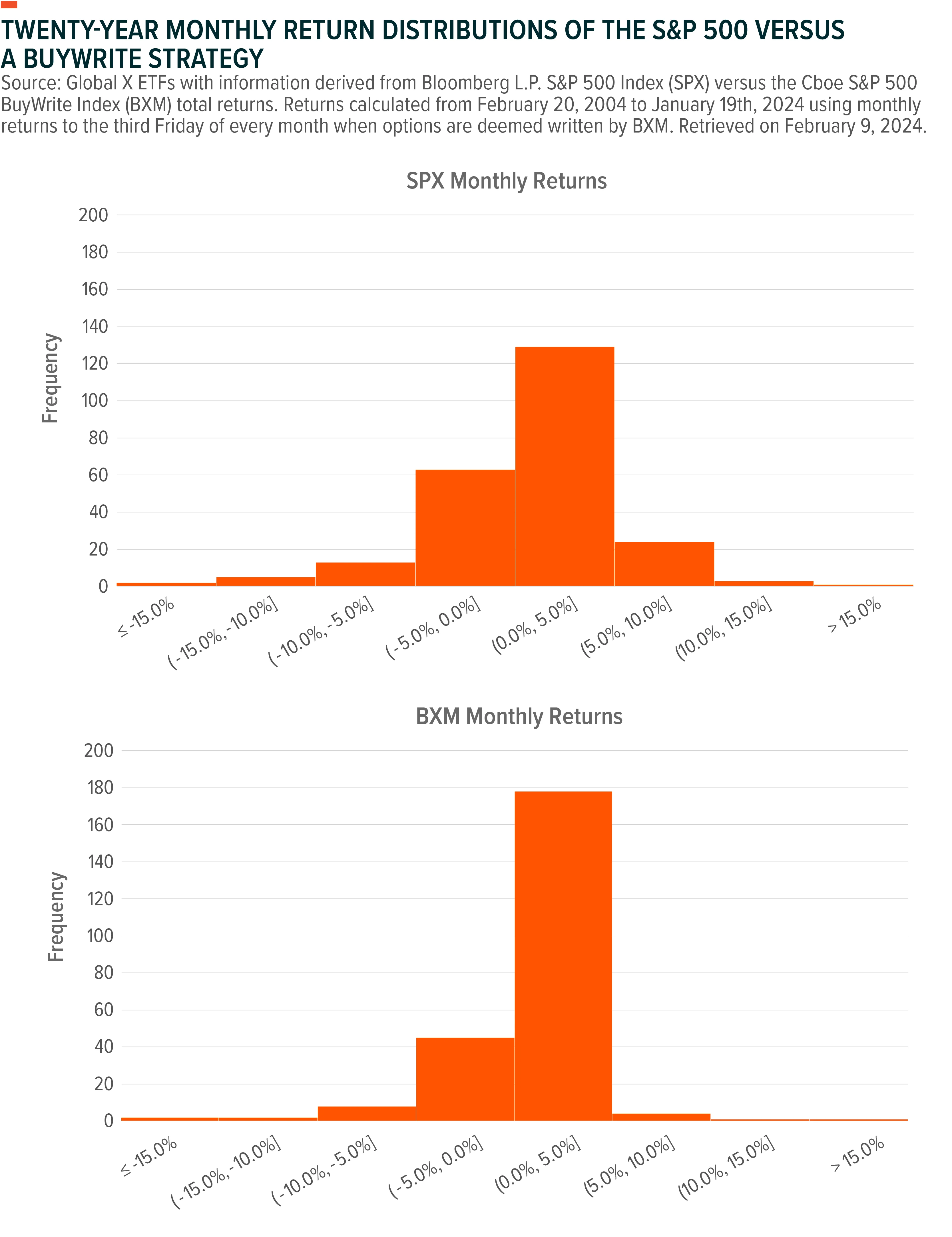
Index returns are for illustrative purposes only and do not represent actual Fund performance. Index returns do not reflect any management fees, transaction costs or expenses. Indexes are unmanaged and one cannot invest directly in an index. Past performance does not guarantee future results.
In demonstrating how covered calls can support a growth-oriented investment strategy, it is important to consider the opportunity for reinvestment of the premiums that the fund seeks to retrieve. The periodic selling of call options can act as a source of consistent cash flow for an investor, which can then be readministered toward a broader growth-targeted allocation. This strategy can be likened to dollar cost averaging, in that premiums can be reinvested upon receipt regardless of the cost. That said, an investor could just as easily choose to reinvest premiums more tactically in an attempt to seek out a lower market price altogether.
For example, a strategy like the Global X Information Technology Covered Call & Growth ETF (TYLG), which writes calls on 50% of its notional holdings, could be paired with long holdings in the constituents of the S&P 500 Information Technology Index. The result is a portfolio that can potentially provide less-widely oscillating patterns of price returns like those in the histogram presentation above. The combination can potentially do so while only losing a few basis points in overall performance by investing premium distributions into an uncovered position.
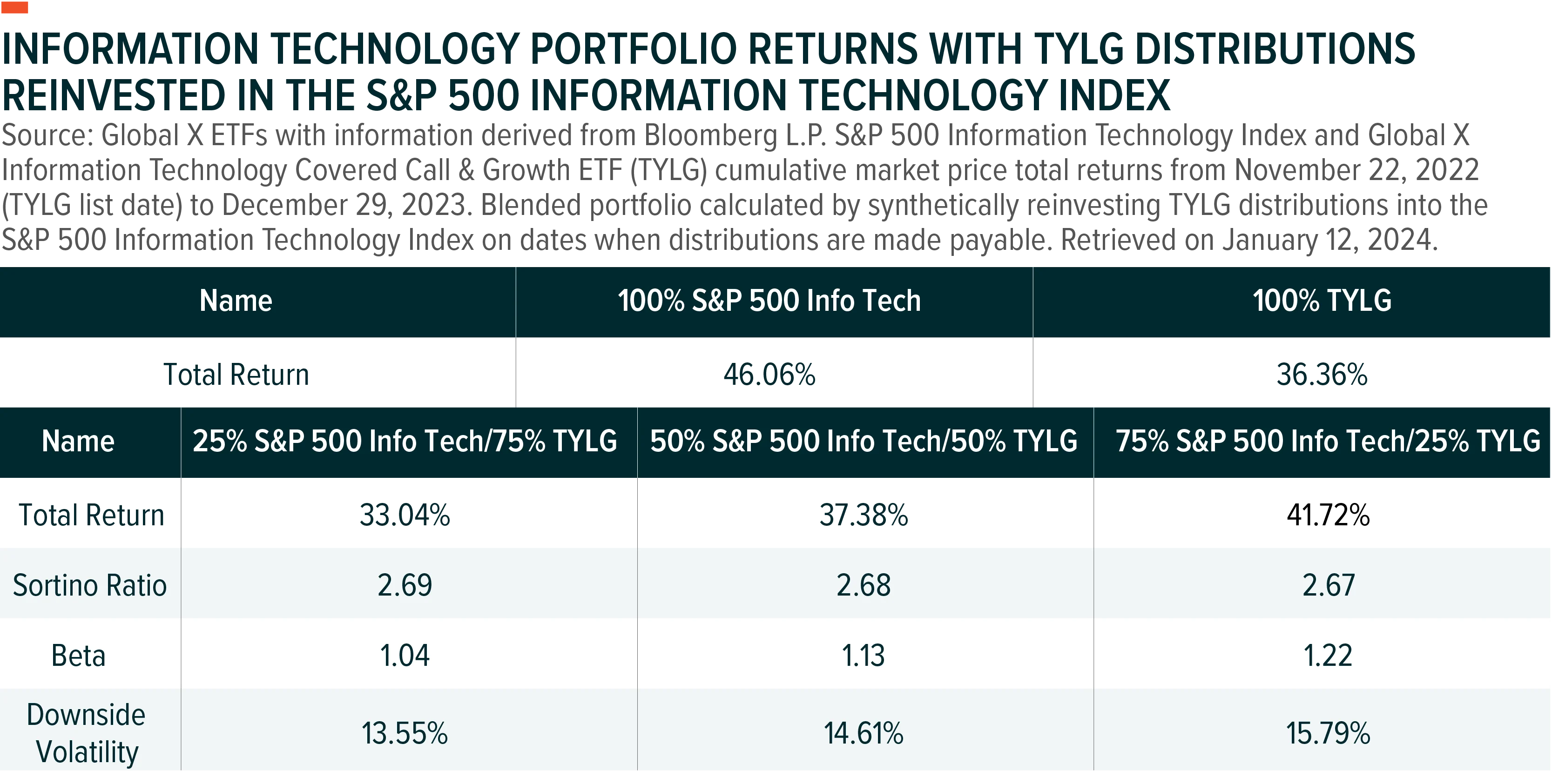
The performance data quoted represents past performance. Past performance does not guarantee future results. The investment return and principal value of an investment will fluctuate so that an investor's shares, when sold or redeemed, may be worth more or less than their original cost and current performance may be lower or higher than the performance quoted. High short-term performance is unusual and investors should not expect such performance to be repeated. For performance current to the most recent month- and quarter-end, please visit our site.
The Fund Structure Offers Exposure to Tech With a Degree of Flexibility
When it comes to the equity of major players in Information Technology, liquidity is rarely an issue. More likely, investors are concerned about individual stock valuations, growth prospects, and share-price momentum. However, investigating these metrics, picking stocks, and analyzing an entry point require more ability, attention, and time than many investors have. A valid alternative is to seek broad exposure through an ETF, which can offer similar liquidity, potentially at a lower overall cost. ETFs have the ability to create these positions and incorporate systematic covered call option writing strategies.
TYLG is one example of a vehicle that can create exposure to covered calls but still allow an investor to maintain half the upside price appreciation potential associated with the Technology Select Sector SPDR Fund (XLK). It does so by purchasing the stocks that make up the Information Technology Select Sector Index and XLK, an ETF that seeks to track the index. TYLG then writes monthly call options on XLK representing approximately 50% of the value of TYLG’s portfolio and distributes the lower of half its premium received or 1% of its NAV. Operating in this fashion, TYLG seeks to create a source of income and allows an investor to maintain long exposure to the constituents of the index.
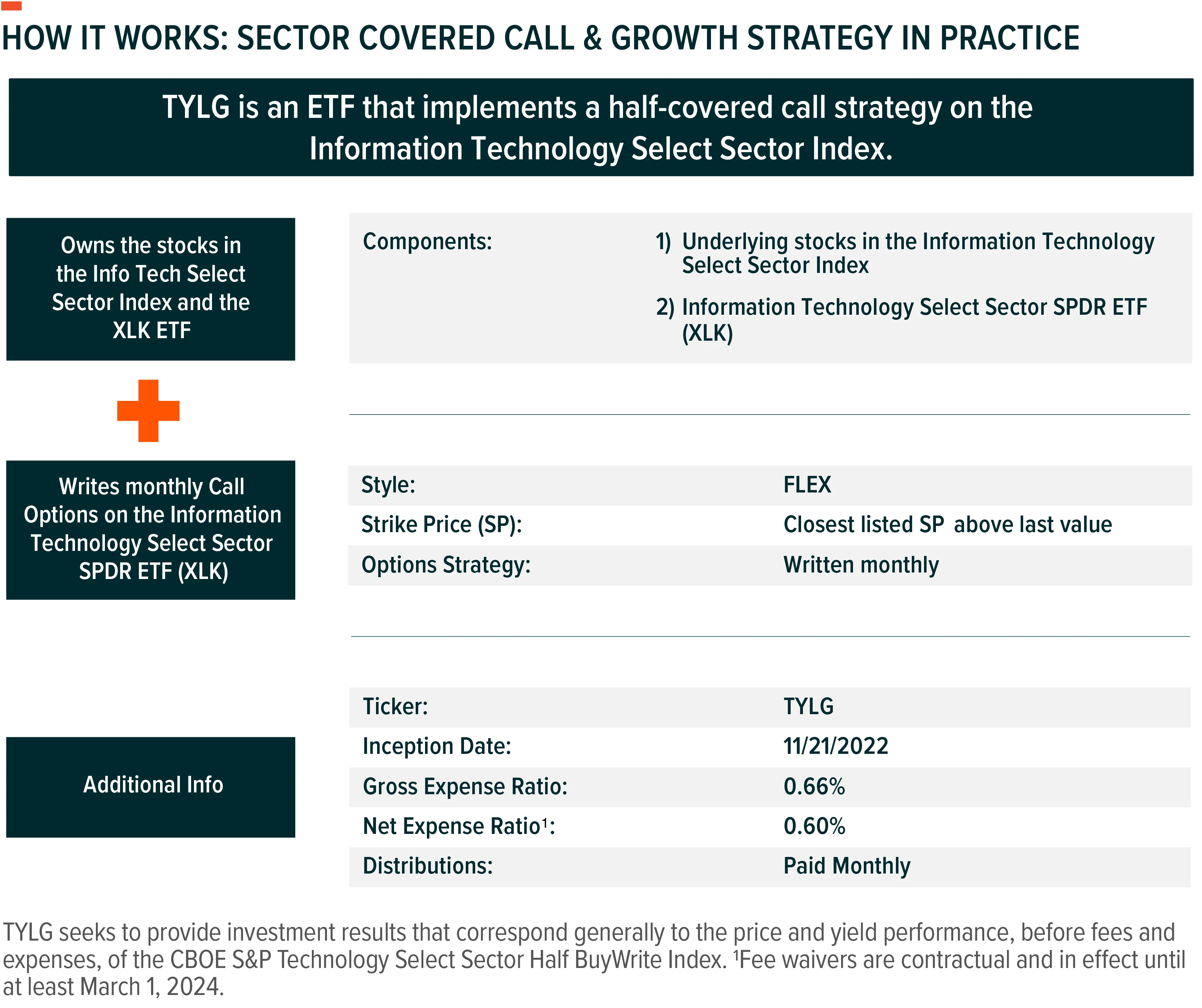
TYLG delivers augmented exposure to the Tech sector by pursuing income through option premiums, creating a positive correlation with volatility. Indeed, while stock prices tend to have a negative correlation with volatility, option premiums generally rise in conjunction with the measure. And by pairing a position in TYLG with an investment in a growth-oriented Tech allocation, an investor could tactically manage what portion of their overall allocation is covered.
Conclusion: Covered Calls May Narrow Tech Position Variability While Seeking to Procure Premiums
Holdings within the broader Information Technology sector are a virtual no-brainer for buy-and-hold investors. The same is true for those investors with a more tactical bent, who want to lean into the growth potential that the sector provides. However, rather significant volatility is common. Covered calls can be a strategy for these swings. By throttling varying levels of asset coverage, investors can harness premiums in an effort to augment their risk/reward profile. Covered call writing also represents an opportunity to maintain exposure to an underlying asset and create a stream of premium distributions for reinvestment aimed at compounding growth.
Related ETFs
TYLG – Global X Information Technology Covered Call & Growth ETF
Click the fund name above to view current performance and holdings. Holdings are subject to change. Current and future holdings are subject to risk.