
AI’s rapid and broad advancement was tangibly felt at the 2026 Consumer Electronics Show (CES). Across keynotes, management conversations, and exhibit demonstrations, we noticed a consistent signal that AI capabilities have moved beyond novelty and experimentation toward real-world execution and measurable impact, underscoring the technology’s growing maturity.
The broader ecosystem is evolving in parallel to support this shift. From chips to software and applications, the AI stack is being rebuilt for scale. In hardware, Nvidia and AMD showcased next-gen AI semiconductors for data center and edge deployments, reinforcing that future AI experiences will be powered by scalable compute across every layer of the stack. Intel emphasized inference-led solutions, highlighting the growing diversity of AI workloads. Across consumer hardware and devices, AI-driven upgrades were increasingly visible, reflecting a broader dispersion of AI capabilities across industries and everyday use cases.
The most notable signal of this progress was in robotics and automation, as AI gets increasingly applied to the physical world. Humanoid robotics companies were especially prominent, marking a clear progression from prior years and signaling how quickly the ecosystem is moving from visibility to early commercialization.
This is one of two pieces on the leading themes from CES 2026. Read the companion article, CES 2026: Autonomous Driving Hits an Inflection Point.
Key Takeaways
Rapid advances across hardware and software are enabling AI to be increasingly deployed in real-world settings, demonstrating measurable impact and growing maturity.
Next-generation compute platforms are distributing AI capabilities across data centers, edge devices, and personal computers, broadening adoption and reinforcing long-term growth across the AI ecosystem.
Autonomous collaborative robots are increasingly emerging as core industrial infrastructure and moving from optional automation to essential components of modern factories, logistics networks, and construction environments.
AI Semiconductors Mature to Support Workload Complexity
Improving AI models and exponential usage are putting pressure on the AI semiconductor industry to innovate toward more sophisticated yet efficient processing systems.
AMD CEO Dr. Lisa Su’s keynote was a highlight of the event, outlining a vision for AI that scales across data centers and everyday devices—potentially compounding global compute demand to more than 10,000 zettaflops over the next five years, up from roughly 100 zettaflops today.1 AMD’s tightly integrated systems of CPUs, GPUs, networking, and software appear well placed to meet that demand. AMD also offered an inside look into its Helios rack-scale platform, a modular, open design built to support next-generation AI workloads in the yotta-scale infrastructure era. Additionally, AMD unveiled the Instinct MI400 Series accelerator portfolio, including the new MI440X tailored for enterprise AI deployments, and a preview of the upcoming MI500 Series GPUs, which are expected to deliver up to 1,000x the performance of earlier generations when they begin shipping in 2027.2
Nvidia’s keynote introduced the company’s next-generation Vera Rubin AI computing platform – a co-designed system integrating CPUs, GPUs, interconnects, and networking to dramatically expand inference and training capabilities. It delivers significantly higher performance and efficiency than the current Blackwell generation, with up to 10x lower inference costs and notably faster training times, which could make large models and agentic AI more economically viable for enterprise and cloud deployments.3
AI hardware maturity was visible beyond AMD and Nvidia. Intel showcased Panther Lake, its next-generation Core Ultra Series 3 processors. These are built on the company’s advanced 18A manufacturing process, highlighting improved CPU, GPU, and on-device AI performance designed to power the next wave of AI PCs and edge devices.4 Similarly, Qualcomm showcased its next-generation Snapdragon X AI PC platform, designed to enable advanced on-device AI workloads with high performance per watt.5 The announcement reinforced Qualcomm’s focus on efficient, edge-based AI compute, positioning its silicon for AI PCs and other always-on intelligent devices beyond smartphones.
Collectively, we believe these announcements mark a clear inflection point for the AI semiconductor industry as it rapidly reorients toward the demands of accelerated computing. We expect a prolonged CapEx cycle as the broader semiconductor design, manufacturing, and integration ecosystem scales to build and deploy this hardware infrastructure over the coming years to sustain AI workloads.
Robotics Advances Toward Scaled Deployment and Sustained Industrial Integration
Robotics was one of the most visible expressions of AI’s transition into the physical world. Unlike prior years, where robotics demos often felt experimental or conceptual, CES 2026 showcased systems that are already in use commercially. Moreso, it was evident that the scope of robots is expanding beyond just industrial and consumer use cases.
One key takeaway was that robotics is increasingly being installed as core industrial infrastructure rather than optional automation, with presentations across the show highlighting its growing role in underpinning modern factories and supply chains. Our team viewed demonstrations from Hyundai (which owns Boston Dynamics), AMC Robotics, Robotiq, and others on robotic integration and demonstrations of autonomous and collaborative systems designed to work safely alongside humans in industrial settings. Together, these visits reflected growing recognition that robots – from fixed automation to mobile manipulators and perception systems – are increasingly viewed as valuable tools for maintaining competitiveness and efficiency in industrial and infrastructure applications.
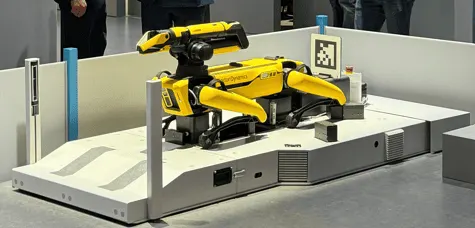
Hyundai’s Boston Dynamics Spot robot was showcased as a practical, four-legged robotic platform designed for real-world autonomy, capable of navigating complex environments, carrying modular payloads, performing inspection and monitoring tasks, and collecting actionable data autonomously. Spot is now operational in more than 40 countries, performing critical tasks such as data collection and safety monitoring in industrial sites.6
Hyundai’s Boston Dynamics Spot Robot Helps with Vehicle Maintenance at Manufacturing Facilities
Sources: Global X ETFs with image derived from: Hyundai. (2026, Jan 7). CES Presentation.
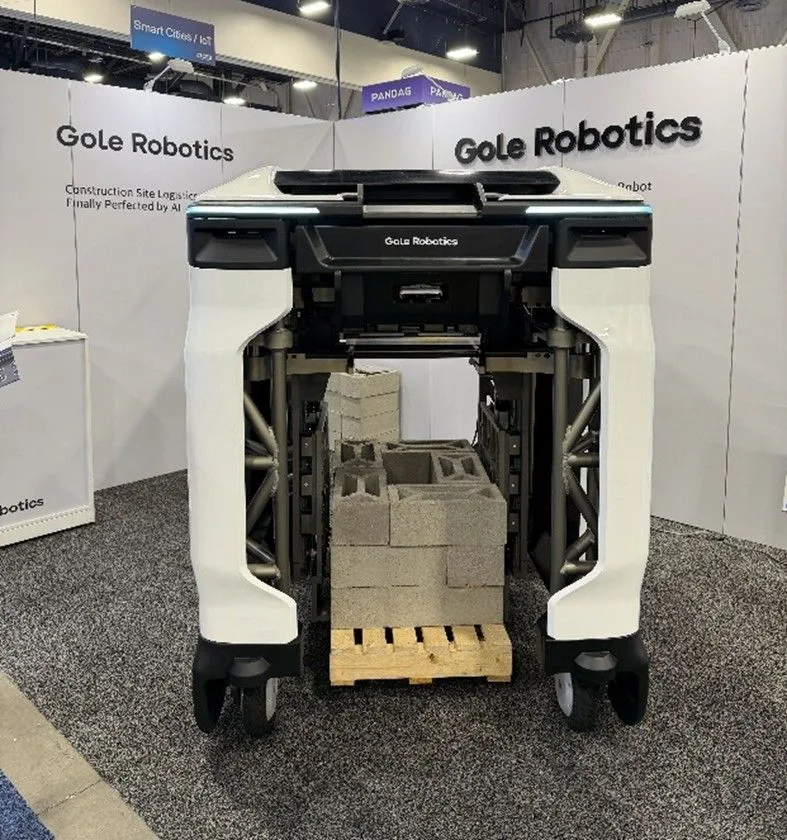
South Korean Gole Robotics demo of its construction-focused robotic system, ND-3, also highlighted how robotics can address labor bottlenecks in manually intensive industries, reshaping labor productivity dynamics and supporting economic growth. The ND-3 is designed to autonomously transport materials while continuously capturing and transmitting real-time data on each task it completes. Its distinctive four-legged, open-frame design enables it to lift and secure heavy payloads internally, while a durable, agile build allows it to operate efficiently in tight spaces and standard elevators that are inaccessible to larger, more cumbersome equipment.7
Gole Robotics ND-3 Is an Autonomous Material Handling Robot Redefining Industrial Logistics
Sources: Global X ETFs with image derived from: Gole Robotics. (2026, Jan 7). CES Presentation.
As systems become easier to integrate and more adaptable, adoption barriers continue to fall, accelerating deployment across manufacturing, logistics, and supply chains. This maturation of the robotics ecosystem – spanning hardware, software, sensors, and edge AI – suggests that productivity gains and labor augmentation are becoming tangible rather than theoretical, reinforcing the long-term case for automation as a structural driver of efficiency and competitiveness across industries.
Humanoids Are Advancing Rapidly Towards Deployment
Breakthroughs in AI are also dramatically speeding up the development and adoption of humanoid robots. Once considered a distant future, humanoids are now taking shape as commercially viable technology, with CES demonstrations highlighting deployable platforms already entering real-world use. This evolution opens up a broad investment landscape, spanning AI semiconductors, advanced sensors, connectivity solutions, and the critical components and materials that underpin these systems, all which were on display on the floor.
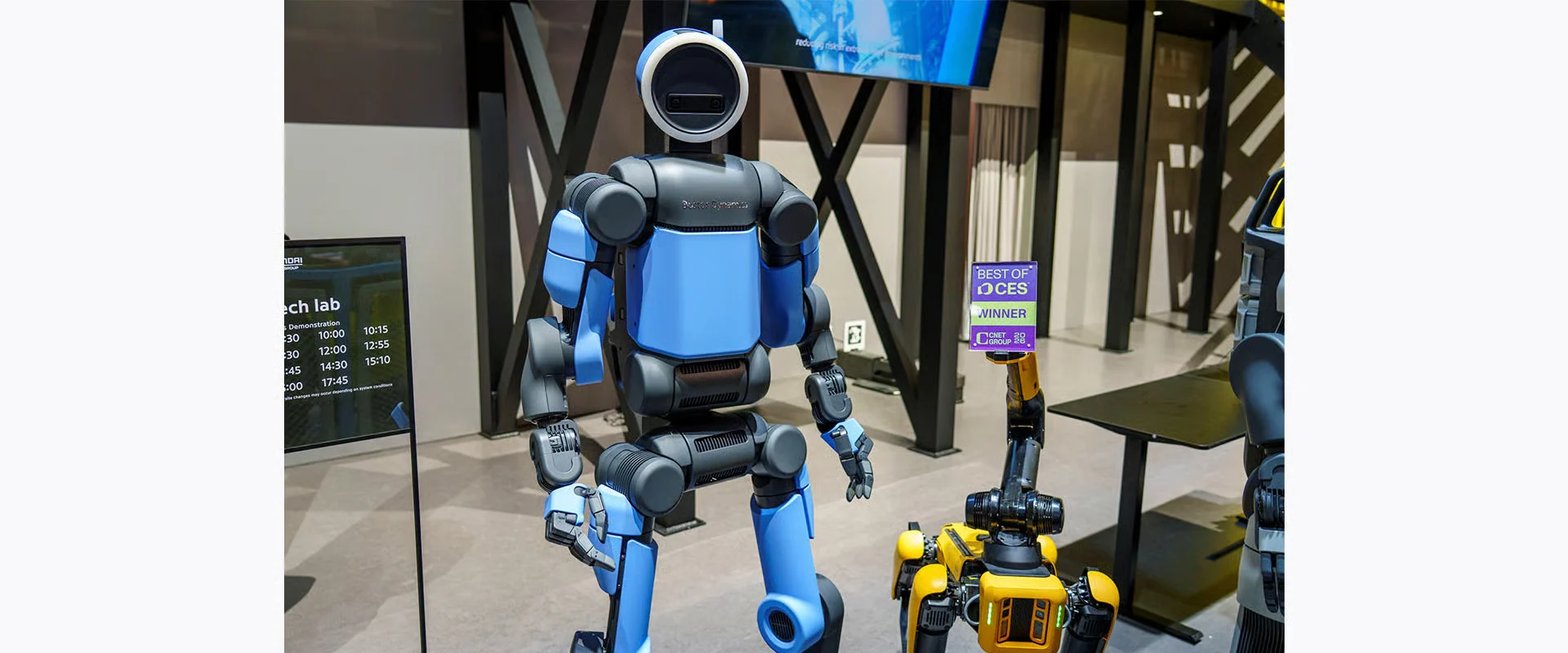
Boston Dynamics’ electric version of its Atlas humanoid was unveiled for the first time, interacting with the audience and demonstrating its full rotational freedom of joints. Atlas is designed to be an enterprise grade humanoid robot that can tackle a variety of industrial tasks, from material handling to order fulfilment. The robot learns new tasks quickly, adapts to dynamic environments, lifts up to 110 pounds, and works autonomously with minimal supervision. Atlas production is already underway; all deployments fully committed for 2026 and fleets are scheduled to ship to Hyundai and Google DeepMind in the coming months.8
Atlas Moves from Prototype to Production-Ready Product
Sources: Global X ETFs with image derived from: Boston Dynamics. (2026, Jan 7). CES Presentation.
Our team also noted the growing participation from Chinese robotics compa
nies such as Dobot and Unitree Robotics. While U.S.-based humanoid systems have established a strong presence at the high end of the market, Chinese players are making meaningful progress in lower-cost, task-specific humanoids.
Unitree Robotics’ G1 model – a compact, foldable humanoid designed for affordability and scalable inspection and manipulation tasks – demonstrated impressive high-speed martial arts movements that highlighted its balance, agility, and motor control. Roughly the size of an average eight-year-old at 4 feet 2 inches, the G1 costs approximately $16,000, benefiting from its smaller form stature, reduced material requirements, and lighter motors.9 Unitree also emphasized its transition toward a robot-as-a-service model, further lowering barriers to adoption through ease of use and cost efficiency.10
Conclusion: The Intelligence Age Is Primed for Acceleration
CES 2026 made it clear that AI has entered a new phase, one defined by mass deployment, scale, and economic impact. The convergence of powerful AI hardware, maturing software ecosystems, and falling integration barriers is accelerating adoption across factories, supply chains, and everyday environments. Taken together, the show reinforced our view that AI technology will continue to serve as the foundational layer shaping productivity, competitiveness, and growth across industries in the decades ahead.