This piece is part of a series that dives deeper into the most prevalent themes of this year’s iteration of our flagship research piece, Charting Disruption. The Earth’s Evolution section focuses on clean technologies, or CleanTech, and the infrastructure at the center of a changing world.
Negative environmental and societal impacts are already being felt at the Earth’s current level of warming, which is about 1.1°C warmer than the pre-industrial period.1 Global consensus is that we need rapid emissions reductions to keep warming below 1.5°C to 2°C and avoid the worst impacts.2 Fortunately, many technologies can yield fast and deep emissions cuts, including renewable energy, energy storage, and electric vehicles (EVs). An overhaul of aging infrastructure is also essential to realizing a more sustainable future, including building out CleanTech manufacturing facilities, advanced power grids, and EV charging networks in the United States.
Key Takeaways
Technology-driven solutions that can help limit the effects of climate change, including renewable energy, hydrogen, and carbon removal, represent a potential $150 trillion investment opportunity through 2050.3
Electric vehicles are forecast to gain significant market share over the coming years as battery technologies advance and become more affordable, creating robust opportunities throughout the EV supply chain.4
U.S. infrastructure is poised for a generational investment due to strong support from recent legislation, a manufacturing boom, and a long-standing need to overhaul the power grid.
CleanTech & Beyond: The Push for Net Zero Emissions
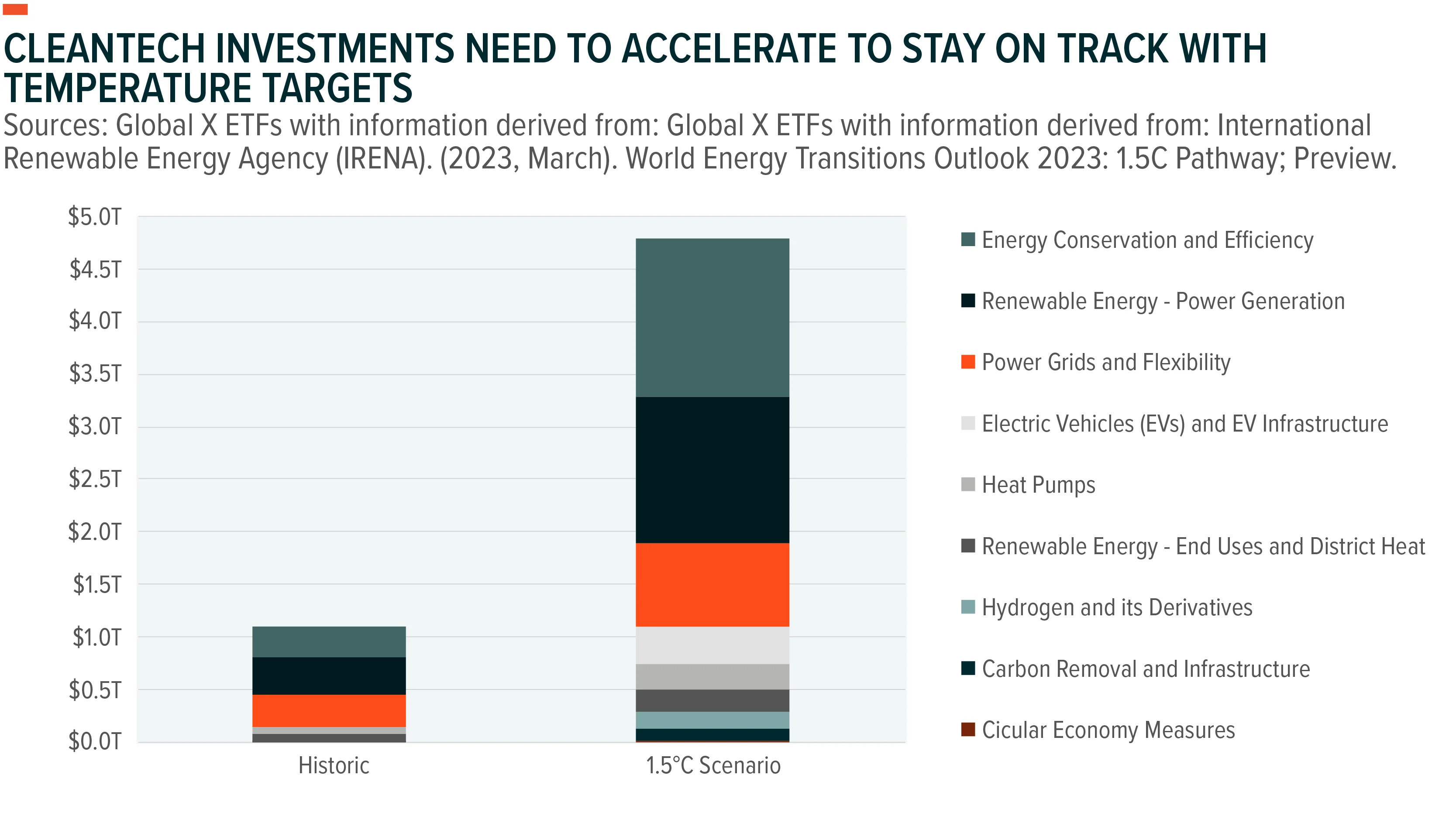
While there is still time to limit warming to below 2°C, it requires rapid, deep, and sustained greenhouse gas emissions reductions. Technology-driven solutions that can push the world closer towards net zero emissions include renewable energy, energy storage, hydrogen, carbon capture utilization and storage (CCUS), and plant-based meat alternatives. The clean energy transition in particular is already well underway due to robust government support, sustained corporate sustainability efforts, technology improvements, and the cost-competitiveness of wind and solar power. Other clean technologies like hydrogen and CCUS are much earlier along in their adoption, but their global project pipelines are also growing steadily. Over the long-term, it is projected that global investment across all energy transition technologies must total an estimated $150 trillion from 2023–2050 to limit warming to 1.5°C, or about $5 trillion annually.5 CleanTech investment is projected to reach $1.7 trillion in 2023, meaning that significant investment opportunities remain.6
An Electric Future: Greener Transportation & Battery Tech Innovations
Electric vehicles are the most effective tool for decarbonizing mobility, and a paradigm shift in the automotive industry is already in progress. Notably, market share for EVs in the light-duty vehicle segment could grow from 13% of sales in 2022 to more than 60% in 2035.7 Accommodative government policies, expectations for continued technology advancements, and increasing buy-in from traditional automakers and consumers support the outlook for a rapidly increasing rate of EV adoption. The growing uptake of EVs also presents important ramifications for supply chains, from materials sourcing to battery recycling. Lithium in particular is expected to remain an essential component in EVs, pointing to the potential for significant demand and investment opportunities over the coming years.8,9 In fact, to stay on track with the 1.5°C warming scenario, investments throughout the entire EV supply chain and associated EV charging infrastructure likely need to total more than $360 billion per year from 2023 to 2050.10
Infrastructure, Reimagined: A New Era for the U.S. Economy
American infrastructure is top of mind as recent legislation works to rebuild deteriorating assets and positions the United States for a return to industrial growth. While the Infrastructure Investment and Jobs Act (IIJA) is still in the early stages and its benefits are yet to be fully realized, nearly $400 billion in funding has already been announced that will be directed to over 40,000 projects.11 Furthermore, the Inflation Reduction Act (IRA) and CHIPS Act have changed the equation for U.S. CleanTech and semiconductor projects, ushering in even more investment that could spur a new era of industrial production. In our view, investments toward updating and expanding infrastructure are essential to meeting sustainability targets, which could add momentum to trends such as the manufacturing boom, the long-standing need to overhaul the grid, and the buildout of a national EV charging network.
Conclusion
Across all segments, technological advancements are key to realizing a greener economy. In the power sector, more powerful solar panels and wind turbines, along with the adoption of energy storge systems and other distributed energy resources, can expand the suitability range for renewable energy and boost grid resilience. For electric vehicles, solid-state batteries could become a potential gamechanger that could bring more range and faster charging at a lower cost. Furthermore, advanced power grids are one of the many infrastructure developments that can support the proliferation of both renewable energy and EVs. The rising use of sustainable technologies and the expansion of supporting infrastructure can both improve everyday lives and positively impact the planet’s future.