This piece is part of a series that dives deeper into the most prevalent themes of this year’s iteration of our flagship research piece, Charting Disruption. This feature focuses on infrastructure, as part of a larger Infrastructure & Environment section, exploring a variety of innovations in the space. For additional insights from the project, please click here.
In order to limit the effects of a warming planet, global investment across energy transition technologies must total an estimated $150 trillion from 2023-2050, which is about $5 trillion annually.1 CleanTech investments reached an estimated record-high $2 trillion in 2024, which means there remains a significant investment gap but also sizeable opportunities.2 Another driver of CleanTech is rapid electrification unfolded by emerging technologies like AI, likely driving growth in renewables and energy storage over the next decade.3,4 We believe that growing energy demands could translate into long-term tailwinds for renewables and other cleantech, leading to compelling potential opportunities for investors.
Key Takeaways
The transformation of the power sector represents nearly half of the $150 trillion in investments that could help limit the effects of climate change.5
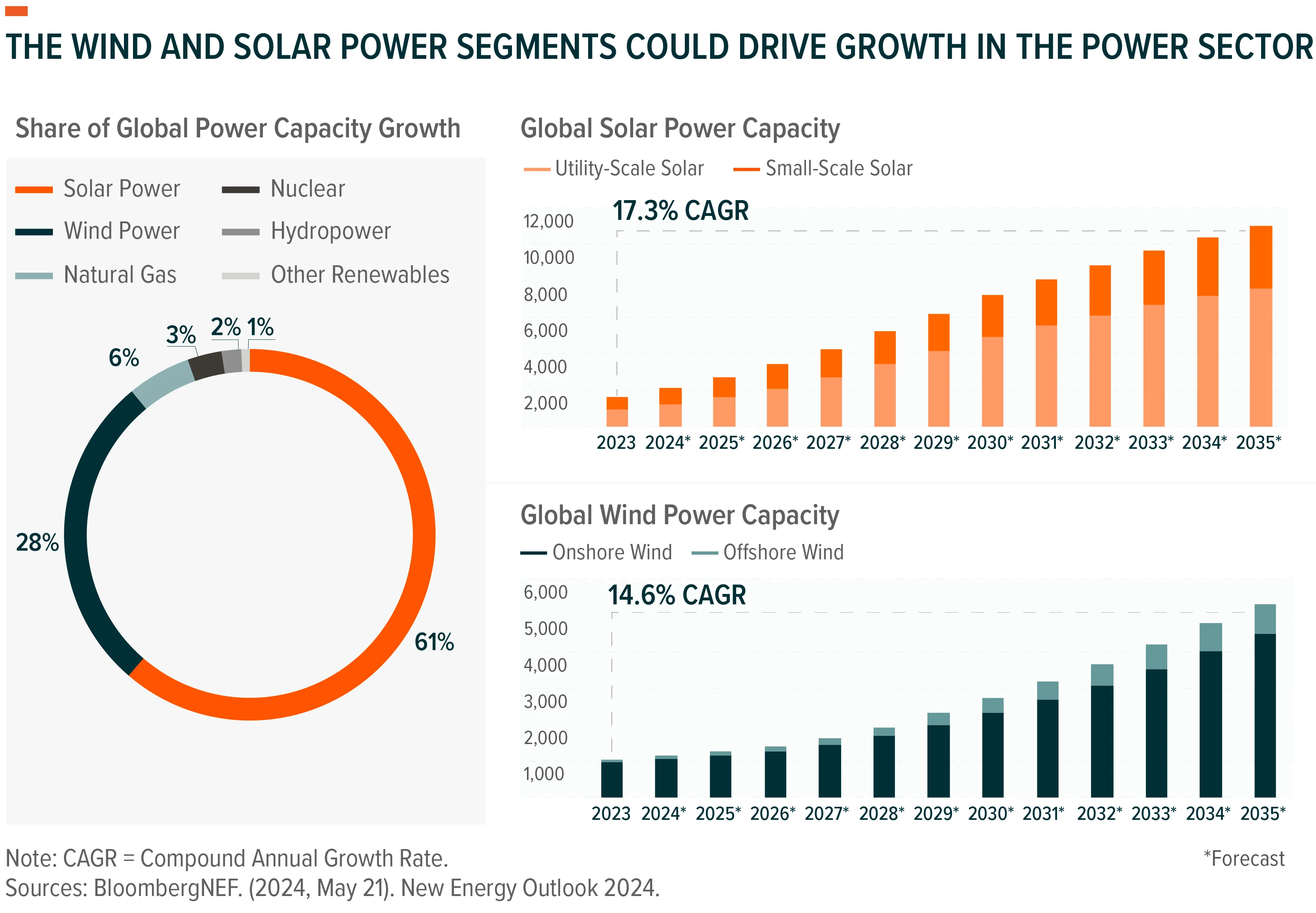
Renewable energy systems, particularly solar and wind power, are forecast to account for up to 90% of global power capacity additions through 2035.6
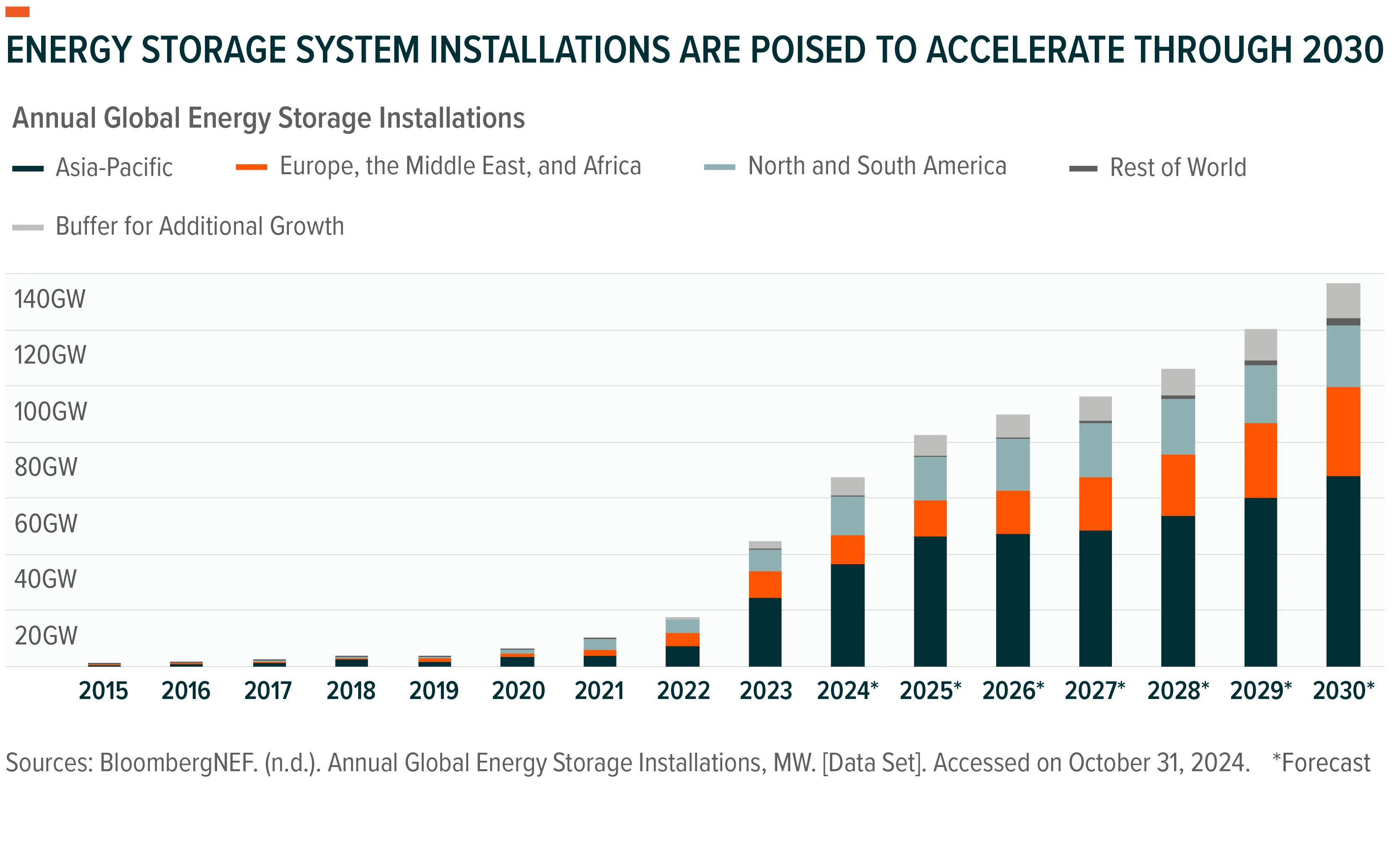
Global energy storage system installations are forecast to grow at a compound annual growth rate (CAGR) of 12.4% between 2024 and 2030, supporting the positive growth outlook for renewables.7
Renewables Could Account for 90% of Capacity Growth in the Power Sector Through 20358
With both temperatures and policy pressures rising around the world, the transformation of the power industry towards higher shares of renewable energy is well underway. Given expectations for continued efforts to reduce global emissions, global solar power capacity is forecast to increase from 2,132GW in 2024 to over 11,000GW in 2035.9 This would equate to a 17.3% CAGR for the solar power industry. Wind power, the second-largest renewables resource, is also expected to experience a strong growth rate with a forecasted 14.6% CAGR.10 By 2035, global wind power capacity could reach over 5,300GW, up from nearly 1,150GW in 2024.11
While supportive policies such as the Inflation Reduction Act in the United States and REPowerEU Plan in the European Union are playing key roles in the renewables industry’s growth, there are several other structural tailwinds that could lead to the widespread use of renewable energy within the world’s power grids. First, solar and wind power systems are highly scalable. For example, solar power systems can range from only a few kilowatts for a single residential system to several gigawatts for a utility-scale system, with the largest being able to provide power to over a million homes.12 They can also be built close to demand centers and can even be constructed on bodies of water, opening up additional potential power generation opportunities for land-constrained regions.
Wind and solar power systems are also highly cost-competitive with traditional power sources. In most countries, wind and solar power generation costs are generally lower than for fossil fuel and non-fossil fuel alternatives.13 For example, in 2023, 96% of new onshore wind and utility-scale solar systems had generation costs that were lower than both new coal and natural gas plants.14
Continued technological progress is likely to make wind and solar power even cost-competitive and efficient. In the solar industry, solar panel manufacturers are advancing towards the commercialization of perovskite technologies, which could be easier to manufacture, lower cost, and more efficient and durable than traditional solar panels.15
Corporate Power Purchases Are Likely to Contribute to Strong Renewables Growth
Given the range of potential benefits of renewable energy systems, corporations have continued to expand renewable energy to cover operational power demand. In the United States, 84GW of renewable power purchase agreements (PPAs) were announced between 2014 and H1 2024.16
Looking forward, corporate renewable energy purchases could become an increasingly large driver for renewable energy growth, particularly in major power markets like the United States. Although corporate purchasers of renewable energy span a range of industries, tech companies including Amazon, Meta, Microsoft, and Google are currently the largest buyers.17 Notably, these companies could experience sizeable increases in their power consumption in the United States with the rising adoption of generative AI and resulting expansion of AI data centers.18
While a range of power sources could benefit from the expected rapid growth in AI-related power demand, the role of renewable energy systems is critical to help corporations meet demand while also staying on track towards their clean energy targets. For example, Microsoft aims to match 100% of its electricity consumption to zero carbon energy sources, 100% of the time, by 2030.19 Google pledged to power its operations with carbon-free energy 24/7 by 2030.20 In December 2024, Google invested in several partnerships to develop renewable energy and energy storage alongside new data center facilities and industrial parks.21
Continued Growth of Energy Storage Remains a Positive Sign for the Energy Transition
The accelerated adoption of energy storage systems is another essential supporting factor to the robust long-term growth outlook for the cleantech industry. Wind and solar are intermittent power sources due to variation of wind conditions and solar irradiance levels. Energy storage systems can help solve intermittency concerns by making power grids more reliable and flexible. Over the past four years, annual global energy storage system installations grew nearly 12x from 3.1GW in 2020 to a projected 36.5GW in 2024.22 By 2030, the world could install nearly 68GW annually.23
The accelerating use of energy storage technologies, particularly battery energy storage systems (BESS), is being supported by the same tailwinds bolstering wind and solar power technologies. With BESS technologies scaling and improving, the cost for a four-hour system could fall nearly 40% between 2023 and 2030.24 Governments are also encouraging the adoption of BESS technologies through supportive policies. In the United States, for example, the Inflation Reduction Act established a 30% tax credit for standalone residential energy storage systems.25 Utilities and their customers alike are also installing energy storage systems to boost reliability amid the increasing risk of weather-related power grid outages.
Conclusion: CleanTech Investment Opportunities Abound as Electrification Gains Pace
The renewable energy industry is poised to experience robust growth over the next decade. In the short term, renewables developers will likely still need to navigate high interest rates, lengthy permitting timelines, and grid bottlenecks. However, growing power demand provides strong structural tailwinds that may help developers overcome these challenges and create significant long-term investment opportunities within the industry. As electricity demand rises, driven by emerging technologies such as data centers and EVs, significant opportunities could emerge for companies throughout the renewable energy value chain, as well as investors.