

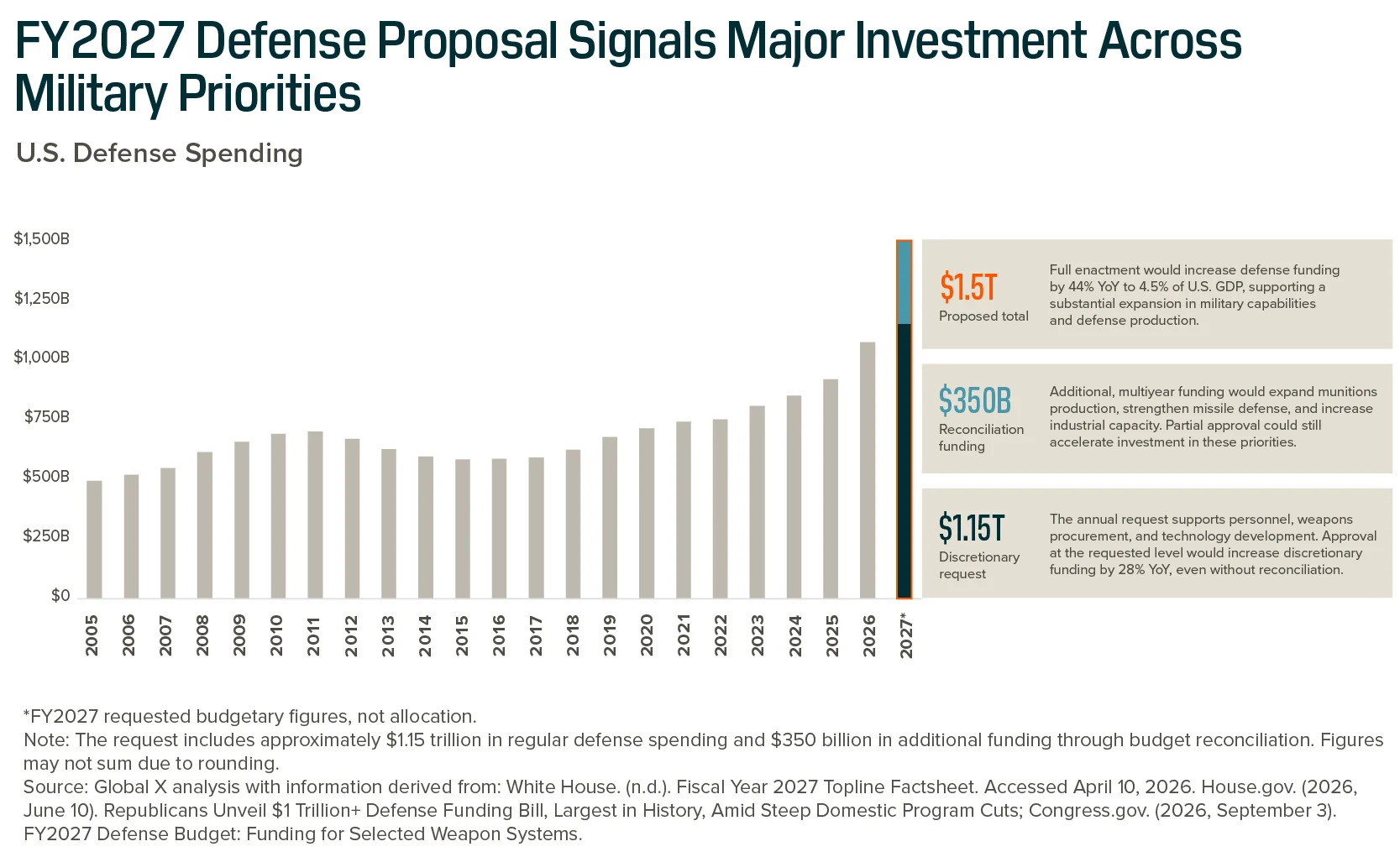
Defense Tech spending is set to step up sharply in FY2027, and we believe the midterm elections are unlikely to change that. The administration’s $1.5 trillion FY2027 defense proposal has two components: roughly $1.15 trillion in regular defense spending and $350 billion in additional funding through budget reconciliation.1 The regular spending, which has bipartisan committee support, would be a ~28% increase over FY2026 on its own. The $350 billion in additional funding through budget reconciliation is where most of the political risk sits and is likely to receive the most scrutiny.
While those differences will shape the final funding mix, urgent replenishment needs and bipartisan support for expanding domestic defense capacity continue to underpin a multiyear investment cycle, and any reconciliation funding that passes would add to it. Our base case assumes the regular budget advances largely intact plus at least roughly $200 billion in reconciliation, or about $1.35 trillion in total national defense funding for FY2027. Even a materially smaller package would still pay for munitions replenishment, shipbuilding, missile defense, and drone production, which supports a multiyear investment cycle for defense tech companies.
Key Takeaways
Political risks to FY2027 defense spending may be overstated, with bipartisan committee support for the $1.15 trillion core budget potentially limiting downside risks.
Urgent military modernization needs, munitions replenishment, and domestic manufacturing priorities could help sustain a multiyear defense investment cycle across a range of election outcomes.
Even our conservative scenario points to $1.35 trillion in FY2027 defense funding, which would represent a substantial increase in investment and could be a meaningful tailwind for the defense industry.
Political Risks Are Concentrated in Reconciliation Funding
The $1.15 trillion regular core defense budget moves through the annual authorization and appropriations process, where Congress has historically negotiated defense funding across party lines. Relative to FY2026 funding, the request represents a ~28% increase.2 We see relatively limited risk to this step up given the bipartisan support already demonstrated so far this year.3
For example, the House Armed Services Committee advanced its FY2027 defense authorization bill by a 44–12 vote.4 The Senate Armed Services Committee approved its version by 18–9.5 Although authorization does not guarantee final appropriations, the committee votes suggest that higher defense spending is not solely a White House priority. We believe there are also strong economic incentives for Congress. Defense manufacturing supports jobs and industrial investment across districts, making investments in shipyards, munitions facilities, and aerospace production politically durable regardless of which party controls Congress.
Reconciliation is treated differently. It can pass on party-line votes, but only while one party controls both chambers, so the additional $350 billion requested through it could face greater political risk. In the Senate, most legislation needs 60 votes to overcome opposition that could block a final vote. Reconciliation removes that hurdle for eligible budget measures, allowing passage by a simple majority (51). Republicans currently hold 53 of the Senate’s 100 seats and control the House, giving them a potential path to approval without Democratic votes if enough of their own lawmakers support the package. If Democrats win either chamber, Republicans would need their cooperation once the new Congress convenes on January 3, 2027. The November election is therefore not the cutoff, since the outgoing Congress could still act before then, but if approval slips past the transition, a divided Congress could lead to a smaller package, changing priorities, or delays.
Even without a change in congressional control, the final size and timing of the additional funding will depend on budget tradeoffs, program readiness, and production capacity. Support for higher defense spending does not necessarily translate into agreement on the full $350 billion: lawmakers must weigh the benefits against additional borrowing or potential spending cuts elsewhere. Some emerging technologies may also require further testing before the military can purchase them at scale. Meanwhile, expanding shipbuilding and munitions production requires factories, suppliers, and skilled workers that take time to develop.
These constraints do not eliminate the case for investment – and funding can help address the production bottlenecks – but they may lead Congress to prioritize investments that are ready to proceed and phase in others as programs mature and capacity expands. A smaller or phased package could therefore still support substantial investment in modernization and domestic defense manufacturing.
Defense Investment Has Bipartisan and Structural Support
Despite these political hurdles, we believe investors are discounting multiple factors that support a substantial increase in defense investment over the near and medium term.
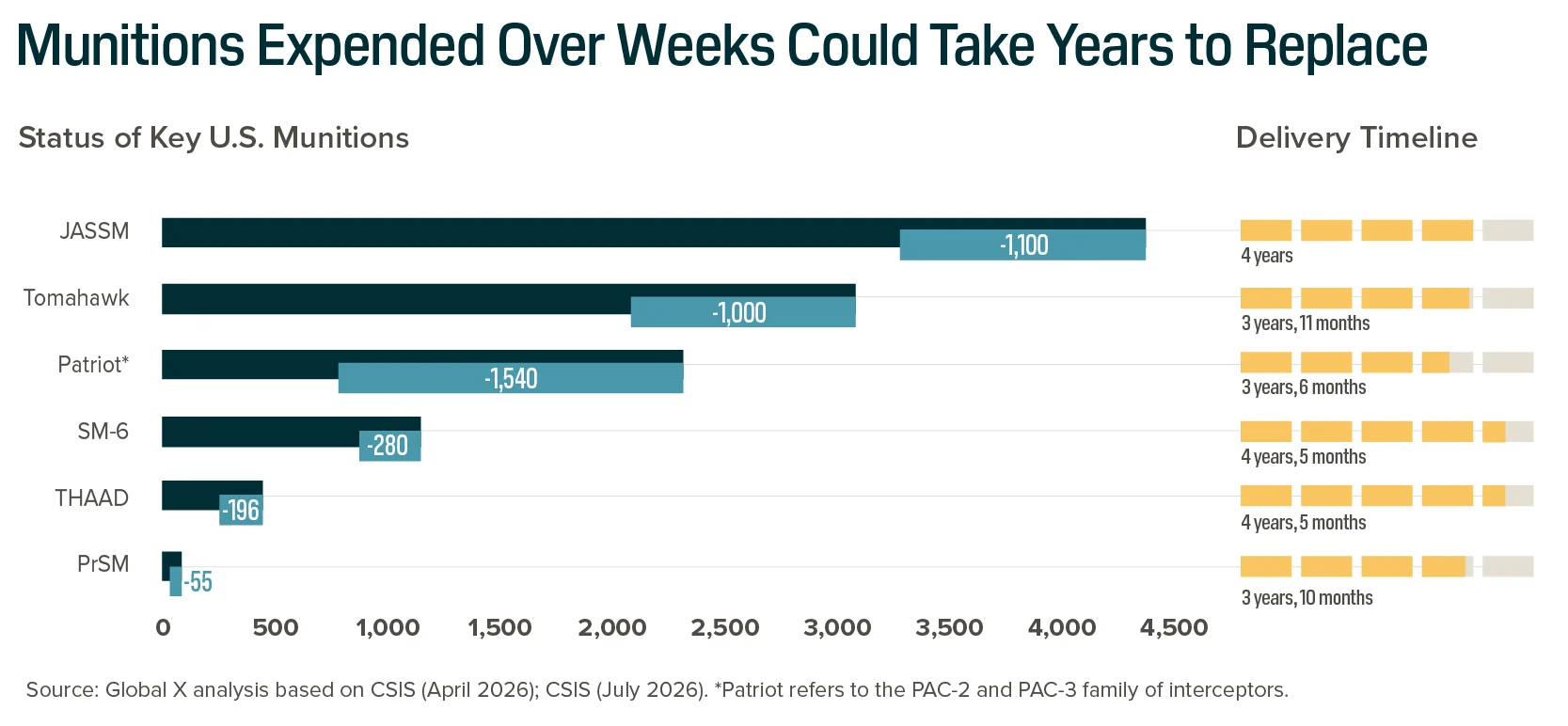
First, the proposed spending addresses real and increasingly urgent capacity constraints. The U.S. needs to replenish depleted munitions inventories, expand naval shipbuilding capacity, strengthen missile defense, and accelerate production of drones and autonomous systems.6 These requirements are becoming more pressing as geopolitical tensions rise and military stockpiles face growing demands. Importantly, much of the investment is directed toward rebuilding production capacity that cannot be expanded overnight. New manufacturing lines, shipyards, and skilled workforces take years to develop. Delaying these investments could prolong existing bottlenecks and make it more difficult to meet future military requirements.
Second, the underlying priorities have support that extends beyond the administration. Defense budgets expanded under the Biden administration, suggesting that higher military investment has been a priority under both parties.7
Even Without Full Reconciliation Funding, Spending Rises Meaningfully
A smaller reconciliation package would not necessarily derail the broader investment cycle. Congress could preserve selected priorities through a reduced supplemental package, building on the roughly $67 billion request the White House submitted in June, or incorporate eligible funding into subsequent annual appropriations.8 This would not be a dollar-for-dollar replacement for the proposed $350 billion, and some investments could be delayed. However, a reduction in near-term funding could mainly change the pace of procurement and capacity expansion rather than eliminate the longer-term demand for those investments.
We believe the 2025 reconciliation package provides an important precedent for evaluating potential FY2027 outcomes. In July 2025, Congress approved approximately $156 billion in additional defense funding through reconciliation, including roughly $29 billion for shipbuilding, $24 billion for air and missile defense, and $25 billion for munitions and supply chain resiliency.9 This demonstrated Congress's willingness to commit substantial funding to military modernization and industrial capacity outside the regular appropriations process.
Building on that precedent, our baseline scenario assumes the regular FY2027 defense budget advances largely intact, alongside approximately $200 billion in additional reconciliation funding. While this is above the previously passed 2025 package, we believe this estimate better reflects the growing urgency of defense requirements.
The ongoing conflict with Iran has placed additional pressure on U.S. munitions inventories, particularly missile interceptors and precision-guided weapons, reinforcing the need to accelerate replenishment and expand domestic production capacity.
Under this scenario, total FY2027 defense funding could reach approximately $1.3 trillion, or around $1.35 trillion including non-DoD national defense funding.10 While not a guaranteed floor, this illustrates how even a substantial reduction to the administration's proposal could still support a significant increase in defense investment.
Conclusion: Look Beyond the Budget Headlines
For investors, the more important question may be how quickly defense funding translates into contracts, production capacity, and equipment deliveries, rather than whether the headline figure is approved in full. While political negotiations could alter the size and timing of reconciliation funding, the underlying requirements are unlikely to disappear. Companies positioned to expand manufacturing capacity and deliver critical military technologies could benefit as the U.S. translates its spending priorities into sustained procurement.