Historically, many Americans have sought to retire in their early to mid-60’s. However, in the recent economic environment, these traditional goals have come to appear somewhat ambitious. The uphill battle stems partly from the difficulties that the traditional 60/40 equity and fixed income portfolio strategy has faced in recent years. In particular, a fixed income allocation focused on US-dollar-denominated investment grade bonds only yielded about 2.6% in aggregate over the last decade, while inflation has ticked upward with relative consistency.1 The backdrop has likely left many retirees inclined to take on more stock market exposure as they seek to sustain their cost of living. And though the interest rate hikes made by the Federal Reserve (Fed) in 2022 and 2023 have led yields to show improvement, the value of many pre-existing bonds has fallen precipitously in response.2 Although “there is no alternative (TINA)” has grown to represent a popular refrain in recent years amongst investors, we believe that Global X’s options suite, which consists of a variety of covered call strategies and risk management opportunities, might provide some alternatives that can potentially boost the yield on, or reduce market and interest rate risks associated with, a retirement portfolio.
Key Takeaways
Lagging bond performance coupled with longer life expectancies and potential adjustments to social retirement programs make harnessing a 60/40 portfolio to retire at 65 less feasible than in the past.
Global X's Covered Call suite offers retirees the potential to introduce a total return solution into their portfolio that is designed to produce option premiums which tend to carry a general positive correlation with volatility.
Global X's Collar and Tail Risk strategies may help keep retirees invested amid extreme market downturns, as they offer long equity exposure and a degree of downside protection.
The 60/40 Portfolio Loses Its Luster as the Gold Standard Retirement Strategy
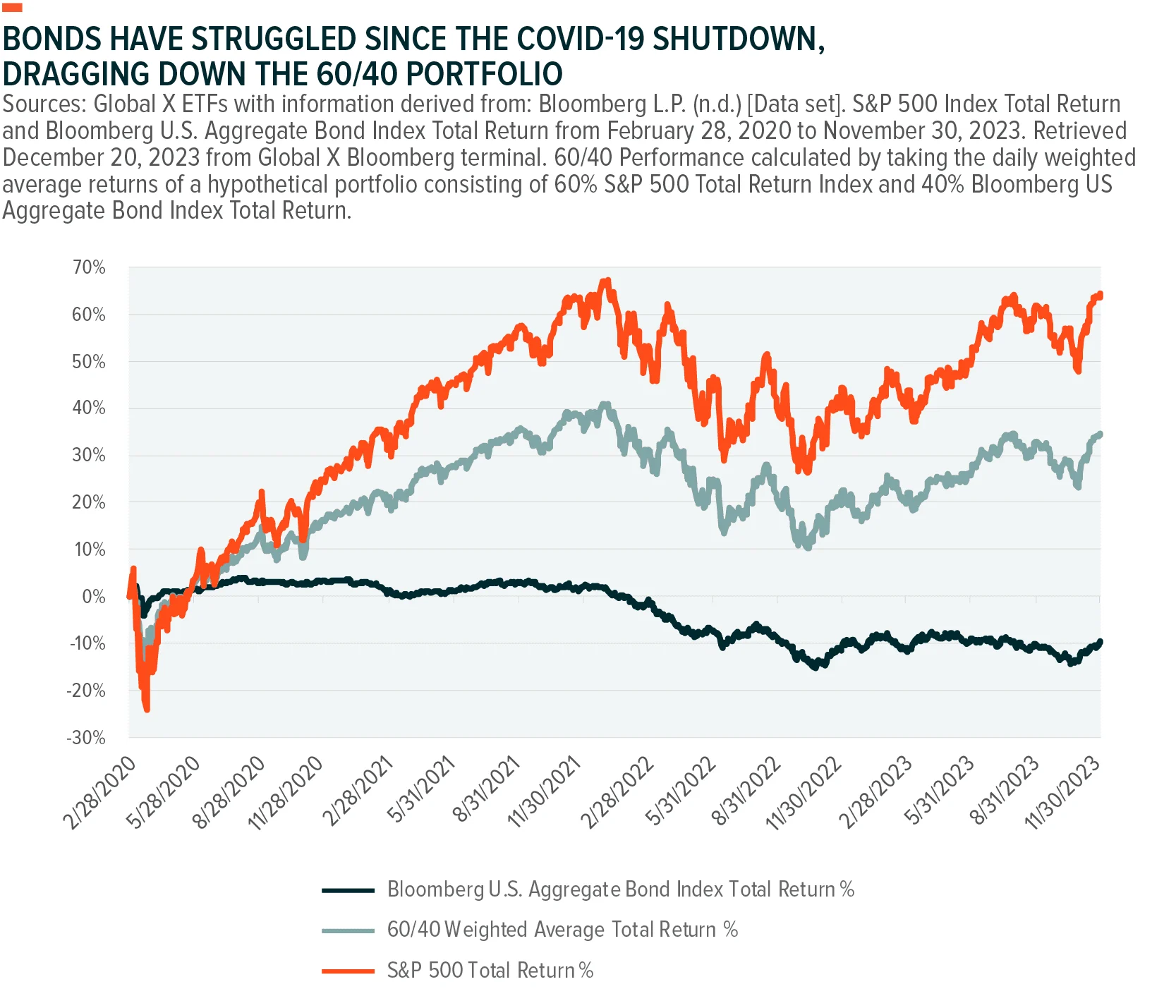
Since economist Harry Markowitz developed modern portfolio theory in 1952, the 60/40 portfolio has largely been the prototypical risk-adjusted portfolio return benchmark for most retirees.3 However, with year-over-year U.S. inflation averaging approximately 4.3% in 2023, and aggregate bond yields only yielding about a half-percentage point more, the 60/40 portfolio’s inflation adjusted yield and total returns have lagged.4,5
Past performance is not a guarantee of future results.
Historically low bond yields in 2020 and 2021, followed by commencement of the Fed’s interest rate hiking cycle in 2022 and 2023, created significant challenges for bond holders. As a result, fixed income investors have likely been forced to take on interest rate risk with little to no return in recent years. The potential implications of conditions like this are significant, not just for investors, but also for their governments. For one, people are living longer than in Markowitz’s day, which requires building portfolios that can last longer. Also, longer life expectancies will pressure government social retirement programs, so much so that many developed countries are already re-thinking retirement eligibility ages or reducing payment amounts to better conform with adjusted actuarial standards.6
Covered Call ETFs Can be A Bond Alternative for Retirees
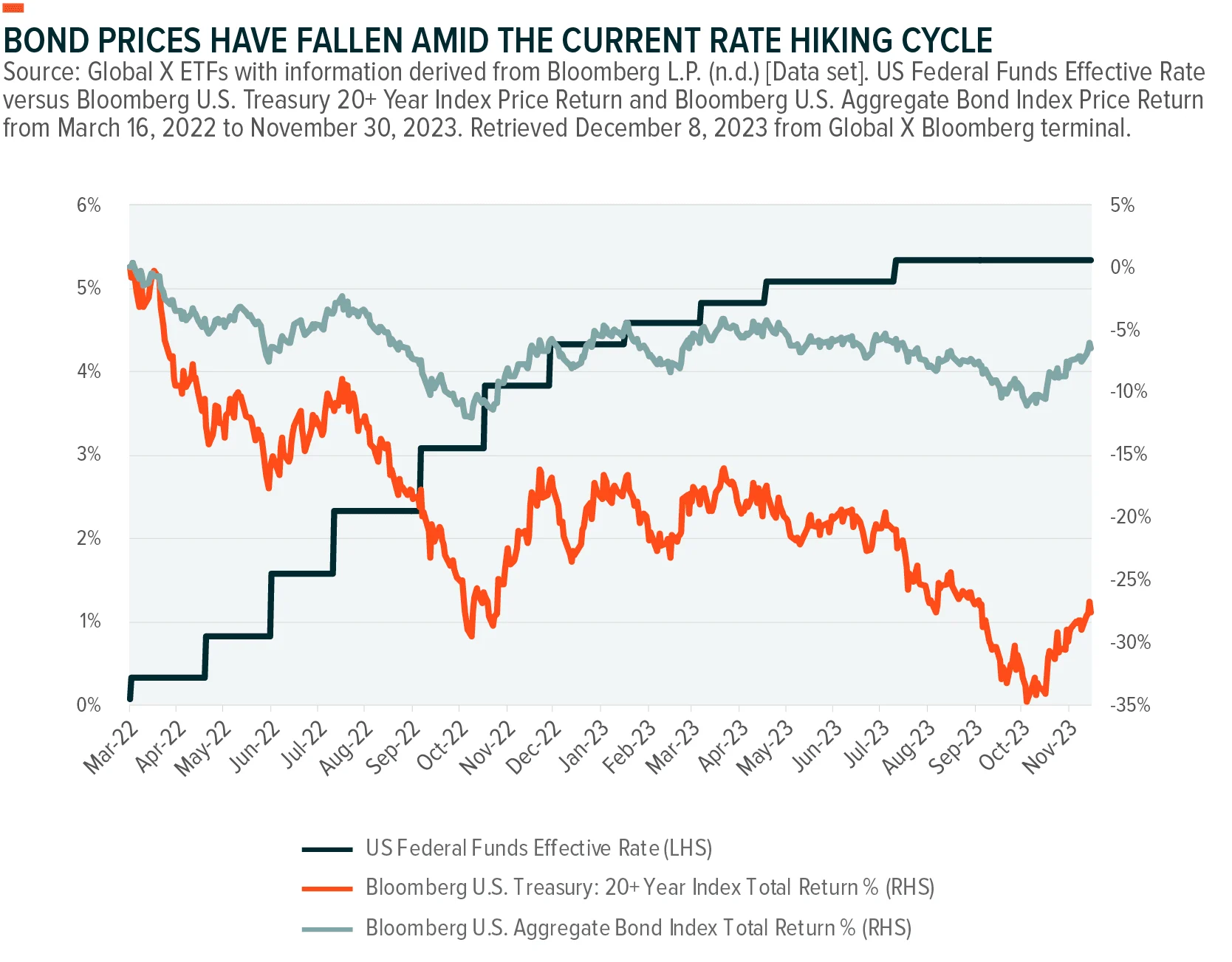
Retirees typically pursue exposure to bonds because they offer a profile that can potentially provide a steady stream of income and a hedge against market downturns. They do so under the assumption that they will receive a fixed coupon payment and that their principal will be returned if the instrument is held until maturity. Of late, however, these characteristics that denote the perceived more predictable nature of fixed income investing have become a bit less predictable with the (Fed) rapidly increasing interest rates and hurting the value of existing bonds. The undertaking has left investors with a difficult choice to either sell their bonds, potentially at a loss, or hold the assets until maturity to regain their principal while they garner a low yield. With the Fed maintaining the ability to raise or lower rates essentially on a whim, the bond market can represent less of a potential hedge when the equity portion of the 60/40 portfolio is turning sour.
For instance, when the Federal Reserve raises interest rates to temper a robust economy, stocks often decline in value due to increased borrowing costs for companies and consumers. Bond prices tend to fall as well because new bond issuances are then generally offering higher yields.
If I own a bond initially yielding 1% with a $1,000 value, and the Fed raises rates to 5%, the value of my bond decreases significantly. This occurs because investors can purchase new bonds with a higher yield. To offset this difference, my 1% bond must be sold at a steep discount from its original $1,000 value to entice a potential investor.
Conversely, if I own a 5% bond and rates decrease due to an economic slowdown, I can sell my bond at a premium from its purchase value. However, I now encounter reinvestment risk because the new instrument I purchase will yield less than the bond I originally held. This effect is generally even stronger for bonds with longer durations because there is more time for the value of these bonds to be hurt by interest rates increasing further. Taking these risks into consideration, we believe today’s bond market may represent a less-efficient means by which to acquire a steady stream of income and hedge against market downturns.
An alternative to traditional bond allocations is Global X’s Covered Call ETFs like the Global X Nasdaq 100 Covered Call ETF (QYLD) and the Global X S&P 500 Covered Call ETF (XYLD), which may be able to provide retirees with a source of premium distributions. These strategies seek to generate income by writing at-the-money index call options on 100% of their equity portfolios. While writing at-the-money calls foregoes the upside price potential associated with the underlying equity investments, the total returns that these funds can provide can act as a compelling alternative to bonds for retired individuals.
Investors who are intrigued by covered call writing as a potential alternative to holding bonds and also wish to participate in some of the growth potential offered by the underlying equity index might find Global X's Covered Call and Growth strategies appealing. These strategies, like the Global X Nasdaq 100 Covered Call & Growth ETF (QYLG) and the Global X S&P 500 Covered Call & Growth ETF (XYLG), take a half-covered approach, allowing investors to maintain long exposure to major equity indices and still pursue monthly derivative income. Particularly beneficial to retirement-age investors, these products offer a mix of potential capital appreciation and distributions.
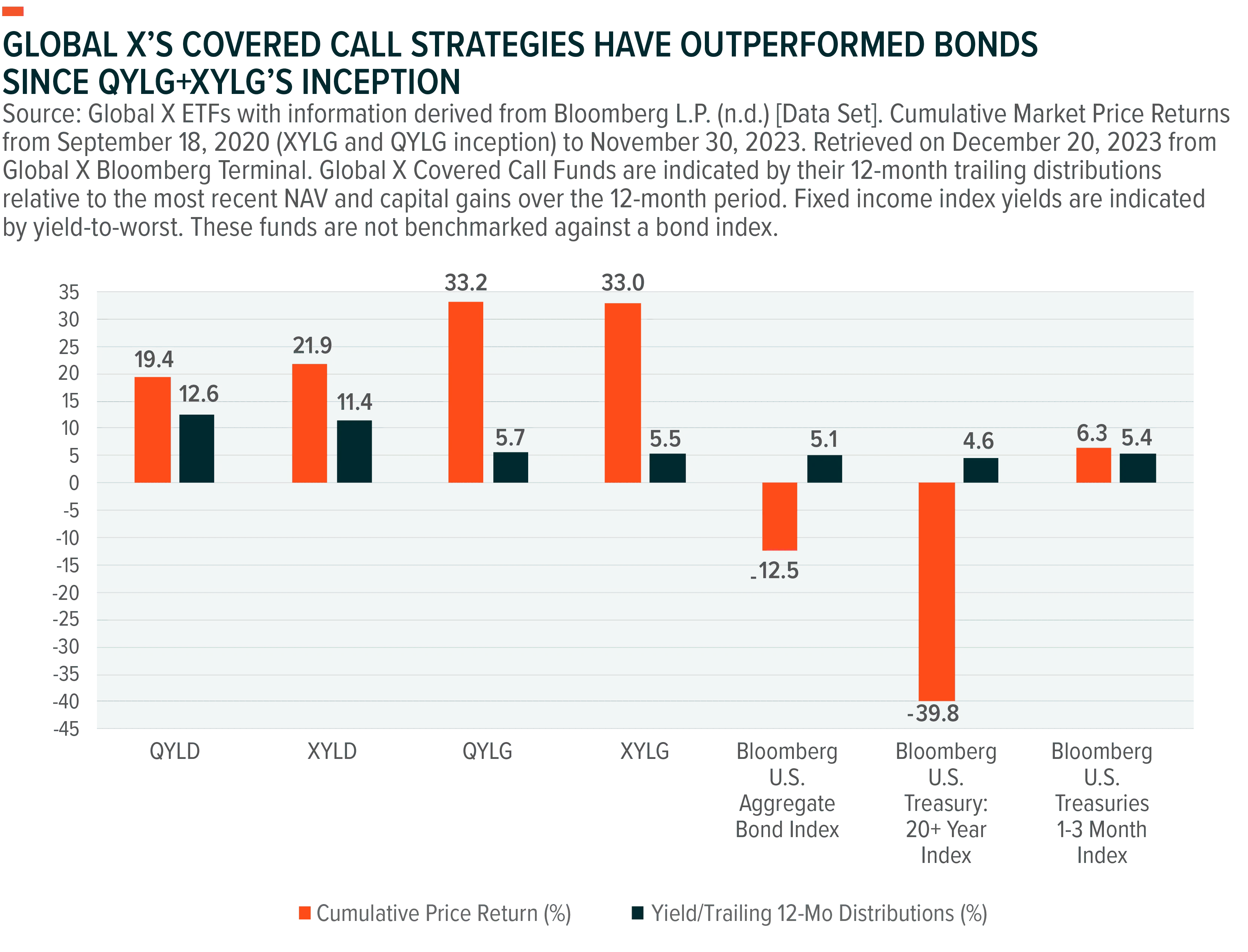
The performance data quoted represents past performance. Past performance does not guarantee future results. The investment return and principal value of an investment will fluctuate so that an investor's shares, when sold or redeemed, may be worth more or less than their original cost and current performance may be lower or higher than the performance quoted. High short-term performance, when observed, is unusual and investors should not expect such performance to be repeated. Performance current to the most recent month- and quarter-end is available at QYLD, XYLD, QYLG, XYLG.
A portion of the Funds’ distributions are estimated to include a return of capital. For information on the breakdown of the most recent distribution, please see the 19a notices for QYLD, XYLD, QYLG and XYLG.
Collar and Tail-Risk Strategies Offer Market Exposure, With Some Downside Protection
A major contributor to the appeal of the 60/40 portfolio is that it might be able to act as a hedge against adverse equity market events. For that potential hedge, investors typically concede the kind of returns that an all-equity investor might receive in a bull market. That hedge, however, has struggled to maintain its relevancy in recent years as noted in the first chart. Derivative-based strategies with a risk-management objective might be able to make that downside hedge more predictable.
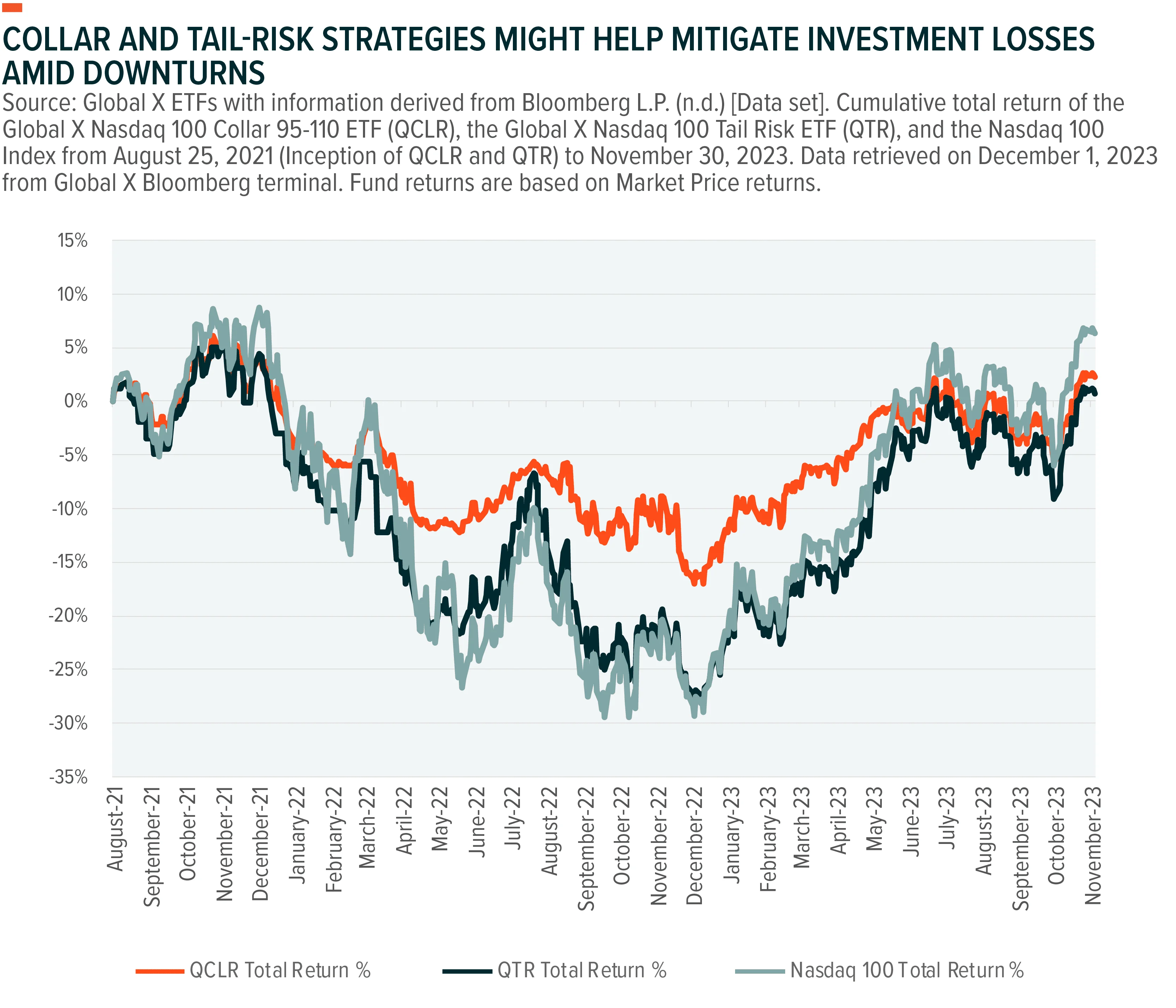
Global X’s Nasdaq 100 Collar 95-110 ETF (QCLR) and its S&P 500 Collar 95-110 ETF (XCLR) aim to limit drawdowns over the option’s three-month tenor to approximately 5% in a worst-case scenario, effectively hedging the retiree’s portfolio with a relatively predictable downside. The funds do so by purchasing 5% out-of-the-money protective puts on their respective underlying indexes. Additionally, by writing call options on the funds’ underlying indices with strike prices that are 10% out of the money, investors may be able to reap the benefits of a 10% upside move for the index over a similar three-month period. The premiums attained by writing these call options also help to finance the put option protection. Thus, like the 60/40 investor, retirees would forgo some market upside, but would maintain a hedge.
Conversely, Global X’s Tail Risk products, the Global X Nasdaq 100 Tail Risk ETF (QTR) and the Global X S&P 500 Tail Risk ETF (XTR), don’t sell call options. Thus, investors have unlimited exposure (minus the fund’s fees and the expense of acquiring protective puts) to the three-month upside potential of the respective index. Both ETFs purchase 10% out-of-the-money put options to mitigate the total downside risk over the life of each option. The Tail Risk funds aim to protect from significant drawdowns, while likely underperforming the reference index when it rises, due to the costs associated with purchasing put protection.
A combination of Global X’s Tail Risk and Collar products can serve as core equity allocations within a portfolio, balancing price appreciation and capital preservation. In that vein, they might also be able to help investors stay invested. Indeed, it’s natural to feel pressure to sell during the worst periods of a down market, and this is especially true for retirees who want to preserve their portfolios. However, these strategies can potentially help alleviate some of those fears. The next chart highlights how QTR and QCLR have done when markets take a turn for the worse, while they tend to lag when markets turn around, due to the cost of hedging their bets against subsequent market downturns.
Past performance is not a guarantee of future results.
Conclusion: Derivative-Based Strategies Can Provide Premium Distributions and Risk Mitigation
We believe that the investment strategies used to position investor portfolios appropriately for retirement require a bit more creativity today than they once did. Market conditions dictate that view, but so do longer life expectancies and their social impacts. With inflation denting yields, Global X’s Covered Call suite and Risk Management products can offer retirement-age investors an alternative to taking on more equity risk within their portfolios. Markets often take the escalator up and the elevator down. For retirees, the latter can be particularly unnerving and life-altering in their golden years, but these derivative-based strategies can add diversification and risk management characteristics to their portfolio, potentially encouraging them to stay invested.
Related ETFs
QYLD - Global X Nasdaq 100 Covered Call ETF
XYLD - Global X S&P 500 Covered Call ETF
QYLG - Global X Nasdaq 100 Covered Call & Growth ETF
XYLG - Global X S&P 500 Covered Call & Growth ETF
QCLR – Global X Nasdaq 100 Collar 95-110 ETF
XCLR – Global X S&P 500 Collar 95-110 ETF
QTR – Global X Nasdaq 100 Tail Risk ETF
XTR – Global X S&P 500 Tail Risk ETF
Click the fund name above to view current performance and holdings. Holdings are subject to change. Current and future holdings are subject to risk.