


Product ResearchMLPsEnergy Infrastructure
MLP Funds: Taxes & Path Dependency
G
Global X Research
Jan 10, 20182 min read
Get the latest news and updates from our team.
Copyright © 2026 Global X. All rights reserved.
SEI Investments Distribution Co. (1 Freedom Valley Drive, Oaks, PA, 19456) is the distributor for the Global X Funds.
Check the background of SIDCO and Global X's Registered Representatives on FINRA's BrokerCheck.
Rohan Reddy
Global X Research
Compared to mutual funds, ETFs tend to be more tax efficient because they have a unique method of conducting transactions that provides fund managers an additional tool to help minimize the distributions of capital gains to investors.1 This is one of a handful of reasons that have been driving investment flows from mutual funds to ETFs.
In this piece, we will explore three questions:
What are capital gains taxes?
Why do ETFs tend to be more tax efficient than mutual funds?
What are some additional tax strategies to consider?
Quick look: What are capital gains taxes?
Funds can incur capital gains taxes by selling a holding for a realized gain.2 If at the end of the year the fund has net realized gains (the difference of realized gains and realized losses), this amount is distributed to the fund’s shareholders as a capital gains distribution. Shareholders holding the fund in a taxable account are on the hook to pay taxes on this distribution at either short term or long term capital gains rates, depending on how long the fund held the securities for.3,4 Broadly speaking, investors would prefer that funds distribute less or no capital gains as it defers tax payments and allows one’s initial investment in the fund to continue to grow on a pre-tax basis.
Why do ETFs tend to be more tax efficient than mutual funds?
In 2015, only 12% of ETFs in the US made capital gains distributions, compared to 57% of mutual funds.5 In 2015, only 2 of Global X’s 51 ETFs made a capital gains distribution.
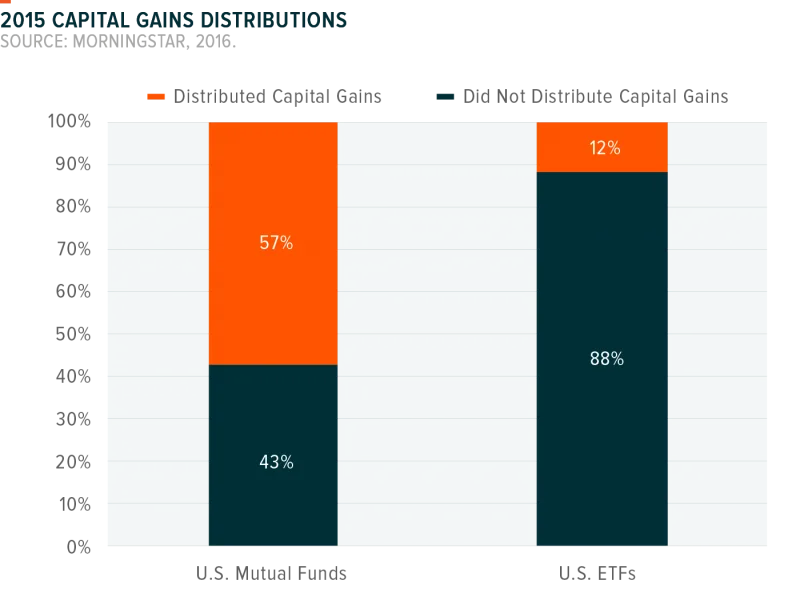
Source: Morningstar, 2016.
ETFs tend to be more tax efficient than mutual funds because they can transact on an in-kind basis, rather than in cash, which has resulted in less frequent capital gains distributions to investors. To understand this, we must first explore how mutual funds incur capital gains.
Mutual funds can generate capital gains in two ways: 1) Redemptions made by fund shareholders; and 2) Regular turnover of the fund’s holdings. Mutual fund transactions are made in cash, meaning that if an investor redeems shares, the manager may be forced to sell fund holdings in order to make cash available to deliver to the redeeming investor. This can result in capital gains, if the manager is forced to sell holdings at a higher price than their cost basis to raise the necessary cash. In addition, whenever a fund manager wants to modify a fund’s exposures, the manager generally must sell shares of certain securities to raise the cash to buy others. This process of selling an existing security for cash can result in capital gains if the securities are sold for an amount higher than their cost basis.
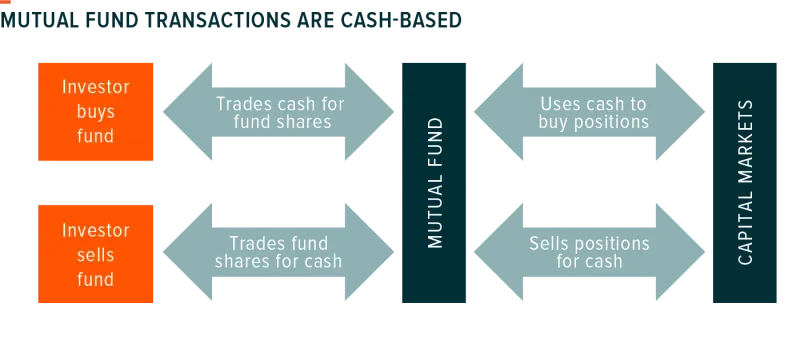
Mutual fund managers may implement a few strategies to potentially reduce capital gains, including holding a higher percentage of the fund’s assets in cash to meet daily redemptions, or employ tax-lot management, which means selling shares with the highest cost basis first.
In many instances, ETFs can avoid generating capital gains even if investors redeem their shares of the fund or if the fund has high turnover. This is because ETFs often have the ability to transact on an in-kind basis, rather than in cash. For example, investors looking to sell shares of an ETF do not receive cash from the ETF sponsor, rather they sell the ETF though an authorized participant (AP) who aggregates ETF shares in large lots called creation units and delivers those shares to the ETF sponsor. In return, the ETF sponsor delivers securities positions held by the fund equal to the value of the creation unit. This in-kind exchange of securities means that the fund is not selling securities for cash and therefore capital gains are not incurred.
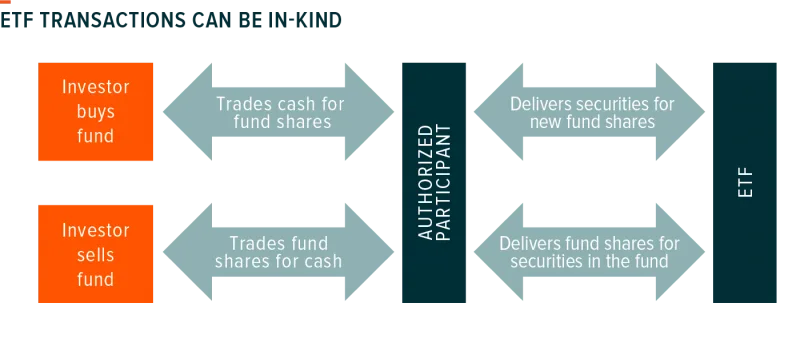
Similarly, consider an ETF portfolio manager who is rebalancing a fund and needs to sell a position that has appreciated significantly since it was originally purchased. Rather than selling that security for cash and incurring capital gains, the portfolio manager can offload those shares to an AP in a process called a custom in-kind redemption. The AP then buys the shares that the ETF portfolio manager wants to own and returns them to the fund via an in-kind creation. Now, the fund owns the correct securities, but avoided a cash transaction of selling shares for cash.
In addition to this custom in-kind redemption tool, ETF portfolio managers can also use tax-lot management to minimize capital gains distributions.
What are some additional tax strategies to consider?6
Aside from using ETF-based portfolios, investors concerned with minimizing taxes may also want to consider other strategies, such as tax loss harvesting and gaining exposure to asset classes with advantageous taxation.
In tax loss harvesting, an investor can potentially reduce capital gains taxes by selling positions that are trading below their cost basis to offset positions that have been sold above their cost basis. Since investors are ultimately taxed on their net capital gains at the end of the year, selling positions at a loss can help reduce this amount. In addition, savvy investors can maintain similar portfolio exposures by selling a position at a loss and entering into a new position with a high correlation to the security that was sold.7
Another tax strategy is to consider securities that have advantageous taxation compared to other similar investment options. For example, the income distributed by ETFs with exposure to bonds is typically taxed at ordinary income rates, which currently are as high as 43.4%. Preferred stock, however, is often taxed at the qualified dividend income rate, which is currently a maximum of 23.8%. Therefore, investors could consider reducing an allocation to bond ETFs and increasing their exposure to ETFs that invest in preferreds.
MLP ETFs are another investment that can receive favorable taxation of their distributions because the distributions are often treated as return of capital. Last year, 100% of the Global X MLP ETF (MLPA) distributions were considered return of capital, which means the distributions reduced an investor’s cost basis. For example, if an investor had a cost basis of $15 and received $0.50 of return of capital distributions, the investor’s new cost basis would be $14.50. Since the distributions reduced the investor’s basis, taxes are deferred until the investor sells his or her position in the fund or their basis falls to zero.
Conclusion
ETFs can be a useful tool for helping investors manage their taxes. ETFs tend to be more tax efficient than mutual funds given their ability to transact on an in-kind basis rather than in cash. In addition, investors can use ETFs for tax loss harvesting and to gain exposure to asset classes with favorable tax treatment.
1. There can be significant differences between mutual funds and ETFs. ETFs trade on an exchange, providing intra-day liquidity, but can result in investors paying additional transaction fees. The majority of ETFs in the US are passively managed. Mutual funds do not trade on an exchange, and investors therefore often transact directly with a mutual fund sponsor to buy or sell shares. Many mutual funds are actively managed, which can result in higher fees and turnover.
2. Gains become ‘realized’ when an investment is sold at a price that is higher than its cost basis. Gains are ‘unrealized’ if the investment has a market value higher than its basis, but the position has not been sold.
3. Short term capital gains tax typically applies when a fund or investor held a position for less than one year. Short term capital gains taxes are equal to ordinary income rates, which currently tops out at 43.4%.
4. Long term capital gains tax typically applies when a fund or investor held a position for longer than one year. Long term capital gains taxes are usually taxed at a more advantageous tax rate than short term capital gains, and currently tops out at 23.8%.
5. Source: Morningstar, 9/30/2016.
6. This information is not intended to be individual or personalized investment or tax advice. Please consult a financial advisor or tax professional for more information regarding your tax situation.
7. It is important for investors to consult a tax adviser to avoid a potential wash sale, which means selling a security at a loss and then buying the same or a substantially identical security within 30 days.
A fund with over 25% of its assets invested in Master Limited Partnerships (MLPs) is structured as a C-Corporation for tax purposes (C-Corp).
A fund with over 25% of its assets invested in Master Limited Partnerships (MLPs) is structured as a C-Corporation for tax purposes (C-Corp).
Explore how the new change to the tax code will impact MLP funds structured as C-Corporations (C-Corps).
Explore how the new change to the tax code will impact MLP funds structured as C-Corporations (C-Corps).