

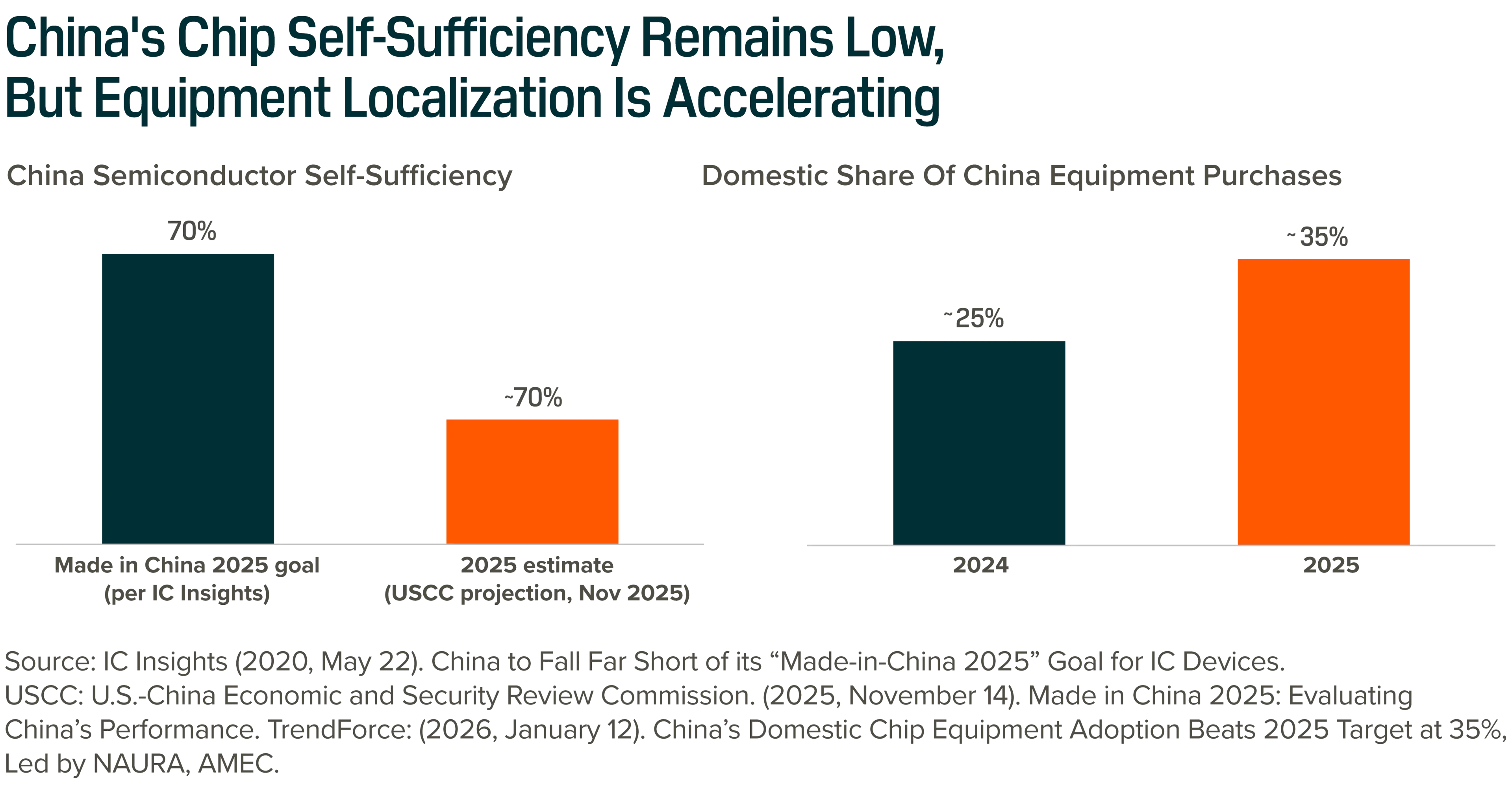
China is both the world’s largest electronics manufacturing base and one of its largest buyers of chips, importing roughly $424 billion of integrated circuits in 2025.1 Yet, for now, domestic suppliers meet only a small part of that demand. Made in China 2025 was a Chinese government industrial policy to upgrade the country’s manufacturing, with semiconductors among its priority areas. The plan targeted roughly 70% semiconductor self-sufficiency by 2025, meaning China would produce about 70% of the chips it uses. Today’s estimates put the actual figure closer to 30%.2
We believe that gap, alongside China’s ambition to compete at the technological frontier of AI, represents a significant investment opportunity. China does not need to match TSMC or Nvidia’s level of sophistication to succeed. Replacing foreign suppliers across even a fraction of its vast home market could create substantial opportunities, while growing domestic demand for AI compute provides another powerful catalyst for innovation and investment. Beijing has made both semiconductor self-sufficiency and technological advancement national priorities, while export controls have reinforced the urgency.
With access to both A and H share companies as well as derivatives, the Global X China Semiconductor ETF (CCHP) offers investors targeted exposure to this journey.
Structural Opportunity: China is trying to localize the entire semiconductor supply chain, creating a multi-year domestic substitution opportunity that does not depend on matching the global technology frontier.
Localization Is Advancing: Domestic suppliers’ share of China’s equipment purchases rose from roughly 25% to 35% in a year,3 the leading domestic DRAM supplier reached about 9.5% of global DRAM revenue,4 and Chinese vendors supplied nearly 41% of the AI accelerators shipped in China in 2025.5
Active Management: Industry success and equity returns are not the same thing. CCHP is actively managed so portfolio managers can select among companies, apply sanctions-aware screens, manage position sizes, and access recent IPOs rather than own the whole theme. CCHP offers active management in the convenience of an ETF wrapper.
The Global Semiconductor Boom Is Raising the Stakes for China
AI and high-performance computing are driving a new growth cycle in the global semiconductor industry. The market is projected to surpass $1.5 trillion in 2026, growing nearly 90% year-over-year (YoY), as demand for advanced processors, memory, networking and other critical components accelerates.6 Beyond AI, growing semiconductor content across electric vehicles, robotics, industrial automation and connected devices is expanding the industry's long-term growth opportunity.
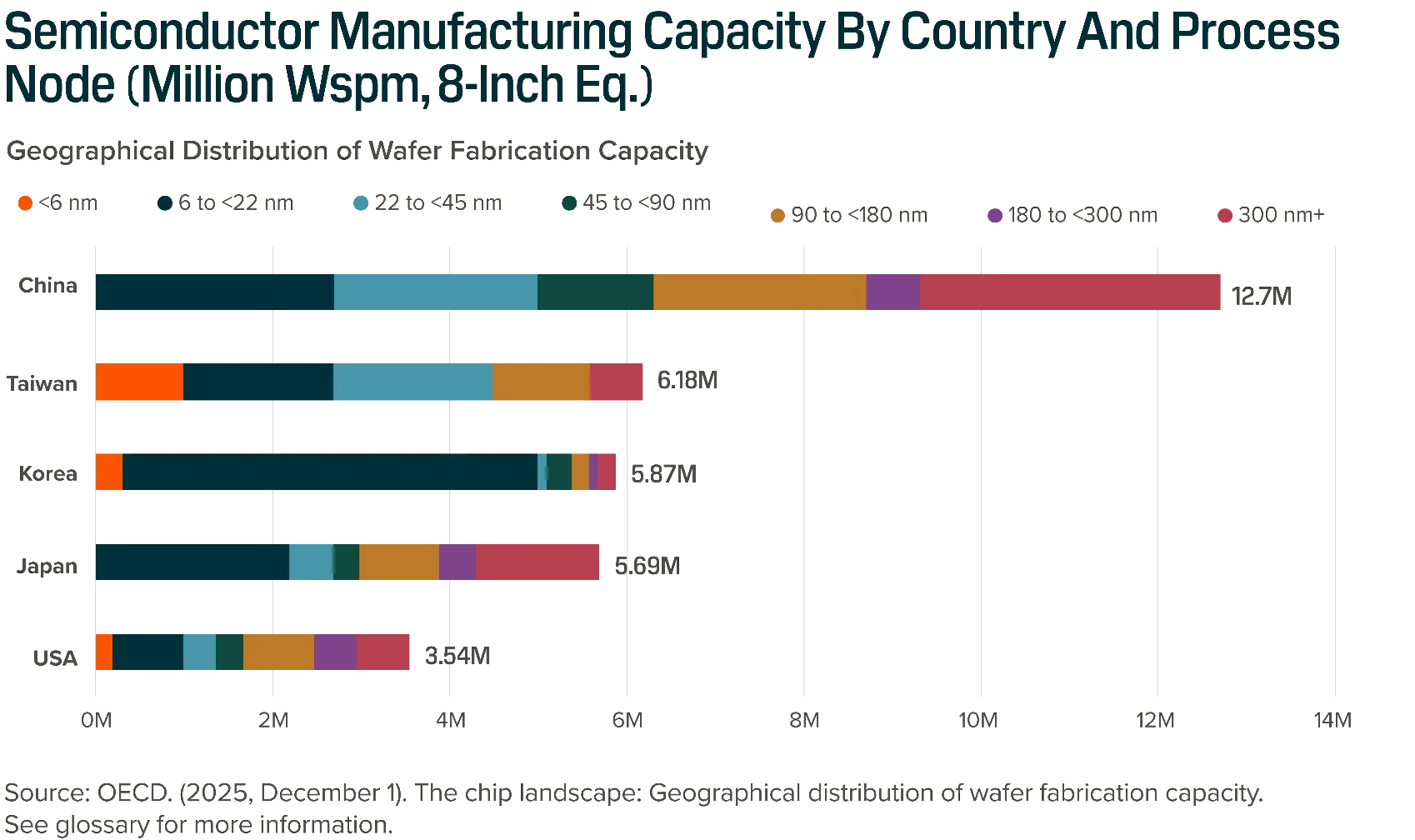
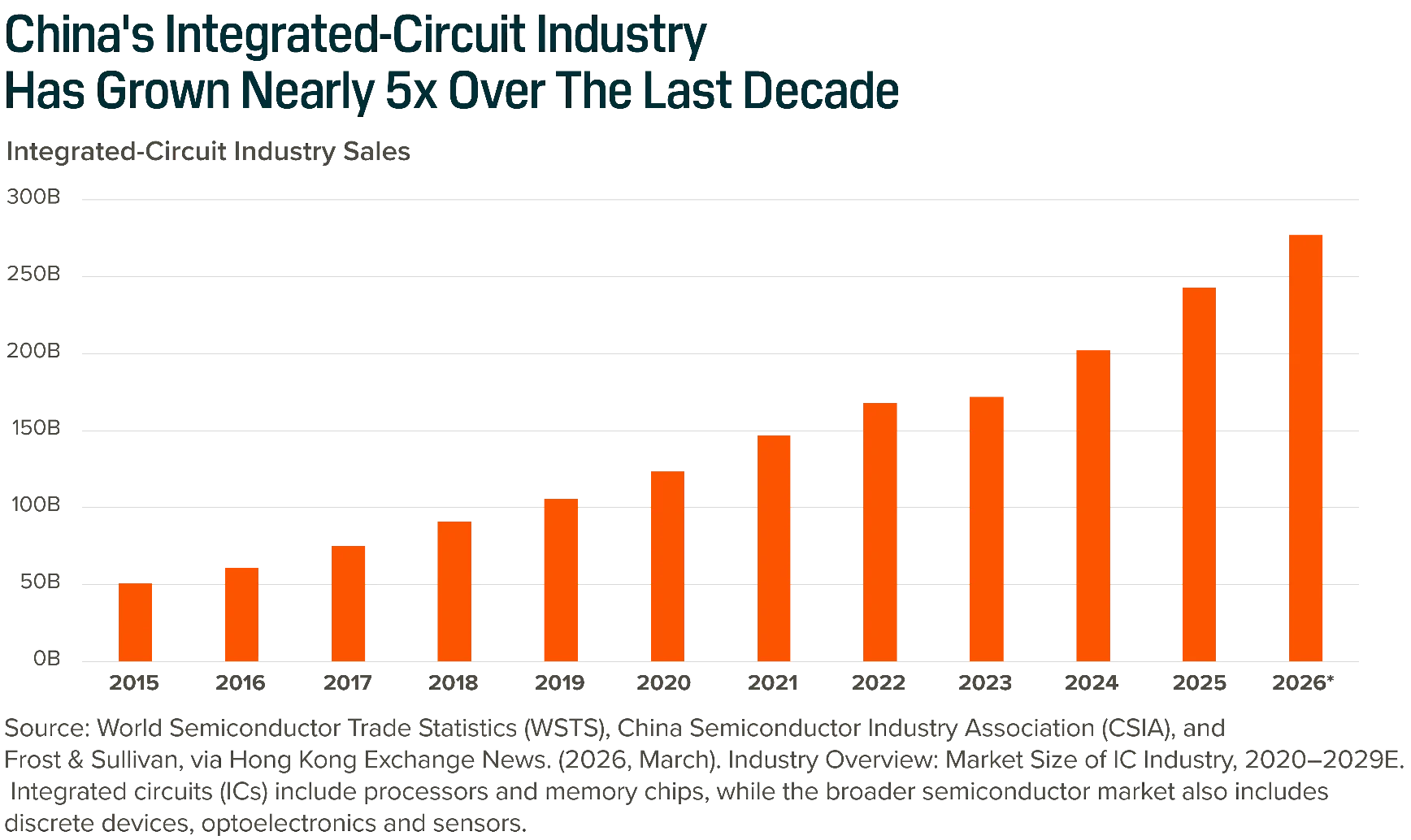
For China, this global expansion coincides with an ambitious push to build a more self-reliant semiconductor industry. China's integrated-circuit industry has grown nearly fivefold over the past decade, reaching $243 billion in sales in 2025.7 China already operates the world's largest semiconductor manufacturing footprint, processing approximately 12.7 million wafers monthly,8 and accounted for roughly $49 billion in chipmaking equipment spending in 2025.9 Yet much of its domestic semiconductor demand continues to be met by foreign suppliers. We believe this combination of substantial existing demand, growing AI investment and an accelerating localization push creates a compelling opportunity for Chinese semiconductor companies. For China, the world’s largest single-country chip market and one that imports more chips than any other product,10 this cycle raises the stakes of self-sufficiency – making it a key priority for the Chinese Communist Party.
China Is Building a Self-Sufficient Semiconductor Supply Chain
Unlike other major semiconductor markets that specialize in particular segments of the supply chain, China is pursuing domestic capabilities across nearly every layer, from chip design and manufacturing to memory, equipment, materials and advanced packaging.11 The objective is twofold: reduce dependence on foreign suppliers across its vast domestic market while developing the technological capabilities needed to compete in advanced computing and AI.
From Targets to Controllable Supply Chains
China's semiconductor ambitions have evolved from achieving a headline self-sufficiency target to building domestic alternatives across the industry's most critical supply-chain bottlenecks. Although Beijing fell short of its Made in China 2025 target of roughly 70% semiconductor self-sufficiency, the objective has evolved from a simple self-sufficiency percentage toward a controllable domestic alternative at every strategic chokepoint. Four goals now drive policy: supply-chain security, AI sovereignty, industrial upgrading across autos, telecom and robotics, and, over time, export capability.12
Funding makes the push structural rather than a one-off subsidy cycle. China’s 15th Five-Year Plan (2026-2030) identifies integrated circuits as an emerging pillar industry and prioritizes technological breakthroughs across the semiconductor value chain.13 The third phase of the state-backed National Integrated Circuit Industry Investment Fund, known as the “Big Fund,” was established with approximately $48 billion (RMB344 billion) in registered capital, exceeding the combined size of its first two phases.14
Counterintuitively, headline risk can be a positive for the sector. We believe export controls can slow progress at the leading edge while strengthening the localization flywheel. Restrictions give Chinese fabs a commercial reason to qualify domestic equipment and materials, which may lift domestic suppliers’ revenue and research and development budgets and can narrow technology gaps over time. That helps explain why the cycle could persist without technological parity. Thus, the less Western companies can sell into China, the bigger opportunity for Chinese players.
The Layers of the Stack
Other major semiconductor countries tend to specialize in parts of the chain. China is pursuing all of it, with different degrees of progress and a different scale of opportunity at each layer:
Mature Nodes Matter More Than Headlines Suggest
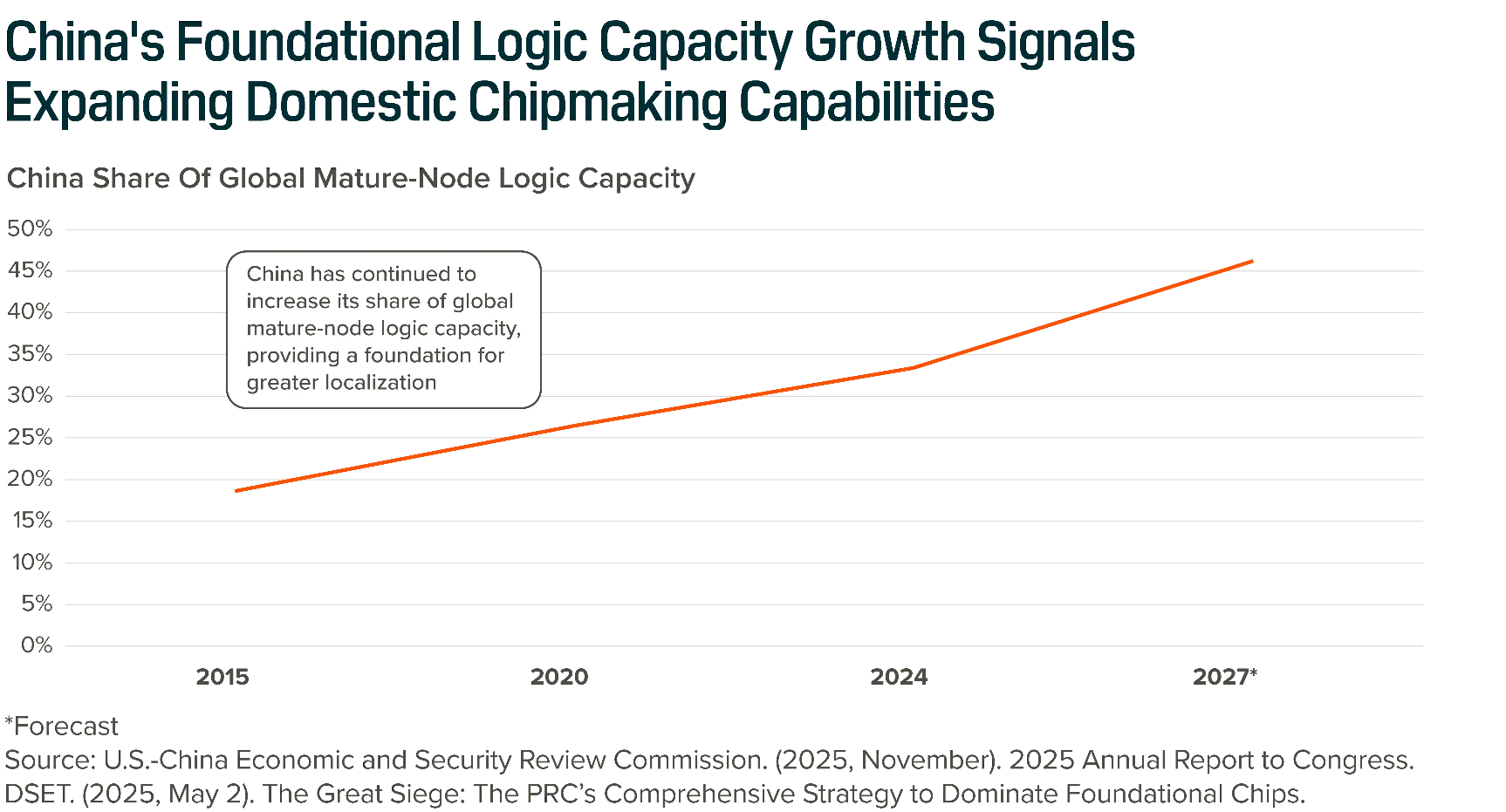
Investor debate often over-focuses on the most advanced nodes. We think that means some are not seeing the forest through the trees. China’s industrial base consumes large volumes of 28nm to 65nm and older chips used in autos, appliances, industrial systems, power electronics, displays and the Internet of Things (IoT). In fact, SEMI projects China’s share of global semiconductor manufacturing capacity will rise from 20% in 2020 to 32% by 2030, and its share of capacity at 22-40 nanometers from 25% in 2024 to 42% by 2028.22 Mature-node strength can therefore be economically and strategically important even without leading-edge parity. China’s integrated-circuit industry has grown nearly fivefold since 2015, to about $243 billion in 2025, with further growth forecast in 2026.23
Where China’s Domestic Ecosystem Is Taking Shape
Equipment and Materials
China is the world’s largest chipmaking equipment market. If nearly $50 billion of equipment is installed in Chinese fabs each year, even a 10 to 20 percentage point shift toward domestic vendors could create substantial revenue growth for local equipment companies.24 Reported domestic equipment adoption rose from roughly 25% in 2024 to roughly 35% in 2025, with some process categories higher.25
SEMI expects China to maintain its leading position as an equipment market through 2028, although growth should moderate in 2026 after several years of elevated investment. SEMI forecasts global equipment sales of a record $165.9 billion in 2026 and $229.5 billion in 2028.26 Local equipment suppliers are positioned to gain share as Chinese fabs qualify domestic tools.
Memory
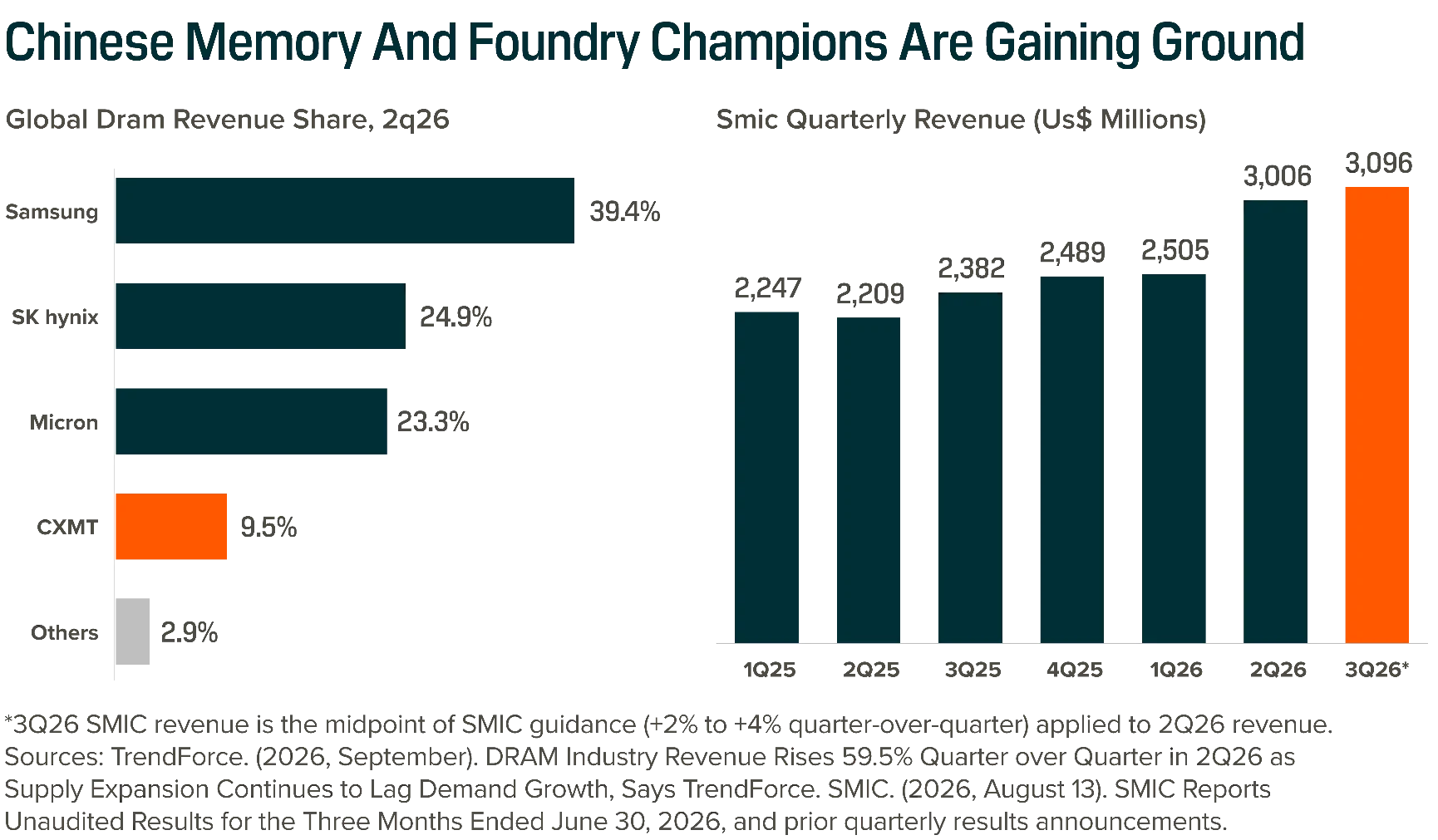
Memory is where localization has become visible in global market share. CXMT reached roughly 9.5% of global DRAM revenue in 2Q26, making it the fourth-largest supplier.27 YMTC, China’s NAND champion, is a key example of memory localization despite equipment restrictions. High-bandwidth memory (HBM) is the weak spot. Global HBM spending is projected to reach $246 billion by 2030, and China remains behind the leaders in HBM, which makes it a capability to watch.28
Foundry and Specialty Processes
China's push for semiconductor self-sufficiency is translating into growing demand for domestic chip manufacturing capacity. Chinese foundries are benefiting from greater localization of chip production, alongside rising demand for AI-related components, power management chips, and mature-node semiconductors. In Q2 2026, China's three leading foundry groups (SMIC, Hua Hong, and Nexchip) generated approximately $4.2 billion in combined revenue, accounting for roughly 7.5% of global foundry revenue.29
Capacity utilization also remains elevated, suggesting healthy demand for domestic manufacturing. Specialty foundry Hua Hong reported record Q2 2026 revenue of $718 million, up 27% YoY, with capacity utilization reaching 102.8%. The company guided for further revenue growth in Q3, underscoring continued demand for domestic foundry services.30
AI Compute
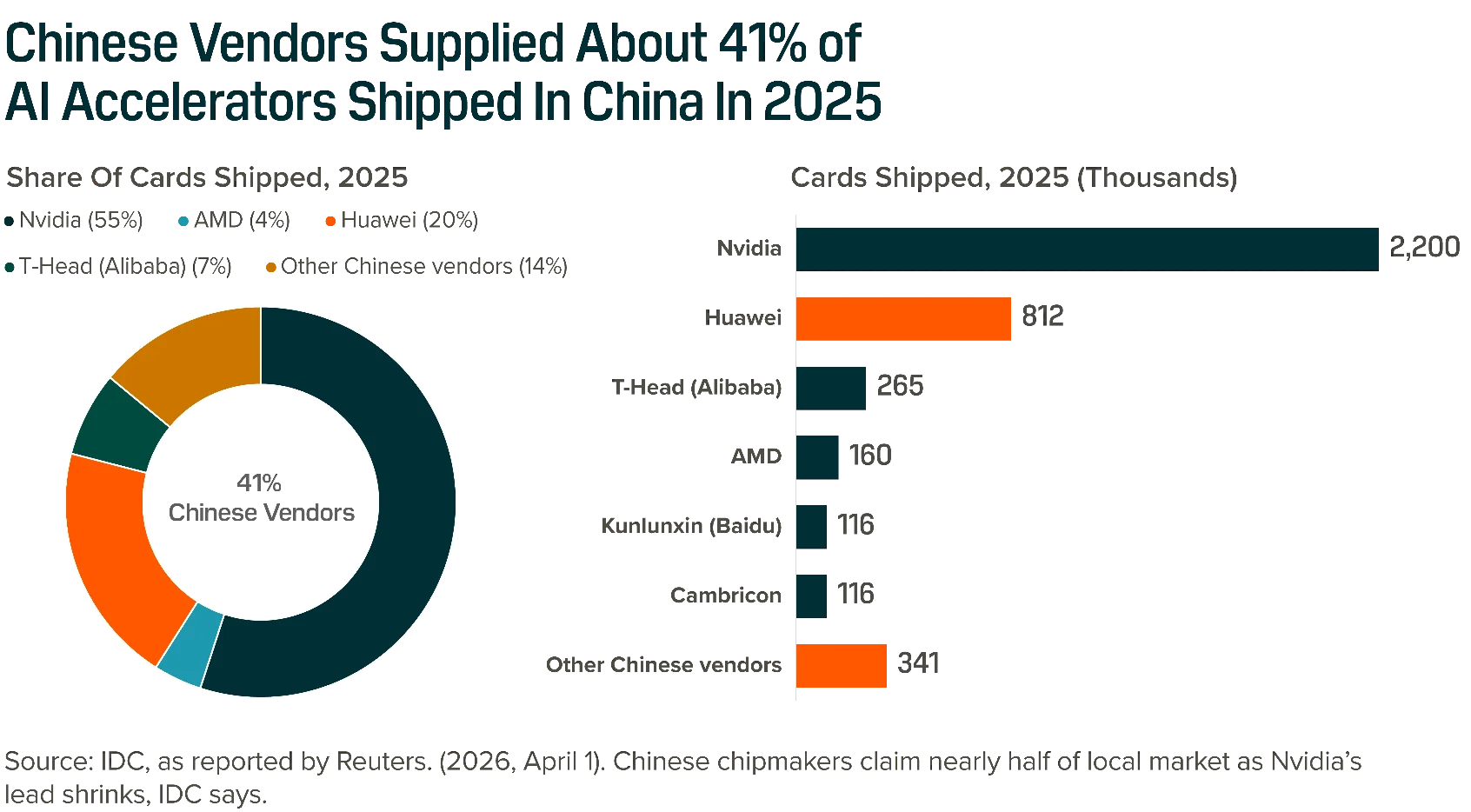
China’s AI buildout adds a demand driver aimed squarely at domestic suppliers. China shipped roughly 4 million AI accelerators in 2025, with Chinese vendors supplying about 1.65 million of them, or nearly 41%.31 IDC expects China’s accelerated server market to exceed $140 billion by 2029, although that total includes servers built on foreign chips.32
CCHP: Targeting China’s Semiconductor Self-Sufficiency Journey
We’re launching the Global X China Semiconductor ETF (CCHP), an actively managed ETF that provides exposure to companies involved in the development and manufacturing of semiconductors across China's domestic chip industry. Designed to capture China's push toward semiconductor self-sufficiency and technological leadership, the fund seeks to provide targeted exposure to companies listed on the Shanghai, Shenzhen, and Hong Kong Stock Exchanges that derive at least 50% of their revenue from semiconductor-related activities, including chip design, fabrication, memory, equipment, materials, and packaging and testing.
The fund combines quantitative models focused on machine learning stock analysis, earnings momentum, and price momentum with fundamental research and active portfolio management in an effort to identify opportunities across China's evolving semiconductor ecosystem. This approach allows the portfolio to adapt as new domestic leaders emerge, while incorporating considerations such as liquidity, investment restrictions, and company-specific risks. Together, the strategy seeks to provide investors with targeted access to China's semiconductor industry as domestic chipmakers expand capacity, pursue import substitution, and compete across increasingly advanced technologies.
We believe an actively managed approach is particularly well suited to China’s evolving semiconductor industry, where technological progress, competitive leadership, and regulatory restrictions can vary significantly across segments. By combining quantitative insights with fundamental research, CCHP seeks to navigate these complexities while identifying emerging opportunities across the domestic supply chain. We believe the fund can complement U.S.-centric technology portfolios and broader Asia semiconductor allocations by providing focused exposure to China's semiconductor self-sufficiency push.
China’s supply chain is maturing unevenly across design, foundry, equipment and memory, so leadership can rotate between sub-segments. Sanctions and entity listings can change faster than a static index rule can respond. And newly listed companies, an important part of China’s semiconductor capital-markets story, may be considered when they meet the Fund’s criteria. Access is also uneven. Many A-share companies are reachable only through Stock Connect, which has eligibility rules and quotas, and the Fund may use swaps where direct investment is impractical because of market access, foreign ownership limits, tax or liquidity.
We believe CCHP can complement U.S.-centric technology portfolios and regional Asia semiconductor allocations by adding focused, actively managed China exposure.
Conclusion: Progress Is Real, But Uneven In China’s Self-Sufficiency Journey
China is building a domestic alternative at every layer of the semiconductor supply chain, supported by policy, capital and a very large home market. AI investment adds a powerful demand driver, and early evidence, from equipment localization to CXMT’s DRAM share, suggests substitution is already underway. The path will be likely uneven, and equity returns may not track industry progress one for one. We believe CCHP offers investors an actively managed way to get exposure to China’s self-sufficiency journey, with portfolio managers selecting among companies rather than owning the whole theme.