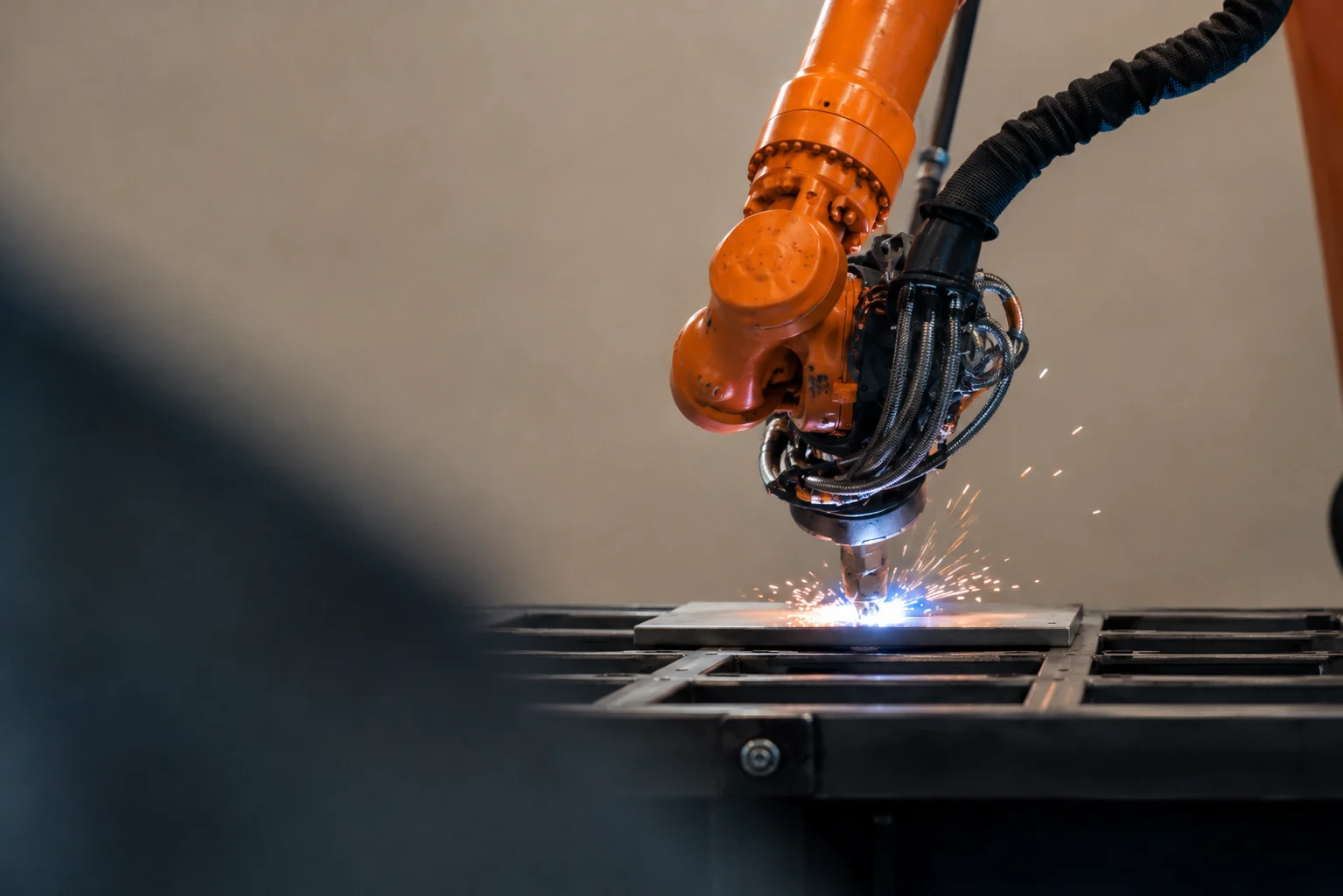
Human imagination and invention have no limits, as seen by the continuous progress of technological advances that turn yesterday’s science fiction – and more – into today’s reality. From the rapid evolution of artificial intelligence (AI) to mechanical arms catching rocket boosters from mid-air — 2024 has shared a glimpse of the future with all of us. Yet, as more and more innovations reshape our world, we may wonder what’s next.
This year’s iteration of our flagship research project, Charting Disruption, aims to shed a quantifiable light on what the future may hold. AI’s growing computational demands are driving massive infrastructure investments, while advances in autonomous systems are revolutionizing defense capabilities. As aging infrastructure undergoes essential modernization, the transportation sector is being transformed by breakthrough battery technologies and strategic material supply chains. Simultaneously, healthcare innovations — such as promising GLP-1 treatments — are emerging to address the challenges of our aging global population.
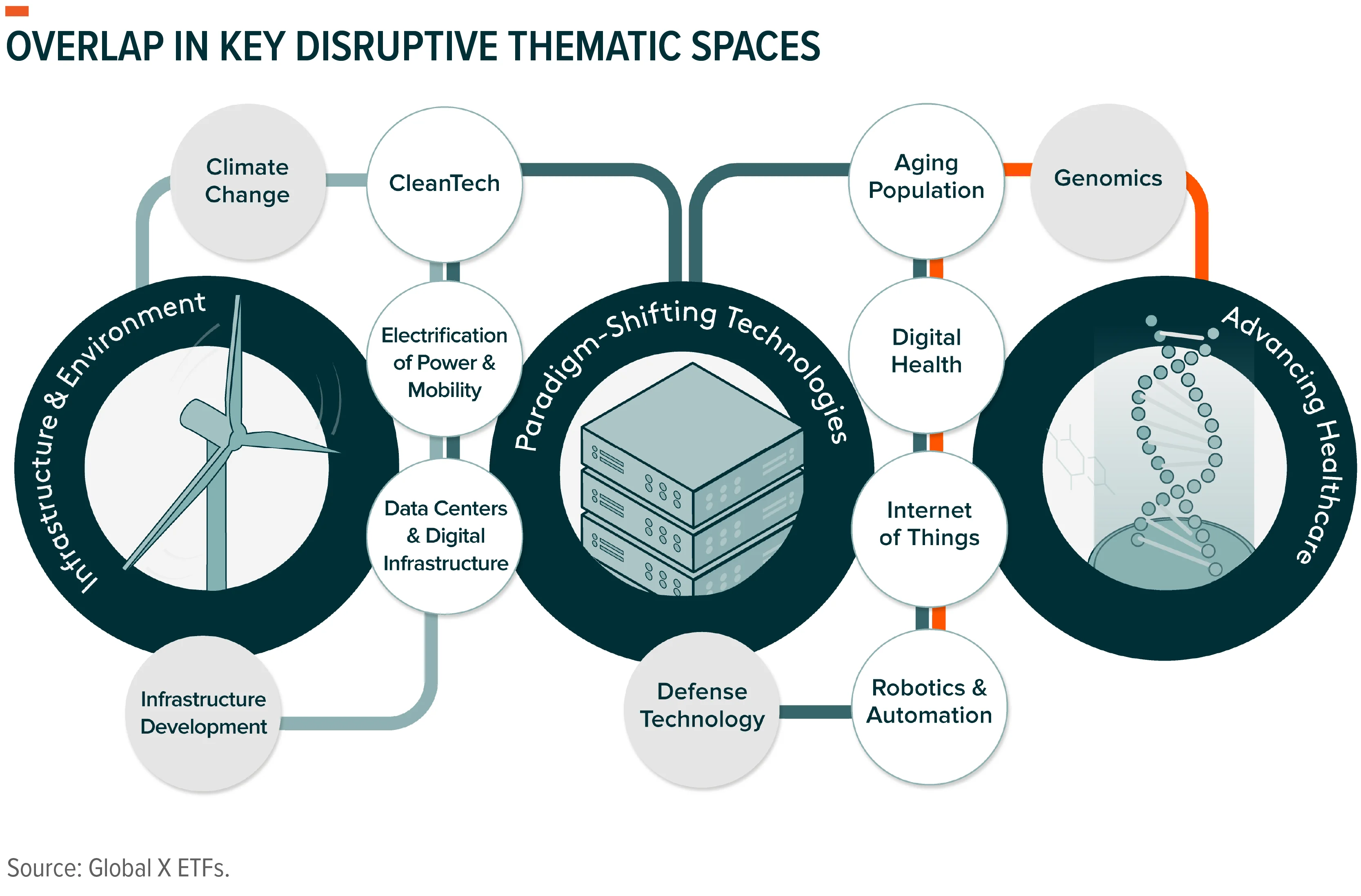
Examining these breakthroughs, we see that innovation rarely occurs in a bubble. The technologies developed in one sphere spill over into others, the rippling effects overlapping and cascading to create the new normal.
Key Takeaways
Charting disruption allows us to look back at the inventions of yesterday to anticipate the impact of the innovations of today and tomorrow.
AI represents perhaps the most ubiquitous disruptive theme in its applications across technologies for industries today, but other key themes demonstrate a similar spillover effect between sectors.
Through data-driven analysis, we predict a future marked by paradigm-shifting technologies, modernized infrastructure, resilient energy supply chains, and revolutionized healthcare.
Quantifying Disruption: Understanding Technology's Ripple Effects
Did you know...
The world’s largest AI supercluster, developed by Elon Musk’s xAI, uses 100,000 Nvidia chips and was constructed in just 122 days in Memphis, Tennessee.1
For each series of 5 to 50 prompts or questions, ChatGPT consumes 500 milliliters of water - almost a 16-ounce water bottle per series.2
One kilogram of hydrogen contains nearly three times the energy of one kilogram of gasoline, emitting only water when used in fuel cells.3
The U.S. defense budget for 2023 was around $858 billion, more than the combined defense budgets of the next ten countries—including China, Russia, and India.4
As the treatment category continues grow, five major GLP-1 drugs — Mounjaro, Zepbound, Ozempic, Wegovy, and Cagrisema — are expected to bring in over $100 billion in sales by 2030.5
A single uranium fuel pellet, about the size of a fingertip, can generate as much energy as a ton of coal or 480 liters of oil.6
Electric vehicles can require up to 80 kilograms (176 pounds) of copper — roughly 4x the amount used in a traditional combustion engine vehicle.7
AI took just 1 year to produce as many images as all of humanity’s photographers did in 150 years.8
Extraordinary Today Could Be Ordinary Tomorrow: Global Issues with Solutions to Scale
Nations around the globe face mounting challenges — from aging infrastructure and geopolitical tensions to demographic shifts and environmental pressures. These obstacles, while daunting, create opportunities to pioneer innovative solutions.
Across developed economies, the infrastructure assets at or past their predicted life expectancy can amplify the risks associated with climate change, slow the growth of innovation, and impede shifting demographics. In November 2021, the Infrastructure Investment and Jobs Act laid the groundwork for a strong foundation that now paves the way for the continued modernization of U.S. infrastructure assets, as approximately two-thirds of the allocated funding remains to be spent as of Q4 2024.14 It’s not just the United States facing these issues, but countries around the world. Regional global projections anticipate a 38%-73% market penetration rate of electric vehicles by 2030.15 New roads, bridges, and power grids will be the literal foundations on which electric and autonomous vehicles drive. They also represent the metaphorical foundations on which we will drive the world forward.
The development and application of AI is building a figurative bridge to revolutionary models with the potential to impact every facet of life as we know it. This year, the rapid adoption of AI across industries stands out as one of the most disruptive trends, already demonstrating a profound impact on a wide range of sectors. At a most personal level, patients stand to benefit from smart medical devices powered by AI and tech-enabled consumer care, allowing them to navigate the system and monitor their health more effectively. Tools for drug discovery utilizing generative AI technology could increase software spending by $41 billion in the next eight years and reduce the time to take a drug to market.16 Analytical tools and software using AI create opportunities to help streamline the healthcare system, reducing pervasive inefficiencies. Also driven in part by the desire for efficient logistical systems, humanoid robots powered by AI software represent a projected multi-trillion-dollar market opportunity.17 On an international scale, applications of AI in precision agriculture could help farmers achieve the requisite 60-70% increase needed in global agricultural production by 2050 to feed the world’s growing population.18 And to ensure domestic security in an era marked by over 30 ongoing global conflicts, the Pentagon’s budgetary request for AI funds more than doubled from 2022 to 2024.19,20
All this brings us back to physical infrastructure, as implementing AI in all its anticipated use cases requires significant investment in this sector to accommodate the power and energy demands of these technologies. Global hyperscale data centers surpassed 1,000 in 2024, as the largest players in cloud computing intensify their efforts to scale up their AI capabilities.21 These leaders in AI also represent the top corporate purchasers of clean energy as they seek to reach ambitious climate goals.AI exemplifies only one disruptive trend. Robotics is another. The projected 2024 market size of service robots exceeds $35 billion for use in medicine, domestic tasks, logistics, agriculture, entertainment, and more.The market size for surgical robots alone is expected to grow from $11.2 billion in 2024 to $27.7 billion in 2030.But this is just the starting point.Invention is continuous. Innovation is accelerating. The unimaginable of today may become tomorrow’s normal. Explore how we chart prospective disruptions for 2025 and beyond.