
Skip to Main Content
Subscribe to Newsletters
Global X Logo
Search
Content loaded

Explore

Our ETFs

Investment Insights

Product ResearchCharting DisruptionMidyear Outlook 2026

Investor Resources

EducationHow to InvestTax Resources

About Us

About Global XNewsroomCareersContact Us

Follow Us

socaial media icon for LinkedInLinkedInSocial media icon for X (twitter)XSocial media icon for FacebookFacebookSocial media icon for InstagramInstagramSocial media icon for Youtube

Copyright © 2026 Global X. All rights reserved.

Privacy PolicyAccessibility Statement
YouTube

Subscribe to our newsletter

Get the latest news and updates from our team.

Subscribe

SEI Investments Distribution Co. (1 Freedom Valley Drive, Oaks, PA, 19456) is the distributor for the Global X Funds.

Check the background of SIDCO and Global X's Registered Representatives on FINRA's BrokerCheck.

Content
Product ResearchCharting DisruptionThematic Growth

Introducing Charting Disruption: Outlook for 2026 and Beyond

x
A
Arelis AgostoDirector of Research & Strategy
Nov 3, 2025·6 min read
CD26-Articles%20Banner-Top-01

Innovation remains one of the most persistent drivers of long-term growth – reshaping industries, creating new markets, and sustaining momentum through economic cycles. Yet identifying trends alone is no longer sufficient. Investors must recognize how themes intersect and reinforce one another, as breakthroughs increasingly emerge from the convergence of technologies, infrastructure, and resources rather than from any single trend.

Artificial intelligence (AI) may be the most visible catalyst of this transformation, but it is far from the only one. Advances in semiconductors, data centers, electrification, and energy systems are powering progress across robotics, defense, and healthtech – forming an interconnected innovation ecosystem that underpins modern growth.

Adoption is also accelerating. Each technological wave reaches scale faster than the last, compressing what once took decades into years. Globalization, automation, and data infrastructure have shortened the path from discovery to application, blurring traditional industry boundaries and amplifying innovation’s ripple effects across the economy.

For investors, this speed and interdependence redefine the opportunity set. Understanding where innovation originates – and how its impact compounds across sectors – has become essential to positioning for the next era of thematic growth. Charting Disruption 2026 explores that evolution, quantifying how convergence is reshaping markets and revealing where tomorrow’s structural opportunities may emerge.
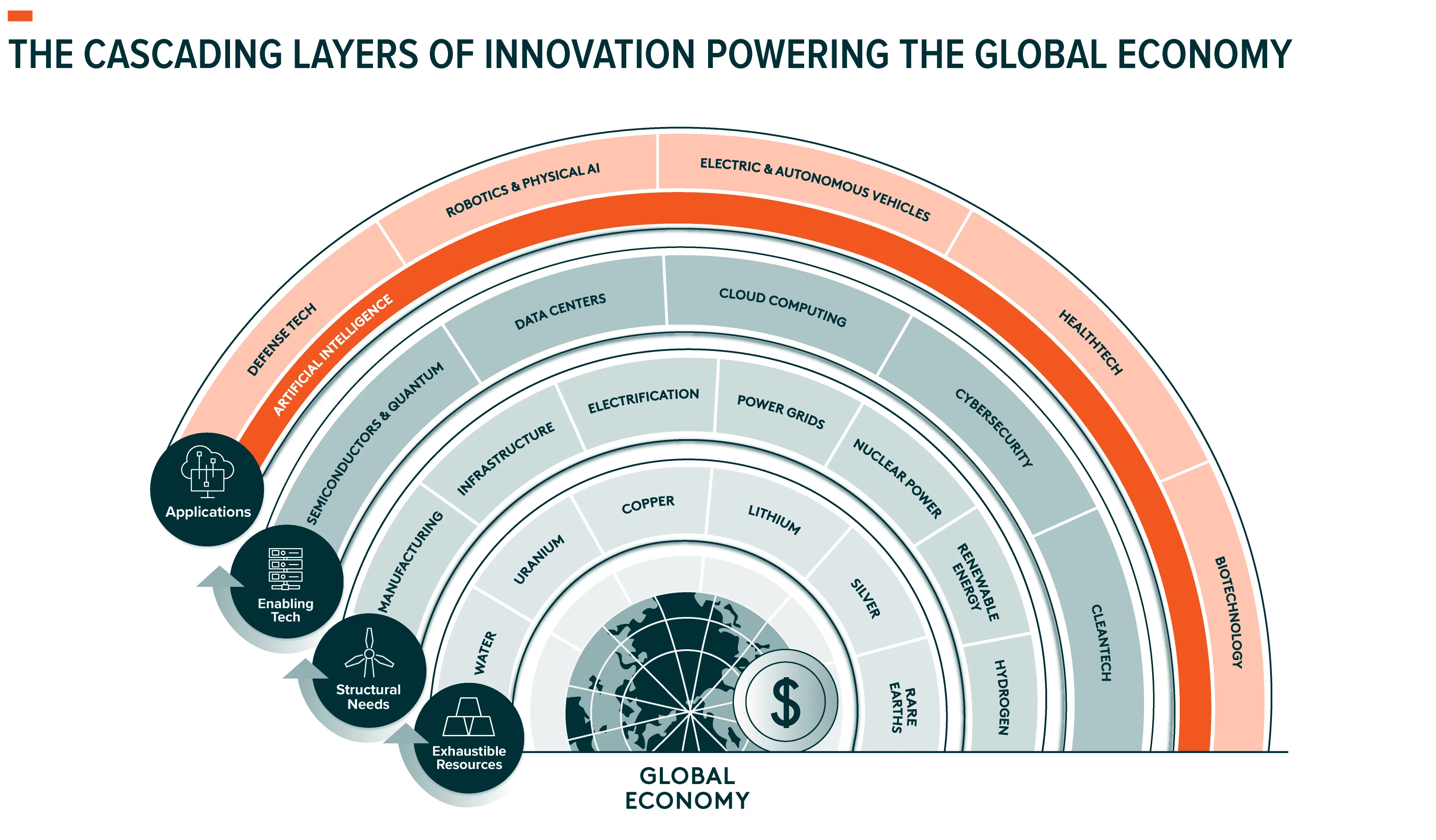
CD26-Converging Themes-v3 Blogpost

Key Takeaways

  • Charting Disruption offers insights into how modern technological breakthroughs trigger cascading change, turning former industry silos into a connected ecosystem where advances in one area accelerate growth in others.

  • AI may be the most pervasive disruptive force catalyzing growth across industries, yet its impact is deeply intertwined with other key themes that are advancing in tandem rather than in isolation.

  • Data-driven analysis highlights how next-generation innovations are reshaping the global economy through transformative technologies, modernized infrastructure, diversified energy networks, and groundbreaking healthcare solutions.

Charting the Path Forward

The architecture of innovation is both interconnected and compounding. Each stage – from the materials that power production to the applications transforming industries – builds on the one before it, creating a continuous cycle of progress. Understanding how these forces interact offers a clearer view of where disruption begins, how it scales, and where tomorrow’s opportunities may emerge.

Exhaustible Resources: Securing the Foundations of Innovation

Technological progress begins with access to finite materials that power production, electrification, and the infrastructure on which modern economies depend.

Sustaining technological progress depends not only on discovery but on the reliable availability of the materials that make it possible. As demand for copper, lithium, uranium, and rare earths accelerates alongside electrification and automation, ensuring access to these essential inputs is critical to maintaining momentum. Efficient production, responsible sourcing, and advances in recycling and substitution will all play a role in preventing material scarcity from becoming a bottleneck to innovation.

Structural Needs: Building the Infrastructure for Growth 

As global demand for energy, connectivity, and production capacity accelerates, the world’s physical and organizational systems are under pressure to expand, modernize, and sustain long-term growth.

The modernization of infrastructure is no longer a long-term aspiration but an economic imperative. Trillions in investment will be required to replace aging assets, expand grid capacity, and build the physical backbone for a more digital, electrified, and interconnected world. These structural systems – spanning transportation, manufacturing, and energy – serve as the bridge between physical resources and technological progress. Their evolution will dictate how efficiently economies can adapt to disruption, support innovation, and sustain resilience in an era defined by accelerated change.

Enabling Technologies: Powering the Digital Core

Digital and computational systems such as semiconductors, data centers, and cloud infrastructure provide the backbone for automation, scalability, and innovation across industries.

The surge in computing power, connectivity, and automation underscores a new phase of efficiency and intelligence across industries. From semiconductors to cloud networks, technological capacity is compounding – reducing costs, expanding scale, and transforming what’s possible. As innovation accelerates, these enabling systems no longer function as support infrastructure alone; they have become the engines of transformation themselves. Their continued advancement will shape how effectively new applications emerge, connect, and redefine the modern economy.

Applications: Turning Innovation into Impact

Innovation ultimately finds meaning through real-world use – transforming ideas into solutions that redefine industries, improve lives, and drive global growth.

As these innovations mature, their influence extends beyond individual sectors – shaping productivity, resilience, and global competitiveness. What once marked the frontier of technology is rapidly becoming the foundation of a new economic paradigm, where investing in innovation means investing in the long-term transformation of everyday life.

Conclusion

The interplay between technological innovation and macroeconomic transformation is reshaping how growth emerges and where opportunity concentrates. Thematic investing offers a framework for capturing this evolution – identifying the structural forces, from digitalization to decarbonization, that transcend sectors and market cycles. By looking beyond traditional classifications, investors can better position for the convergence of trends driving the global economy forward. Innovation may be unpredictable in form, but its trajectory – toward deeper integration, greater efficiency, and expanding impact – remains unmistakably clear.

For additional insights, please view our full report, Charting Disruption: Outlook for 2026 and Beyond.

Copper, also known as the “metal of electrification,” is seeing a sharp rise in demand, due to its high electrical conductivity and malleability, perfect for use in medical devices and EVs, as well as solar and wind energy.1

Due to their use in EVs – not to mention smartphones, laptops, power tools, and cameras – the demand for lithium-ion batteries is projected to grow seven-fold between 2022 and 2030.2

Permanent magnets accounted for 42.5% of rare earth element demand in 2023, for their use in electronics, such as cell phones, and clean energy systems, such as fuel cells.3

Silver’s high electrical conductivity, strong thermal conductivity, antimicrobial properties, and ability to reflect 95-99% of visible light makes it critical to industrial applications such as solar panels.4

Using AI to help generate a 100-word email uses just over one bottle of water.5

Less than ten pellets of uranium fuel – approximately the weight of 10 AA batteries – can power the average household for a year.6

Global fragmentation, aging infrastructure assets, shifting demographics, climate change, the rise of disruptive technologies, are driving an urgent need for as much as $106 trillion in infrastructure investment through 2040.7

By 2035, projections anticipate data center electricity consumption at 1,596TWh, positioning their demand between the 2024 usage levels of Russia (1,193 TWh) and India (2,027 TWh).8,9

Nuclear power represents a potential fuel source with a low average CO2 life cycle, low land footprint, and one of the highest uptime rates of any energy source.10

Achieving national energy ambitions will require adding or upgrading around 80 million kilometers of power grids by 2040, the equivalent of rebuilding the entire existing global power network.11

Surge in accelerated computing is compelling chipmakers and equipment suppliers to ramp and retool for sub-5 nm semiconductor production, critical for producing next-gen processing hardware. By 2030, nearly $500 billion could be spent annually on AI chips, driving at least half a trillion in semi manufacturing CapEx.12

To meet the anticipated 2030 global data center demand, projections estimate an investment need of nearly $7 trillion – $5.2 trillion for facilities supporting AI processing and $1.5 trillion for traditional IT applications.13

Propelled by rapid advances in smaller, more efficient models, the cost of running inference at GPT-3.5 performance levels fell more than 280-fold between November 2022 and October 2024, as hardware expenses declined by roughly 30% per year and energy efficiency improved by about 40% annually.14

Global cloud infrastructure spending is projected to surpass $400 billion in 2025, with approximately 60% of the market captured by Amazon Web Services (30%), Microsoft’s Azure (20%), and Google Cloud (13%).15

Cybersecurity remains a top priority for businesses and individuals, as the Federal Bureau of Investigation revealed over $16 billion in losses due to cybercrime in 2024, up 33% from 2023.16

In addition to success rates between 94-100%, robot-assisted surgeries may offer several patient benefits, including reduced postoperative discomfort, lower likelihood of infection, minimized blood loss, shortened hospital recovery times, and less visible scarring.17

Cheap and adaptable drones offer significant economic advantages in warfare over traditional tanks, costing 25,000 times less, reducing time to build by 4,380 times, and offering 50,000 times the production capacity.18,19,20

Global EV sales surpassed 17 million units in 2024, pushing their share of the global car market above 20% for the first time.21 With affordability improving across regions, EVs are on track to exceed a 40% market share by 2030.22

Currently, drugs take about 10-15 years and $1.8 billion to develop, while just 10% of investigational treatments gain approval, but AI can help reduce pre-clinical delays and lower costs by up to 50%.23,24,25,26

GLP-1 therapies continue to demonstrate strong potential for weight management and a wide range of other health applications, contributing to projected revenues of $183 billion by 2032.27

Related articles

1of2
ETF EducationThematic GrowthDisruptive Technology

Why a Good Theme Can Deliver the Best Defense

T

Tejas Dessai

Apr 23, 20268 min read
Product ResearchThematic GrowthDisruptive Technology

AI Does Not Kill Cybersecurity, It Enhances the Opportunity

ETF EducationThematic GrowthDisruptive Technology

Why a Good Theme Can Deliver the Best Defense

Footnotes
  1. Ross, L., & de Naoum, K. (2024, May 9). The Reasons Why Demand for Copper is Growing. Thomas.

  2. Statista Research Department. (2025, January 22). Lithium-ion Batteries - Statistics & Facts. Statista.

  3. Government of Canada. (2025, September 19). Rare Earth Elements Facts.

  4. Zadeh, J. (2025, September 15). The Green Revolution: How Silver Demand Powers Clean Technology. Discovery Alert.

  5. Garcia, M. (2024, December 13). AI Uses How Much Water? Navigating Regulation of AI Data Centers' Water Footprint Post-Watershed Loper Bright Decision. Available at SSRN.

  6. Canadian Nuclear Association. (2025). Nuclear Fuel.

  7. Green, A., Nangia, J. & Sandri, N. (2025, September 9). The infrastructure moment. McKinsey & Company.

  8. Ember. (n.d.). Electricity Data Explorer. Accessed September 5, 2025.

  9. Hostert, D., Kimmel, M., Berryman, I., Pegios, K., Quintero, R., Song, S., Verma, A., & Vasdev, A. (2025, April 15). New Energy Outlook: Energy and Climate Scenarios that Connect the Dots. BloombergNEF.

  10. Conte, N. (2021, August 27). The Power of a Uranium Pellet. Energy Shift.

  11. International Energy Agency (EIA). (2023, November). Electricity Grids and Secure Energy Transitions: Executive Summary.

  12. Global X ETFs forecast as of Sep 19, 2025 with information derived from: eeNews Analog, Feb 2025; FactSet, n.d., accessed Sep 19, 2025; IDC, Sep 2025; Yahoo!Finance, Sep 2025, and Deloitte (n.d.). Semiconductor expansion may require smart capital spending processes, accessed on October 30, 2025.

  13. Noffsinger, J., Patel, M., Sachdeva, P., Bhan, A., Chang, H., & Goodpaster, M. (2025, April 28). The Cost of Compute: A $7 Trillion Race to Scale Data Centers. McKinsey Quarterly.

  14. Maslej, N, Fattorini, L., Perrault, R., Gil, Y., Parli, V., Kariuki, N., Capstick, E., Reuel, A., Brynjolfsson, E., Etchemendy, J., Ligett, K., Lyons, T., Manyika, J., Niebles, J. C., Shoham, Y., Wald, R., Walsh, T., Hamrah, A., Santarlasci, L., Lotufo, J. B., Rome, A., Shi, A., Oak, S. (2025, April). The AI Index 2025 Annual Report. AI Index Steering Committee, Institute for Human-Centered AI, Stanford University.

  15. Richter, F. (2025, August 21). The Big Three Stay Ahead in Ever-Growing Cloud Market. Statista.

  16. Federal Bureau of Investigation’s Internet Crime Complaint Center. (2025, April 23). FBI Releases Annual Internet Crime Report. Federal Bureau of Investigation (FBI).

  17. Cleveland Clinic. (2024, April 30). Robotic Surgery.

  18. Baldor, L. C. (2023, February 17). Tank Plant in Small Ohio City Plays Big Role in Ukraine War. AP News.

  19. McNabb, M. (2024, May 31). The Rise of Tiny FPV Drones in Warfare: How They’re Used. Dronelife.

  20. Seitz, I. (2025, May 21). AbramsX: The Army’s New ‘Super’ Tank Should Make Russia Sweat. National Security Journal.

  21. International Energy Agency (IEA). (2025, May 14). Global EV Outlook 2025: Expanding Sales in Diverse Markets.

  22. Ibid.

  23. PhRMA. (2021, September 20). 2021 Profile: Biopharmaceutical Research Industry.

  24. Wouters, O.J., McKee, M., & Luyten, J. (2020, March 3). Estimated Research and Development Investment Needed to Bring a New Medicine to Market, 2009-2018. Journal of the American Medical Association, 323(9): 844-853.

  25. Van Norman, G.A. (2019, June 24). Phase II Trials in Drug Development and Adaptive Trial Design. Journal of the American College of Cardiology: Basic to Translational Science, 4(3): 428-437.

  26. Rodriguez, A., Meier, C., Serazin, E., Gooch, J., Aggarwal, P., Steene, A., Jayatunga, M., Nayak, S., Randall, W. (2023, June 26). Unlocking the Potential of AI in Drug Discovery. Boston Consulting Group (BCG).;

  27. Evaluate Pharma. (n.d.). GLP-1 Sales by Indication. Accessed September 19, 2025.

In volatile markets, thematic strategies can offer a rare mix of resilience and potential structural growth.

In volatile markets, thematic strategies can offer a rare mix of resilience and potential structural growth.

AI expands cyber complexity and attack surfaces, driving higher security demand—making cybersecurity a potential beneficiary, not a casualty, of AI.

I

Ido Caspi

May 15, 20265 min read
T

Tejas Dessai

Apr 23, 20268 min read
Product ResearchThematic GrowthDisruptive Technology

AI Does Not Kill Cybersecurity, It Enhances the Opportunity

AI expands cyber complexity and attack surfaces, driving higher security demand—making cybersecurity a potential beneficiary, not a casualty, of AI.

I

Ido Caspi

May 15, 20265 min read
