
Content loaded
Copyright © 2026 Global X. All rights reserved.
SEI Investments Distribution Co. (1 Freedom Valley Drive, Oaks, PA, 19456) is the distributor for the Global X Funds.
Check the background of SIDCO and Global X's Registered Representatives on FINRA's BrokerCheck.
Get the latest news and updates from our team.

Electricity demand is rising after decades of relatively flat growth. In the U.S. alone, demand is expected to increase 49% by 2050, placing new demands on a power system that was not built to support it.1 Data centers, electric vehicles, and industrial activity are increasing the need for reliable power, while new power plants and grid connections can take years to bring online.
Nuclear power can provide reliable, low-emissions electricity, but the time and cost involved in developing conventional reactors have historically limited new construction. Nuclear can also strengthen energy security by diversifying the power mix with steady generation that is less exposed to weather variability and fossil-fuel price swings. Small modular reactors, or SMRs, could help address nuclear’s historic limitations: their smaller size and factory-built components may allow nuclear capacity to come online more quickly and be added in stages, while also making it possible to serve remote sites or generate power closer to where it is used. SMRs could meaningfully contribute to the broader goal of tripling global nuclear capacity by 2050.2
SMRs build on more than 70 years of military experience with nuclear microreactors, but their commercial use remains at an early stage.3 Recent government support, customer commitments, and a growing pipeline of projects are bringing the industry closer to its first commercial deployments in North America, as interest grows in how SMRs could help meet rising electricity demand.
To help investors access this emerging segment, we are introducing the Global X Small Modular Reactor ETF (SMRZ), an actively managed ETF focused on companies developing SMRs and the specialized suppliers that support them.
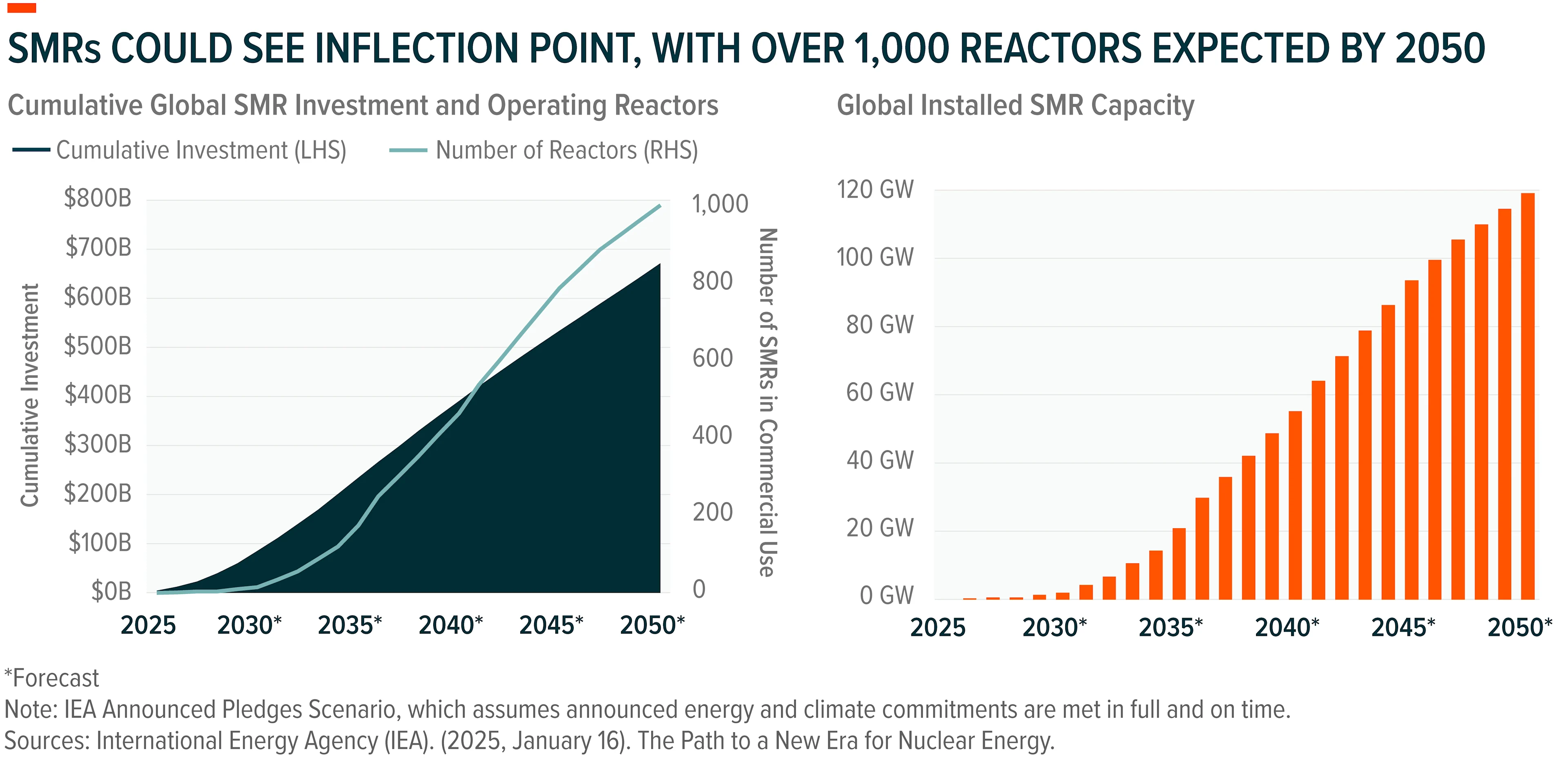
New dispatchable power additions could cover the equivalent of only 42% of projected U.S. electricity demand growth through 2030, highlighting the challenge of matching new supply with rising demand.4
SMRs could make nuclear power more flexible to deploy: factory-built modules are designed to shorten construction timelines and reduce upfront Capital Expenditures (CapEx), while allowing operators to add reliable, low-emissions capacity in stages, including near existing grids or at remote, off-grid sites.
We believe the industry is entering an inflection point. Two commercial SMR sites in Russia and China represent about 280 MW of operating capacity, while North American projects target first power around 2030.5,6,7 By 2050, over 1,000 SMRs are projected to be generating power worldwide.8
The Global X Small Modular Reactor ETF (SMRZ) offers focused exposure to SMR developers and select companies supplying fuel, components, and technology.
After years of modest growth, U.S. electricity demand could rise substantially, driven by growth in data centers, electric vehicles, and industrial activity. Data centers alone could account for 20% of U.S. electricity demand by 2035, up from about 6% today.9 The scale-up to meet that demand, however, will take time. Through 2030, new dispatchable supply additions could amount to only 42% of projected new U.S. power demand.10
Nuclear power is uniquely positioned to help meet this demand. Nuclear plants can produce electricity around the clock and deliver consistent output, while generating lifecycle emissions comparable to wind, among the lowest of any power source.11 Yet conventional reactors can take 8 to 15 years and more than $10 billion to build.12,13 Each project requires site-specific licensing, construction, and review, so costs and timelines can vary widely and limit how quickly nuclear capacity can grow over the next 25 years.
Nuclear’s current fleet is also limited. The fleet, in general, is aging. 156 GW of nuclear capacity is expected to retire by 2050, compared with about 340 GW of projected additions.14 Retirements could therefore absorb nearly half of new capacity, limiting the net increase in operating nuclear power.15
As countries pursue the goal of tripling global nuclear capacity by 2050, they will need ways to bring new nuclear power online more quickly and at lower cost.16 SMRs are being developed as one potential solution.
SMRs are designed around standardized modules that can be built in factories, transported, and assembled on site. Shifting more work to factories and applying standardized designs across projects could shorten project timelines and reduce upfront construction CapEx, with costs potentially falling as production scales. Some designs target factory-built construction for up to 80% of a project.17 Standardized designs could ease the regulatory burden by allowing developers to reuse parts of the design review and licensing work across projects, potentially shortening approval timelines while preserving site-specific reviews. Their smaller size could also allow a more compact footprint, while a modular approach could let developers start with one unit and add capacity as demand grows.
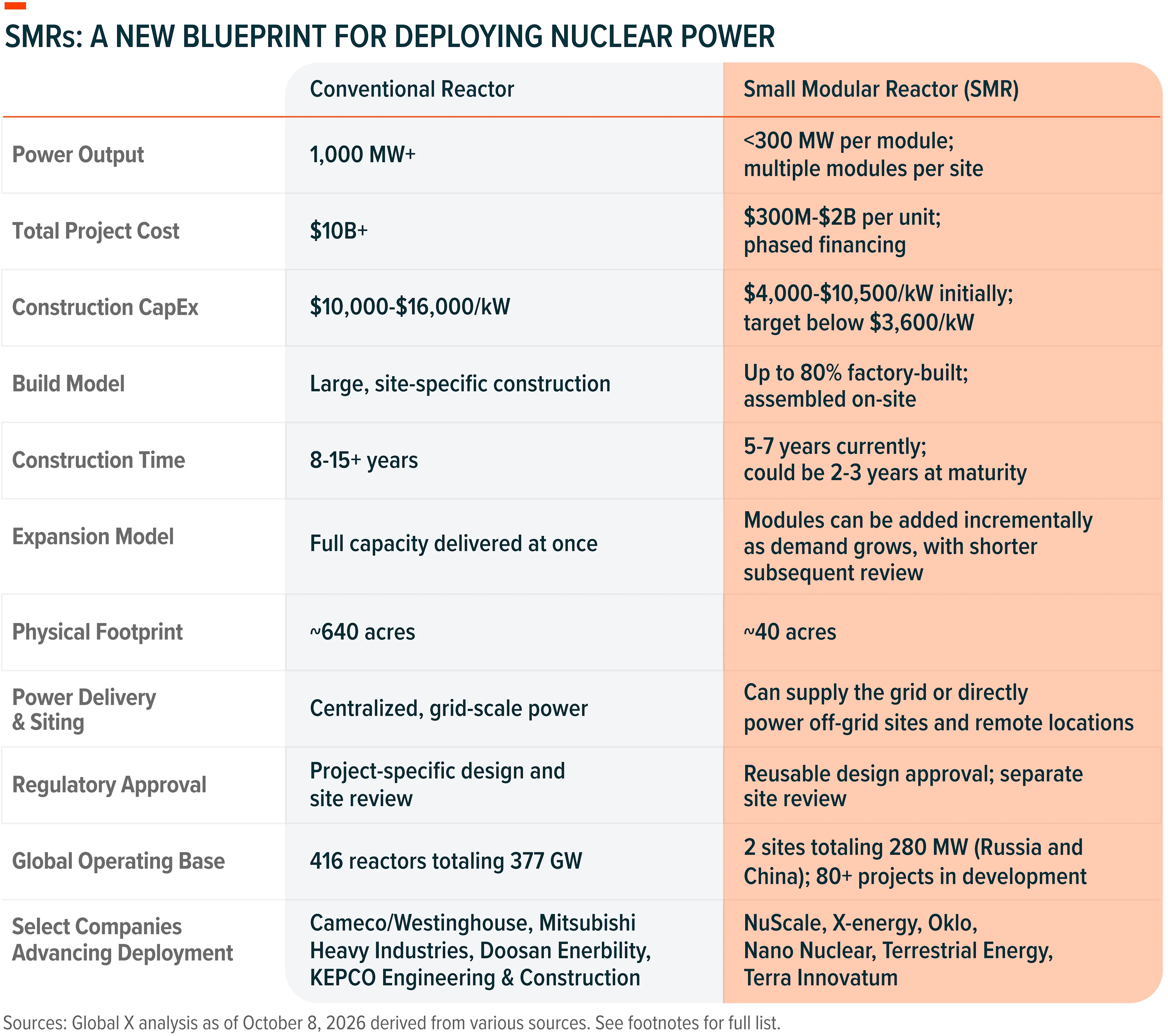
SMRs are moving from early deployments toward a broader commercial pipeline. Construction timelines are estimated at three to five years today, with the potential to fall to two to three years as the industry matures.18 Those estimates are expected to become clearer as projects are completed and developers gain experience with successive builds.
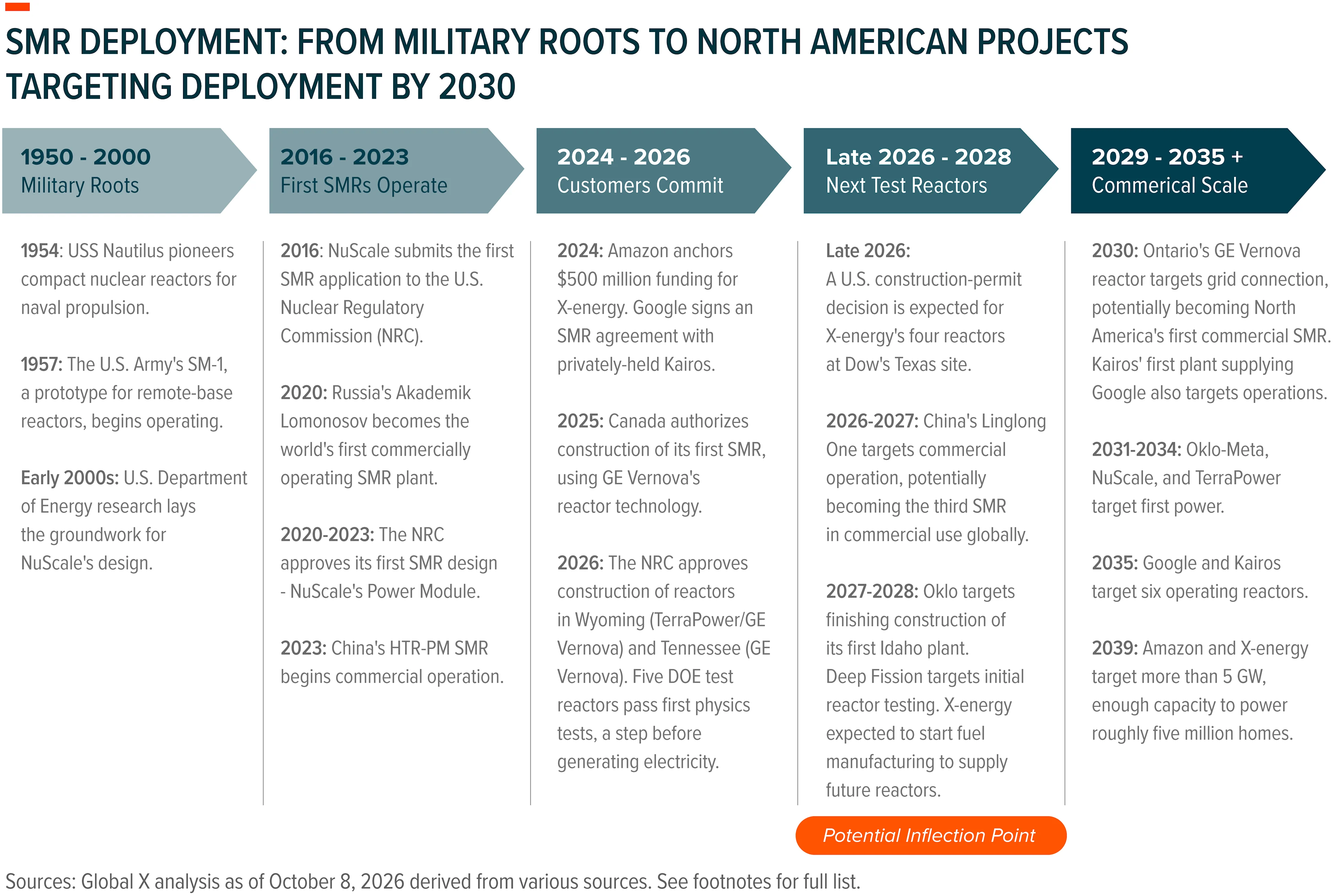
Two commercial SMRs are already in use, one in Russia and one in China, with about 280 MW of combined capacity.19,20 Another 80 SMR projects are in development worldwide, and the industry may be approaching an inflection point as developers and suppliers reach key regulatory milestones.21 In 2025, the U.S. Nuclear Regulatory Commission (NRC) approved NuScale’s US460 standard reactor design.22 The approval gives NuScale and its prospective project partners a head start: future US460 projects can build on the NRC’s review of the reactor design, potentially only requiring site-specific approvals. GE Vernova Hitachi’s BWRX-300 has advanced through construction licensing in Ontario and, most recently, received the first U.S. construction permit for a commercial SMR at TVA’s Clinch River project in Tennessee.23,24 These steps bring North American SMR projects closer to first power – a feat expected by 2030.25
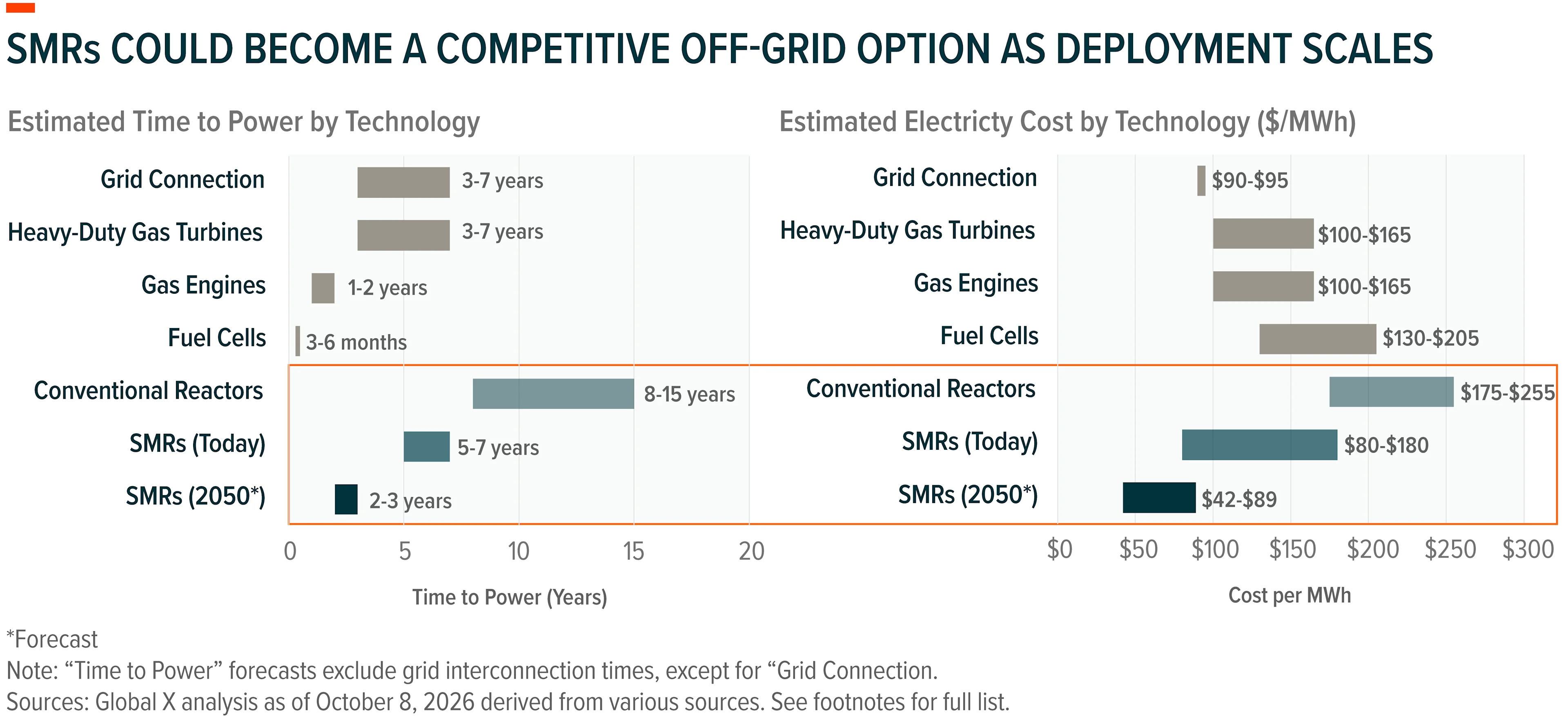
One particularly beneficial use case for SMRs is off-grid power. In 2025, the capacity of U.S. projects waiting in interconnection queues exceeded installed capacity by about 50%, with projects taking a median of five years from connection to request to completion.26 For data centers, manufacturers, mines, and remote communities, those delays are shifting focus towards power generated at or near the site, bypassing grid interconnections altogether.
For data center developers, a grid connection can take longer than constructing the facility itself. Onsite generation could help close that timing gap. Nearly two-thirds of data center developers are evaluating onsite power and about 45 GW of SMR capacity has been announced for data centers, almost entirely in the United States.27 Even for data centers that are close enough to the grid, off-grid power could ease competition for electricity and limit pressure on residents’ bills.
SMRs could ultimately bring reliable, low-emissions nuclear power directly to sites with large or remote energy needs. Today, first projects may take longer to deliver power and cost more per megawatt-hour than established onsite options such as natural gas generators and fuel cells.28 With repeated builds and greater scale, timelines and costs could fall, making SMRs more competitive with those alternatives and potentially less costly than securing a grid connection.29
That potential is drawing partnerships from utilities and major technology companies. Ontario Power Generation and GE Vernova Hitachi are advancing a four-reactor project in Canada; Google is working with Kairos Power on an initial reactor and additional units; Meta and Oklo, alongside other developers, have outlined multi-reactor plans; and Amazon has backed X-energy’s development plans.30,31,32,33 Together, these partnerships give SMR developers the utility partners, prospective power buyers, and investment needed to move projects forward – an important step toward making SMRs a scalable source of power for large energy users.
SMRZ offers investors a focused way to access companies working to bring small modular reactors to market. As demand grows for reliable, low-emissions power, the ETF invests across small module reactor developers and the specialized fuel, component, and technology suppliers that could help make SMRs a scalable part of the energy mix. The actively managed fund uses the Akros Small Modular Reactor Index as a reference for an initial set of potential SMR Companies. The index targets up to 15 companies and gives greater weight to the two companies with greater SMR exposure.
The universe spans established businesses with significant SMR-related revenue and earlier-stage developers that qualify through relevant contracts, research agreements, or patents. That reach across the value chain gives investors exposure to both companies supporting projects today and innovators working toward future deployments. Some developers do not yet generate revenue, and their commercial prospects depend on projects still in development.
For investors with broader electrification or nuclear exposure, SMRZ may serve as a focused complement, adding targeted exposure to companies developing SMRs and the specialized ecosystem around them. The fund’s performance will depend on the industry’s ability to secure approvals, finance and build projects, and attract customers. The expense ratio is 0.75%.
SMRs could expand nuclear power’s role by making new capacity more flexible to build and locate. As early projects advance, the industry is approaching a pivotal point where modular designs could deliver reliable power at commercial scale. SMRZ gives investors focused exposure to the developers and specialized suppliers working to make that next phase of nuclear power a reality – all in one U.S.-listed ETF.
Related ETFs
SMRZ – Global X Small Modular Reactor ETF
Click the fund name above to view current performance and holdings. Holdings are subject to change. Current and future holdings are subject to risk.
BloombergNEF. (2026, May 19). New Energy Outlook 2026.
U.S. Department of Energy. (2023, December 1). At COP28, Countries Launch Declaration to Triple Nuclear Energy Capacity by 2050, Recognizing the Key Role of Nuclear Energy in Reaching Net Zero.
Naval History and Heritage Command. (n.d.). USS Nautilus (SSN-571). Accessed October 8, 2026.
Global X analysis derived from: William Blair. (2026, June 11). Racks & Stacks May 2026.
World Nuclear News. (2023, December 6). China’s Demonstration HTR-PM Enters Commercial Operation.
World Nuclear News. (2023, November 24). First Refueling at Floating Nuclear Power Plant.
GE Vernova. (n.d.). GE Vernova Hitachi’s BWRX-300 Small Modular Reactor (SMR). Accessed October 8, 2026.
International Energy Agency (IEA). (2025, January 16). The Path to a New Era for Nuclear Energy.
Forgash, E. (2026, July 21). Data Centers on Track to Suck Up a Fifth of US Power Use by 2035. Bloomberg.
Global X analysis derived from: William Blair. (2026, June 11). Racks & Stacks May 2026.
U.S. Department of Energy. (2021, March 24). Nuclear Power is the Most Reliable Energy Source and It's Not Even Close.
Ritchie, H. (n.d.). How long does it take to build a nuclear reactor? Sustainability by Numbers.Accessed October 8, 2026.
Georgia Public Service Commission. (n.d.). Vogtle Units 3 and 4 Construction Monitoring Report (31st report). Accessed October 8, 2026.
International Atomic Energy Agency (IAEA). (2025). Energy, Electricity and Nuclear Power Estimates for the Period up to 2050.
Ibid.
U.S. Department of Energy. (2023, December 1). At COP28, Countries Launch Declaration to Triple Nuclear Energy Capacity by 2050, Recognizing the Key Role of Nuclear Energy in Reaching Net Zero.
Coombes, C. (2019). Modular Manufacture and Construction of Small Nuclear Power Generation Systems
Bank of America Institute. (n.d.). Q&A Quick Guide: Small Modular Reactors. Accessed October 8, 2026.
NucNet. (2026, October). Hot Testing Begins at China’s Linglong-1 Small Modular Reactor.
World Nuclear News. (2023, December 6). China’s Demonstration HTR-PM Enters Commercial Operation.
Nuclear Energy Agency. (n.d.). NEA Small Modular Reactor Digital Dashboard. Accessed October 8, 2026.
U.S. Nuclear Regulatory Commission. (n.d.). NuScale US460 Standard Design Approval Documents. Accessed October 8, 2026.
Canadian Nuclear Safety Commission. (2025, April 4). Commission Authorizes Ontario Power Generation Inc. to Construct 1 BWRX-300 Reactor at the Darlington New Nuclear Project Site.
Nuclear Energy Agency. (n.d.). NRC Approves Construction of Nation’s First Small Modular Reactor. Accessed October 8, 2026.
GE Vernova. (n.d.). GE Vernova Hitachi’s BWRX-300 Small Modular Reactor (SMR). Accessed October 8, 2026.
Rand, J., Cheyette, A., Talley, C. et al. (2026, July 16). Queued Up: 2026 Edition. Lawrence Berkeley National Laboratory (LBNL).
International Energy Agency (IEA). (2026, April 16). Data Centre Electricity Use Surged in 2025, Even with Tightening Bottlenecks Driving a Scramble for Solutions.
Global X analysis derived from: Anderson, J. (2025, May 20). US Gas-fired Turbine Wait Times as Much as Seven Years; Costs Up Sharply. S&P Global Commodity Insights. Goldman Sachs. (2025, November 2). Fuel Cells Could Help Meet the Power Demand from Data Centers. Goldman Sachs. (2026 February 2). Fuel Cells Poised to Capture 1/3 of Data Center Power Demand by 2030. Kaufman, A. (2026, September 18). Nuclear Is Cheaper Than We Think It Is. Heatmap. Lazard. (2026, July). Lazard’s Levelized Cost of Energy. Mathrani, A. (2026, May 6; revised 2026, September 18). The Sprint: Data Centers Are Building a Parallel Energy System in the US. RaboResearch. Nøland, J. K., Hjelmeland, M., & Korpås, M. (2024). Cost Projections of Small Modular Reactors: A Model-based Analysis. Rand, J., Cheyette, A., Talley, C. et al. (2026, July 16). Queued Up: 2026 Edition. Lawrence Berkeley National Laboratory (LBNL). SMR Intel (2026, March 23). How Much Do Small Modular Reactors Cost? U.S. Department of Energy (2024, September 8). Pathways to Commercial Liftoff: Advanced Nuclear. WattThe?!. (n.d.). SMR vs. Traditional Large Reactor Cost Comparison Calculator. Accessed September 21, 2026. Wolfe, Sean. (2025, July 25). Oracle, Bloom Energy Strike Data Center Power Deal. Power Engineering.
Ibid.
Darlington New Nuclear Program (DNNP). (2025, December 12). Darlington New Nuclear Program Overview. Ontario Power Generation.
Kairos Power. (2025, August 18). Google, Kairos Power, TVA Collaborate to Meet America’s Growing Energy Needs.
Chapman, M. (2026, January 9). Meta Lines up Massive Supply of Nuclear Power to Energize AI Data Centers. AP News.
Amazon News. (2025, October 16). How Amazon Is Helping to Build One of the First Modular Nuclear Reactor Facilities in the United States.
Sources for SMRs vs Conventional Reactors
Global X analysis as of October 8, 2026 derived from:
BloombergNEF. (2026, May 19). New Energy Outlook 2026.
Bloomberg Intelligence. (2025, October 23). X-energy leads small nuclear development.
Kaufman, A. (2026, September 18). Nuclear Is Cheaper Than We Think It Is. Heatmap.
MIT Center for Advanced Nuclear Energy Systems, (2024, July). 2024 Total Cost Projection of Next AP1000.
L, Jennifer. (2026, April 22). What is SMR? The Ultimate Guide to Small Modular Reactors. CarbonCredits.com.
Nuscale. (2025, March 3). 2025 Annual Report.
Nuscale. (n.d.). NuScale Power Module. Accessed September 21, 2026.
U.S. Department of Energy. (2023, March). Pathways to Commercial Liftoff: Advanced Nuclear.
U.S. Energy Information Administration (EIA). (2025, August 11). Five countries account for 71% of the world’s nuclear generation capacity.
WattThe?!. (n.d.). SMR vs. Traditional Large Reactor Cost Comparison Calculator. Accessed September 21, 2026.
World Nuclear Association. (2025, January 6). World Energy Needs and Nuclear Power.
World Nuclear Association. (2025, October 1). Small Modular Reactors.
World Nuclear Association. (2026, July 29). Small Modular Reactor (SMR) Global Project Tracker.
Sources for SMR Timeline
Global X analysis as of October 8, 2026 derived from:
American Nuclear Society. (2025, August 19). A New Collaboration among Kairos, TVA, and Google.
Bloomberg News. (2026, February 13). Amazon-backed Nuclear Company Gets US Approval for Reactor Fuel.
Canadian Nuclear Safety Commission. (2025, April 4). Commission Authorizes Ontario Power Generation Inc. to Construct 1 BWRX-300 Reactor at the Darlington New Nuclear Project Site.
GE Vernova. (2026, September 29). NRC Issues First U.S. Construction Permit for a BWRX-300 Small Modular Reactor at Tennessee Valley Authority’s Clinch River Site.
GE Vernova. (n.d.). GE Vernova Hitachi’s BWRX-300 Small Modular Reactor (SMR). Accessed October 8, 2026.
Idaho National Laboratory. (2018, December 12). New Reactor Project’s Roots Go Back to 1990s Idaho Research.
Maxim Group. (2026, August 31). Deep Fission Initiation Report.
Naval History and Heritage Command. (n.d.). USS Nautilus (SSN-571). Accessed October 8, 2026.
NucNet. (2026, October). Hot Testing Begins at China’s Linglong-1 Small Modular Reactor.
Nuclear Newswire. (2010, February 7). Historic Army SM-1 Nuclear Plant.
NuScale. (2017, January 12). NuScale Submits First Ever Small Modular Reactor Design Certification Application.
NuScale Power. (2026, August 5). NuScale Power Reports Second Quarter 2026 Results.
Oklo Inc. (2026, January 9). Oklo, Meta Announce Agreement in Support of 1.2 GW Nuclear Energy Development in Southern Ohio.
Tennessee Valley Authority. (2025, August 18). Google and Kairos Power to Deploy First Advanced Nuclear Plant in Tennessee Valley Under Orderbook Agreement.
U.S. Department of Energy. (2026, July 6). Department of Energy Celebrates Fourth Criticality ahead of July 4th Goal.
U.S. Department of Energy, Office of Nuclear Energy. (2023, January 20). NRC Certifies First U.S. Small Modular Reactor Design.
U.S. Department of Energy, Office of Nuclear Energy. (2026, March 9). NRC Issues Construction Permit for Terrapower’s Natrium Advanced Reactor.
William Blair. (2026, October 2). OKLO: First of a Kind, Fast of a Kind: Takeaways from our Groves Site Visit.
World Nuclear News. (2023, December 6). China’s Demonstration HTR-PM Enters Commercial Operation.
World Nuclear News. (2023, November 24). First Refueling at Floating Nuclear Power Plant.
World Nuclear News. (2026, April 23). TerraPower Starts Construction of ‘First US Utility-scale Advanced Nuclear Plant’.
X-Energy. (2024, October 16). Amazon Invests in X-energy to Support Advanced Small Modular Nuclear Reactors and Expand Carbon-free Power.
X-Energy, Inc. (2026, August 13). Q2 2026 10Q.
Sources for Off-Grid Power Sources’ Time to Power and Electricity Cost
Global X analysis as of October 8, 2026 derived from:
Anderson, J. (2025, May 20). US Gas-fired Turbine Wait Times as Much as Seven Years; Costs Up Sharply. S&P Global Commodity Insights.
Goldman Sachs. (2025, November 2). Fuel Cells Could Help Meet the Power Demand from Data Centers.
Goldman Sachs. (2026 February 2). Fuel Cells Poised to Capture 1/3 of Data Center Power Demand by 2030.
Kaufman, A. (2026, September 18). Nuclear Is Cheaper Than We Think It Is. Heatmap.
Lazard. (2026, July). Lazard’s Levelized Cost of Energy.
Mathrani, A. (2026, May 6; revised 2026, September 18). The Sprint: Data Centers Are Building a Parallel Energy System in the US. RaboResearch.
Nøland, J. K., Hjelmeland, M., & Korpås, M. (2024). Cost Projections of Small Modular Reactors: A Model-based Analysis.
Rand, J., Cheyette, A., Talley, C. et al. (2026, July 16). Queued Up: 2026 Edition. Lawrence Berkeley National Laboratory (LBNL).
SMR Intel (2026, March 23). How Much Do Small Modular Reactors Cost?
U.S. Department of Energy (2024, September 8). Pathways to Commercial Liftoff: Advanced Nuclear.
WattThe?!. (n.d.). SMR vs. Traditional Large Reactor Cost Comparison Calculator. Accessed September 21, 2026.
Wolfe, Sean. (2025, July 25). Oracle, Bloom Energy Strike Data Center Power Deal. Power Engineering.


