


This piece is part of a series that dives deeper into the most prevalent themes of this year’s iteration of our flagship research piece, Charting Disruption. This feature focuses on infrastructure, as part of a larger Infrastructure & Environment section exploring a variety of innovations in the space. For additional insights from the project, please click here.
Electric vehicles (EVs) are no longer a niche segment within the transportation sector. In 2024, battery EV (BEV) and plug-in hybrid EV sales in the light-duty segment reached a combined 17.1 million vehicles, accounting for around 20% of global passenger vehicle sales.1 In 2025, global sales of EVs are forecast to grow 19% year over year (YoY), to reach 20.4 million units, and by the mid-2030s, annual EV sales could exceed 60 million units.2,3 The long-term growth outlooks are underpinned by several tailwinds, including supportive policies and tech advancements. Companies throughout the EV supply chain stand to potentially benefit from the transformation of the transport sector, including miners, battery producers, and automakers.
Key Takeaways
Global EV sales are forecast to grow from 17.1 million units in 2024 to 62 million units by 2035, representing a compound annual growth rate (CAGR) of 13%.4
Several tailwinds underpin the robust growth outlooks for EV sales, including supportive policies in major auto markets like China and the European Union, as well the introduction of more affordable electric vehicles and battery tech advancements.
The rising adoption of EVs is forecast to require a sizeable increase in EV battery production, which could create new opportunities for both battery producers and miners of key battery materials like copper and lithium.
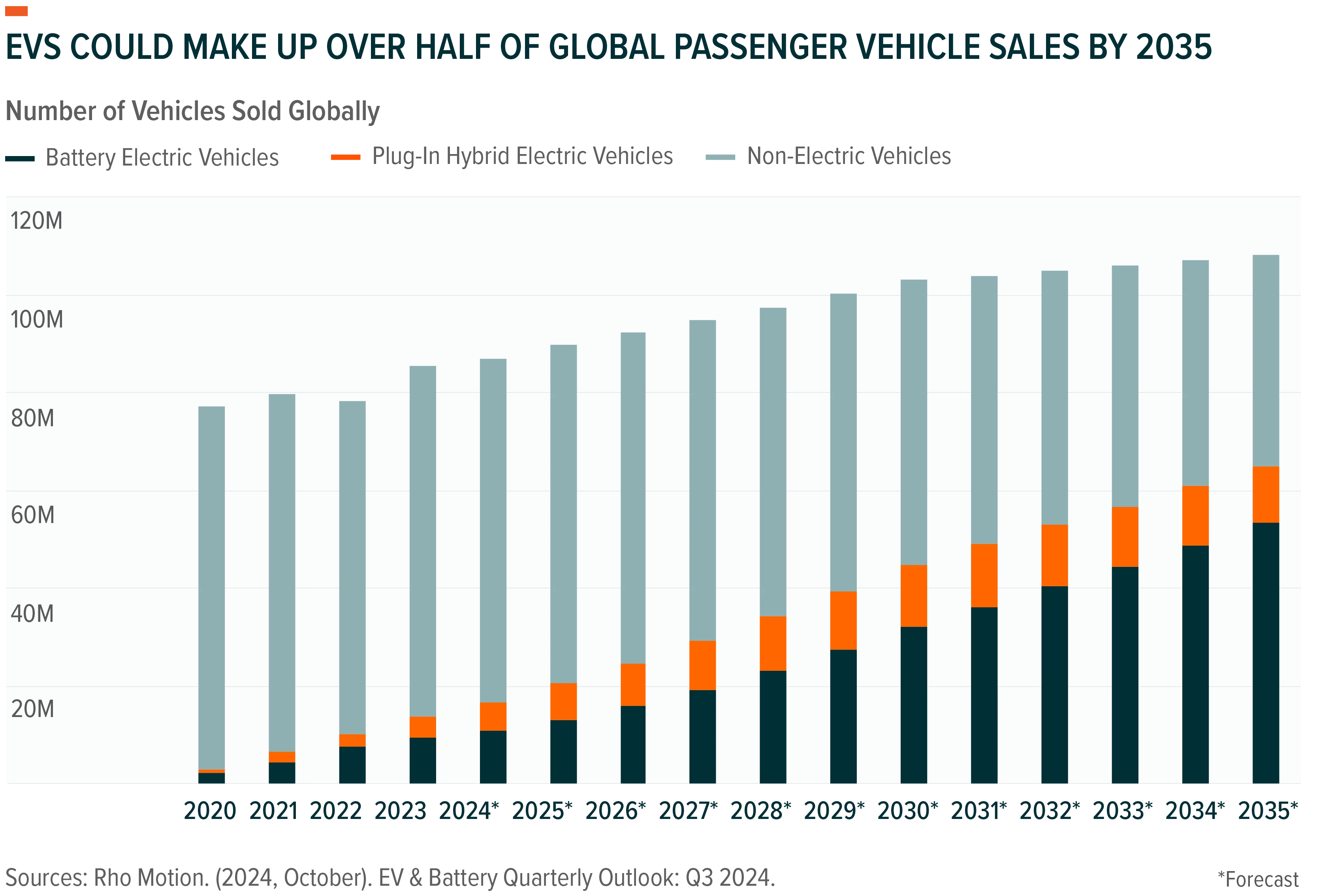
EVs Could Be the Dominant Technology in the Light-Duty Segment by the Mid-2030s5
As the future of mobility becomes increasingly electric, the market share for EVs in the light-duty vehicle segment could grow from an estimated 20% in 2024 to more than 63% by the middle of the next decade.6 At the regional level, China is expected to remain the country with the highest penetration rates for electric vehicles. By 2030, nearly three in every four vehicles sold could be electric.7 However, other major auto markets, including the United States and European Union, could also experience strong EV market share growth.8
These growth outlooks are supported by a range of factors. First, supportive government policies remain a primary tailwind for EV automakers in many countries, particularly in China and throughout the European Union. Most notably, in April 2024, China introduced a vehicle trade-in policy to encourage further uptake of EVs.9 In H2 2024, China recorded five straight months with greater than 1 million EV sales, which was widely attributed to the program.10,11 As a result, the government renewed the subsidy program for 2025 and expanded the pool of old vehicles that qualify.12
Additionally, many automakers continue to work towards more electrified line-ups. For instance, to counter a slowdown in pure EV adoption in markets like United States and the EU, some automakers such as Toyota and Ford have shifted focus temporarily towards more hybrid EVs.13,14 In our view, hybrid vehicles can act as a bridge towards the broader electrification of the transport industry.
Third, many automakers still plan to introduce more affordable BEV models to the market in the next couple of years, which could further catalyze the market. Kia, Stellantis, Chevrolet, Tesla, and Ford are among the automakers that are expected to introduce vehicles with a starting price under $35,000 to the U.S. market.15 The introduction of more affordable models in the United States and Europe is widely viewed as an essential next step for the EVs to reach a higher market share.
Battery producers and automakers are also making strides in integrating next-generation batteries and enhancing vehicle efficiency, which could improve the performance of electric vehicles and help the industry overcome barriers to widespread adoption. For example, in 2024, Toyota, QuantumScape, Honda, and Hyundai were among the companies that announced major milestones on the journey towards the mass commercialization of next-gen solid-state EV batteries.16,17,18,19 Possible benefits of solid-state batteries include faster charging capabilities, higher range, and improved safety, all of which could help address continued concerns from potential buyers over range and safety.20
Additionally, extended-range EVs (EREVs), a hybrid EV system that can be more environmentally friendly than conventional hybrids, could help electrify SUVs and pickup trucks while removing price barriers and alleviate concerns over range.
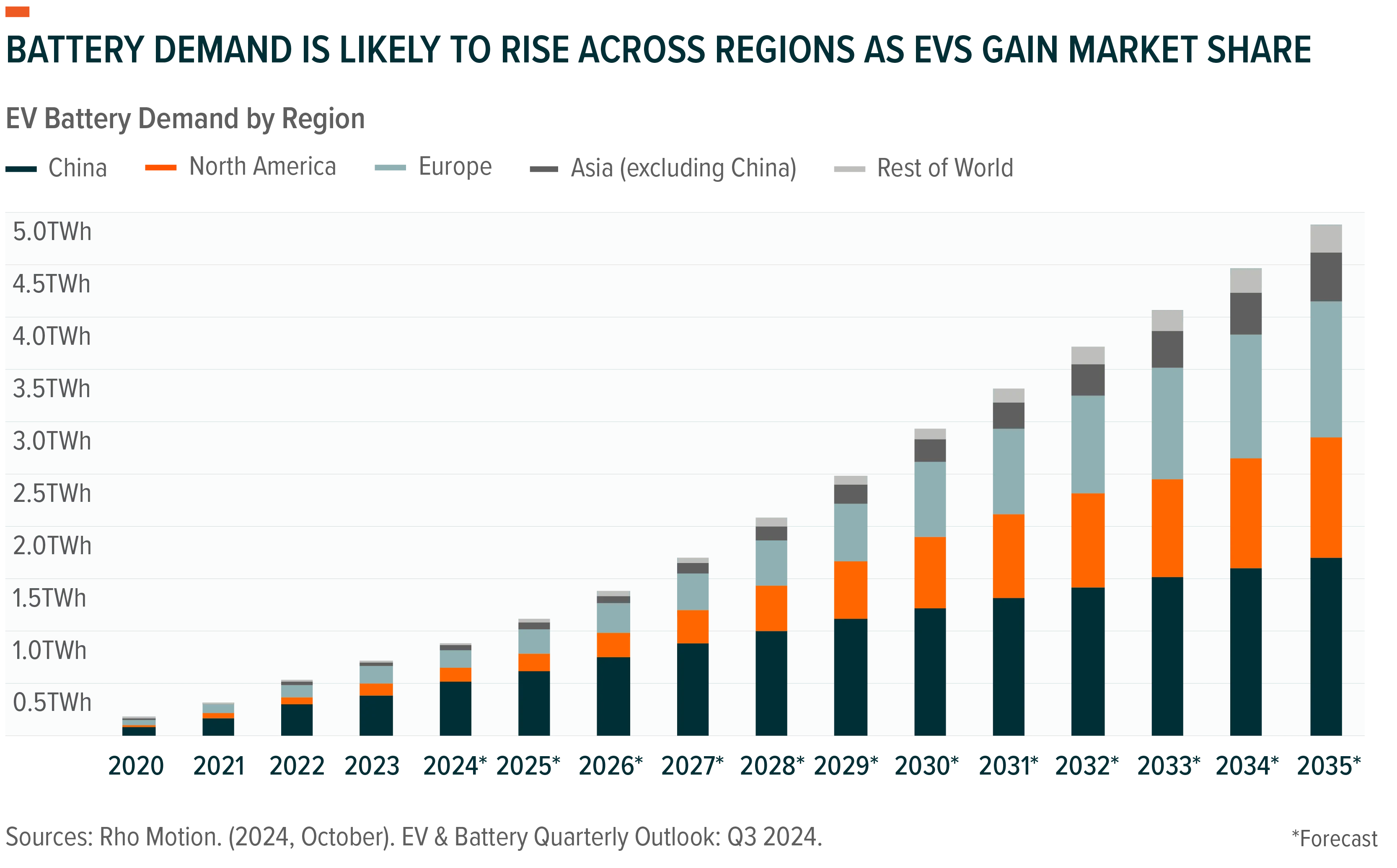
EV Battery Demand Is Expected To Increase Significantly As Transport Becomes More Electric
EV battery demand is forecast to grow nearly 5x from 884GWh in 2024 to 4.88TWh by 2035 as EV use rises globally.23 China is expected to remain the leader in both EV battery demand and production capacity.24 However, companies are also investing in gigafactories in Europe and North America to help meet projected demand within those regions and gain broader access to supportive policies and rising demand for both EV and energy storage battery solutions.
Growth in EV battery demand could also boost demand for several minerals. Global copper demand from EVs could grow 8x between 2023 and 2035, while lithium, nickel, and manganese could experience 9x, 7x, and 16x growth over the same period.25 The graphite, cobalt, and rare earths mining industries are also projected to experience added demand from the electric vehicle transition.26 Across all EV-related minerals, demand is forecast to increase from under 2,000 kilotons in 2023 to over 12,000 kilotons by 2035.27
Mineral supplies may not be able to keep up with demand as electrification gains pace, and the lithium and copper industries face some of the highest risks for supply shortfalls that could materialize within the next decade.28 For example, EVs are expected to remain the largest end-use segment for the lithium industry, and total global lithium demand is forecast to increase from 1.3MMt in 2024 to 3.3MMt in 2030.29 While the lithium industry faces difficult market conditions with an oversupply in early 2025, the long-term outlook points to the potential for robust growth opportunities.
Conclusion: No Longer a Niche Segment Within the Transportation Sector
The long-term EV growth outlook remains positive due to structural tailwinds such as government policies, automaker investments, and technology advancements. The introduction of more affordable models could help automakers overcome some of the challenges that the EV industry has been facing over the past year. Additionally, progress in battery technology and powertrain optionality from automakers could further help boost adoption. As the transport industry becomes more electric, companies throughout the EV value chain are positioned to potentially benefit.
