
The stars aligned for preferred securities over the first ten months of 2024, with credit quality improving, investors seeking to extend duration, and technicals acting as a tailwind to drive performance of the asset class past most other investment grade fixed-income instruments.1 The upward trajectory has been shaped by sentiment surrounding the path of interest rates, most notably as it pertains to longer-duration exchange-traded preferreds. However, gains originally stemmed from the market pricing in expectations for an aggressive stretch of monetary easing and were nurtured further by its reaction to a long-rumored economic slowdown within the United States that ultimately failed to materialize. The environment has represented somewhat of a Goldilocks zone for preferred securities in 2024, and if inflation remains contained, preferreds could offer appealing returns moving forward, as well.
Key Takeaways
Against a nearly ideal backdrop for growth, there are an array of factors to credit for the gains experienced by preferred securities over the last year. Most emphatic, however, were likely duration exposure and tight credit spreads, which reacted positively to falling interest rates and healthy U.S. economic activity.
Although the path of interest rates may remain a narrative worth monitoring moving forward into 2025, tamed inflation and its influence over credit may be the biggest key to preferreds maintaining their upward trajectory.
The fluidity of interest rates has been on display in recent months, after the yields on long-term instruments in fact moved higher in the aftermath of the Federal Reserve’s (Fed) September cut. This may open the door for investors in fixed-rate preferreds to take advantage of a higher income opportunity, while floating-rate securities might also help account for interest rate volatility.
Preferred Securities Are Receiving Widespread Support
Representing the top-performing fixed-income asset class over the first 10 months of 2024 across nearly all investment grade and high yield segments, preferreds have benefitted materially from falling inflation, monetary easing, and strong economic activity.2 In this environment, rate sensitive sectors like financials, real estate investment trusts (REITs), and utilities have all performed well, and this has been a boon to preferreds, as they all represent arenas in which the asset class has relatively high issuer exposure. Outsized benefits experienced by these sectors in the early innings of the current rate cutting cycle helped the ICE BofA Diversified Core U.S. Preferred Index outperform the Bloomberg U.S. Corporate High Yield Bond Index year over year, on a total return basis, by 6.67% as of October 31, 2024.3 Indeed, duration exposure seems to have been the most significant factor driving preferreds’ performance.
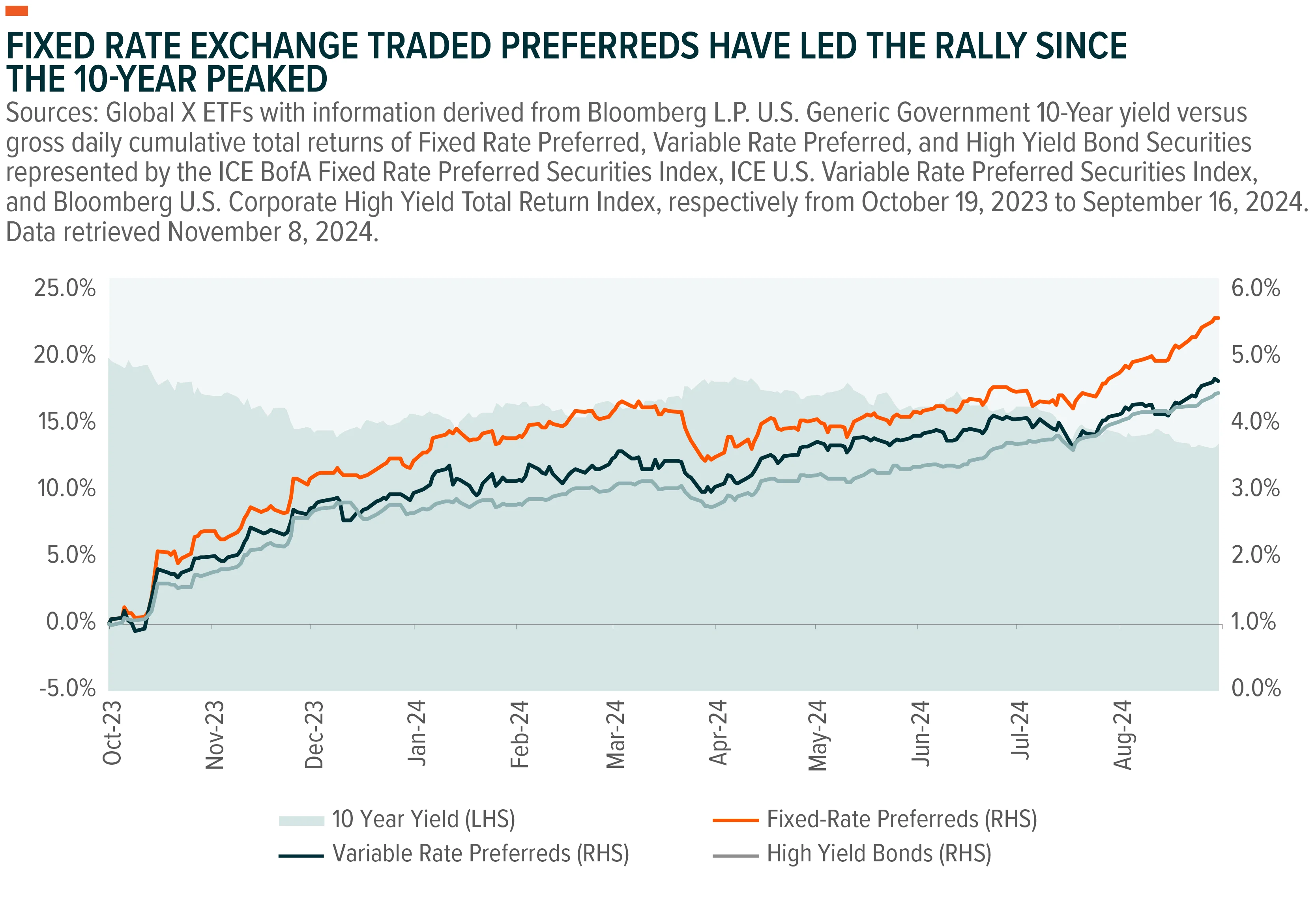
The impact that rate sensitivity has had on preferreds is most notably quantified when contrasting their performance with the relationship that they share with the yield on 10-year U.S. Treasuries. Since the yield on the 10-year Treasury peaked at about 4.98% in mid-October of 2023, it has fallen to close as low as 3.63% on September 16, 2024, just two days before the Fed initiated its rate cutting cycle.4 The decline could be attributed to the start of more-persistent easing in the Consumer Price Index (CPI), which declined from 3.7% to 2.4% from September of 2023 to September of 2024.5 Between the dates on which those results were announced, the ICE BofA Diversified Core U.S. Preferred Index rallied over 23% in a move that was spearheaded by $25 par exchange-traded retail preferreds, which carry the highest rate sensitivity within the preferreds universe.6
The Credit Environment Continues to Improve Amidst Monetary Tailwinds
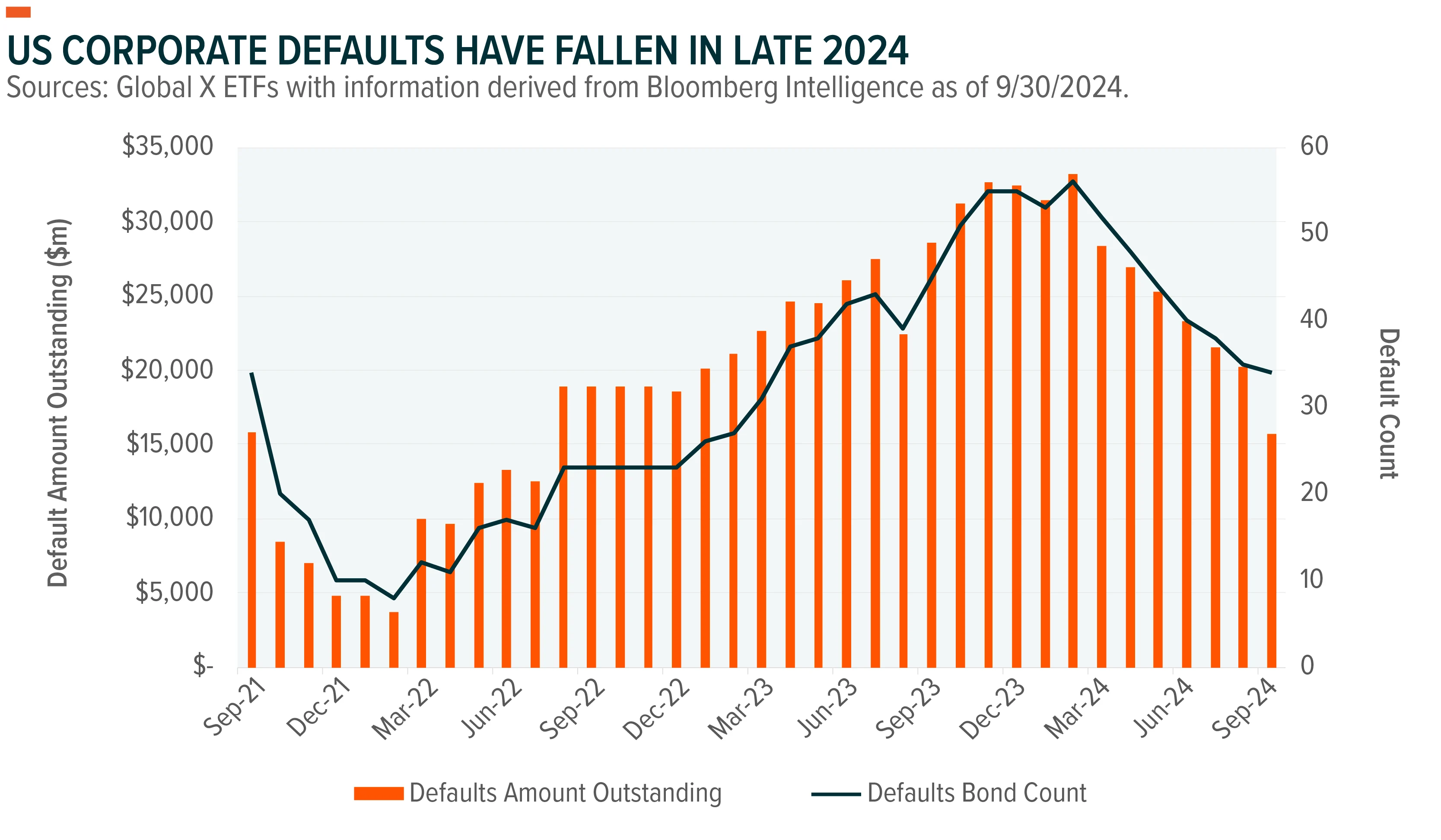
Credit has also been a major driver of preferred returns throughout 2024, with tight spreads illustrating the resilience of corporate balance sheets amid a strengthening U.S. economic climate. On October 30, 2024, the ICE BofA US High Yield Index Option-Adjusted Spread fell to 2.80, its tightest level since 2007, just prior to the start of the global financial crisis.7 This spread seemingly reflects broad optimism toward credit moving forward, as well as rising investor demand. In fact, as of September 30, 2024 total corporate defaults within the U.S. had fallen to just $15.7 billion, roughly half the value experienced at their peak in 2024 of $33.1 billion.8
Contrary to popular arguments regarding the lack of relative risk/reward, we believe that tight credit spreads may be warranted given the overall strength of the economy. Under the belief that the long-term trajectory for interest rates will move downward, the argument for maintained strength in corporate credit could be made. Preferreds issues, which are predominantly concentrated in BBB credits, may continue to offer relatively attractive yields while allowing investors to largely maintain an investment-grade exposure.
Should the Fed slow its pace of rate cuts near current levels, preferred stocks may continue to deliver competitive income returns in such a flat/moderately declining interest rate environment. Meanwhile, a moderating pace of rate cuts is unlikely to suggest significant economic strife and reduces the probability of call risk. This further supports the ability of issuers to maintain dividends while simultaneously preserving the income streams that support their distributions.
The Outlook for Preferreds Depends Upon the Path of Inflation
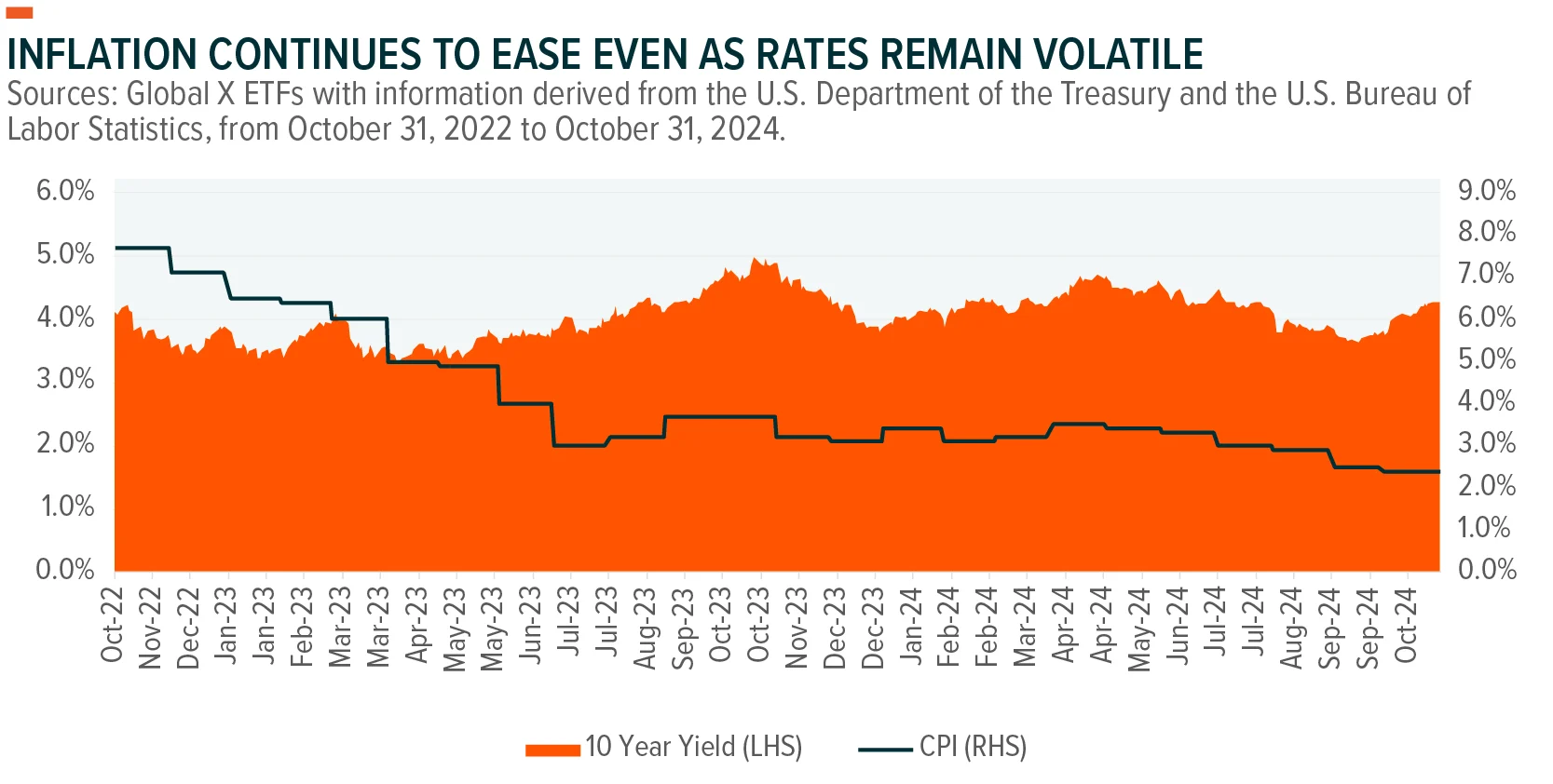
The benchmark interest rate may prove beneficial to the preferreds universe in the coming months, but the trajectory of inflation could be the even more decisive force that keeps momentum intact. So far in the 4th quarter, the 10-Year Breakeven Inflation Rate has remained largely consistent with the trends it has exhibited over the past two years.9 Notably, however, the Consumer Price Index registered a 2.4% YoY reading for September, and it has been on a gradually declining pace since June of 2022.10 This seems to paint a picture around recent interest rate volatility reflecting unwavering U.S. economic strength rather than inflation-induced spikes.
Interest rate volatility certainly remains a concern, but a combination of monetary easing and falling inflation may remain conducive to credit markets in 2025, potentially supporting performance. From our vantage, potential moves higher in long-term rates may present opportunities to acquire longer-duration assets at attractive levels. Simultaneously, inflows into preferreds ETFs have grown to nearly $2.8 billion YTD, providing a significant tailwind even as net issuance fell slightly in 2024.11 The combination of credit optimism and inflows has been supportive to the preferreds market.
Positioning Options Depend on Your Rate Outlook
Index strategies that hold exchange-traded preferreds may do well in flat-to-downward trending rate environments, as their underlying securities potentially deliver elevated income distributions. This could remain the case if the Fed continues to gradually ease interest rates. What’s more, these elevated yields offer an attractive income buffer against potential negative rate movements, while the perpetual structures and longer durations attributable to fixed-rate preferreds set them up to potentially outperform in falling rate environments.
Individuals worried about interest rate volatility, on the other hand, may be inclined to pivot toward variable rate fixed-to-floating and floating-rate structures, which feature shorter durations (closer to one year) and tend to perform better in volatile rate environments. Such variable rate preferreds are able to track movements in rates, which may help their relative performance when rates are rising, as well. Variable rate structures could potentially offer the benefits of attractive yields, wide spreads to comparable duration Treasuries, and some protection against interest rate volatility. Though we note that they carry greater reinvestment risk should interest rates fall more precipitously.
The Sweet Spot for Preferreds Could Be Wider Than Expected
The core competencies that give preferreds their appeal as hybrid securities with attractive yields have been the key drivers of their performance in 2024. Despite the dramatic gains they’ve experienced, however, it’s hard to ignore the state of the market that makes them an attractive proposition for 2025, as well. Duration has historically outperformed during periods of falling rates, and they represent an asset class that can offer competitive yields coupled with investment-grade credit exposure to potentially protect against market volatility. As the market forces that underpin this Goldilocks scenario remain intact, interest rates and credit may continue to support the growth potential of preferred securities.
