


Product ResearchEquity Income StrategiesOptions
Qualified Dividend Income: Edging Out Bond Interest When it Comes to Taxes
G
Global X Research
Mar 14, 20256 min read
Get the latest news and updates from our team.
Copyright © 2026 Global X. All rights reserved.
Global X Research
Global X Research
SEI Investments Distribution Co. (1 Freedom Valley Drive, Oaks, PA, 19456) is the distributor for the Global X Funds.
Check the background of SIDCO and Global X's Registered Representatives on FINRA's BrokerCheck.
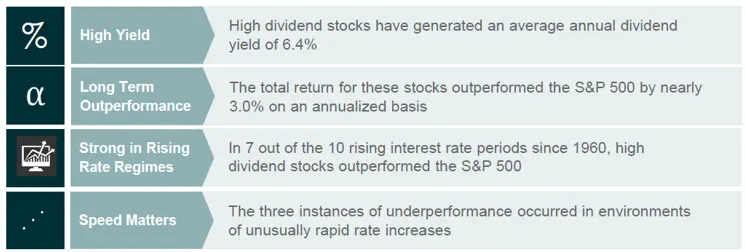
With the Fed expecting to continue to raise rates over the next few years, many investors are eager to understand how high dividend yielding stocks may react. We’ve prepared an analysis based on the performance and behavior of the highest decile1 of dividend paying stocks from 1960 to 2017.
Key Findings Include:
The full report on High Dividend Stocks in Rising Rate Environments can be explored here.
1. Deciles are ten tiers of stocks based the ranking of a common characteristic. For this analysis, all stocks in the considered universe are ranked by dividend yield and those in the 90th percentile or higher are included in the highest, or 10th decile. Stocks in the 80th to 90th percentile range are included the 9th decile, and so on. Stocks with the lowest dividend yields are in the 0th to 10th percentile range and are included in the lowest, or 1st decile.
Sources
Portfolio returns sourced from Fama and French Portfolios Formed on Dividend Yield, where all stocks listed on NYSE, AMEX, and NASDAQ have been considered. Stocks have been segregated into 10 portfolios (deciles) based on dividend yield (D/P).
Rising interest rate regimes sourced from the US Federal Reserve, defined as periods where the yield of 10 Year US Treasuries increased by more than 100 basis points over a period of 10 months or longer.
Dividend-paying equities and preferred stocks can help mitigate portfolio volatility and their distributions may receive favorable tax treatment versus bonds.
Dividend-paying equities and preferred stocks can help mitigate portfolio volatility and their distributions may receive favorable tax treatment versus bonds.
Many investors expect a soft landing, but adopting a defensive strategy may be prudent, as the risk of additional volatility could be underestimated.
Many investors expect a soft landing, but adopting a defensive strategy may be prudent, as the risk of additional volatility could be underestimated.