



Product ResearchSemiconductorArtificial Intelligence
Memory Is the New Bottleneck in AI Semiconductors
I
Ido Caspi
Mar 23, 20267 min read
Get the latest news and updates from our team.
Copyright © 2026 Global X. All rights reserved.
SEI Investments Distribution Co. (1 Freedom Valley Drive, Oaks, PA, 19456) is the distributor for the Global X Funds.
Check the background of SIDCO and Global X's Registered Representatives on FINRA's BrokerCheck.
Ido Caspi
This piece is part of a series that dives deeper into the most prevalent themes of this year’s iteration of our flagship research piece, Charting Disruption. This feature focuses on robotics, as part of a larger section on Paradigm-Shifting Technologies, exploring a variety of innovations in this space. For additional insights from the project, please click here.
The real-world application of artificial intelligence hinges on robotics. In manufacturing, robotic systems can address labor shortages while ensuring precision production, enabling trends such as reshoring of manufacturing to the western hemisphere. In the services sector, robotic systems can tackle rote and repetitive tasks, freeing human workers to focus on higher-value responsibilities. In healthcare, for example, surgical robots enhance precision, improve efficiency, and drive better outcomes for patients.
The next transformative leap in robotics may come from humanoid robots. Advancements in AI algorithms, more efficient chips, and improved sensors are accelerating this breakthrough technology. As these technologies evolve, humanoid robots could become seamlessly integrated into everyday life. By 2036, cumulative sales of humanoid robots could approach 100 million units.1
Robotics is central to the application of AI to the real world. Advancements achieved in AI in the last few years should help unlock new robotics use cases across industrial and services sectors.
Industrial applications of robotics, particularly to manufacturing, stand to benefit from growing labor costs in the U.S. as well as growing demand from precision industries such as semiconductor and EV manufacturing.
An inflection point in robotics may emerge when humanoid technology development speeds up and sees broader adoption.
The use of robotics in industry dates to the 1950s, when industrial robots were used for simple tasks such as printing, welding, and assembly.2 With the advent of microchips and software, the capabilities of fixed robotic setups transformed dramatically, making them faster, more precise, and programmable. This evolution not only enhanced their performance but also broadened their range of applications across various industries and smaller scale production.
Today, with the availability of sophisticated AI algorithms, more powerful chips, improved sensors and actuators, and a deeper understanding of electro-mechanical systems, the capabilities of industrial robots have advanced significantly.
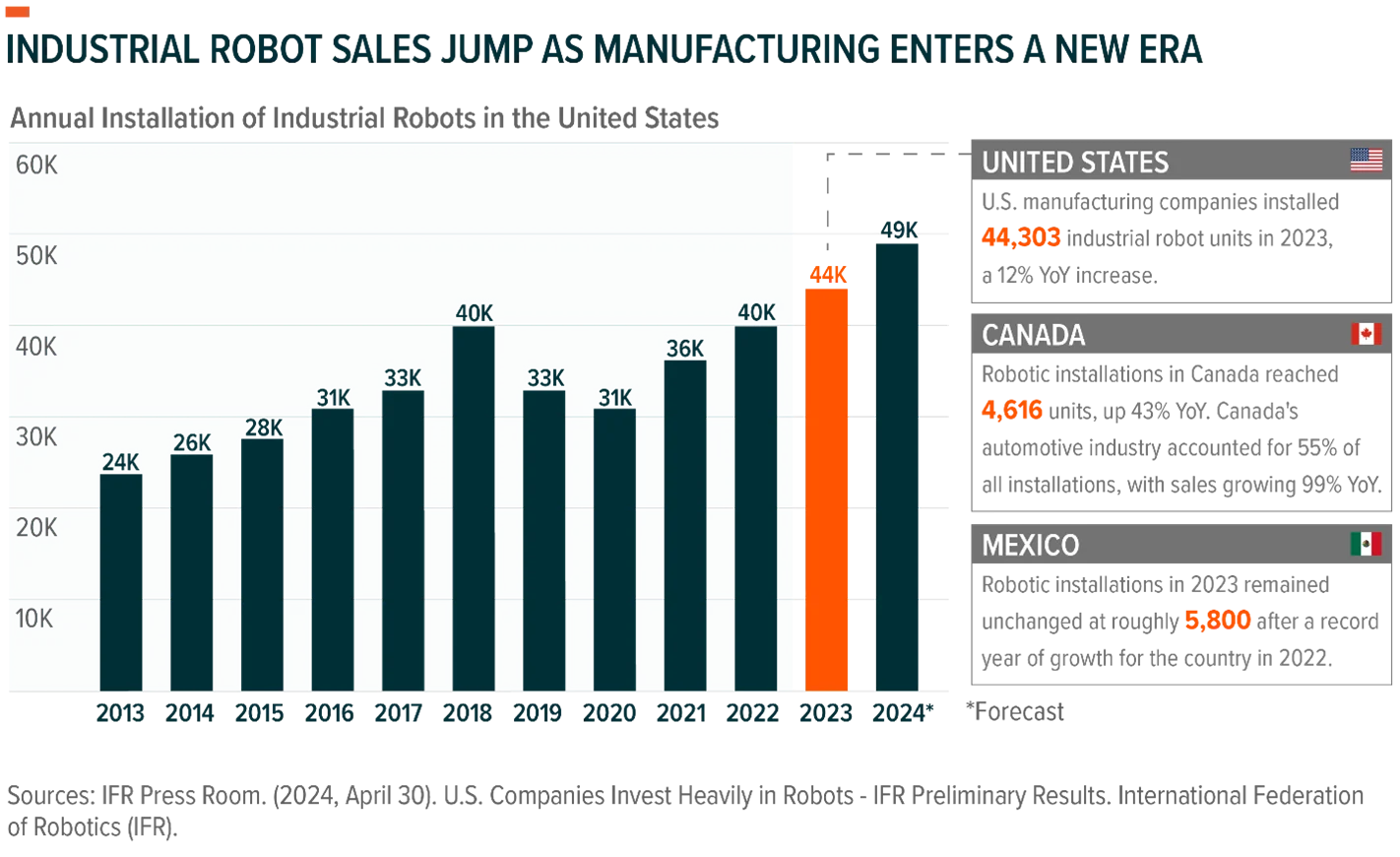
This has also spurred their adoption and use. In 2023, global manufacturers installed nearly 4.3 million industrial robots, marking 10% year-over-year (YoY) growth.3 Demand is particularly strong in markets like North America, supported by catalysts such as reshoring of manufacturing. For example, manufacturers in the United States installed 44,303 industrial robots in 2023, reflecting a 12% YoY increase.4 Canada saw even stronger growth, with 4,616 units installed—a 43% YoY jump—primarily driven by the automotive sector.5
Amidst reshoring, manufacturers also favor robotics as the solution to tackle the dual pressures of rising labor costs and maintaining production cost parity. In the United States, manufacturing wages increased nearly 4% in 2023, making it challenging for companies to produce locally while sustain unit economic advantages associated with globally outsourced production.6 By 2030, U.S. manufacturing wages are expected to grow even higher, by roughly 35% compared to 2023 levels.7
Moreover, investments targeted at reshoring precision-heavy industries such as electronics goods, semiconductors, and automotive further necessitate the adoption of advanced robotic systems to ensure quality and price parity. These sectors demand exacting production standards that only state-of-the-art robots can reliably meet.
Lastly, the cost of deploying industrial robots is also rapidly coming down, with a nearly 25% decline in the last decade due to advances in sensors, software, and hardware.8 Declining prices could make this technology even more accessible.
Unlike industrial robotics, where robot usage can be confined to a fixed range, robotics applications in the services industry must be far more versatile. Robots operating in environments such as retail services or entertainment venues need to be both adaptive and safe to function effectively around humans. This puts a high barrier for acceptance, requiring near-perfect engineering of robotic technology.
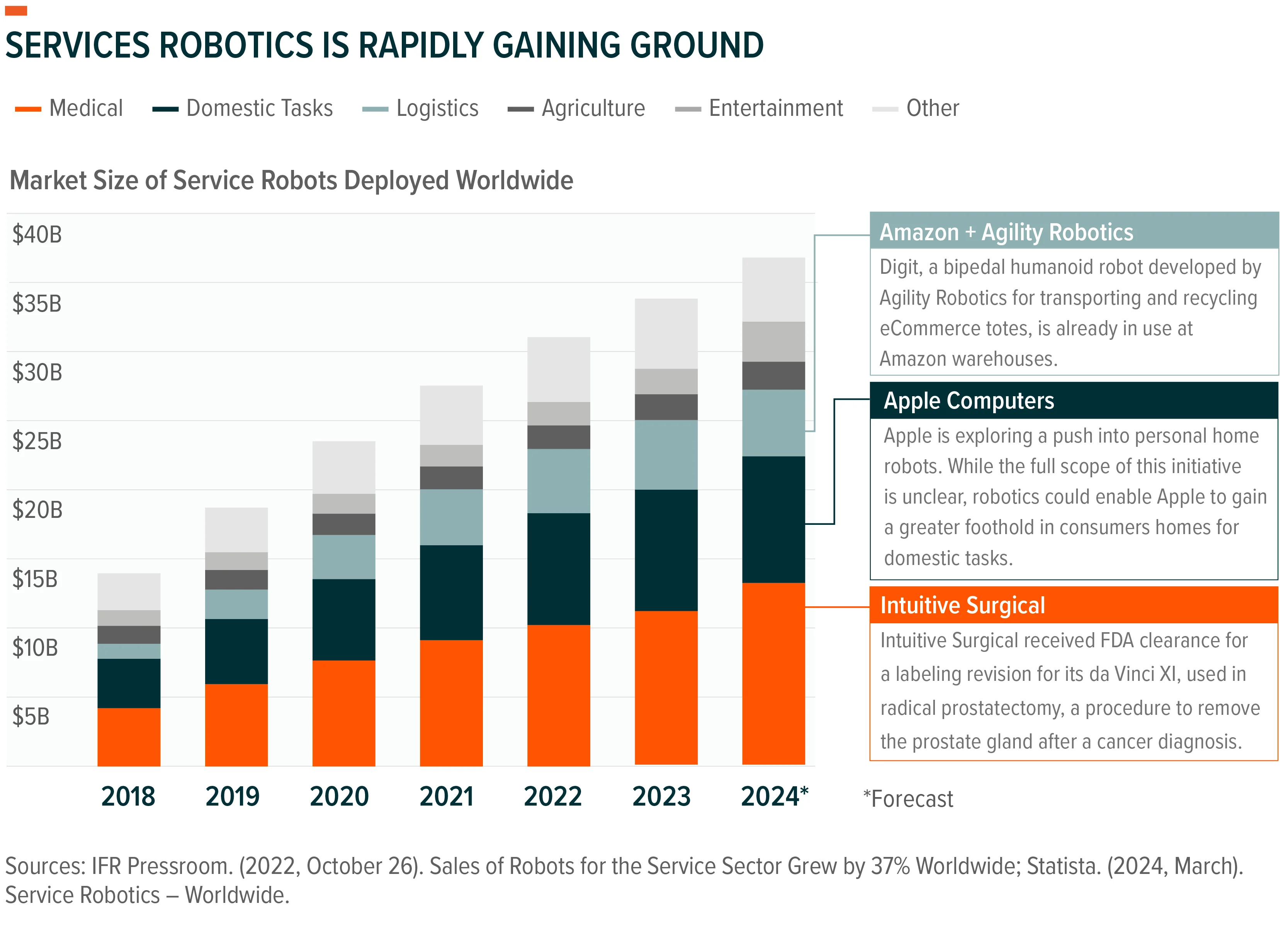
However, recent technological advancements and development of robotics across growing use cases promise progress. In healthcare, robots are seen playing a growing role as assistants to surgeons, adding precision and reliability to surgical procedures. Intuitive Surgical, a pioneer in surgical robotics systems, most recently disclosed nearly 2.2 million surgeries conducted on its da Vinci surgical systems in 2023, which grew 22% year over year (YoY) and highlighting growing use of such technologies.9
In logistics and transportation, the use of robots in well-defined indoor and outdoor geographic spaces enables e-commerce companies to operate more efficiently. Amazon operates nearly 750,000 robots across its operations worldwide - roughly one robot for every two employees.10 The robots help the company stay productive amidst turnover rates as high as 150% annually in its warehouses.11 Walmart’s warehouses, for their part, have been getting a boost from robotic fork-lifts.12
Similarly, the restaurant sector, , can benefit from robotics in counter work, order serving, food preparation, and even security.13 As of 2022, only one service robot is engaged per 1,500 restaurants globally, suggesting growth potential.14
Factors such as safety and ability to work alongside humans prolong the adoption curve for services robots, but we see steady expansion of the technology playing out this decade, benefiting the broader automation theme.
Our physical environment is designed primarily for humans. Naturally, robots taking humanoid form could find it much easier to function effectively around us. Human-like shape is also anticipated to enhance social acceptance of robots, making it easier to integrate robotics into domestic applications.15 For these reasons, the arrival of humanoids could mark a key inflection point for robotics.
Advancements achieved in AI, particularly in making AI interact with humans through technologies like large-language models, bring us closer to this reality. Technological progress has also attracted capital support. For example, there has also been a noticeable uptick in private funding targeted towards humanoid development in 2023 and 2024.16
The market for humanoids could easily surpass fixed robots as industrial and domestic use cases emerge. In industries, humanoids could surpass collaborative robots (co-bots) by handling more complex tasks—ranging from heavy lifting to adapting to varied work environments, delivering unmatched flexibility and driving significant productivity gains. At home, humanoids could revolutionize daily life by assisting with tasks such as cleaning, cooking, and caregiving.
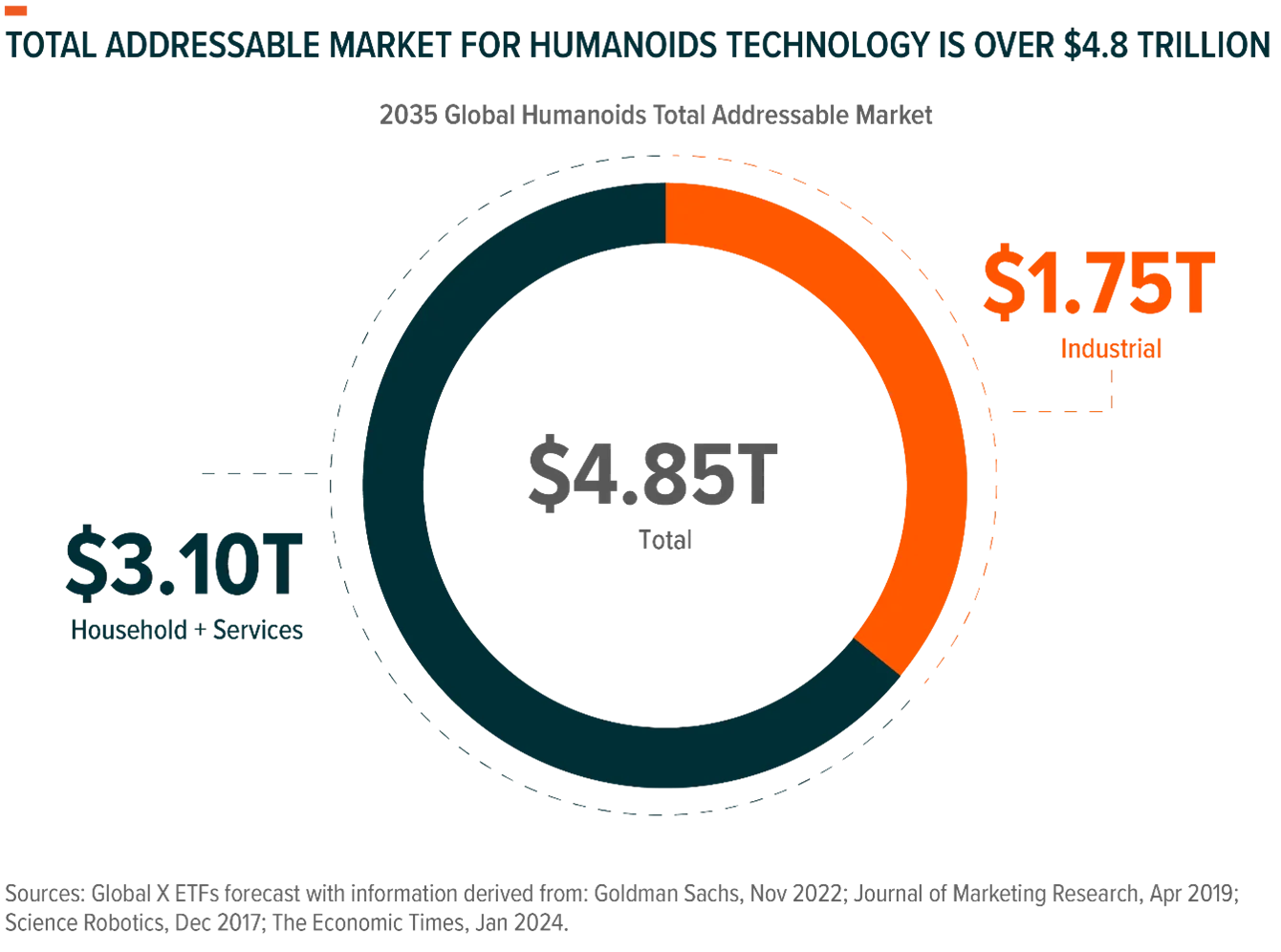
By 2036, humanoid sales are projected to approach 100 million cumulative units.17 The trajectory of humanoid technology may well mirror the rise of automobiles in their earliest days, marking the beginning of a profound technological shift. Across industries and domestic applications, humanoids could address a $4.8 trillion market by 2035.18
Robotics is key to bringing AI into the physical world. As AI becomes more advanced, affordable, and accessible, automation will grow faster. Parallelly, short-term industrial catalysts such as demand for greater precision, efficiency, and flexibility are only expected to strengthen, allowing the technology capital and resources to expand. The industry’s most profound disruption yet will likely come with humanoid robots, which are set to reach a tipping point by 2030, transforming how we live, work, and operate our economy. As this interconnected innovation unfolds, we believe the automation and AI theme is a growing opportunity for investors looking for disruption.
1. Global X ETFs forecast with information derived from Wevolver. (2020, September 23). A history of industrial robots.
2. Ibid.
3. Ibid.
4. IFR Press Room. (2024, September 24). Record of 4 million Robots in Factories Worldwide.
5. American Machinist. (2024, May 1). Automakers Still Lead Demand for Automation.
6. Ibid.
7. FRED Economic Data. (2024, November). Average Hourly Earnings of All Employees, Manufacturing. Accessed on December 12, 2024.
8. Global X ETFs with information derived from: FRED Economic Data. (2024, November). Average Hourly Earnings of All Employees, Manufacturing. Accessed on December 12, 2024.
9. Global X ETFs with information derived from: Klump, R., Jurkat, A., & Schneider, F. (2021, November 1). Tracking the Rise of Robots: A Survey of the IFR Database and Its Applications. MPRA Paper No. 110390. Goethe University, Frankfurt
10. Intuitive Surgical. (2024, October 17). Q3 2024 Investor Presentation
11. Yahoo Finance. (2024, April 11). Amazon Grows To Over 750,000 Robots As World’s Second-Largest Private Employer Replaces Over 100,000 Humans.
12. Forbes. (2022, October 24). Amazon Responds To Release Of Leaked Documents Showing 150% Annual Employee Turnover
13. Toast. (n.d.). How to Help Reduce Restaurant Turnover Rates and Foster Retention. Data as of January 2024. Accessed on December 18, 2024.
14. Aaron Allen & Associates. (n.d.). Restaurant Robotics: How Robots Are Changing Foodservice. Data as of 2022. Accessed on December 18, 2024.
15. C.S. Song, Y.K. Kim. Science Direct. (2022, July). The role of the human-robot interaction in consumers’ acceptance of humanoid retail service robots.
16. Crunchbase. (2024, June 27). Robotics Startups On The Rise In 2024.
17. Global X ETFs with formation derived from: Goldman Sachs, Nov 2022; Journal of Marketing Research, Apr 2019; Science Robotics, Dec 2017; The Economic Times, Jan 2024
18. Ibid.
AI’s rapid expansion is shifting the semiconductor bottleneck from compute to memory, positioning high-bandwidth memory leaders to benefit.
AI’s rapid expansion is shifting the semiconductor bottleneck from compute to memory, positioning high-bandwidth memory leaders to benefit.