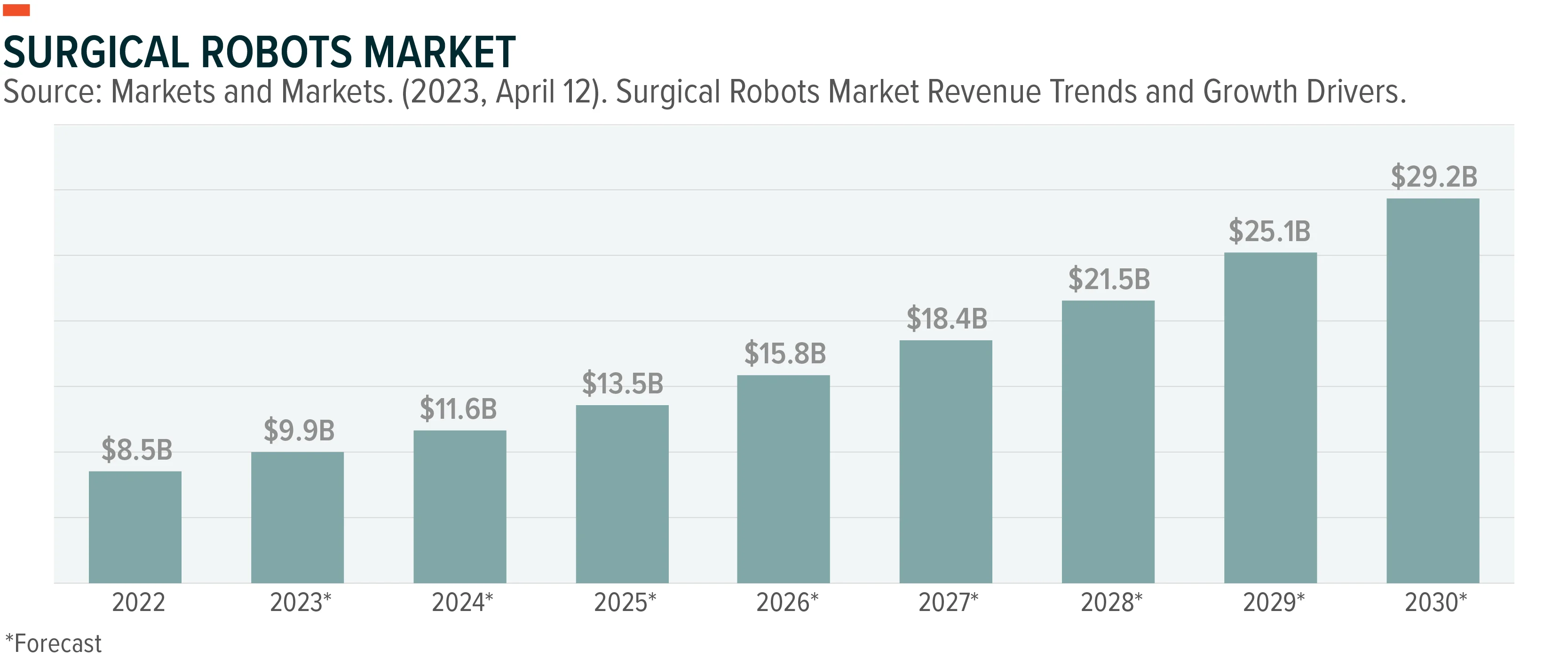
Surgical robots have been utilized for over 20 years, though improved hardware and artificial intelligence (AI) applications now allow surgical robots to assist in increasingly complex procedures.1 Further technological improvements and open payment models for surgical platforms stand to revolutionize surgical care and accelerate adoption of surgical robots, fueling what could be a $29 billion market.2 As adoption grows, we believe this will open up investment opportunities for the companies building and enabling this technology.
This piece is part of a series that dives deeper into this year’s iteration of our flagship research piece, Charting Disruption.
Key Takeaways
Surgical robots offer notable advantages over traditional surgical methods. Aided by cutting-edge hardware and AI integration, these systems are growing in popularity as they assist in increasingly complex procedures and drive improved patient outcomes.
High upfront costs have been a barrier to broader surgical robot adoption, but the Robotics-as-a-Service model has advantages for both producers and consumers and is expected to boost demand.
The surgical robotics market is expected to grow at a 17% compound annual growth rate (CAGR) through 2030, which could unlock investment opportunities for the companies building and enabling this technology.3
Surgical Robots: Background
Surgical robots represent a transformative leap in medical technology. Unlike traditional methods, where surgeons rely solely on their manual dexterity, these robotic systems integrate advanced technologies, including AI and sophisticated mechanical components. The primary objective is to enhance precision, improve outcomes, and enable minimally invasive procedures.
Robotic arms allow surgeons to operate through much smaller incisions compared to traditional open surgery and even laparoscopic procedures. Surgical robots are designed to augment the skills of human surgeons, providing them with greater control, flexibility, and access to intricate anatomical structures. These systems often consist of robotic arms equipped with specialized surgical instruments, controlled by surgeons through a console, that can maneuver within the body with a high level of precision. The systems translate the surgeon's hand movements into scaled, fluid motions, eliminating natural human tremors that can compromise accuracy.
The incorporation of AI provides real-time data analysis, helps avoid obstacles during surgery, warns of potential complications, and allows surgeons to “feel” the tissues and structures being manipulated, even during a minimally invasive procedure.
Growing Demand for Surgical Robots
The adoption of robotic surgery is expected to accelerate in the coming years. Fewer than 5% of surgeries globally are done with robots today.4 Thanks to more medical schools teaching robotic techniques and a shift in willingness to adopt new technologies, an estimated 78% of U.S. surgeons show interest in embracing robotics.5
Surgical robots cost millions of dollars, historically placing them beyond the reach of the average medical institution.6 However, new sales models, such as equipment leasing contracts, also known as Robotic-as-a-Service (RaaS), are expected to make surgical robots more accessible and help drive adoption. For example, in its latest earnings release, Intuitive Surgical noted that 48% of its total placements for its da Vinci system were operating leases.7 The benefits of RaaS are both for the hospitals and the robotic manufacturers. For hospitals, it helps avoid large upfront capital expenditures and allows facilitates to have predictable budgeting. For the companies, RaaS generates a predictable income stream while yielding higher margins than upfront sales.
Patients are also increasingly interested in robot-assisted surgeries, as they have shown to result in shorter hospital stays, smaller surgical scars, lower risk of infections, and less pain during recovery.8
The surgical robotics market is expected to grow at a 17% CAGR through 2030.9
Surgical Robots: Competitive Landscape
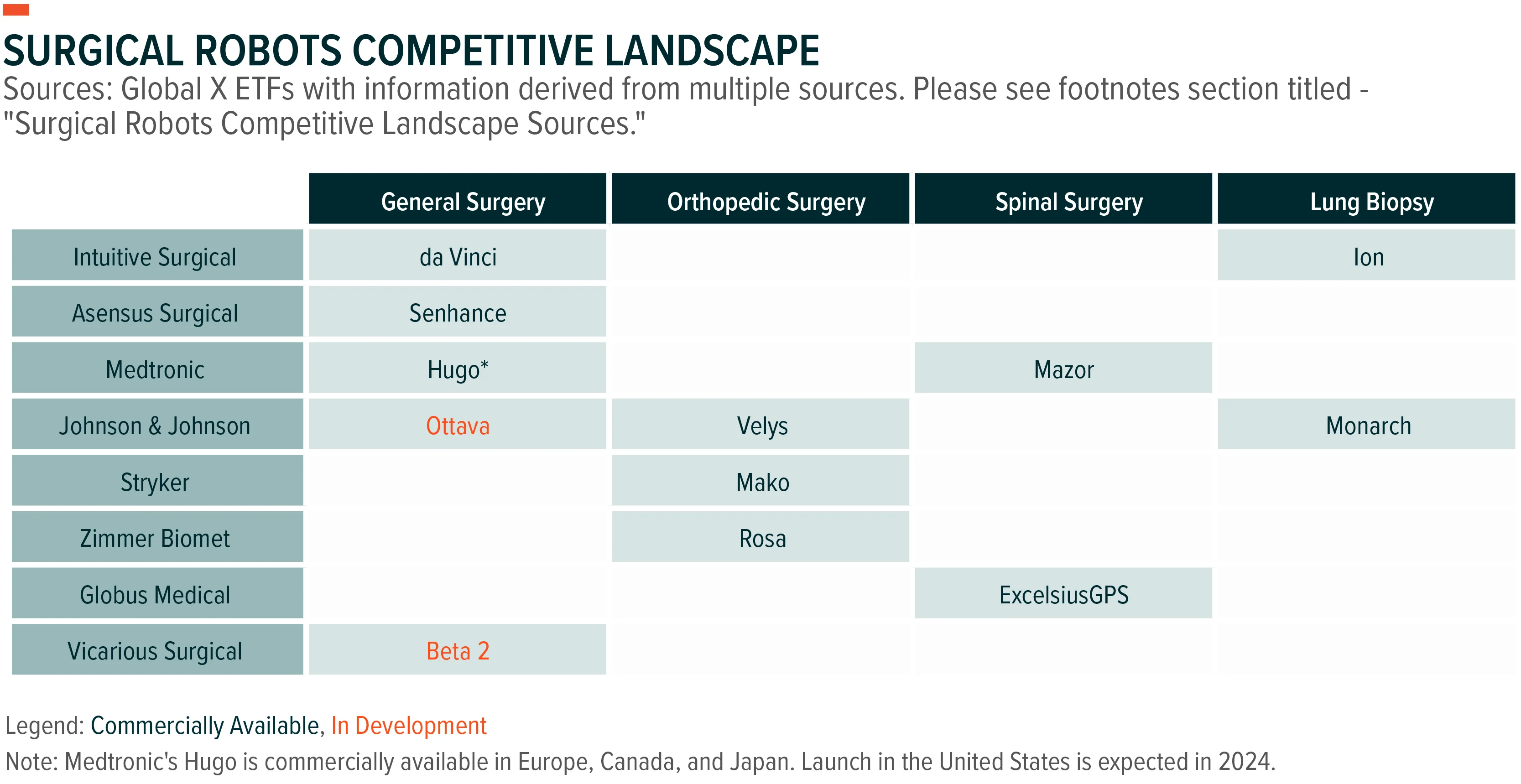
In the realm of surgical robots, the general surgery category stands as the most mature, with Intuitive Surgical leading the way. Intuitive Surgical achieved a historic milestone in 1997 with its da Vinci robot, the first surgical robot to receive FDA approval.10 This groundbreaking technology has been deployed in over 8,000 installations worldwide, facilitating more than 13 million procedures to date.11
With anticipated advancements in the field, including new releases from Medtronic and Johnson & Johnson, the number of robot-covered procedures is expected to grow significantly. Intuitive Surgical, for its part, recently revealed its next-generation surgical robot, the da Vinci 5, which has 10,000 times the processing power of the current da Vinci model.12
Recent developments in lung biopsy also point to increased conversion between diagnostic and surgical intervention, helping to engrain surgical robotics across the healthcare continuum.
Conclusion
Surgical robots are just one of the areas where the intersection of technology and healthcare continues to revolutionize patient care. Adoption of this technology is expected to surge as improved hardware and AI integration allow surgical robots to assist in increasingly complex procedures and further improve patient outcomes. Increased accessibility is another tailwind that could unlock opportunities for the companies building and enabling this technology.