SEI Investments Distribution Co. (1 Freedom Valley Drive, Oaks, PA, 19456) is the distributor for the Global X Funds.
Check the background of SIDCO and Global X's Registered Representatives on FINRA's BrokerCheck.
Content
Product ResearchEmerging MarketsBrazil
Views From the Ground: Why Brazil and Why BRAZ? 2025
x
P
Paul DmitrievSenior Investment Analyst
Apr 4, 2025·7 min read
We recently returned from a due diligence trip to Sao Paulo and Rio de Janeiro, where we conducted over 30 corporate meetings and site visits. Local investor positioning in Brazilian equities remains low, but we left optimistic on Brazil as a top contrarian idea for 2025. The current environment could present an opportunity to buy high quality companies at distressed valuations, and we believe bottom-up stock selection can be a powerful differentiator versus the benchmark MSCI Brazil Index.
Key Takeaways
We see opportunities in Brazil based on depressed valuations, a potential political shift toward more orthodox economic policies, enticing dividend yields, limited local investor equity ownership, and a potential path toward an investment grade credit rating.
The Global X Brazil Active ETF (BRAZ) offers a client friendly structure and looks beyond the benchmark in an attempt to find companies with low leverage, strong management teams, and that we believe can deliver returns above their cost of capital.
During our time in Brazil, we saw the impact of a weak currency and a government with a plummeting approval rating. However, we also saw reason for optimism and are eager to take advantage of a potential turnaround.
Why Brazil?
A Favorable Backdrop
We believe that Brazil offers an enticing backdrop for investors for four main reasons.
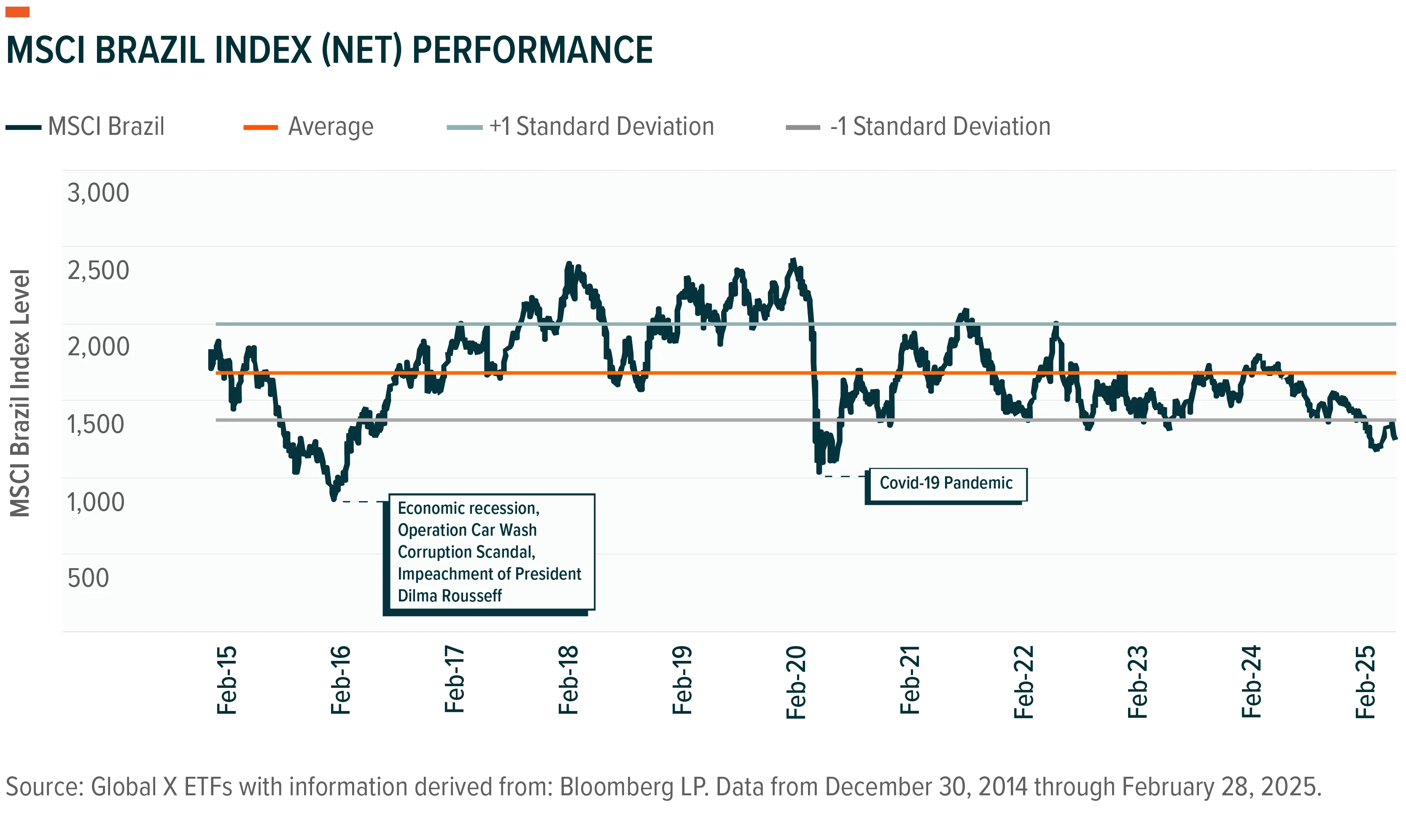
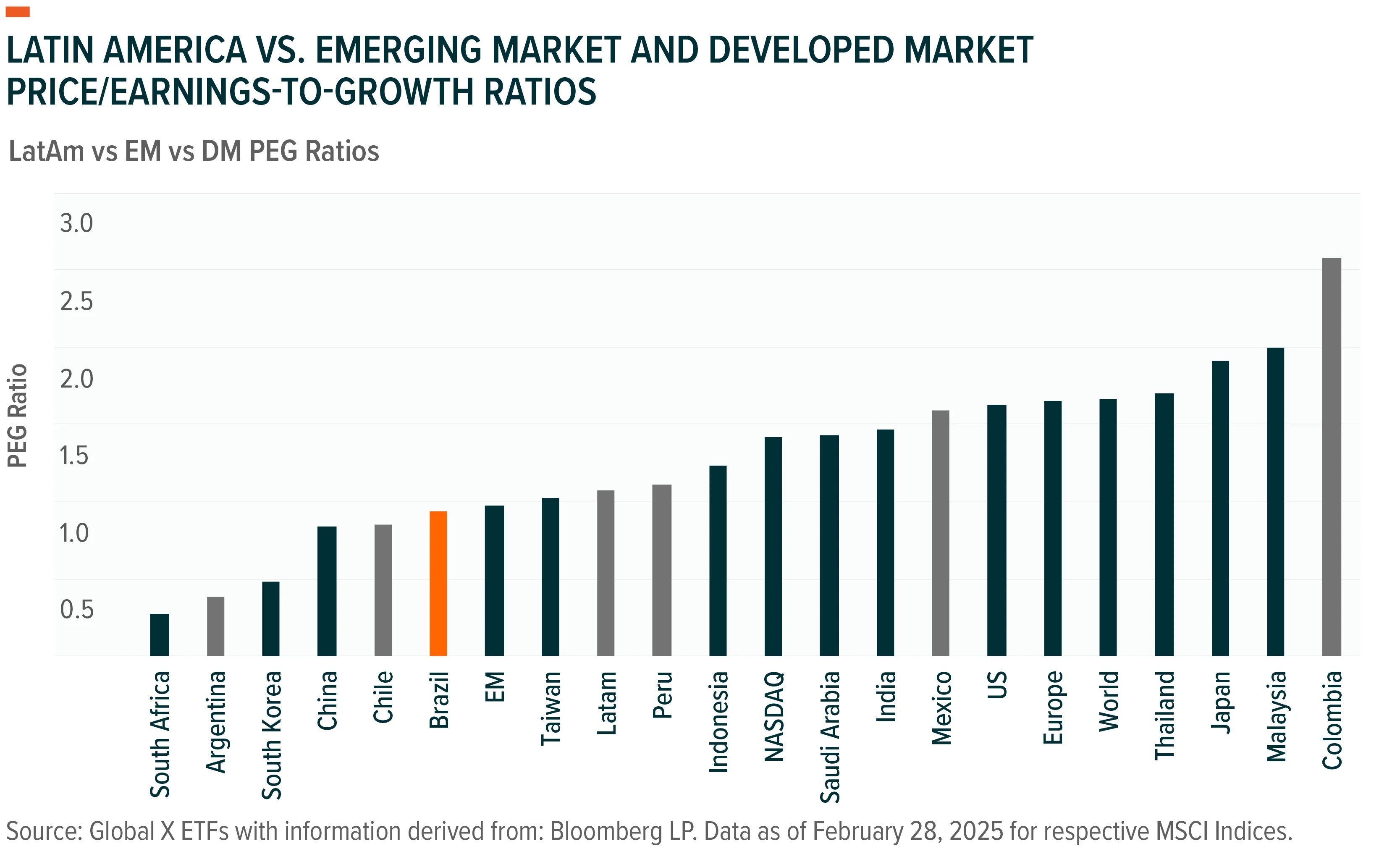
Deep Value: We see attractive valuations in Brazil, with the MSCI Brazil Index trading at a 6.7x price-to-earnings (P/E) ratio (33% and 20% below 10- and 5-year averages, respectively), reaching near Covid-19 pandemic and 2016 Brazilian crises lows.1 We view sentiment as overly pessimistic, especially given that the broad market as measured by the MSCI Brazil Index has produced 16% returns on equity (ROE) and paid a 7.6% dividend yield.2
Past performance is not a guarantee of future results.
A Top Contrarian Idea
As we wrote in our Global X 2025 EM Outlook on January 23rd, we view Brazil as a top contrarian idea. We noted that Brazil appeared to have hit peak pessimism despite an attractive backdrop of low unemployment, mid-single-digit inflation, and better-than-expected GDP data. Also, we saw the executive branch as getting in the way of the country’s potential economic strength via a lack of fiscal orthodoxy. On the bright side, we felt this backdrop could be creating an opportunity to buy high quality companies at distressed valuations, a view we continue to hold. Digging deeper, we’re focused on:
Past performance is not a guarantee of future results.
Why BRAZ?
Meeting Highlights
Conclusion
After the Battle of Waterloo, Baron Rothschild famously said, “Buy when there’s blood in the streets.” With index valuations 43% below the ten-year historical averages, investors with low exposure to equities, and a government with a plummeting approval rating, we saw the damage and are eager to take advantage of a potential turnaround.
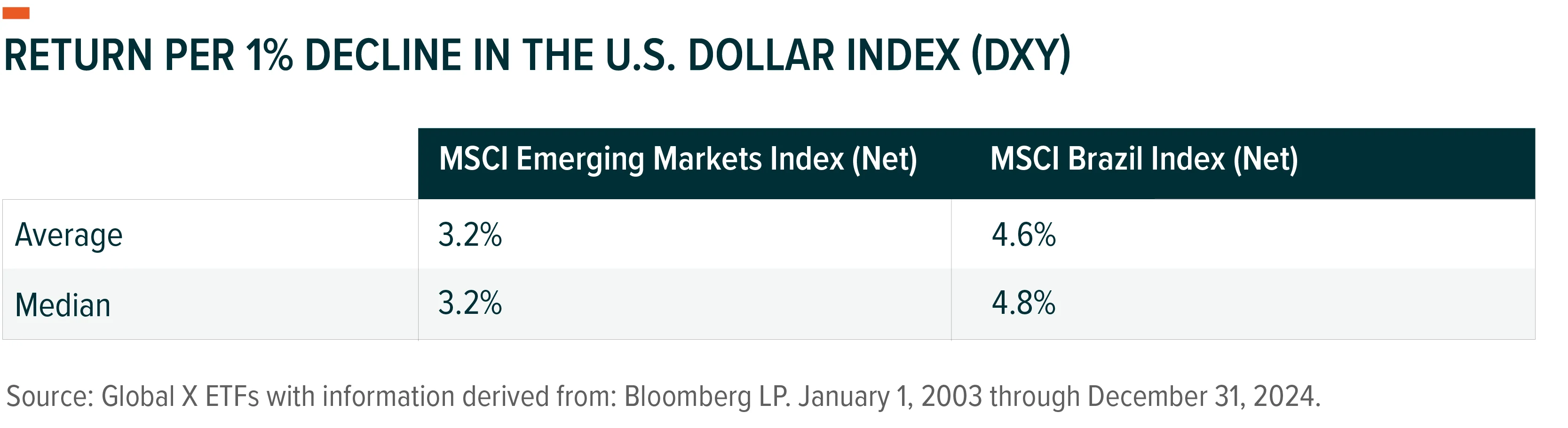
Potential U.S. Dollar Hedge: Over the past 22 years, the U.S. dollar has historically carried a strong inverse relationship with Brazilian equities, with the MSCI Brazil Index (Net) climbing over 4.5% for every 1% decline in the U.S. Dollar Index (DXY).3
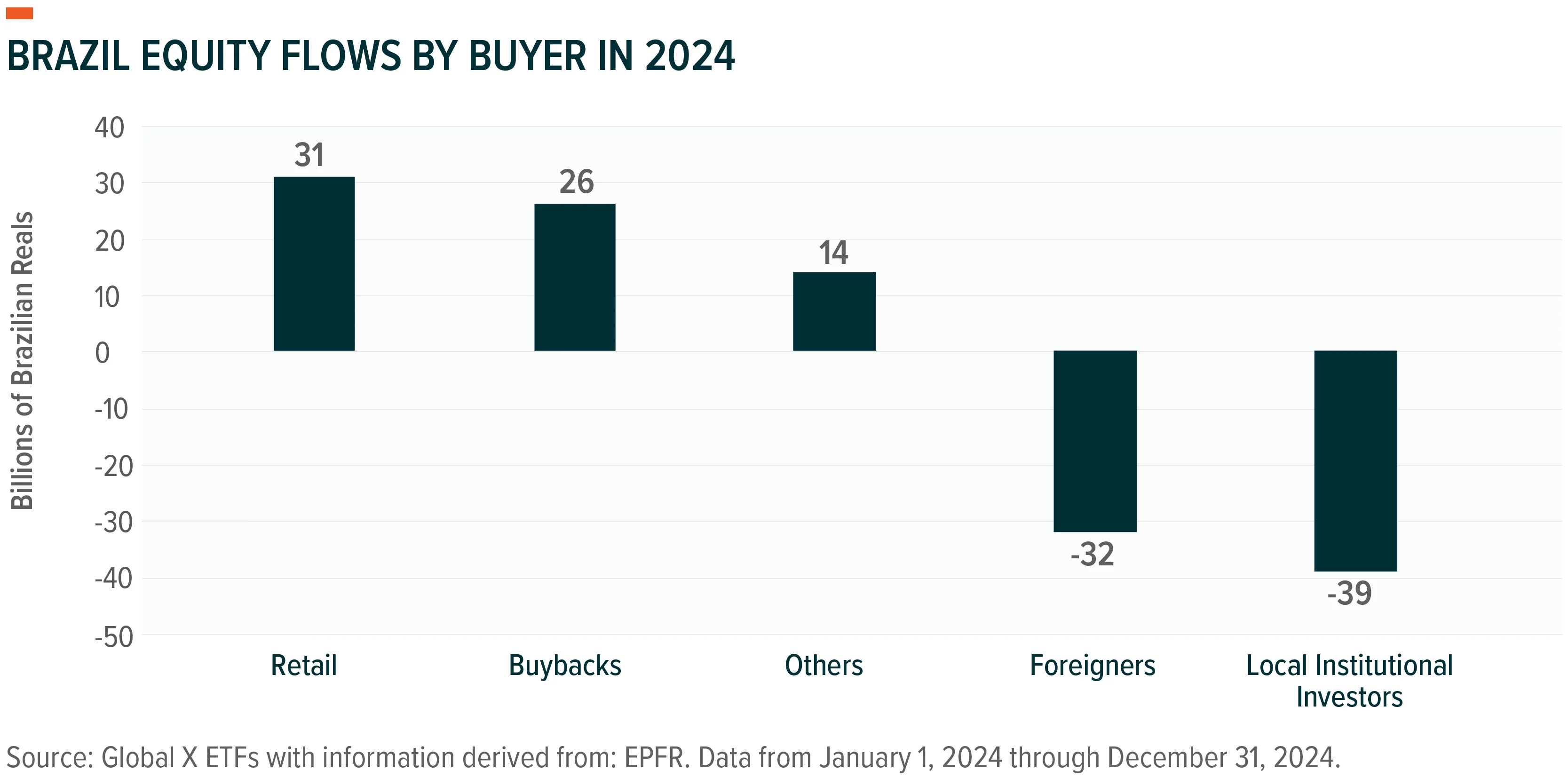
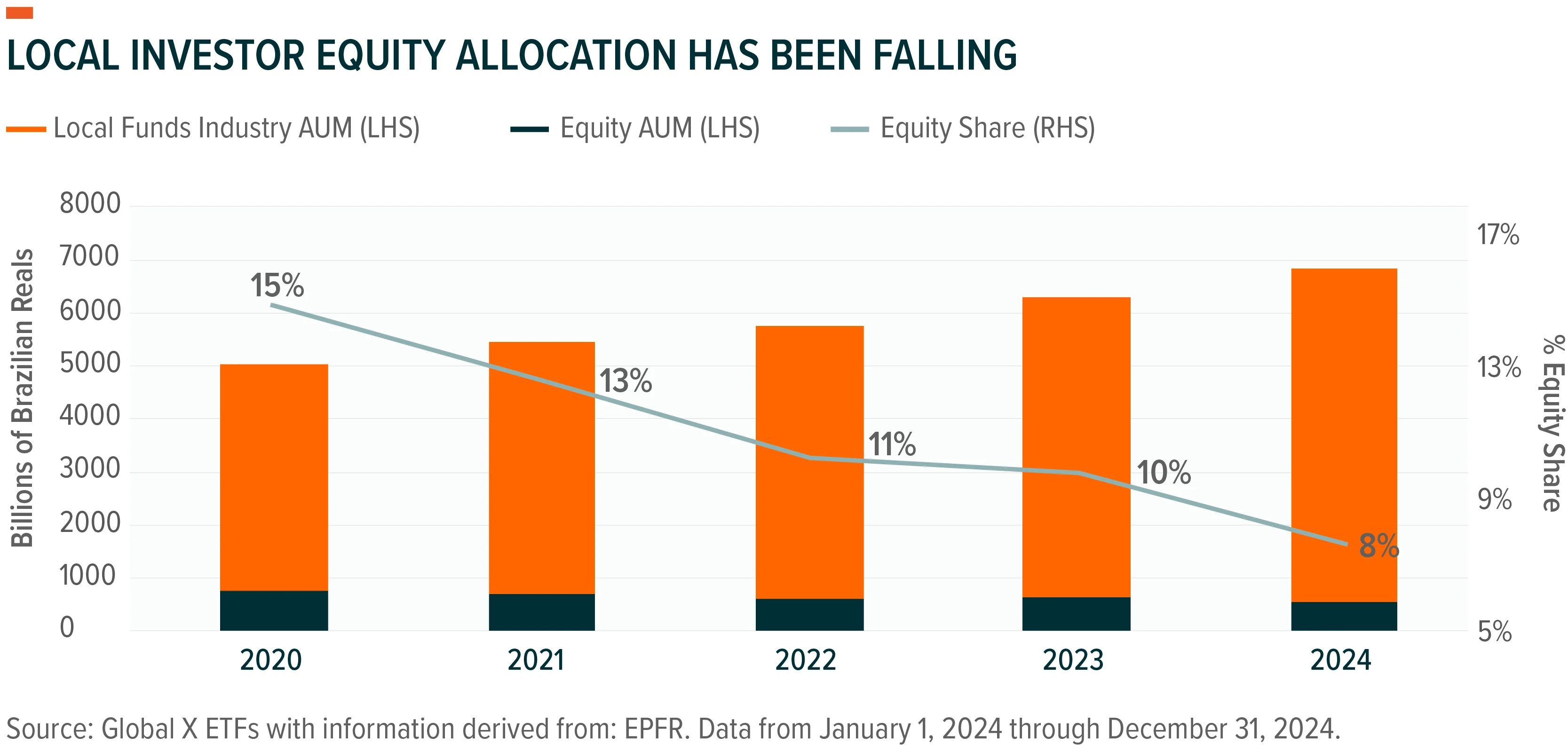
Positioning: Both local retail and foreign investors have been selling Brazilian equities, but corporate management teams are buying back shares.4 Foreign investors sold BRL32.1bn of Brazilian equities in 2024, less than the BRL39bn sold by local investors, but still more than enough to offset any retail buying (individuals) and buybacks from corporates (non-financial companies).5 Allocations to Brazilian securities also declined throughout 2024, reaching only 7.8%, lower than those seen in the 2016 Lavo Jato crisis (8.5%) during one of Brazil’s worst recessions (Lavo Jato, or Operation Car Wash, was Brazil’s largest ever corruption probe).6 Local investors have been pulling money from equities for nine consecutive months (as of January 31, 2025), with January outflows totaling BRL8.9bn.7 This could be creating an interesting entry point, as shown via the sizable pickup in corporate buybacks. While there is no guarantee they will continue, we like the idea of buying alongside management.
Reforms and a Path to Investment Grade: Over the past several years, Brazil has gone through an ambitious reform agenda that included state-owned enterprise (SOE) reform, pension reform, central bank reform, fiscal reform, and tax reform. Rating agencies are paying attention, with S&P upgrading Brazil’s credit rating to BB in December of 2023.8 Our meeting with Fitch in Brazil reinforced our belief that the country offers sizable growth potential, given its recent string of growth surprises.
Foreign Exchange as a Barometer: When currencies weaken, markets, politicians, and the average person notice. The impact of the real per USD exchange rate falling below 6 to 1in December, 2024 was brought up frequently during our visit and has often been a level where government actors begin to react.9
Elections in 2026: Although markets normally begin pricing in elections 6-12 months ahead of voting, given a lack of clear catalysts ahead, the market is likely starting to look at the October 2026 elections in Brazil. Brazil’s current President has recently gone through two brain surgeries, chemotherapy, and very low approval ratings. He will be 81 years old by the next election and it appears increasingly unlikely that the current administration will stay in office. The two other front-runners are centered politicians with orthodox economic views. Similar to what we saw in Argentina recently, we believe investors would reward the market with any signs of change.
Interest Rate Cycle: Combined with interest rates that we think will likely peak around 15% this year (possibly creating one of the strongest carry trades in the world) ahead of a potentially meaningful rate cutting cycle in the first half of 2026, we believe that the set-up for Brazil to deliver strong returns continues to improve, especially given the historical relationship between equity performance and rate cutting cycles in Brazil. When looking at Brazil’s equity performance during the previous seven completed rate cutting cycles, we have seen the MSCI Brazil Index (Net) rally in four of them and move down in three.10 Importantly, those rallies have averaged roughly 96.7% upside (cumulative), where the declines averaged only roughly 14.5% (cumulative).11
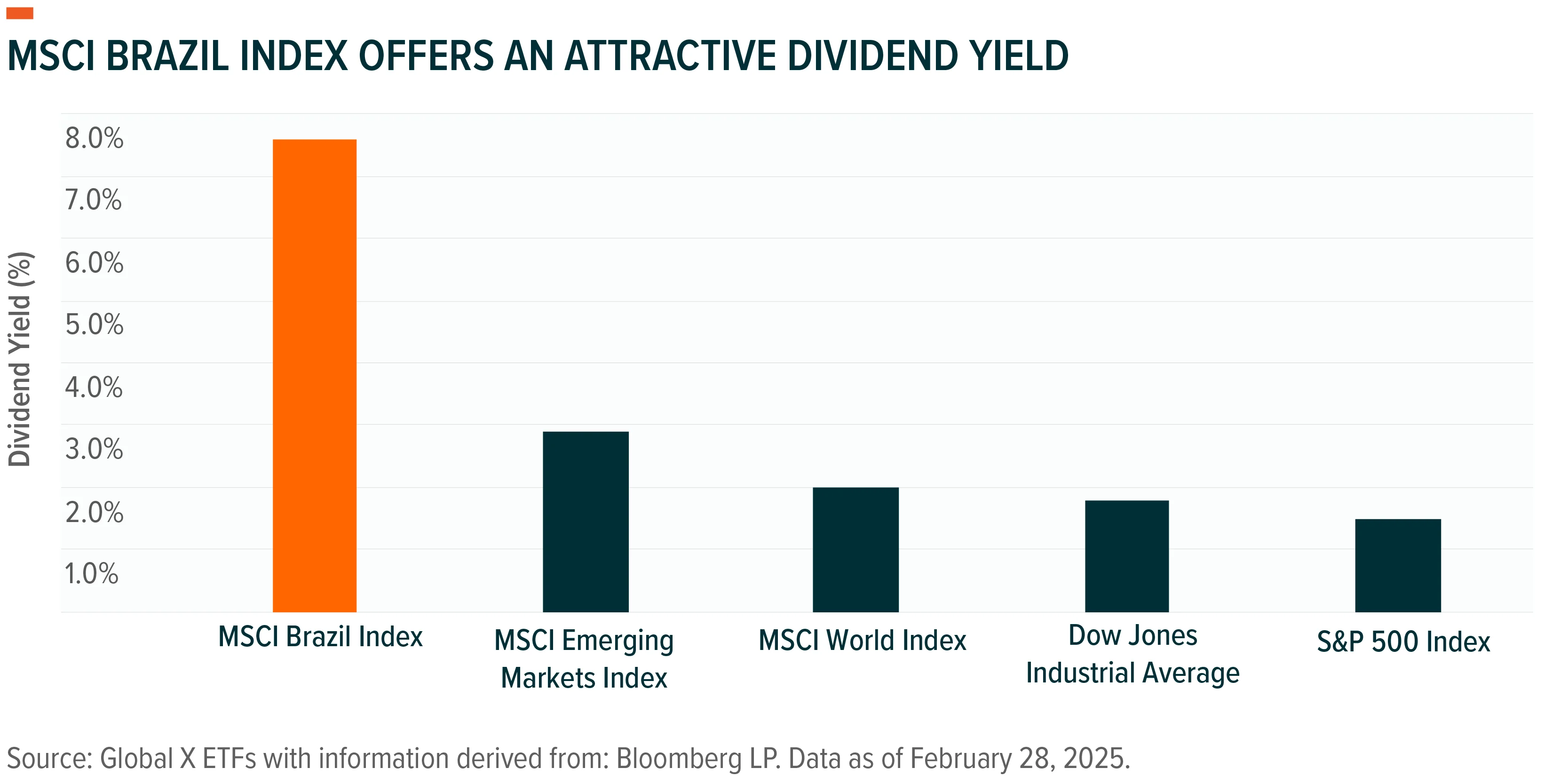
A Strong Dividend Yield: The MSCI Brazil Index offers one of the highest dividend yields globally, superior to developed markets, which makes waiting for further change more palatable.
Active and Concentrated: The Global X Brazil Active ETF (BRAZ) is the only active fund registered in the U.S. (ETF or mutual fund) dedicated to Brazilian equities.12 We seek to differentiate ourselves from passive strategies with a fundamental and concentrated approach – focusing on companies with low leverage, strong management teams, and that we believe can deliver returns above their cost of capital. BRAZ typically holds 20-30 names and has consistently been underweight state-owned enterprises (SOEs). This allows investors the chance to diminish SOE exposures and gain access to off-benchmark names.
Client Friendly Structure: Offering bottom-up active management with a competitive fee, along with the intraday liquidity, transparency, and tax efficiency of the ETF structure. The structure also means that liquidity is determined by the underlying shares and not by the ETF’s daily volume or assets under management.
Looking Beyond the Benchmark: The broad MSCI Brazil Index benchmark is ~68% concentrated in three sectors, two companies make up nearly 26% of the index, and the top five names almost 48%.13 BRAZ allows investors to potentially decrease these exposures and looks at companies that may have come to market on U.S. exchanges or in nearby countries, but still derive most of their revenues from Brazil, such as MercadoLibre and ERO Copper. In fact, there are now 17 Brazilian stocks that are listed in the U.S. but not in Brazil with a total market cap that is comparable to the entire Ibovespa Index.14
Footnotes
1. Bloomberg LP. Data as of February 28, 2025. 2. Ibid. 3. Global X ETFs analysis of data from Bloomberg LP. January 1, 2003 through December 31, 2024. 4. EPFR. Data from January 1, 2024 through December 31, 2024. 5. Ibid. 6. Ibid. 7. EPFR. Data from January 1, 2024 through January 31, 2025. 8. Reuters. (2023, Dec 19). S&P Upgrades Brazil to ‘BB’ Following Major Tax Reform. 9. Bloomberg LP. Data as of January 31, 2025. 10. Bloomberg LP. Data from January 3, 2000 through December 31, 2024. 11. Ibid. 12. Bloomberg LP. Data as of December 31, 2024. 13. Ibid. 14. Ibid. 15. Vivara. Q424 Results Presentation. Data as of December 31, 2024. 16. Rumo. Q424 Results Presentation. Data as of December 31, 2024.
Glossary
Price/Earnings-to-Growth (PEG) Ratio: The PEG ratio is a valuation metric that is equal to a stock’s price-to-earnings ratio divided by its earnings growth rate. A lower PEG ratio suggests a stock may be undervalued.
Standard Deviation: Standard deviation is a statistical measure of the variation or dispersion within a set of numbers. In investing it is used to discuss the volatility in returns. Typically, fixed income returns are more stable while equity returns have a higher level of volatility.
MSCI Emerging Markets Index: The MSCI Emerging Markets Index offers large- and mid-cap representation across 24 EM nations. As of February 28, 2025, it held 1,250 constituents.
MSCI Brazil Index: The MSCI Brazil Index is designed to reflect the performance of large- and mid-cap stocks in the Brazilian market. As of February 28, 2025, the index held 49 constituents covering roughly 85% of the Brazilian equity universe.
U.S. Dollar Index (DXY): The U.S. Dollar Index measures the value of the dollar against a basket of six foreign currencies (euro, pound, yen, Swiss franc, Swedish krona, and Canadian dollar).
Credit Rating: Credit ratings are an assessment of a corporation’s or country’s ability to repay its debt obligations. Investment grade scores range from AAA (highest) to BBB, and speculative grades range from BB to D (lowest).
MSCI World Index: The MSCI World Index is designed to capture large- and mid-cap equity representation across 23 Developed Market countries. As of February 28, 2025 it held 1,395 constituents.
S&P 500 Index: The S&P 500 Index consists of 500 of the largest and most liquid stocks traded on U.S. exchanges.
Dow Jones Industrial Average: The Dow Jones Industrial Average consists of 30 large and prominent stocks traded on U.S. exchanges.
Real Interest Rate: The real interest rate is equal to the nominal interest rate minus inflation.
Investment Philosophy: We look for companies that benefit from both bottom-up and structural tailwinds, with moats helping them stand out from competition, management teams aligned with minority shareholders, and clear near- and long-term catalysts, exhibiting growth at a reasonable price characteristics. At the end of the day, we search for companies that we believe can consistently earn and compound returns above their costs of capital.
Investment Process: A strict investment process based on a quantitative screen, sector specialists’ stock analysis, and risk-adjusted portfolio construction, all supported by a three-person team that has deep personal, academic, and professional experience managing Brazil portfolios.
Vivara: Vivara is the dominant jewelry company in Brazil commanding nearly 3x the market share of the next four players combined.15 Its scale, brand, and know-how have helped it consolidate a very fragmented market. With various different brands, the company caters to aspirational purchasing in different consumer segments. Management plans to emphasize growth around its two highest-margin formats, providing scope for potential increased penetration and higher return on invested capital.
Rumo: Rumo, Brazil’s leading railroad operator, is the largest logistics company in Latin America.16 It is a structural long-term growth story predicated on a dominant player unlocking increased volumes via structural trends, track expansions, fleet renewals and various opportunities to increase efficiencies. The company has also benefited from the steady increase in transportation of commodities from the center of Brazil to the ports via train at the expense of trucks given lower transportation costs.