


Real Estate Investment Trusts (REITs) returned 29% in 2019, supported primarily by the Fed and other central banks around the world pivoting to more accommodative monetary policies.1 Lower interest rates reduced borrowing costs and spurred greater investor demand for REITs given their typically high dividend yields. After a strong year, however, investors are questioning whether REITs have further upside. In this post, we explore valuations within the REIT segment and identify areas that may demonstrate more attractive characteristics.
In this piece, we analyze:
The recent REIT rally fueled by central bank policy
Looking for more attractive valuations via high yielding equity REITs
The compelling reasons to look towards the Mortgage REIT segment
Central Banks Fueled 2019’s REIT Rally
In November 2018, the 10-year Treasury yield stood over 3.20% and a hawkish stance by the Fed led the market to believe rates would continue to climb higher. But policy changed just one month later, as the Fed reversed course and began cutting rates. Other major central banks followed suit. The European Central Bank (ECB) announced a fresh €20 billion a month stimulus plan, China’s People’s Bank of China (PBOC) announced their first loan rate cut in three years, and the Bank of Japan (BOJ) signaled openness to a rate cut.
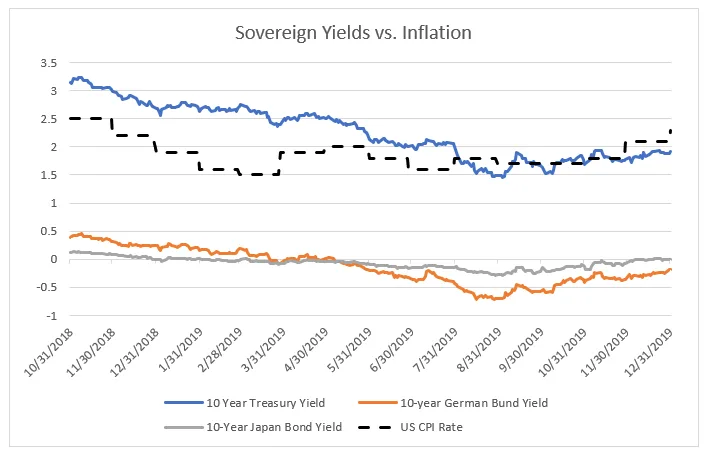
Source: Bloomberg. Data from 10/31/19 to 12/31/19. Inflation represented by US Consumer Price Index.
As rates fell, investors clamored for higher yield investments, including REITs, which are required to pay out 90% of their income to shareholders. Fund flows into Real Estate ETFs totaled over $6 billion in 2019.2 Beyond greater investor demand, REITs benefited at an operational level, as lower interest rates allowed many to refinance their debt. As a result, REITs climbed 29% in 2019, but EBITDA growth only made up 2% of that total return. The EV/EBITDA valuation went up nearly three multiples, showing that much of the rally was due to a valuation expansion based on investor demand rather than fundamental improvements in their investments.
But after three rate cuts in 2019, the Fed is now showing little appetite for further rate cuts. The markets are still expecting a full rate cut in 2020, but it is likely that rates have already, or are close to, bottoming.
High Yielding Equity REITs Offer More Attractive Value
Given the surge in REIT prices, valuations on the broad asset class are stretched, with REITs now trading 12% above their 10-year long term EV/EBITDA averages.3
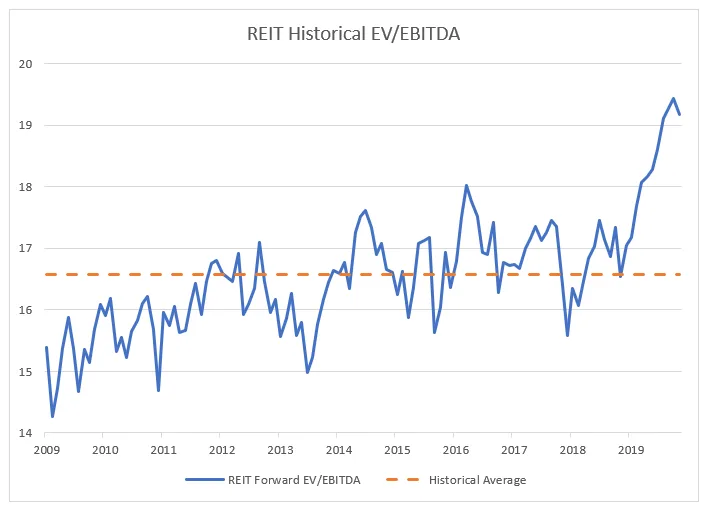
Source: Bloomberg. REITs represented by FTSE NAREIT All Equity REITs Index. Data from 12/31/09 to 12/31/19.
Given that valuations appear extended in the broader REIT market, investors may want to consider REITs with less frothy multiples. One area that typically offers more attractive valuations are high yield REITs, or those with higher dividend yields than the broader market. This is intuitive because yield is a function of price and dividends, so higher yielding securities tend to have lower relative prices.
As shown in the table below, high yield REITs, represented by the equity REIT constituents of the Solactive Global SuperDividend REIT Index (which is tracked by SRET- the Global X SuperDividend® REIT ETF), exhibit higher cap rates within each REIT sector than the broader Global REIT index. Similar to how investors use price-to-earnings measures to analyze the valuations of common stocks, cap rates are a common way of valuing real estate properties. It is calculated by dividing a REIT’s Net Operating Income by its Current Market Value. A lower cap rate indicates properties that are relatively overvalued compared to those with higher cap rates.
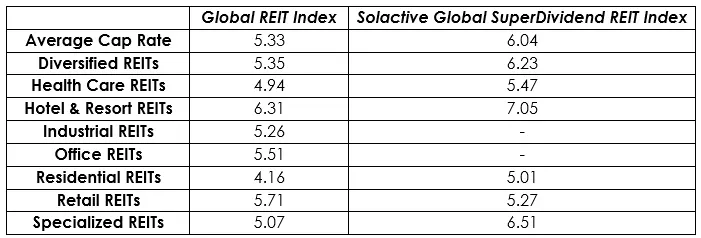
Source: Bloomberg. Data based on average of holdings cap rates across each REIT property segment. Global REIT Index represented by FTSE EPRA NAREIT Global REITs Index. Data as of 12/31/19.
Analysis using other valuation metrics shows a similar story. EV/EBITDA and Price/Adjusted Funds from Operations (AFFO) both indicate that high yielding REITs exhibit lower valuations compared to their broader REIT asset class.

Source: Bloomberg. Data based on average of Equity REIT EV/EBITDA. Data based on average of Equity REIT Price to Adjusted Funds from Operations. Includes only US Equity REITs as those ones report Funds from Operations numbers. Broad Equity REITs represented by FTSE EPRA NAREIT Global REITs Index. Data as of 12/31/19.
For investors concerned that the recent run-up in the broader REIT space may result in muted future returns, narrowing in on REITs with more attractive valuations could help improve long term performance and reduce the susceptibility to valuation contractions if interest rates rise or the economy stumbles.
Mortgage REITs Back In Vogue
Mortgage REITs (mREITs) are a fundamentally different business than Equity REITs. Rather than owning physical properties, mREITs own and trade mortgages. While each mREIT has a unique approach and portfolio of assets, typically they borrow short term debt to finance buying longer term mortgages. MREITs benefit from the difference between the yield on the mortgages they own and their financing costs, which can be impacted by the steepness of the yield curve and the credit spread on mortgages above government debt. For example, when the yield curve briefly inverted, mREITs lagged behind their Equity REIT counterparts, because long term debt yielded less than short term debt.
Given that the yield curve has returned to a positive slope, mREITs are back on many investors’ radar.
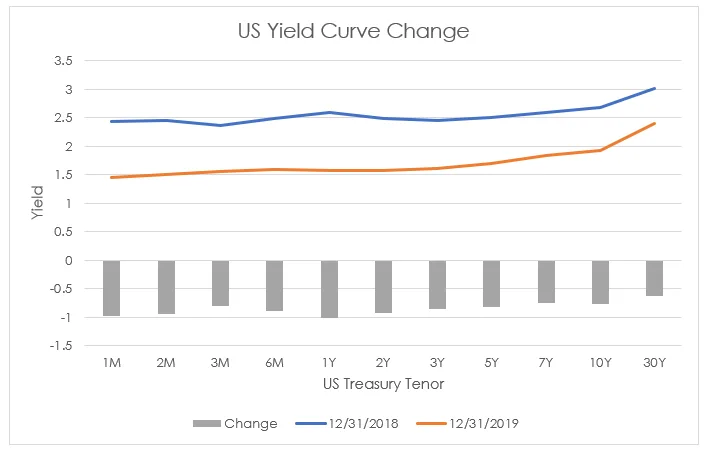
Source: Bloomberg. Data from 12/31/18 to 12/31/19.
If interest rates have indeed bottomed and are likely to stay low for the near future, it could be an advantageous environment for mREITs. Historically, when interest rate volatility is low, Mortgage REITs perform well because borrowers are less likely to prepay their mortgages to refinance their home or building. Conversely, high volatility interest rate periods tend to be negative for mREITs because either prepayments or extensions become more likely.
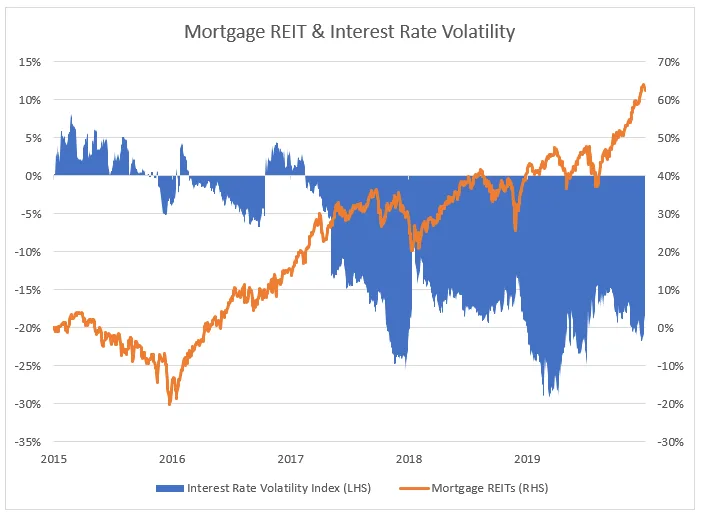
Source: Bloomberg. Data from 1/28/15 to 1/27/20. Interest Rate Volatility measured by CBOE Interest Rate Volatility Index. Mortgage REITs represented by FTSE NAREIT Mortgage REIT Index. Left hand side is Interest Rate Volatility Performance and Right Side is Mortgage REIT performance.
Mortgage REITs have historically maintained a high yield spread to 30-year government bonds, due to their use of leverage, mortgage credit spreads, and their hedging and forecasting strategies. Even in a period of dovish monetary policy, mREITs continue to adjust their interest rate sensitivity, balance sheet leverage, and credit risk. At a time when US Treasuries are yielding almost just a breakeven amount to inflation and international sovereigns are offering negative rates in many cases, Mortgage REITs have been playing an important role in providing higher yields to investors.
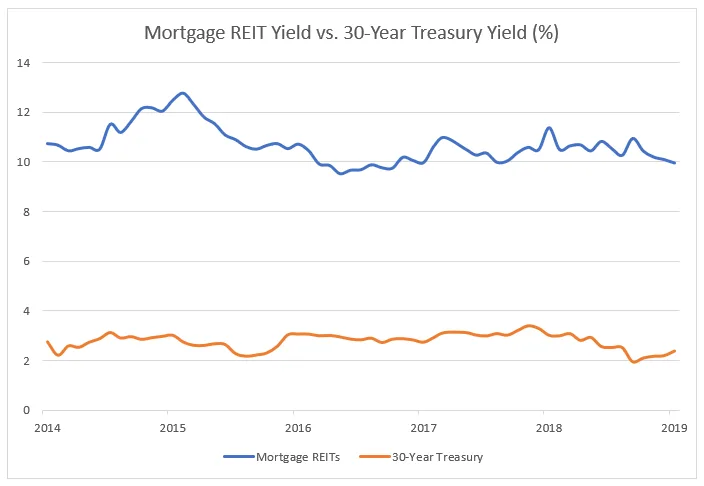
Source: Bloomberg. Data from 12/31/14 to 12/31/19. Mortgage REITs represented by FTSE NAREIT Mortgage REIT Index.
Conclusion
Given that we expect interest rates are close to bottoming and that REITs enjoyed strong performance in 2019, investors ought to become more discerning in their approach to REITs to avoid potentially overvalued investments. Screening for higher yielding equity REITs is one way to uncover more attractively valued segments of the REIT market. In addition, mortgage REITs may now be a well-positioned segment given the steeper yield curve, low interest rate volatility, and their attractive dividend yields.
Related ETFs
The Global X SuperDividend REIT ETF (SRET) invests in 30 of the highest yielding REITs around the world.