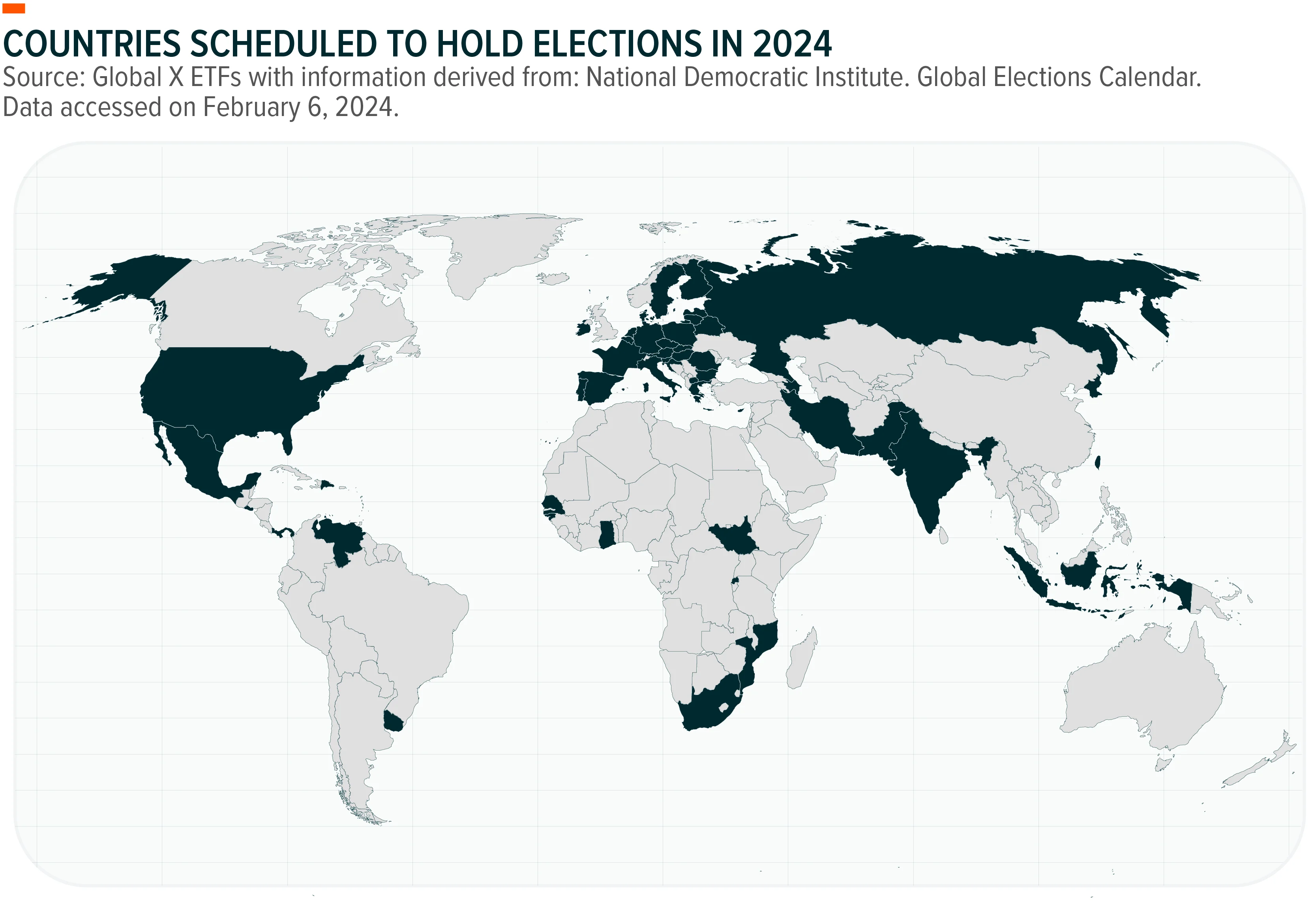
More than 40% of the world’s population, representing over half of global GDP and nearly 80% of global market cap, will head to the polls in 2024, likely setting the stage for a year filled with political headlines, volatility, and potential change.1,2 History tells us that politics can have an outsized influence on both a country’s economic and equity market outlooks, emphasized by recent developments in Greece and Argentina. The 2024 election cycle has the potential to be extremely decisive, with geopolitical tensions remaining elevated, and as we witness both growing polarization and continued economic uncertainty. Despite the expected volatility, we see room for optimism, especially within emerging markets (EMs).
Key Takeaways
Numerous pivotal elections are on tap in 2024, and the outcomes could have an outsized influence on economic and equity market outlooks in a wide range of both emerging and developed economies.
The 2024 election cycle will likely bring both volatility and opportunity to emerging markets, a situation that could benefit active managers.
Recent outcomes in Greece and Argentina underscore the impact politics can have on a country’s equity markets, and we are paying particularly close attention to elections in Mexico, India, and the United States.
Transformative Power of Politics Was on Display in 2023
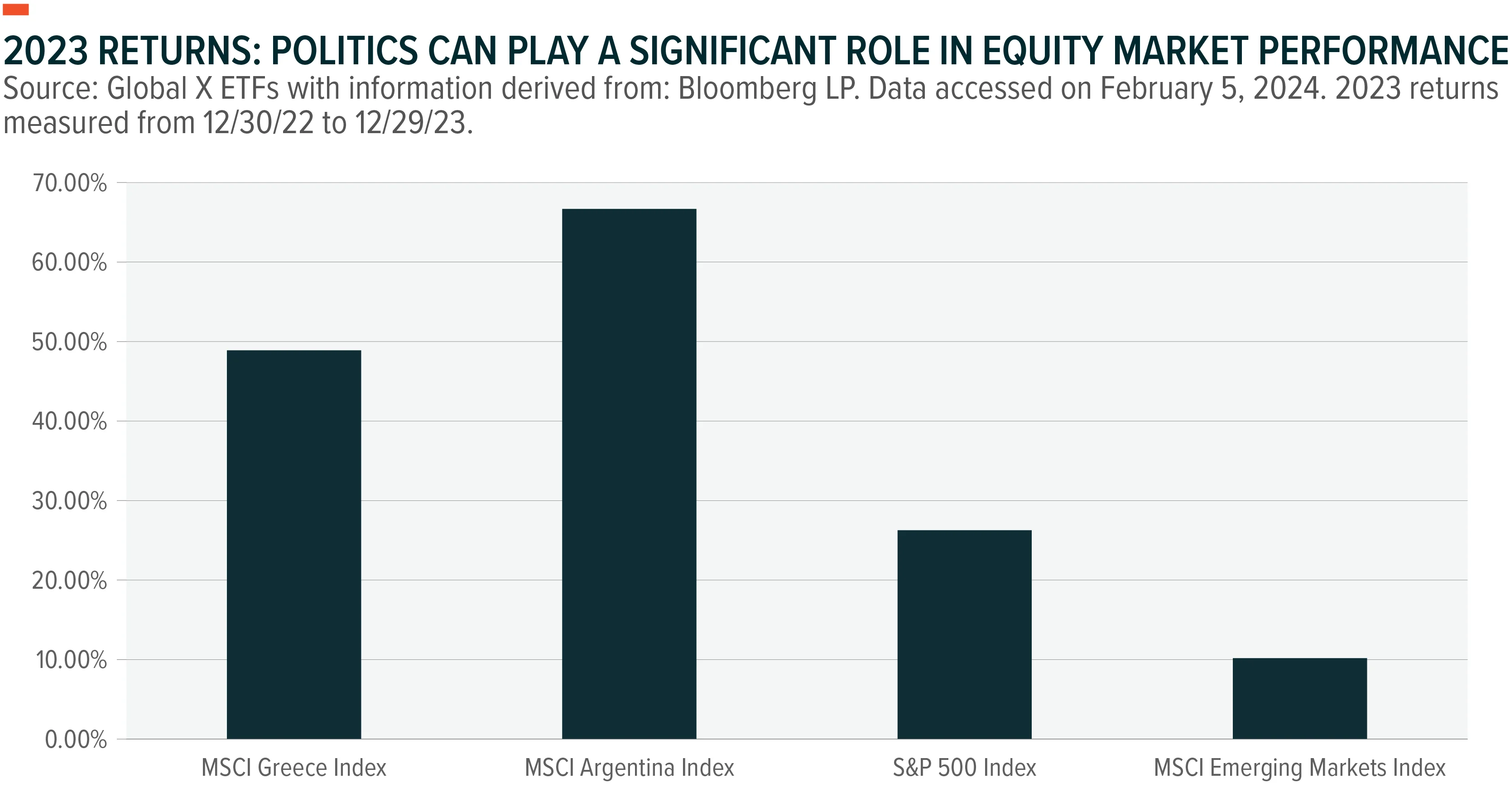
Greece and Argentina held critical elections in 2023, with both countries electing their respective pro-market candidates. In Greece, citizens definitively reelected incumbent Prime Minister Mitsotakis for a second term, with his New Democracy party gaining a majority in the Greek Parliament. Mitsotakis and his Administration have been key in the Greek economic recovery, implementing reforms and other pro-market policies that paved the way for Greece’s sovereign credit rating to be upgraded to Investment Grade late last year.3 In Argentina, the population decisively rejected Peronism, electing the neo-liberal Javier Milei as President. Since then, Milei has moved swiftly to normalize the economy, passing a series of measures aimed at reducing government spending and returning the economy to orthodoxy. Markets rewarded these favorable political outcomes, with the MSCI Greece and MSCI Argentina indices returning roughly 48% and 67%, respectively, in U.S. dollars in 2023.4 The examples of Greece and Argentina emphasize the significance politics can play for both economic growth and equity performance. Looking at 2024, we identify potential similar opportunities within emerging markets.
2024 EM Elections: Divergent Paths Underscore the Benefits of Active Management

U.S. Presidential Election
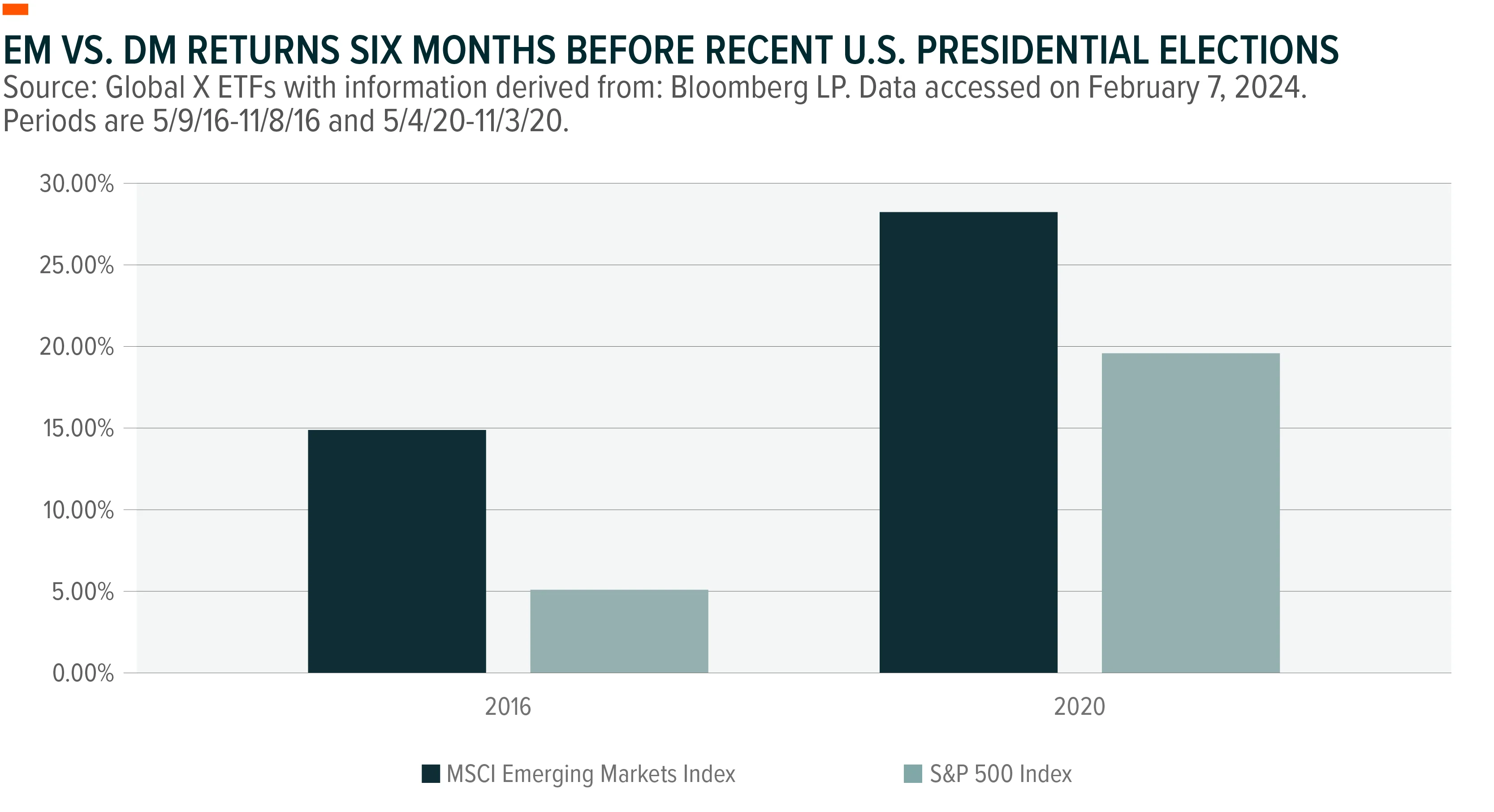
The consensus believes a Biden/Trump rematch is ahead in 2024. However, a large dissatisfaction for either candidate, and growing support for Robert Kennedy Jr., potentially opens the door for a third-party candidate to meaningfully enter the race. The main issues top of voters’ minds are immigration, the economy, government spending, and certain social issues such as abortion rights. In terms of direct EM impacts, we expect that both candidates will maintain their hawkish rhetoric towards China, while Mexico could also come up in immigration discussions. However, we expect this to be more bark than bite, with limited tangible actions expected. On the domestic policy front, like in many election years, we expect little action out of the already gridlocked congress, with the government likely to kick most issues to the next administration. We see this gridlock as potentially negative for the U.S. dollar, making us positive on emerging markets given the strong boost EM countries receive from a weaker U.S. currency. We also note that during the six-month period leading up to the past two U.S. Presidential elections, EM equities outperformed the S&P 500 Index by a wide margin. As a result, we continue to be positive on emerging markets, which stand to benefit from higher expected growth rates while valuations remain comparatively attractive.
Conclusion: Emerging Markets Appear Well Positioned in 2024
The plethora of elections in 2024 sets the stage for a year filled with political headlines, volatility, and policy change. Recent outcomes in Greece and Argentina underscore the impact politics can have on a country’s economic and equity market outlooks. We see India and Mexico as likely beneficiaries of election results, while outcomes in the U.S., South Korea, and South Africa remain more uncertain. U.S. elections will likely result in congressional gridlock throughout the year, while China and Mexico could come under scrutiny in the leadup to the U.S. election. However, we don’t expect concrete policy changes. As a result, we see emerging market equities as well positioned in 2024, while the expected volatility could create opportunities for active managers.