

This piece is one in a series that delves further into the leading themes emerging from this year’s iteration of our flagship research project, Charting Disruption.
Artificial intelligence is moving from a race to develop increasingly capable models to a global effort to scale intelligence across the economy. Supporting this shift will require a historic infrastructure buildout, with as much as $7.3 trillion in capital expenditure (CapEx) expected between 2025 and 2030.1 The opportunity, however, extends well beyond the companies building AI. As compute capacity expands and the cost of using AI declines, intelligence could become a foundational driver of productivity, enable AI agents, and create opportunities across the broader technology stack. We expect the impact to also extend across industries, with AI poised to reshape fields ranging from biotechnology and industrial automation to cybersecurity.
Key Takeaways
AI investment is broadening into demand for semiconductors, networking, electronic components, power infrastructure, and data centers.
Growing evidence of monetization is further reinforcing the investment cycle.
As intelligence becomes more capable and affordable, companies applying it across software, healthcare, robotics, and other industries could capture a growing share of the value created.
Laying the Foundation
The scale of investment required to support broad AI adoption is becoming difficult to overstate. We estimate that cumulative AI data center investment could reach approximately $1.6 trillion over seven years, exceeding the inflation-adjusted cost of historic U.S. megaprojects such as the Apollo program and the Interstate Highway System.2 Across the broader ecosystem, as much as $7.3 trillion could be invested in AI infrastructure between 2025 and 2030, with hyperscalers accounting for nearly 80% of that spending.3
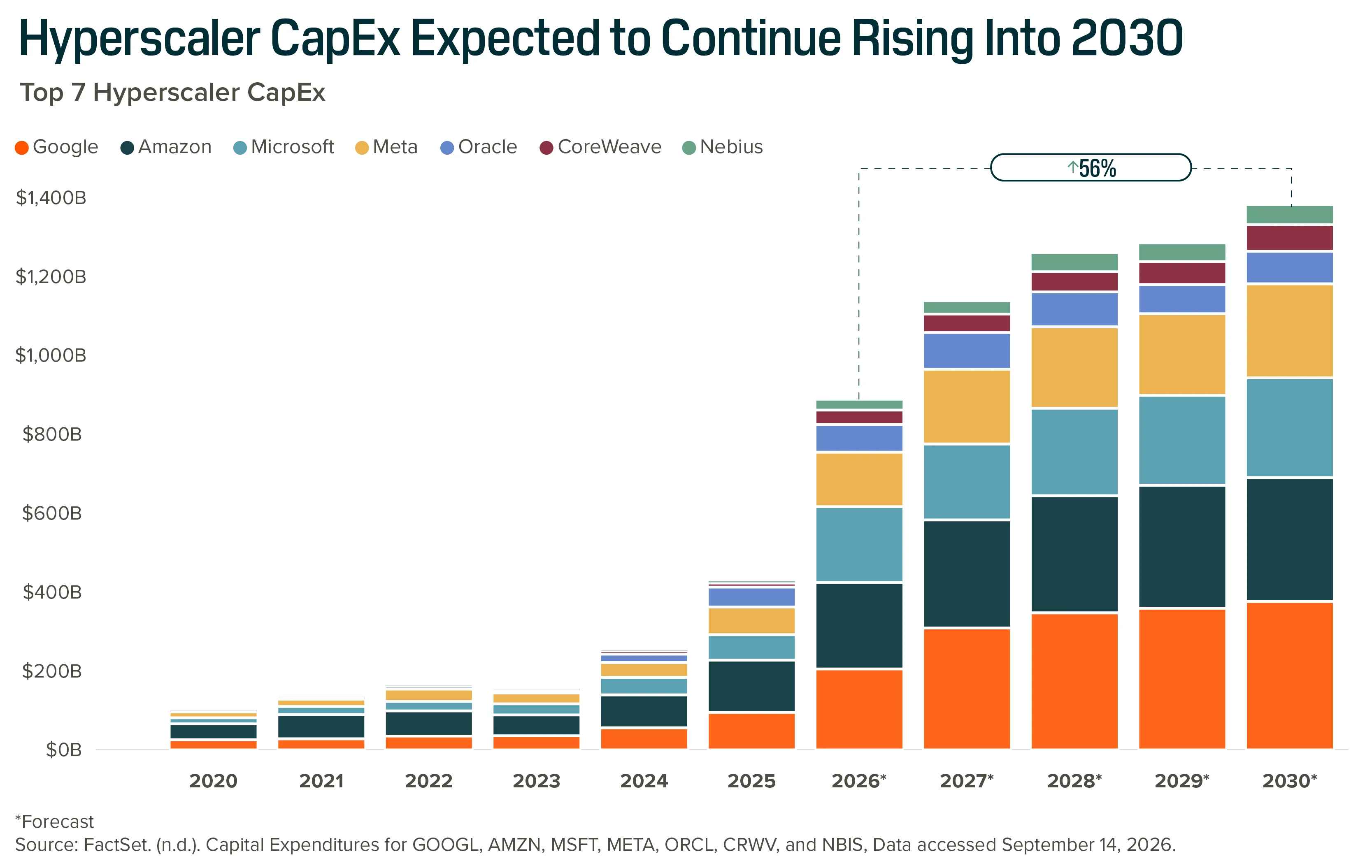
The investment marks a fundamental shift for the world's largest technology companies. For much of the past two decades, digital platforms built relatively asset-light businesses, leveraging software and scale to drive growth. AI is pushing them toward a more capital-intensive model, with competitive advantage increasingly dependent on access to computing capacity and the infrastructure needed to operate it.
The investment creates a broad waterfall of beneficiaries. Spending starts with accelerators and servers, then extends across the supply chain as expanding computing capacity drives demand for memory, networking, optical connections, and power-management components.
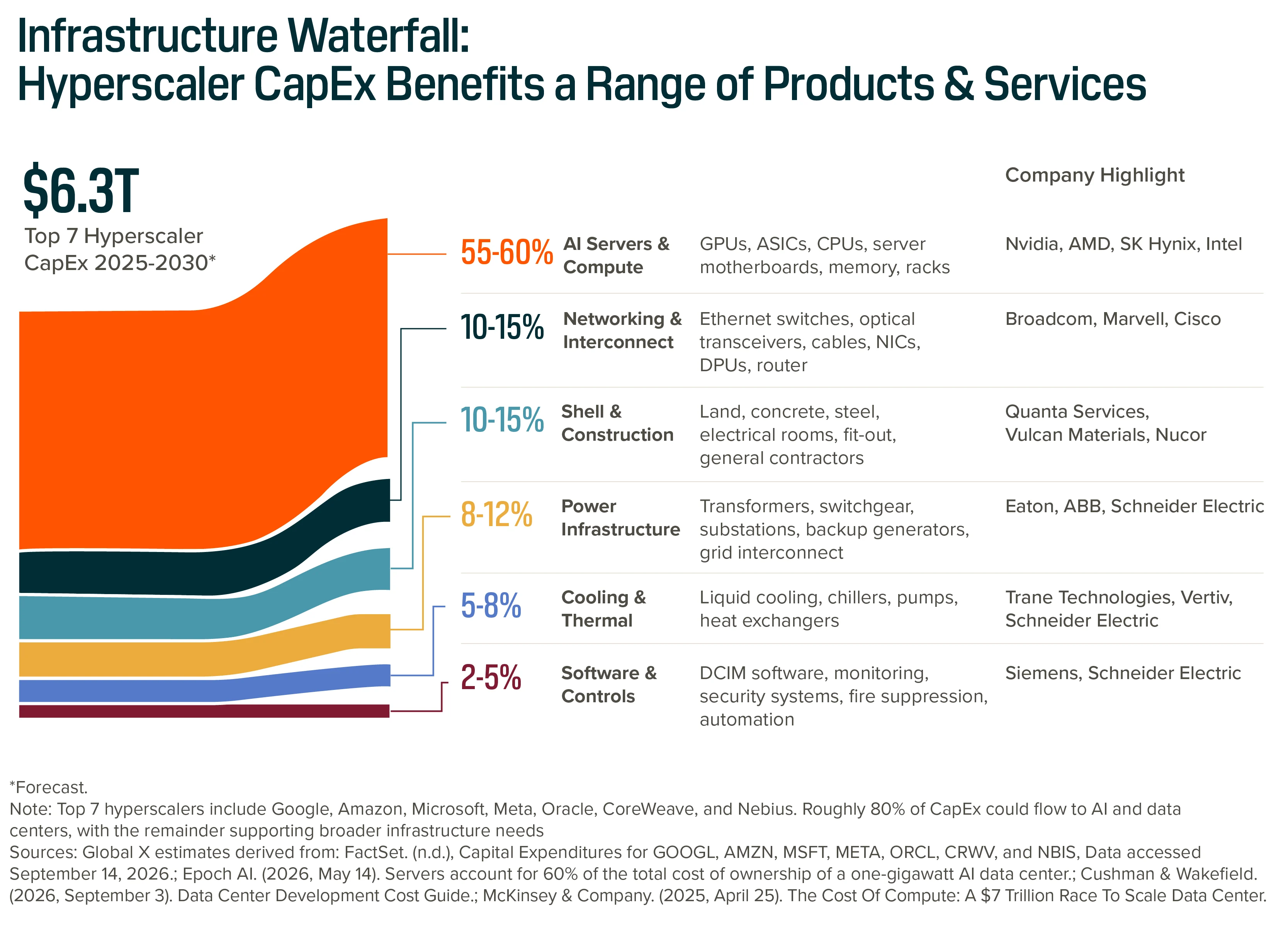
Beyond the server rack, demand extends to cooling systems, electrical equipment, grid connections, and the physical construction of the data center itself. As AI campuses grow from facilities measured in tens of megawatts to projects planned at gigawatt scale, the opportunity extends well beyond chip designers.
We estimate that global semiconductor sales could reach approximately $1.5 trillion in 2026, up ~90% YoY, and approximately $2.3 trillion by 2030, nearly triple the 2025 level.4 In addition to U.S.-based chip designers like Nvidia, Asian chipmakers are also coming into focus, underscoring how interconnected the global supply chain is as it races to deliver volumes. Asia accounts for roughly 75% of global semiconductor manufacturing capacity and approximately 90% of the world's most advanced chips used in AI accelerators.5
But capital commitments alone cannot bring new capacity online. AI demand can grow much faster than the physical infrastructure required to serve it. Our estimates suggest token demand could increase nearly 70-fold between 2025 and 2030, while global data center capacity expands approximately 2.2 times.6 Power availability, grid connections, transformers, and advanced hardware can take years to secure, limiting how quickly supply can respond. Memory illustrates the squeeze: we estimate that available supply in 2030 could fall about 18% short of demand, even as high-bandwidth memory spending grows more than 45% annually.7 With data center vacancy near 1%, operators with access to power and ready-to-use capacity are well positioned to benefit from tight supply and strong leasing demand.8
These constraints can prolong the infrastructure investment cycle and direct spending toward companies best positioned to overcome them. But the ultimate test is whether the capacity being built can be used productively and generate sufficient returns – shifting the focus from the scale of investment to the economics of monetization.
Monetization Brings ROI into Focus
The question now turns to how quickly AI companies monetize that spending into sustainable revenue. Early signs suggest monetization is gaining traction. Our analysis of 15 AI revenue-generating companies indicates that annualized AI-related revenue could exceed the annual depreciation expense associated with AI assets by mid-2027, with annual revenue potentially overtaking capital spending by late 2029.9 By 2030, our model projects approximately $1.6 trillion in annual AI-related revenue across that ecosystem.10
Those industry-wide revenue projections show the potential scale of AI monetization; data center economics illustrate what it could mean for a single infrastructure investment. A gigawatt-scale AI facility can require approximately $40 billion in upfront capital investment, alongside substantial recurring operating costs.11 The amount of value generated from that investment, however, depends on what the computing capacity is used for. We believe that one gigawatt of capacity could support roughly $12 billion in annual revenue from raw compute, or $24 billion from inference, models, and APIs, or as much as $48 billion from end-user applications. At those revenue levels, illustrative payback shortens from about 3.6 years for raw compute to under one year for end-user applications.12
For investors, that difference gap points to a broader opportunity: value may accrue not only to infrastructure providers, but also to companies building services on top of it. Selling computing capacity provides a route to monetization, but the same underlying infrastructure can support greater revenue as providers move up the value chain. Model developers can charge for access to intelligence through APIs, while application providers can capture value by using that intelligence to solve specific problems or automate economically valuable tasks. This highlights how the commercial opportunity extends beyond the companies helping finance the initial buildout, and how over time, the spectrum of investable opportunities across the application layer could vary, offering investors more optionality.
That application opportunity depends in part on whether lower costs make AI economical to use at scale. As AI becomes cheaper to run, businesses can deploy it across more workflows and increase the volume and complexity of tasks performed. Lower prices can reduce revenue per unit of compute, but they can also expand total usage. This creates a reinforcing cycle: better and cheaper models enable more applications, greater adoption drives demand for inference and computing capacity, and that demand supports further investment.
The result is a potential shift in the drivers of the AI cycle. Infrastructure spending lays the groundwork, but rising utilization and monetization increasingly determine the industry's ability to earn returns on that investment. We believe this transition could help sustain the buildout while broadening the investment case toward platforms that translate intelligence into measurable economic value.
Scaling Intelligence into Economic Value
In previous technology cycles, the initial investment in hardware and foundational infrastructure enabled new software platforms and applications. AI could follow a similar path, with value creation increasingly extending into the application layer. As models become more capable and less expensive to use, the opportunity expands from providing intelligence to applying it.
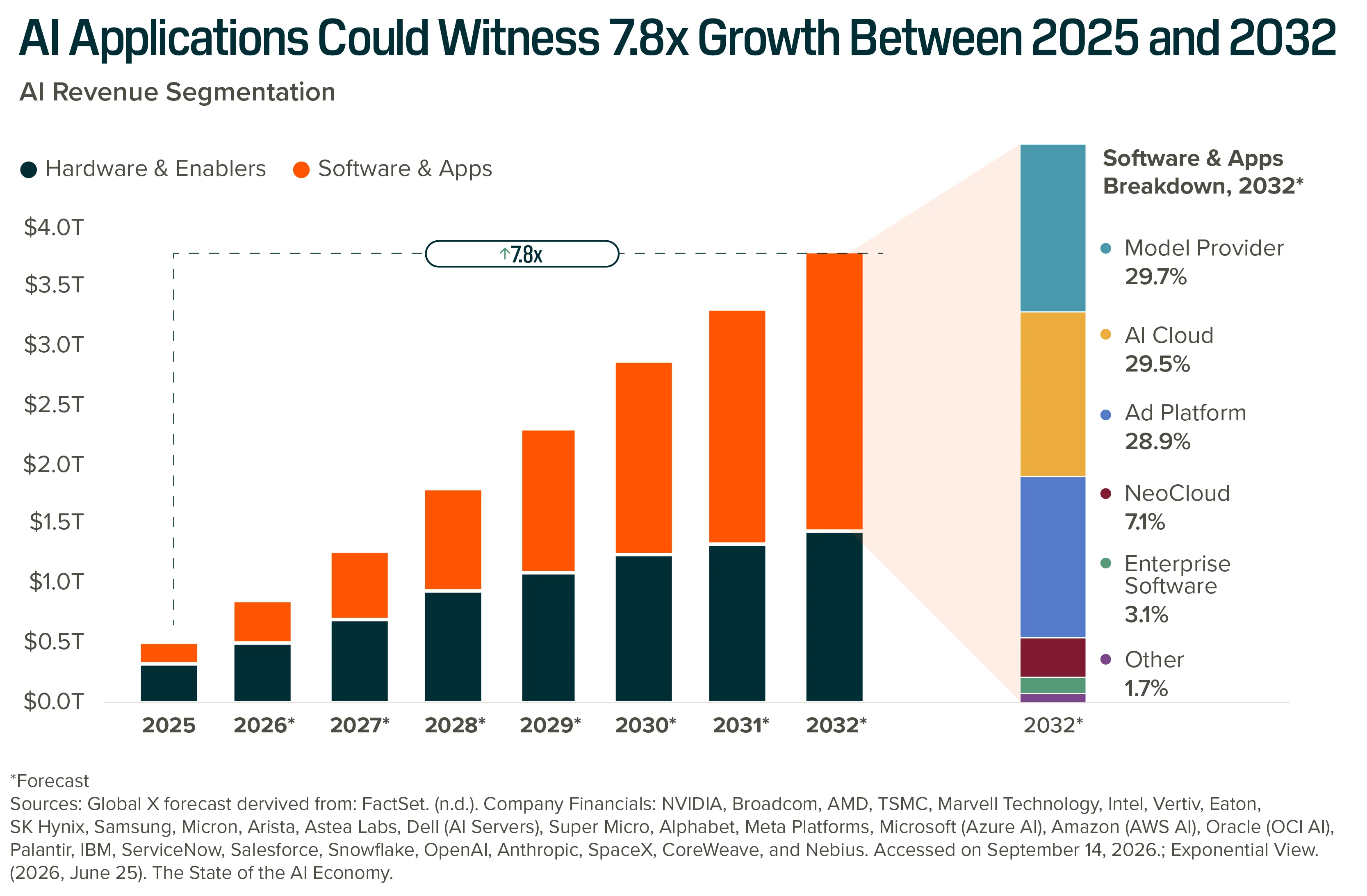
While the opportunity is still taking shape, we believe revenue across AI software and applications could grow roughly 7.8 times between 2025 and 2032, outpacing the expansion of hardware and infrastructure revenues over the same period.13 Large language model providers, such as Anthropic, OpenAI, or even open-weight leaders like Meta Platforms and Z-AI, could potentially drive 30% of software and application revenues. By 2032, that revenue could approach $700 billion as AI translates intelligence into workflows and economic outcomes.14 AI cloud and ads could form another substantial part of the revenue base.
The potential extends beyond IT, as models also rapidly transform other industries. In healthcare, AI can help researchers connect genomic, imaging, and clinical data to identify patterns and prioritize potential drug candidates, with roughly 790 AI-discovered molecules now in development.15 While clinical validation and regulatory milestones remain, these tools could improve parts of the drug discovery process and make increasingly complex biological data more useful.
Robotics offers another route for AI to move into the physical economy. Advances in perception and reasoning could allow machines to perform a wider range of tasks, extending automation beyond highly structured industrial environments. As these systems develop, the opportunity could span AI software, processors, sensors, batteries, motors, and precision components.
Cybersecurity and enterprise software also stand to benefit as organizations integrate AI into their operations while managing the risks that greater automation creates.
These markets are at different stages of commercialization, and their economics will vary. The broader point is that AI's opportunity does not end with the infrastructure required to train and run models. As intelligence becomes more accessible, companies may be able to apply it across an expanding range of products, services, and workflows.
Conclusion: The Next Phase of the AI Cycle
The AI opportunity is expanding from building the capacity to deliver intelligence to applying it across the economy. Infrastructure remains essential, but the longer-term opportunity will also depend on which companies can turn increasingly capable and affordable AI into products, services, and measurable productivity gains. We believe this creates a broadening investment opportunity, spanning the physical infrastructure powering AI today and the technologies and industries positioned to benefit as its adoption scales.
For additional insights, please view our full report, Charting Disruption: Outlook for 2027 and Beyond.


