


Product ResearchRoboticsArtificial Intelligence
Robotics: AI Moves into the Physical Economy
T
Tejas Dessai
Mar 17, 202610 min read
Get the latest news and updates from our team.
Copyright © 2026 Global X. All rights reserved.
SEI Investments Distribution Co. (1 Freedom Valley Drive, Oaks, PA, 19456) is the distributor for the Global X Funds.
Check the background of SIDCO and Global X's Registered Representatives on FINRA's BrokerCheck.
Global X Research
Tejas Dessai
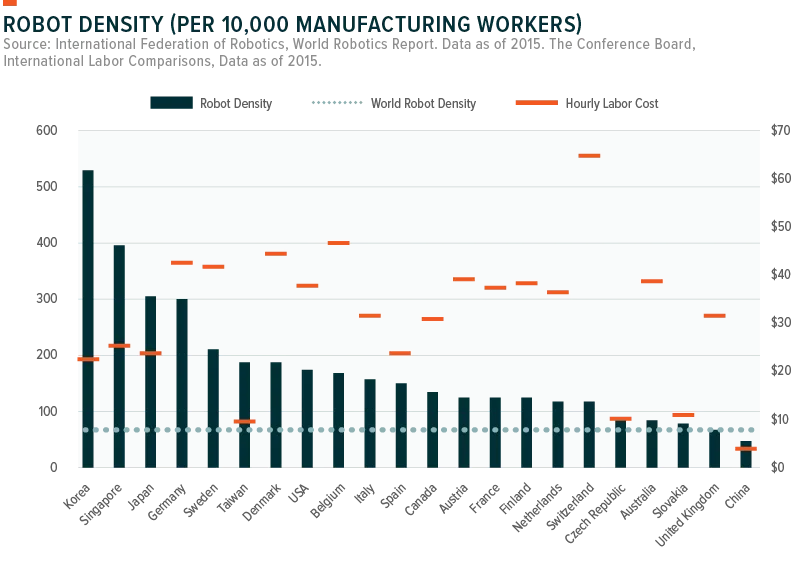
Much of the debate around the rise of robotics technology is how it could displace workers in the manufacturing sector around the world. In the chart below, we show the robot density (number of industrial robots per 10,000 manufacturing workers) for major manufacturing countries. We also include the average compensation cost per hour for manufacturing workers in each country. Intuitively, one would believe that countries with higher labor costs would have greater robot density, as robots would present a more cost efficient alternative to high cost labor. We found, however, that many higher labor cost countries in Europe have comparatively low robot density, which could be representative of protectionist labor or manufacturing policies, or a slower than expected adoption of the robotics technology. Developed Asian countries like Korea, Singapore, and Japan, however, have demonstrated a much higher than expected adoption of robotics technology given their lower labor costs, presumably as those countries have placed a greater emphasis on maximizing global competitiveness.
We believe falling costs, rapid technological improvement, and a supportive policy backdrop are converging to push robotics toward an inflection point in 2026.
We believe falling costs, rapid technological improvement, and a supportive policy backdrop are converging to push robotics toward an inflection point in 2026.