


Product ResearchCoreFixed Income Strategies
Global X Emerging Markets Bond ETF (EMBD) 1Q26 Commentary
G
Global X Research
May 15, 20264 min read
Get the latest news and updates from our team.
Copyright © 2026 Global X. All rights reserved.
SEI Investments Distribution Co. (1 Freedom Valley Drive, Oaks, PA, 19456) is the distributor for the Global X Funds.
Check the background of SIDCO and Global X's Registered Representatives on FINRA's BrokerCheck.
Global X Emerging Markets Bond ETF (EMBD) 1Q26 Commentary
Multiple authors
Global X Research
The Emerging Market (EM) asset class is comprised of 24 countries with various languages, economies, and political systems. Given this diversity, there are myriad factors that impact the group’s economic growth rates and equity market performances. Historically, however, three factors have had an outsized influence on EM performance: interest rates, U.S. dollar strength, and China. Recently, we have seen encouraging developments on all three of these fronts. This combination, in addition to EM’s favorable demographics and expanding consumer class, could be a significant catalyst to drive economic growth and consumption in EMs, making this an intriguing time for investors to reassess their EM allocations.
Between interest rate cuts by the U.S. Federal Reserve, potential U.S. dollar weaknesses, and monetary and fiscal stimulus in China, EM equities may be poised to benefit from the convergence of three powerful tailwinds.
Consumption names within EM could be particularly appealing, as lower interest rates reduce individual debt burdens and encourage people to borrow and spend.
We believe that EM’s favorable demographics and rapidly expanding consumer class support the consumption theme’s long-term structural story.
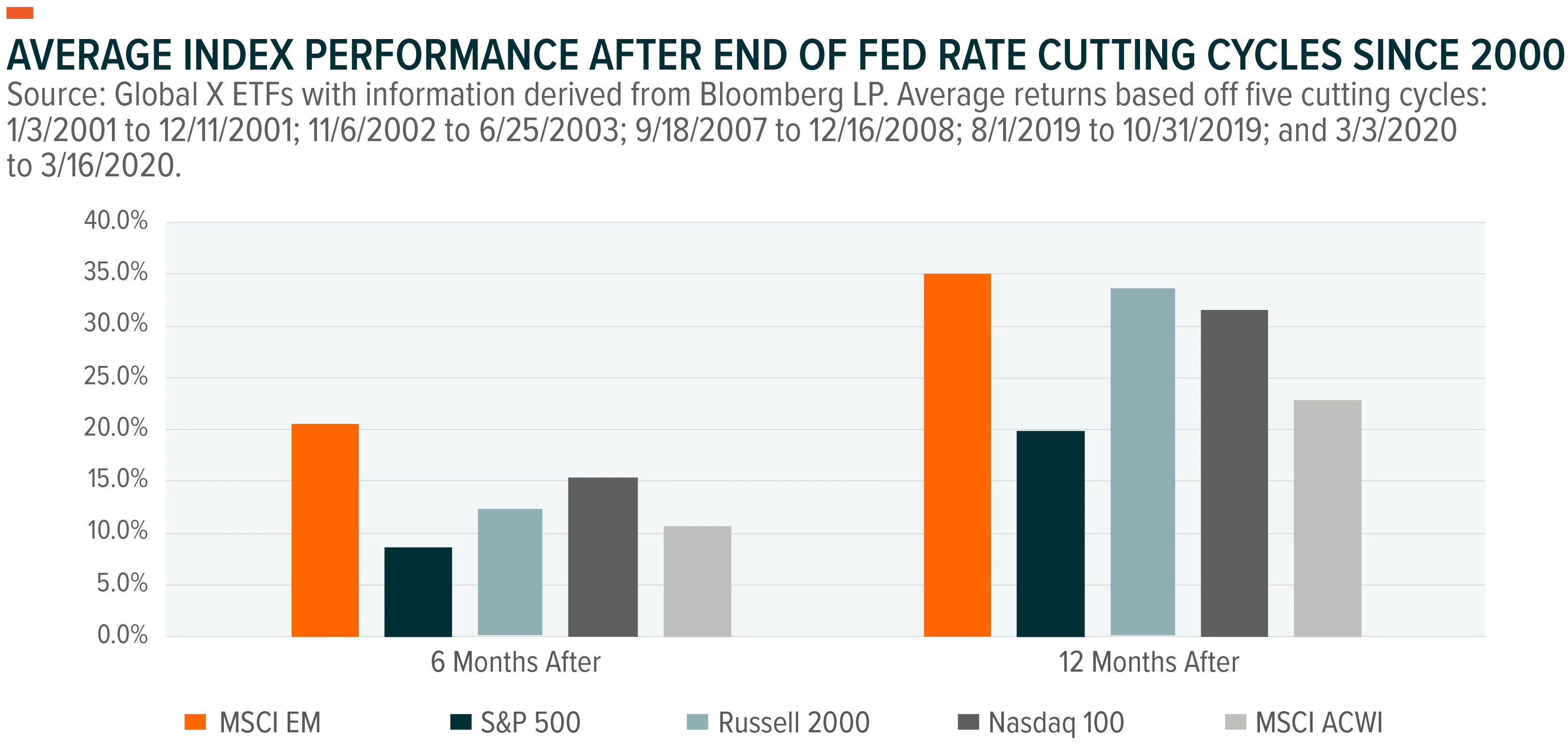
We see three powerful tailwinds aligning for Emerging Market assets. First, after a significant hiking cycle, the U.S. Federal Reserve (Fed) cut interest rates by ½ a percentage point at its September meeting.1 Looking at 6- and 12-month periods following the end of Fed cutting cycles since 2000, Emerging Market equities have outperformed U.S. equities.
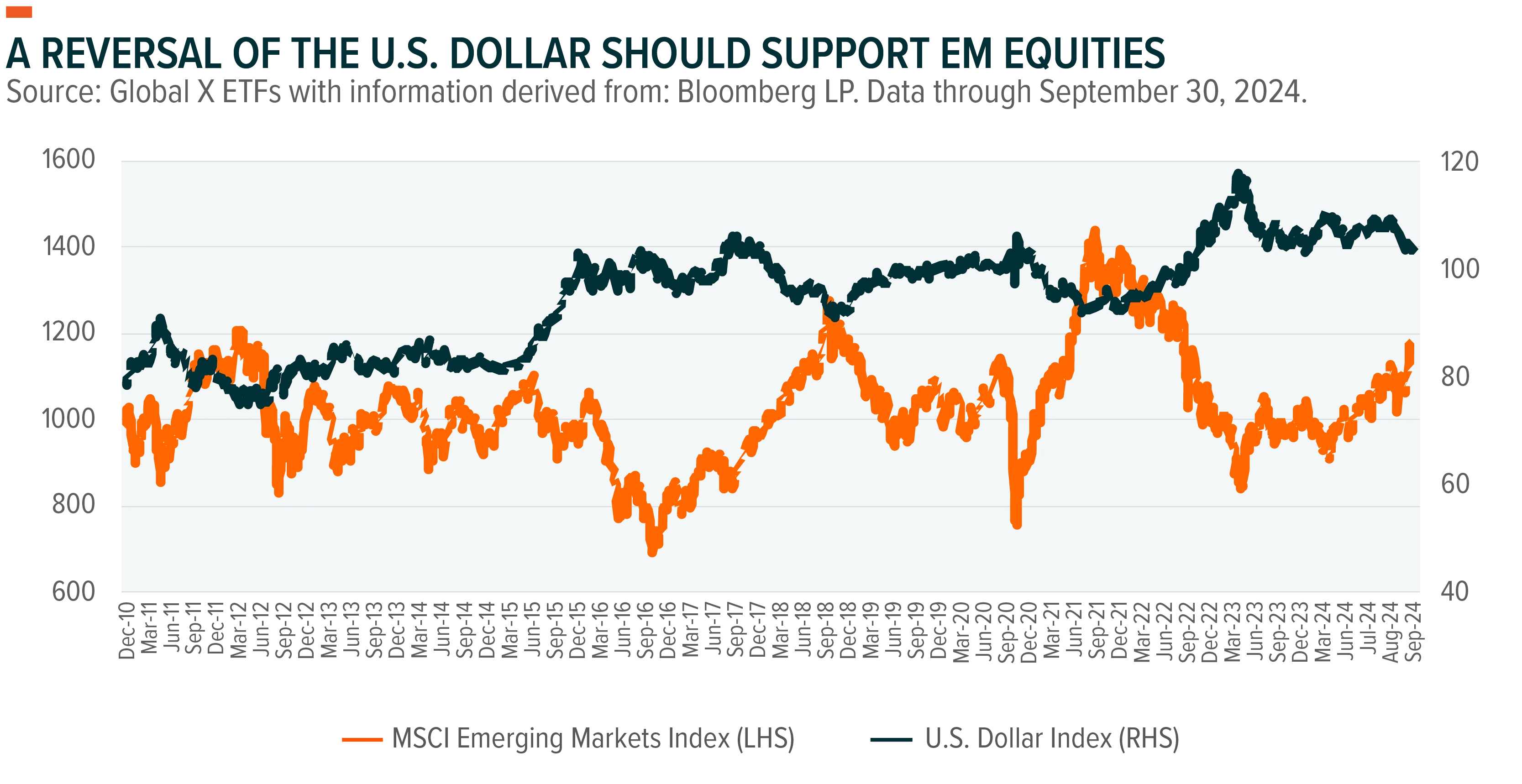
Second, the combination of easier monetary policy, incrementally slower U.S. economic growth, and a U.S. fiscal deficit not seen since the FDR Administration has led the market to reassess the sustainability of U.S. dollar strength.2 Historically, EM equities have returned roughly 3.5% for every 1% decline of the U.S. dollar.3
Third, China recently unleashed a powerful wave of monetary and fiscal stimulus, aimed to stabilize the economy and support consumption. This represents a meaningful change in policy for Beijing, with economic growth re-emerging as a government priority. Though the stars seem to be aligning for the asset class, we believe that consumption-oriented sectors should benefit most.
From a bottom-up perspective, Emerging Market consumption names can often fall into the “growth” category. This is due to low penetration rates, attractive demographics, and bright prospects for long-term growth. For analysts attempting to discount cash flows to assess a company’s value, this means that much of the intrinsic value comes from long-term cash flows, making these companies especially sensitive to discount rates. As interest rates come down, mathematically (holding everything else constant), this implies higher price targets and potential market re-ratings. We’re additionally optimistic on EM companies levered with floating rate debt that should see net interest expenses decline and earnings increase as interest rates fall.
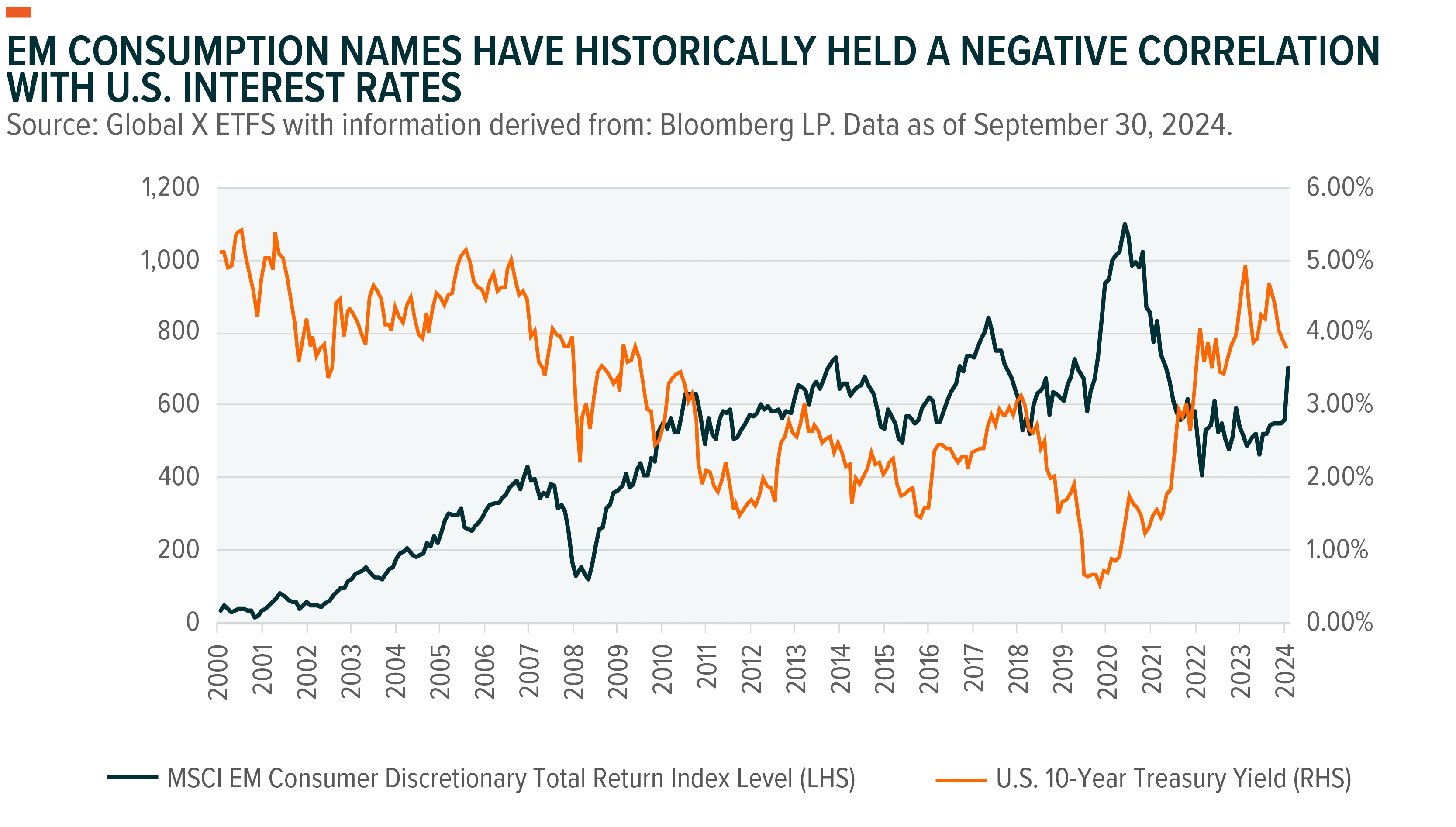
Looking at EM consumption from the top down, lower interest rates become a powerful driver as the reduction in individual debt burdens plus a lower cost of capital incentivizes consumers to borrow and spend again. When looking at financial companies, lower rates can also have a strong benefit to asset quality, as borrowers should have an easier time paying back their loans. This, coupled with rising real wages globally, represents a potentially powerful tailwind for consumption.4
Most Americans know the story of the U.S. baby boom. After WWII, birthrates in the U.S. surged, leading to population growth and increased demand for housing, education, healthcare, products, and services. This created employment growth and, in time, a significant expansion of the U.S. middle class. This growing middle class changed spending dynamics, as “Baby Boomers” looked to purchase homes in the suburbs, buy second cars, and take vacations. This created a virtuous cycle of employment opportunities, more discretionary income, and more consumption. The U.S. benefitted from 76.4 million babies born from 1946 through 1964.5 Global X believes there will be various similar economic patterns across Emerging Markets, as roughly five billion people are expected to be in the consumer class by 2031.6
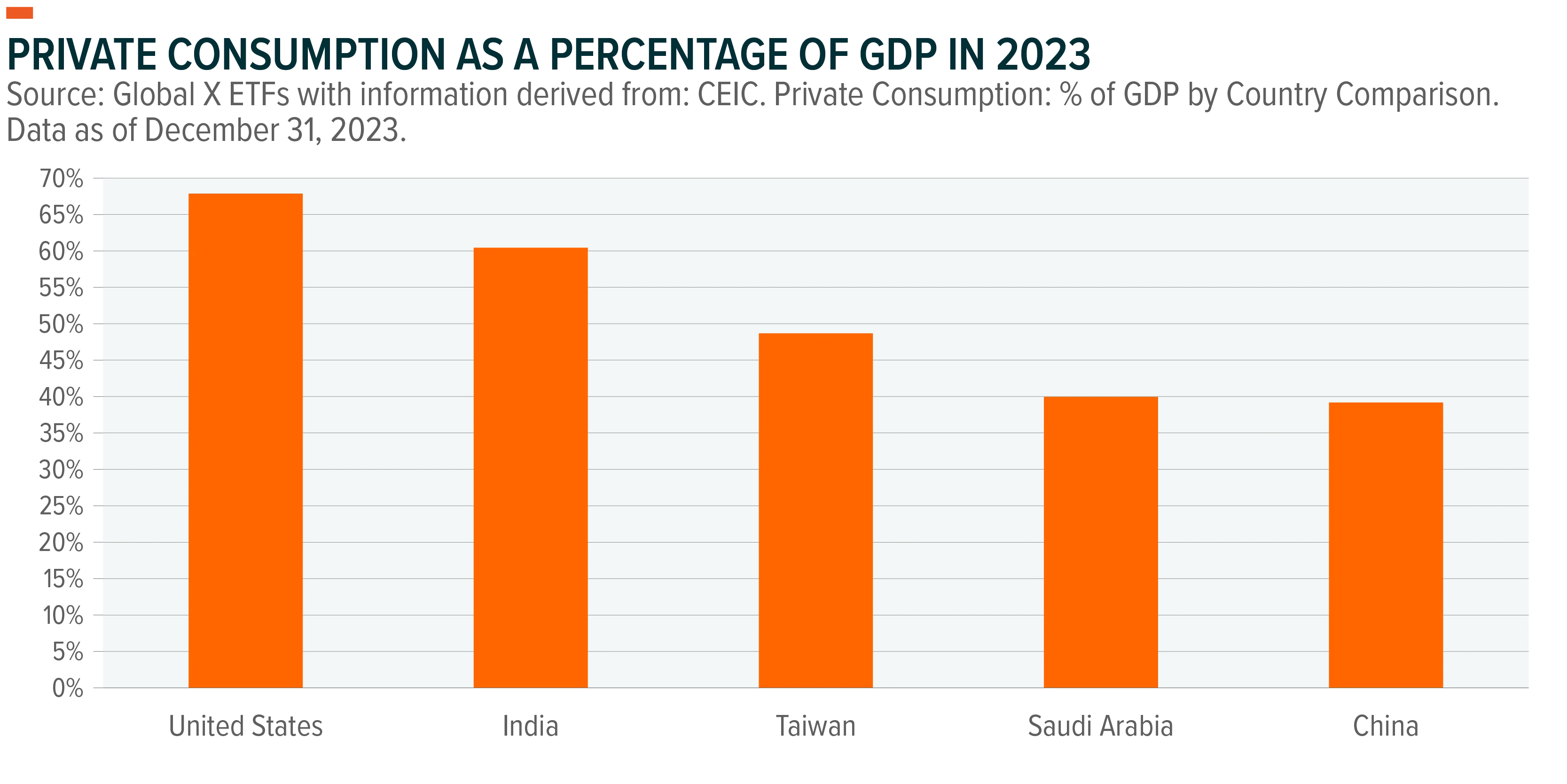
Within consumption, we include companies from sectors including Discretionary, Staples, Financials, Healthcare, Communication Services, Information Technology, and Industrials. Global X believes that focusing on consumption trends not only allows an investor to benefit from structural (and often more predictable) stories, but it also allows active managers to reduce exposure to commodities, which could reduce overall exposure to the volatility of commodity prices, the unknowns in trade rhetoric, and the variability in foreign exchange swings. Ultimately, we aim to reduce volatility and improve risk-adjusted returns within our actively managed EM funds.
1. CNBC. (2024, Sep 18). Fed Slashes Interest Rates By a Half Point, an Aggressive Start to its First Easing Campaign in Four Years.
2. Bloomberg LP. Data as of September 27, 2024.
3. Global X ETFs analysis of data from Bloomberg LP. EM Equities are represented by the MSCI EM Index and the U.S. Dollar by the DXY Index. 12/31/1999 through 08/21/2024.
4. Trading Economics. (2024, October 2). Wage Growth Forecasts 2024/25.
5. Population Reference Bureau. (2014, Apr 16). Just How Many Baby Boomers Are There?
6. World Data Lab. (2023, Jul 26). How The World Consumer Class Will Grow From 4 Billion To 5 Billion People By 2031.
Emerging Market debt had a volatile first quarter, as an initially supportive macro environment was rocked by an oil-driven geopolitical shock.
Emerging Market debt had a volatile first quarter, as an initially supportive macro environment was rocked by an oil-driven geopolitical shock.
The Global X Emerging Markets Great Consumer ETF seeks to tap into secular growth in domestic spending across emerging markets.
The Global X Emerging Markets Great Consumer ETF seeks to tap into secular growth in domestic spending across emerging markets.