

This piece is one in a series that delves further into the leading themes emerging from this year’s iteration of our flagship research project, Charting Disruption.
Innovation has a physical supply chain. From AI and robotics to defense tech, electrification, and manufacturing, scaling new technologies and infrastructure requires materials such as copper, lithium, and rare earths, as well as reliable water for uses such as data center cooling. As adoption and infrastructure development accelerate, securing these inputs is becoming more challenging: mineral production and processing are concentrated in a handful of countries, new mines can take years to develop, and water availability can shape where resource-intensive projects are viable. If access falls short, projects may face higher costs or delays, and geopolitical disruptions could constrain the rollout of technologies and infrastructure. Resource access can shape not only what gets built, but how quickly and where. Meeting future demand will likely require investment in mineral production and processing, alongside technologies that improve water availability and use.
Key Takeaways
Demand for critical resources such as copper, lithium, and rare earths is expected to rise through 2040 as mineral-intensive technologies and infrastructure become more integrated into the global economy.1
Data center growth is bringing water availability and cooling-system choices into sharper focus, as system design can affect facility water needs. Global supply chains may fall short of required demand, with the potential for double-digit deficits to emerge by the mid-2030s.2,3 Filling the gaps to meet demand could require nearly $550 billion in new investments through 2040 across just the copper, lithium, and rare earths value chains.4
Government efforts to diversify supplies and reduce reliance on only a handful of countries could create new opportunities for resource providers, particularly rare earths.
Critical Resources Are at the Core of AI Advancement and the Modern Economy
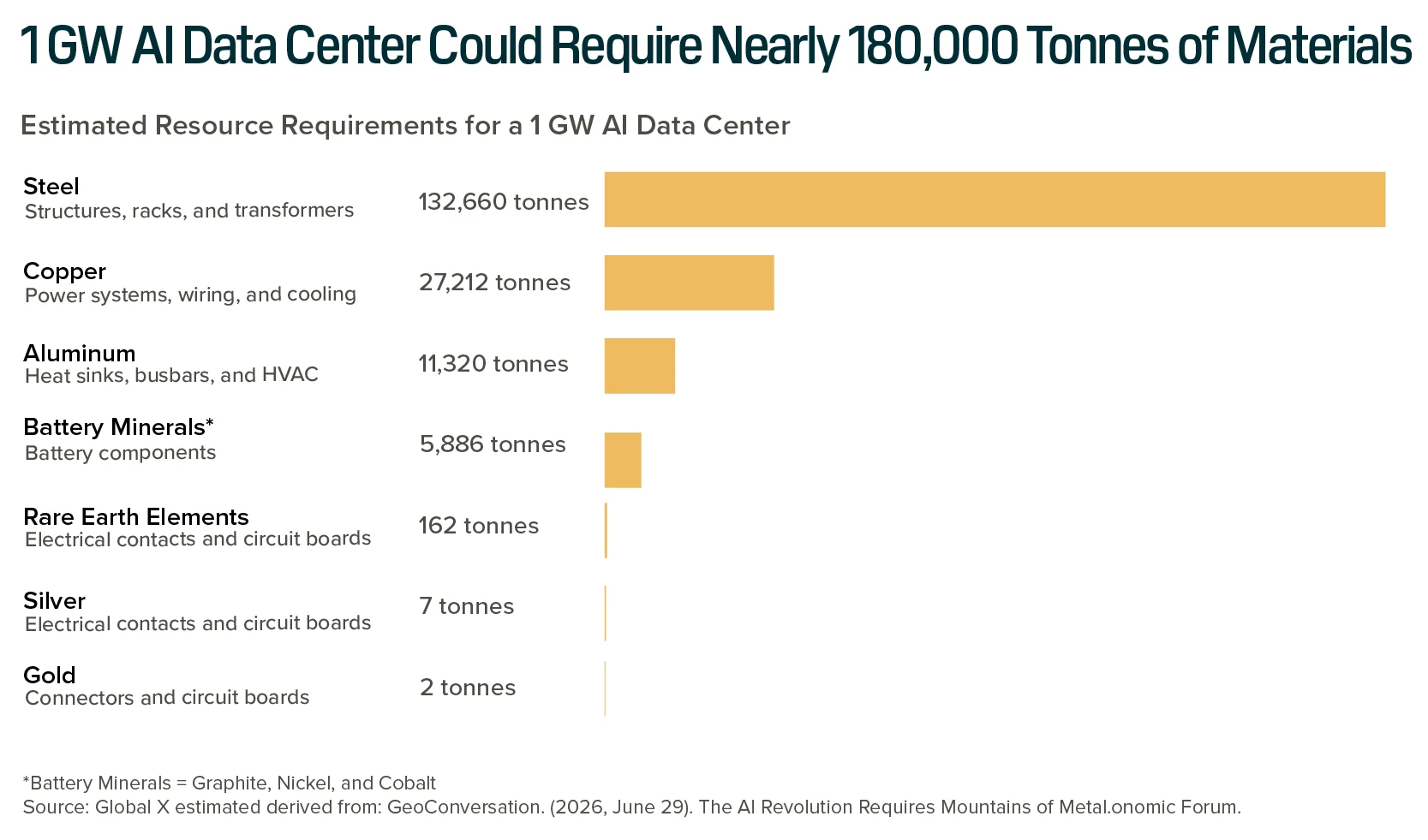
The AI, defense, mobility, power, and manufacturing industries are resource-intensive, creating significant reliance on global critical resource supply chains. For example, a 1 GW data center can require nearly 180,000 tonnes of materials, including nearly 133,000 tonnes of steel, 27,212 tonnes of copper, and 162 tonnes of rare earth elements, among others.5 Data centers can also depend on water availability, depending on the cooling system installed.
Defense technologies such as fighter jets and submarines often require hundreds to thousands of kilograms of rare earth elements, with their magnetic and filtering properties being essential to motors, radar, targeting systems, and other onboard technologies.6 Electric vehicles (EVs) can require over 5x as many minerals as a comparable internal combustion engine vehicle, while wind and solar systems also require more minerals than their fossil fuel-fired counterparts, including rare earths.7
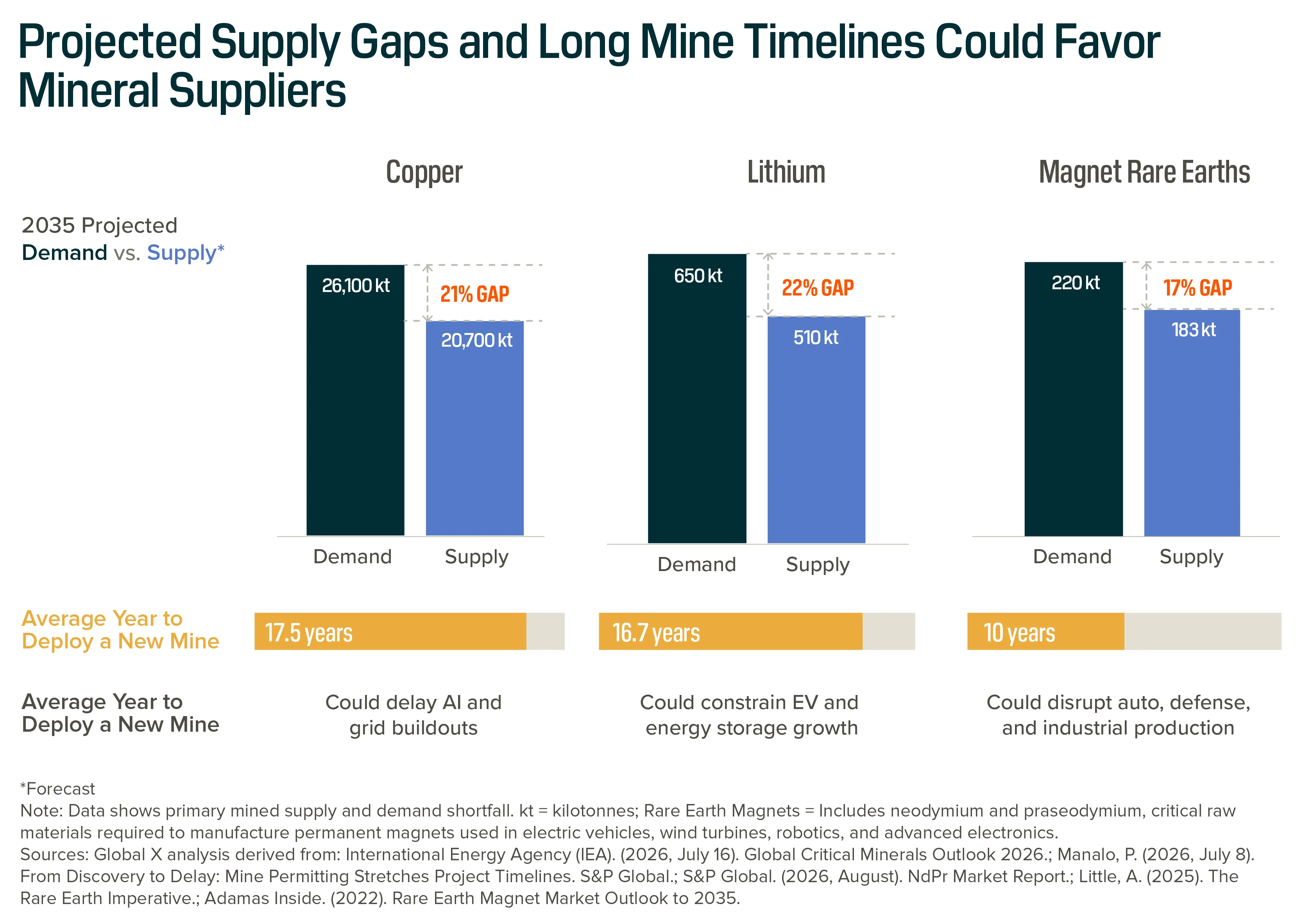
Supply chains for several of these resources, however, may fall short of future demand levels, due to lengthy mine development timelines, years of underinvestment, and geographically concentrated supply chains. Given current mines and project pipelines, mined supply shortages of 17% to 22% could exist by 2035 for copper, lithium, and rare earth elements.8,9 With new mines taking a decade or more to build, investments must be made immediately to avoid prolonged shortfalls that could slow innovation globally.10
Copper: Data Center and Power Grid Construction Could Build on an Already Large Base
Copper’s conductive properties make it one of the most important materials of the modern world. Everyday economic uses should remain the foundation of copper demand, but emerging technologies and rising grid infrastructure investment are becoming increasingly important drivers of consumption.11 Between 2025 and 2040, global copper demand could increase 50%, facilitated by higher spending on energy infrastructure and electrification, AI and data centers, and defense. In total, nearly two-thirds of forecasted demand growth could be driven by these three end-use segments.12
The world’s growing copper needs are materializing just as copper supplies are beginning to tighten. In the coming years, global copper supplies are expected to fall as existing mines age, ore grades decline, and new mines are slow to come online.13 On average, it takes more than 17 years to deploy a new copper mine due to permitting delays, regulatory uncertainty, and rising costs. By 2035, a 21% supply gap could emerge between primary mined supply and demand, highlighting the urgency for new investment into copper production.14 Over the next decade, the widening deficit could increase the value of existing production, creating opportunity for miners who invest in capacity now.
Lithium: Near-Balanced Market Leaves Little Room for Shifts in Supply and Demand
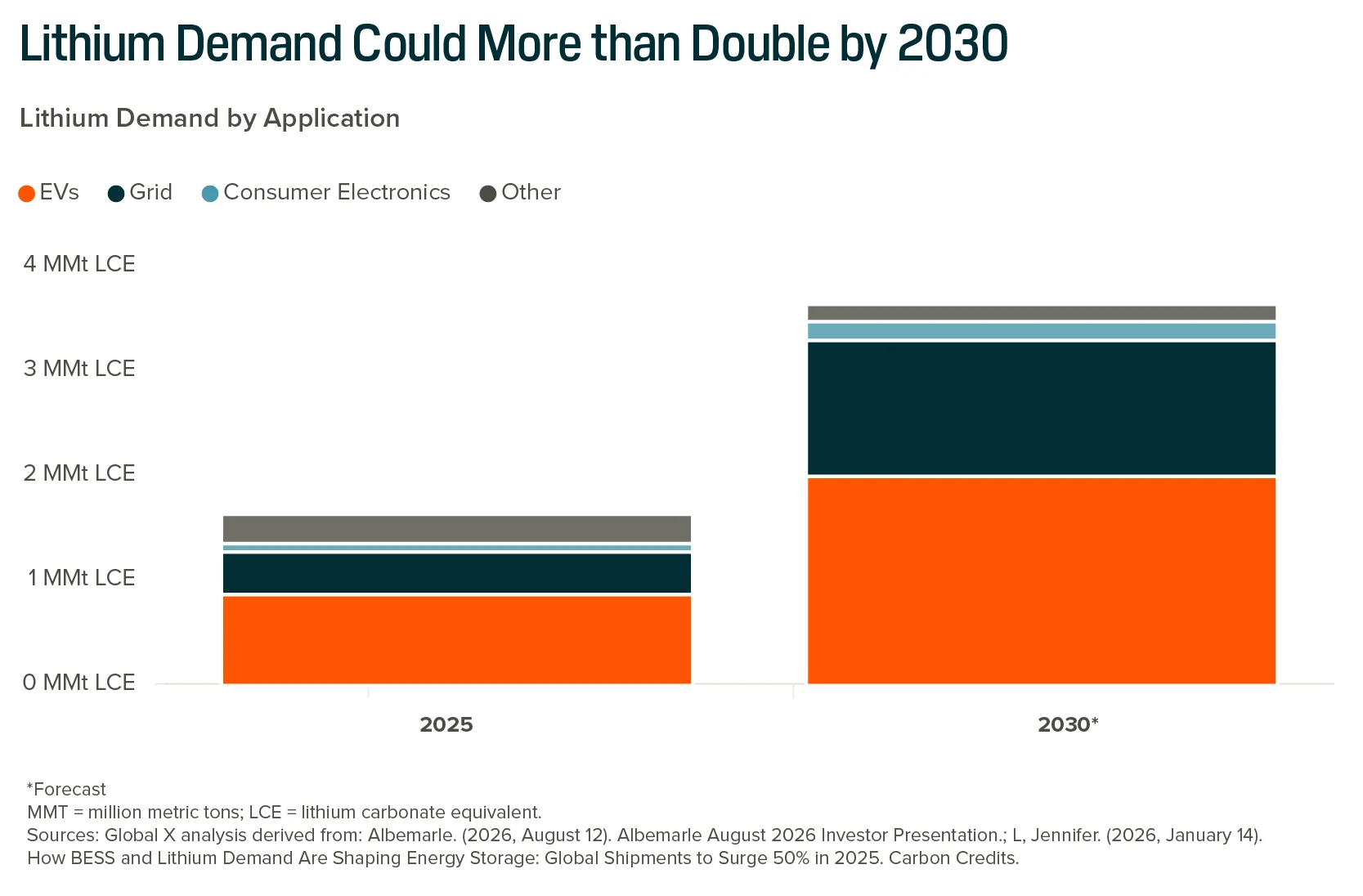
Lithium’s key role in many battery technologies makes it another important material for the buildout of grid infrastructure, as well as the electrification of the mobility sector. Lithium demand could more than double between 2025 and 2030 to reach 3.6 million metric tonnes of lithium carbonate equivalent (LCE) by 2030, with EVs and energy storage expected to account for more than 90% of global demand. Long-term tailwinds for lithium miners remain robust, with accelerating battery storage adoption adding to EV demand.
On the supply side, government regulations in China and Zimbabwe have led to a tightening supply environment since 2025.16 A modest surplus is forecast from 2028 to 2034, but it may offer little cushion if EV and energy storage demand outpaces expectations or new projects are delayed. Lithium mines take nearly 17 years on average to develop, so supply cannot quickly adjust when the balance shifts.17 That long response time makes producers able to bring reliable capacity online strategically important, even as the market moves in and out of balance.
Rare Earths: Highly Concentrated Supply Chain Creates Risks for Next-Gen Tech
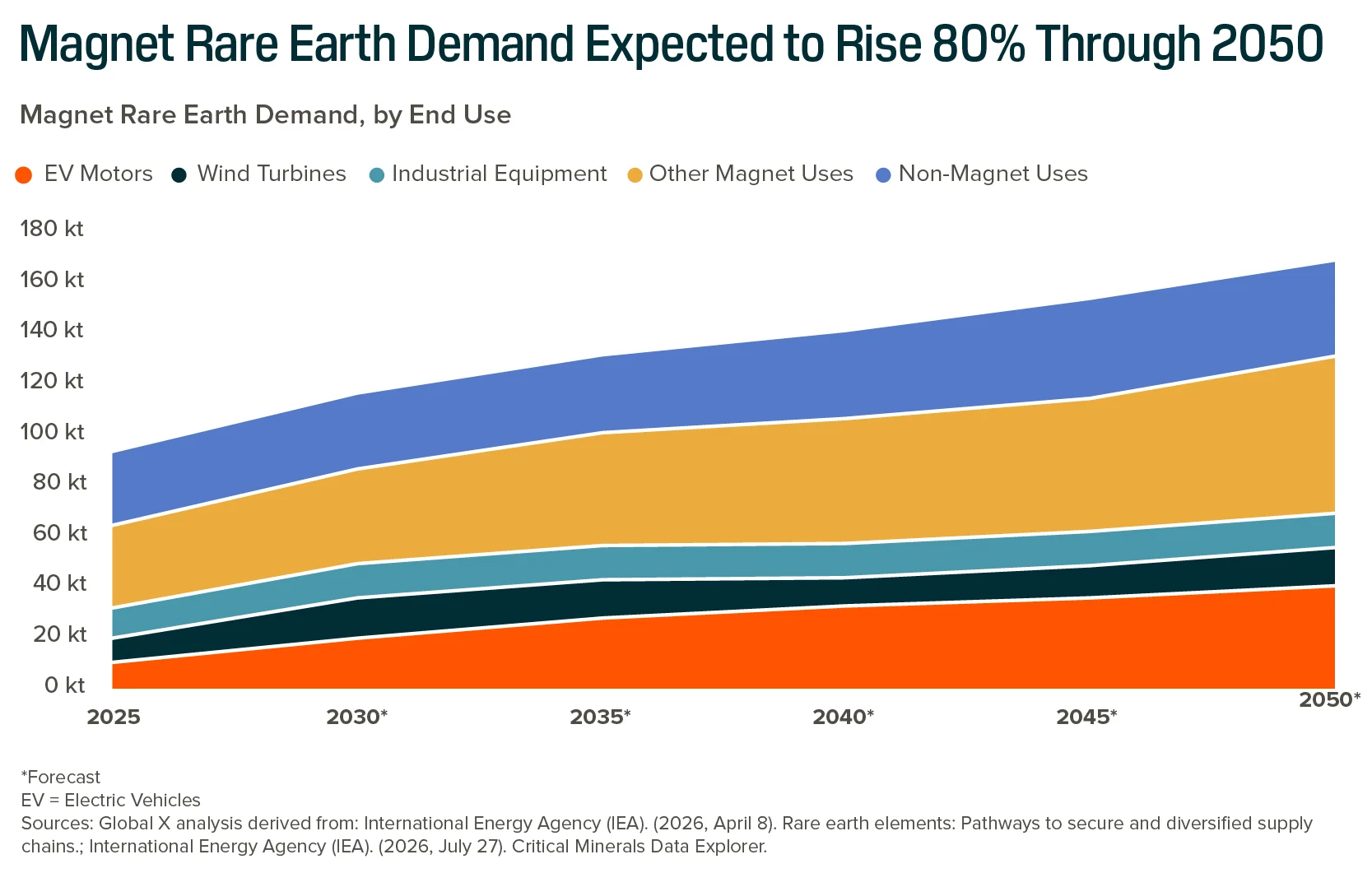
Rare earth elements have fluorescent, conductive, and magnetic properties that make them useful in more than 200 products and processes, such as motors, ceramics, electronics, sensors, defense technologies, and petroleum refining. Magnet rare earths, such as neodymium, praseodymium, terbium, and dysprosium represent one of the largest opportunities within the rare earths landscape, given their vital role in EV motors, wind turbines, and defense technologies. Global demand for magnet rare earths is forecast to increase 80% from 93kt to 168kt by 2050.18
However, by 2035, the magnet rare earths market could face a 17% supply deficit.19 In addition to these primary supply risks, the rare earths supply chain is highly concentrated, with China controlling 85% of refined rare earths production and 94% of rare earth permanent magnet manufacturing.20 In 2025, China introduced export controls, posing a risk to global supply chains for both rare earths and the technologies that are reliant on them.21 The total economic value of production that relies on rare earth exports from China is $6.5 trillion per year.22 Given that rare earths are essential to energy security, defense applications, and economic growth, many governments are bolstering policy efforts that support domestic rare earths production and processing, creating new opportunities throughout the value chain.
Clean Water: Demand From AI and Industry Is Meeting Supplies Already Under Strain
Water is an input to many of the same technologies driving mineral demand. Data centers can use it for cooling, and nuclear power generation depends on it.23 Water constraints tend to be local, shaped by aging infrastructure and by whether supplies sit near new demand. About two-thirds of new U.S. data centers built or in development since 2022 are in areas of high water stress, and data center capacity across 15 major global markets has nearly doubled since Q1 2023.24,25
These pressures add to a broader need for water infrastructure. The World Bank estimates that $6.7 trillion of water-related infrastructure investment will be needed by 2030, rising to $22.6 trillion by 2050, and notes that about 85% of annual water-sector spending still comes from the public sector.26 Investment is largely directed toward upgrading and expanding treatment, distribution, reuse, and efficiency systems. Companies that provide clean water technologies and services could benefit as that spending scales.
Conclusion: A ~$550B Opportunity for the Building Blocks of Disruptive Technologies
Demand for critical resources could surge as AI adoption accelerates, electrification progresses, and defense remains a key focus for many governments.27 Being able to meet the rising demand and reduce supply chain risks will likely require immediate and sustained investment across the value chain, from mining to processing. Through 2040, the copper, lithium, and rare earths industries could require nearly $550 billion in total investment, with other critical resources, such as clean water, expanding the opportunity even further.28,29 For investors, the resource challenge spans a broad value chain, from companies producing and processing critical materials to those developing solutions for water access, treatment, and efficiency.
For additional insights, please view our full report, Charting Disruption: Outlook for 2027 and Beyond.