For a market delivering record mid-cycle earnings growth, the apathy and indifference seem palpable. We hear anecdotal stories of allocators neutralizing equity overweights, adding duration, and looking for strategies to increase diversification. While these are perfectly reasonable risk management approaches, the unasked question is why investors are increasingly doubtful at this point in the cycle going into earnings season.
Let’s do a quick review. Companies have delivered the fastest pace of mid-cycle earnings growth in 40 years.1 Large-cap equities have had multiples on 2026 and 2027 earnings contract, making stocks cheaper than they were at the start of the year.2 Nominal GDP growth has trended higher while real GDP has largely remained steady.3 The Bloomberg recession indicator is at a mere 20%.4 The job market is not exceptional but seems healthy enough.5 Consumers continue to spend despite inflationary pressures.6 Corporate profit margins near record highs suggest real, measurable productivity growth across the economy.7
Of course, investors should monitor several areas of concern. Inflation likely means higher rates, which could drag down growth.8 Geopolitics, including an escalation in international affairs and the coming U.S. midterm elections, add uncertainty. The sustainability of AI investment and the recent decline in market breadth amplify concentration risks.9 That said, we believe the backdrop is supportive for a continued advance in equities, especially amid earnings season, which might offer key glimpses of 2027 forecasts.
Key Takeaways
Investor sentiment waned through the summer as market breadth narrowed despite otherwise positive economic and corporate signals.
The setup for Q3 earnings remains attractive, but market performance likely hinges on the sustainability of the AI capex cycle.
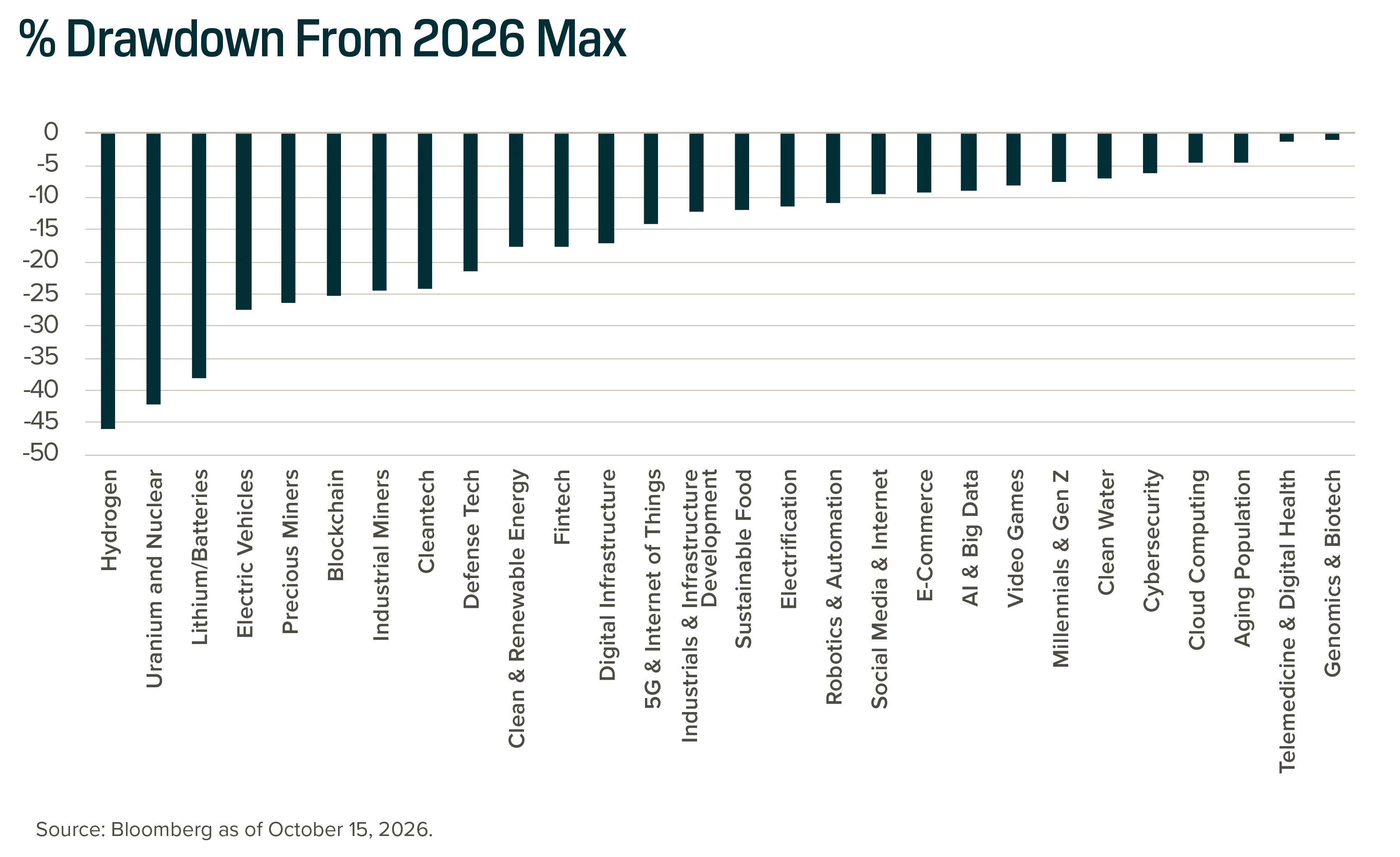
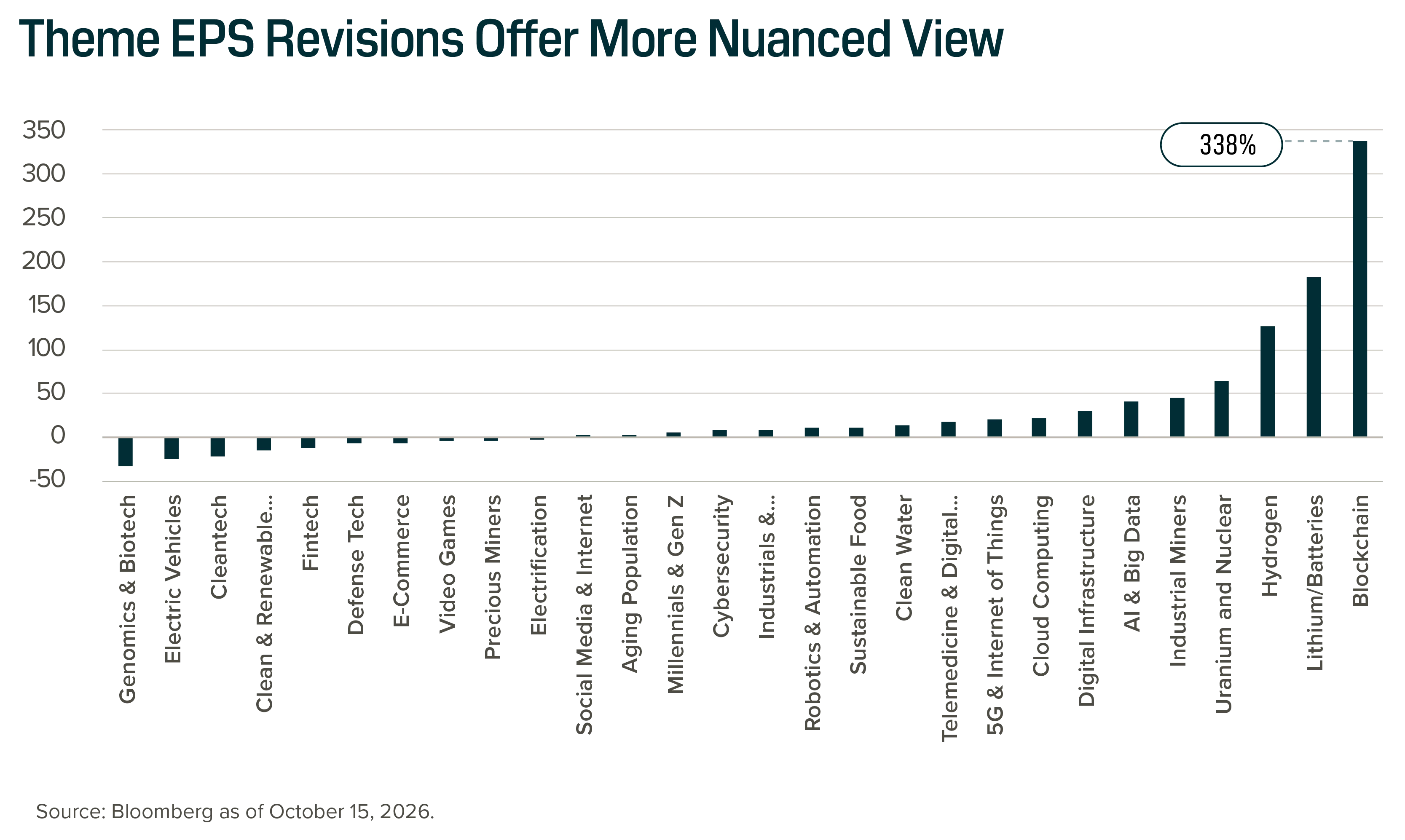
Many of the themes that have experienced the sharpest drawdowns in 2026 have also seen the largest earnings revisions, potentially creating attractive entry points.
Creepy Crawly Sentiment
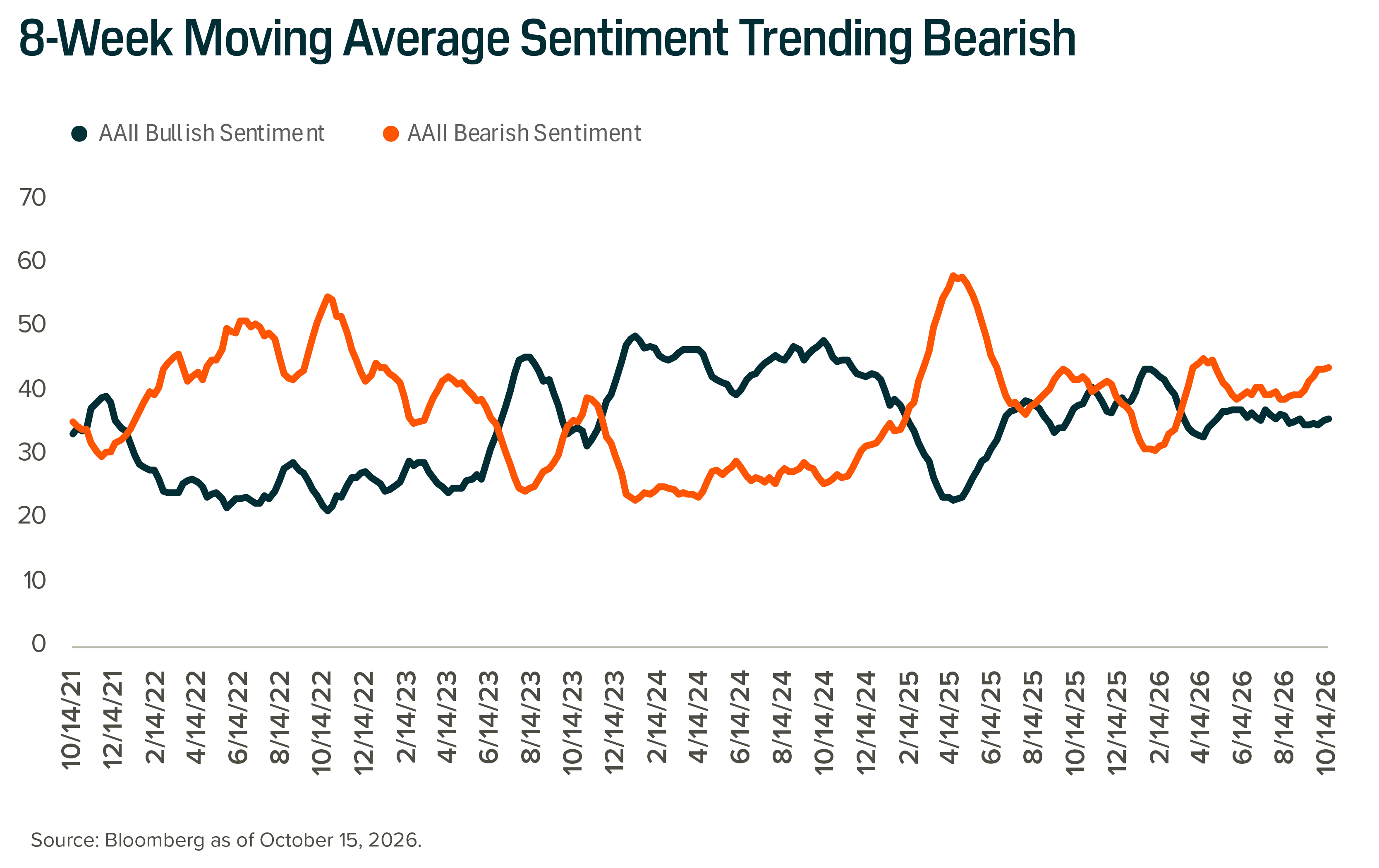
The market tends to climb the wall of worry in bullish periods, and this one is yet another example. Investors, however, are increasingly skittish. Bearish sentiment in the American Association of Individual Investors (AAII) survey rose above bullish sentiment in late March and more recently has been trending higher.10
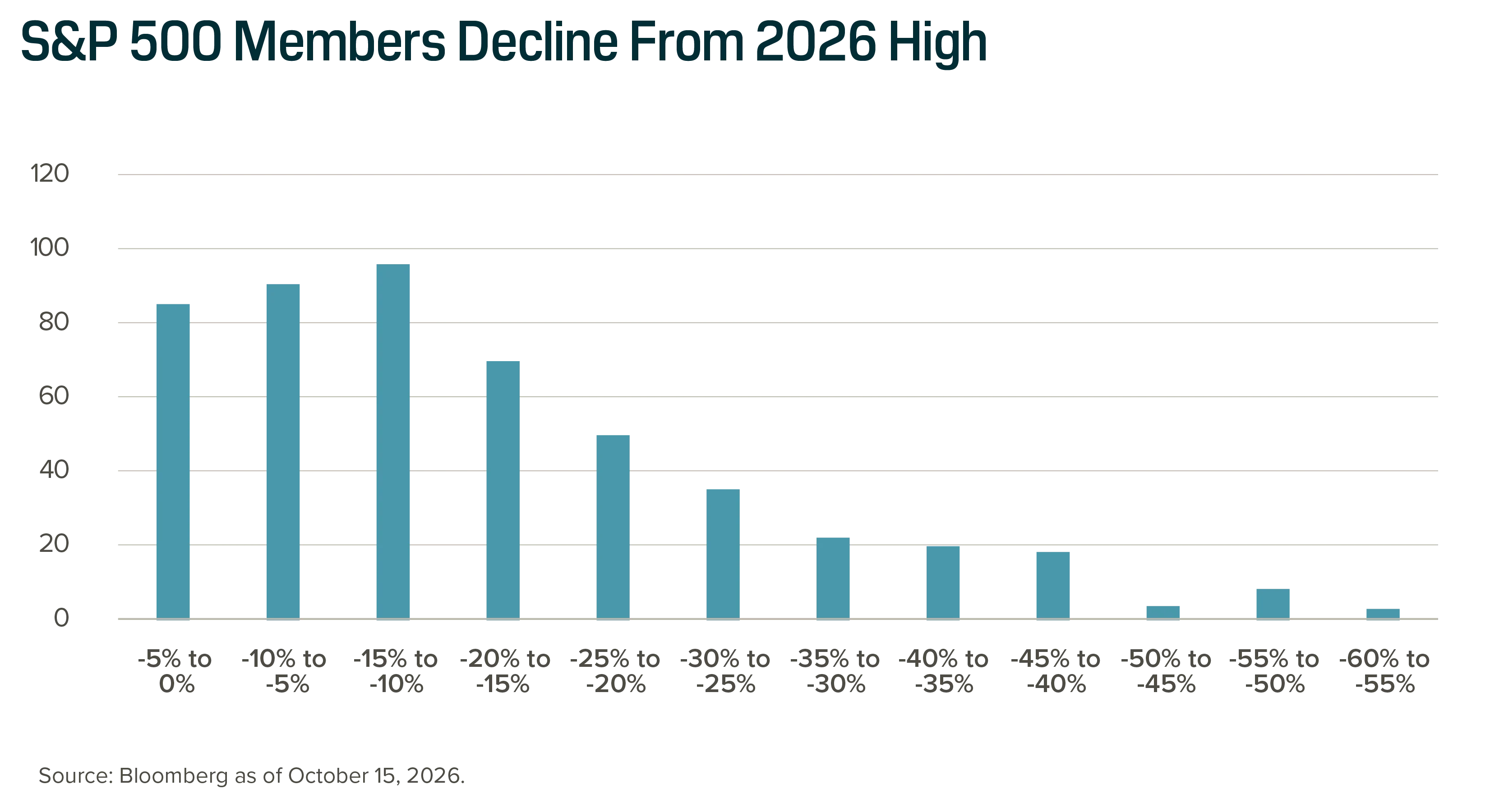
There are plenty of potential culprits behind this uneasiness, and one that has garnered headlines is narrowing market breadth. About a third of S&P 500 stocks are now in bear market territory, having moved down by 20% or more from 2026 highs.11 This divergence has investors concerned that the underlying corporate fundamentals might not be as strong outside of the AI and data center trades, yet companies have not revised down expectations.12 These steep drawdowns are worth monitoring, but they might not be as dangerous a warning signal as some believe.
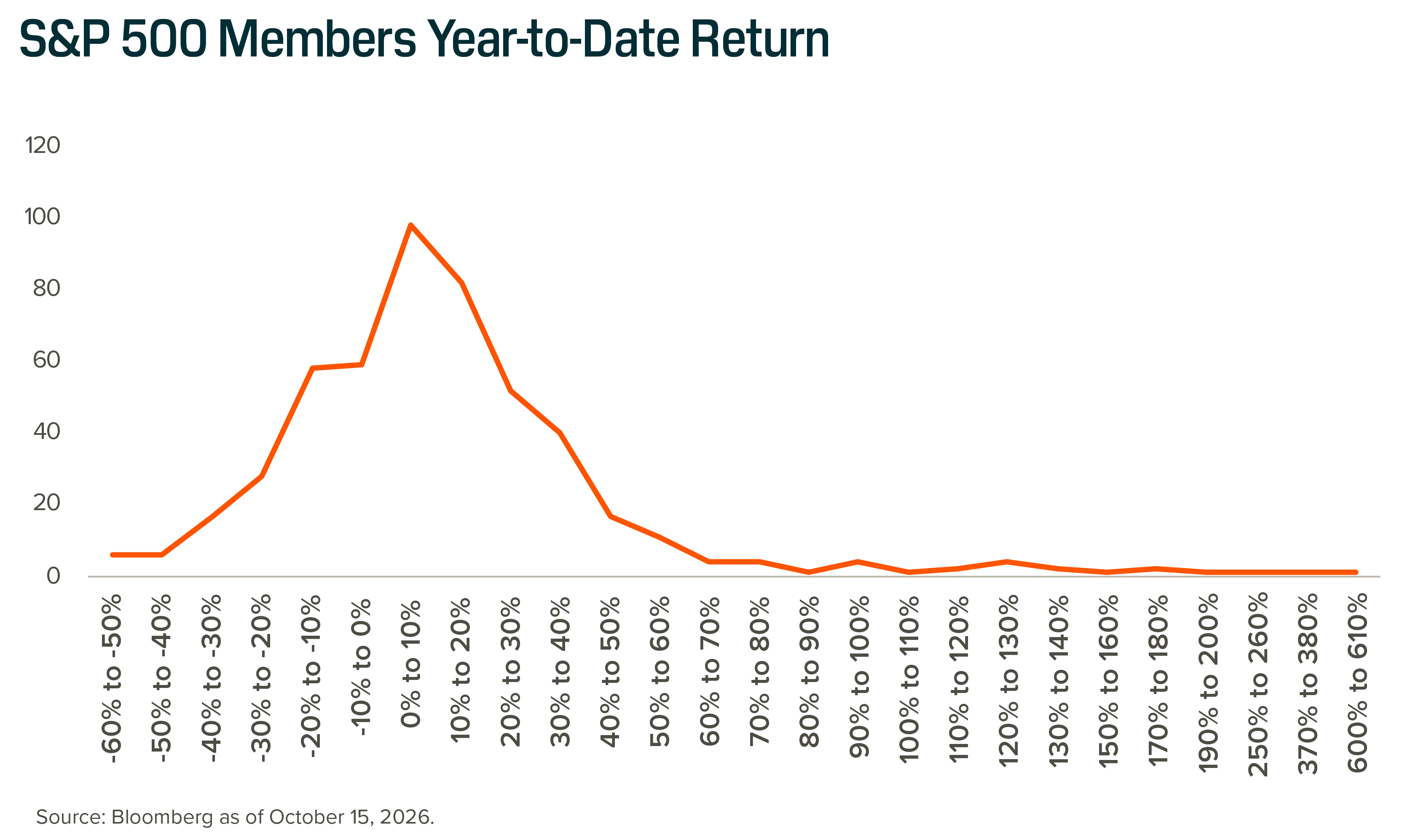
Around two-thirds of S&P 500 stocks are still delivering positive returns year-to-date, and 70% of those in positive territory are up more than 10%.13 So, relative to highs, there is some weakness in the market, but most constituents continue to deliver decent returns. Considering the reasonably broad move higher, the relative fear and discomfort that seems pervasive in the market may be more behavioral than fundamental.
Trick or Treat This Earnings Season
The general malaise or sense of caution is particularly interesting given the strong fundamental setup, highlighted by an earnings engine firing on all cylinders. A couple of weeks into third-quarter earnings season, and companies are delivering on lofty expectations with sales growth up double digits and margins still healthy despite inflation pressures across the supply chain.14
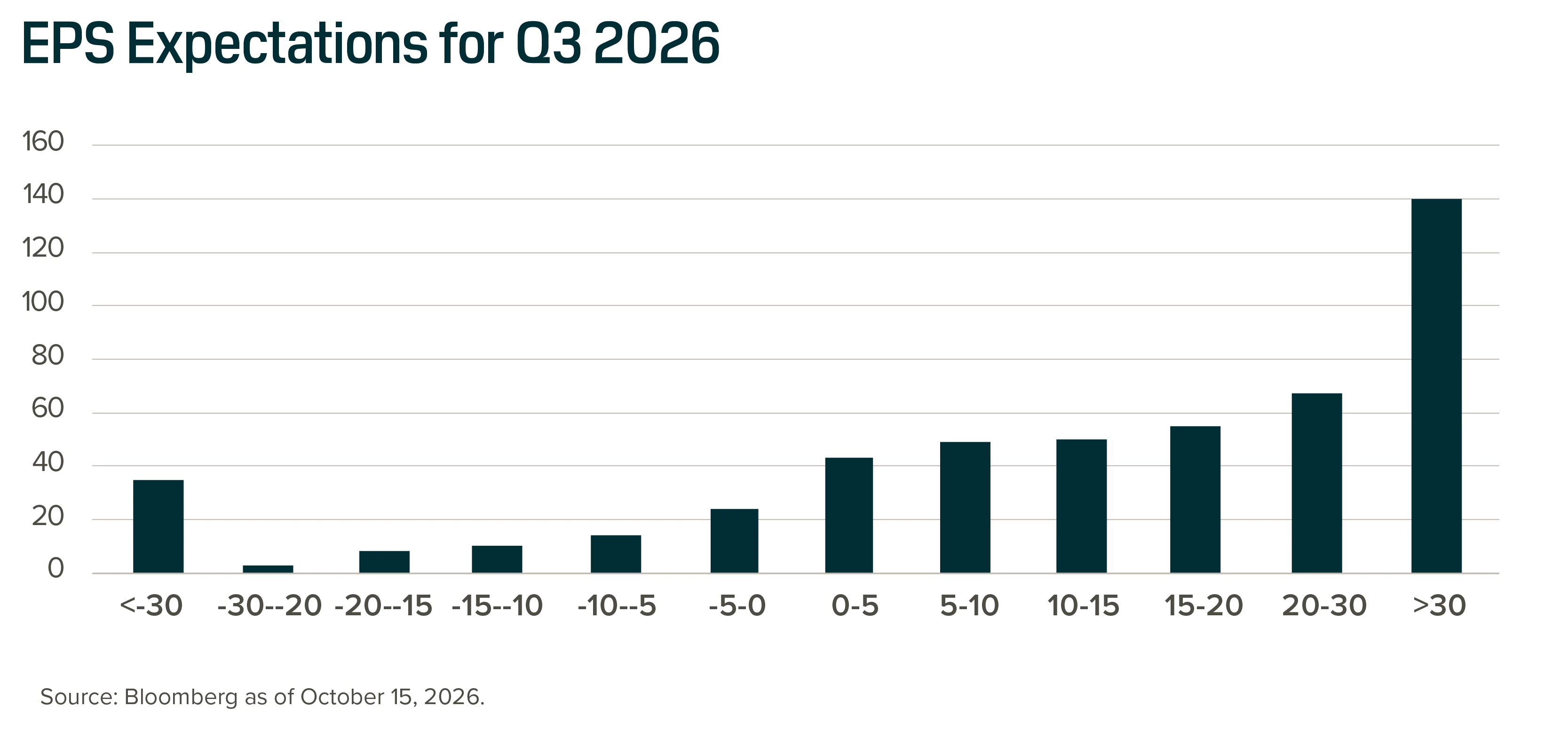
Current forecasts call for 80% of the S&P 500 to deliver positive quarterly year-over-year earnings growth, with 140 companies expected to deliver EPS growth above 30%.15 The average consensus price target on S&P 500 stocks is for 18% appreciation, with 454 of them expected to deliver positive returns.16
And this is not a one-quarter story. S&P 500 companies are delivering the fastest earnings growth in almost 35 years without a recession.17 The only periods where earnings growth exceeded the current 2026 estimate of 25% were following the 1991 recession, the 2001 dotcom bust, the 2007-08 financial crisis, and the 2020 COVID shutdown. Since 1990, there are no instances of large companies delivering this type of earnings acceleration in the middle of an economic cycle, and certainly not at the end of one.18 It would be unusual to see this type of earnings performance ahead of a recession or meaningful slowdown.
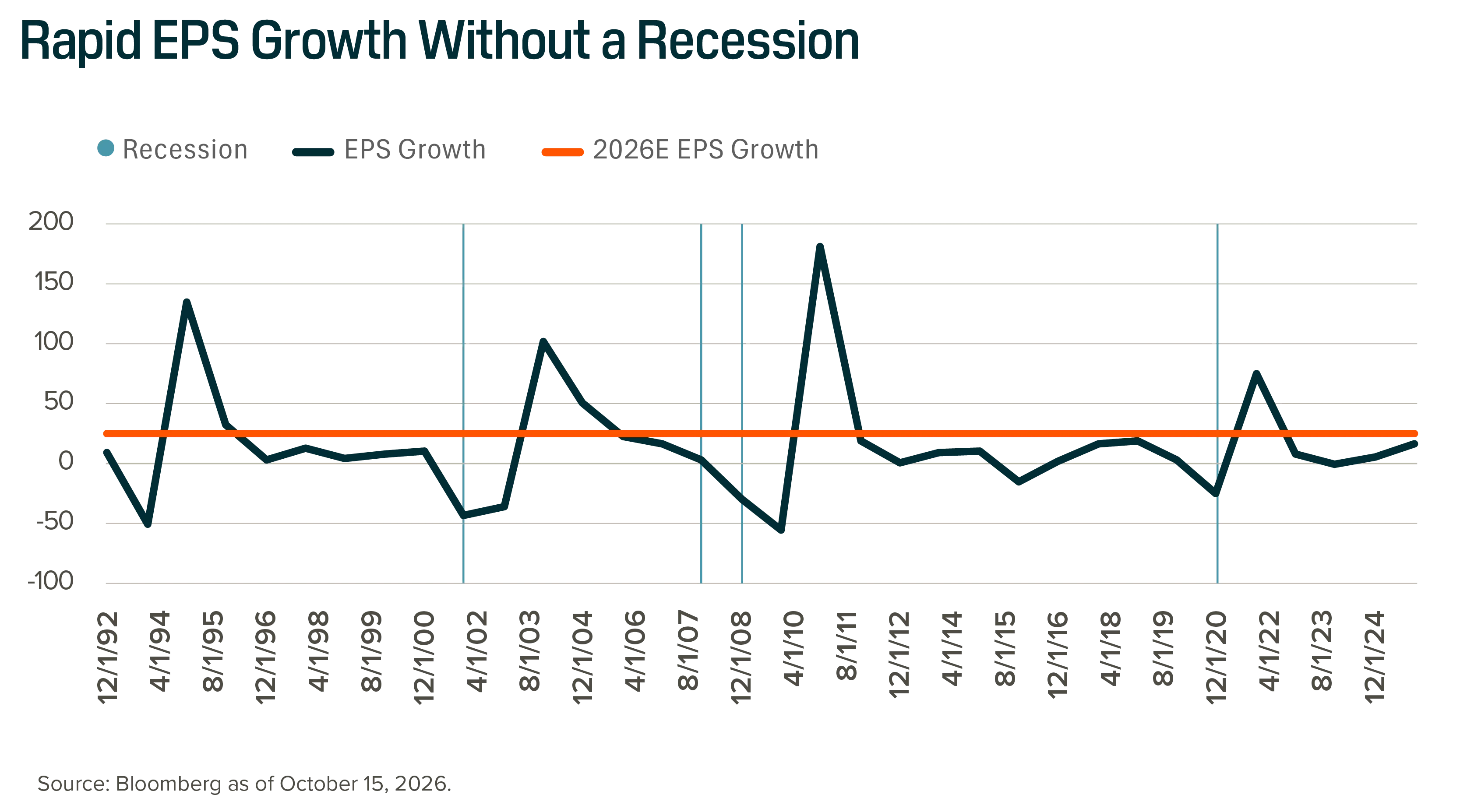
Earnings will likely overshadow macro data over the next few weeks, but expectations around the sustainability of the AI investment cycle will likely overshadow earnings. Based on investor behavior in 2026, those expectations are set to cast a long shadow. Aside from the midterm elections and higher long-term rates, this fall’s market jitters may stem from a growing discontinuity between expectations across economic investment and capital expenditures.19
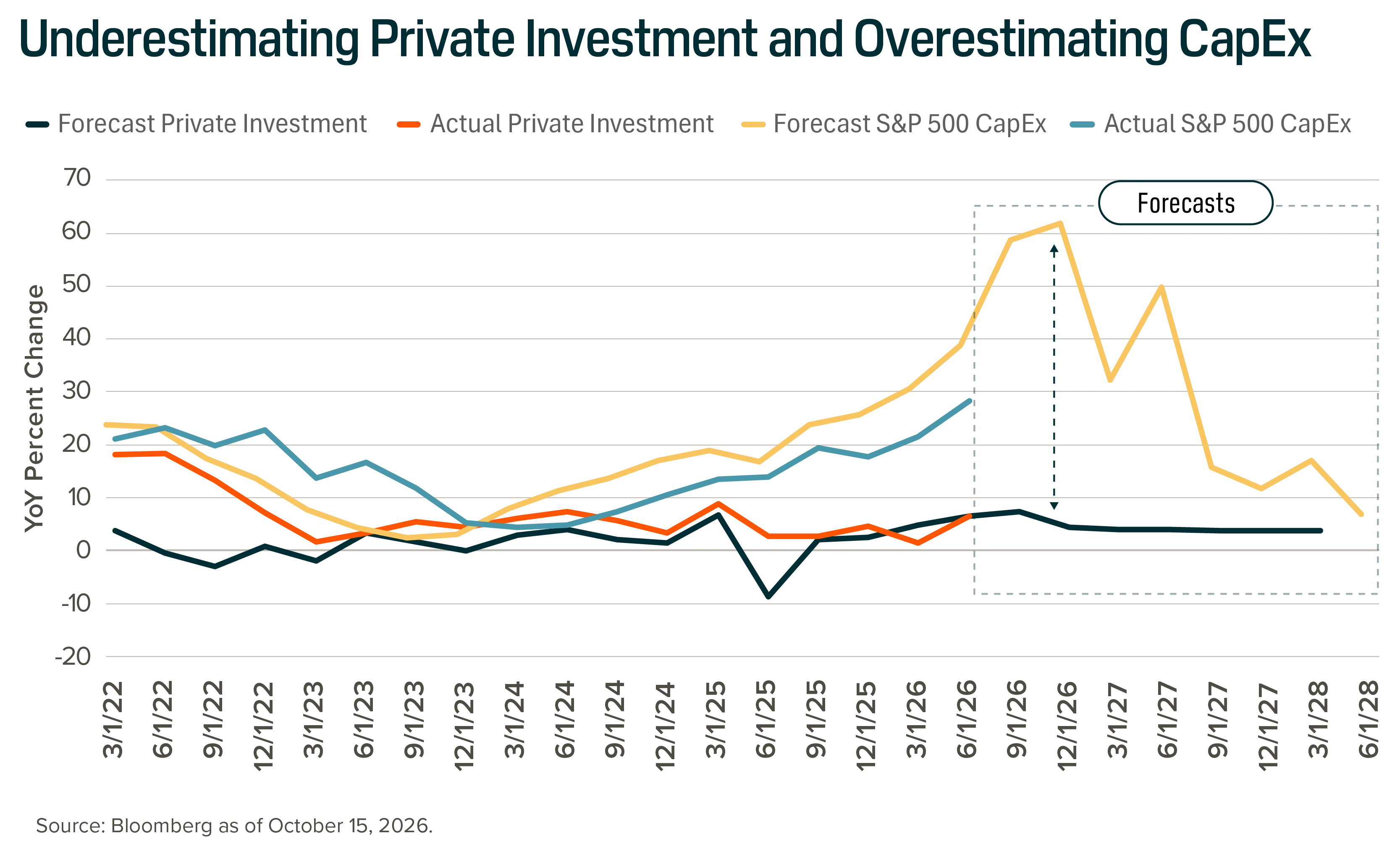
A quick glance might leave the impression that economists and analysts don’t talk to each other. Economists project investment growth around 3.8% through 2027 and 2028.20 Meanwhile, corporate forecasts call for a massive increase in capex through next year before spending starts to slow, but remains positive, in 2028.21 Both projections probably can’t be true. Either the capex spending boom materializes, meaning investment forecasts are too low and GDP continues to accelerate, or the macro forecasts point to lower capex spend that results in slower cash burn and improved profitability.
We think that capex materializes and growth expectations are too low, though a slower cash burn and higher margins would also be a good outcome.
Also notable is a systemic tendency for forecast error. Macro investment forecasts have consistently come in too low, leading to upside surprises in both investment and GDP.22 Corporate spending forecasts have tilted in the other direction, overestimating corporate spend.23 The good news is that corporate spending may be getting more efficient in driving improvements or returns to investment, potentially a positive indicator for the AI capex cycle’s sustainability.
Sorting the Sweets
We are generally fans of stepping into markets when fear is running high, especially when the macro signals are markedly positive. In a nervous market like this one, why not look for opportunities in themes that have sold off while also undergoing positive earnings revisions?
Keep in mind that many of these themes delivered performance in the year and months before their drawdown, which suggests potential opportunities in areas that are not obvious at the index or sector levels. Materials and industrials stand out. Uranium and nuclear, lithium and battery, industrial mining like copper, and defense themes are all in correction territory despite favorable conditions on supply shortages.24 The data center and digital infrastructure themes along with U.S. infrastructure could also offer interesting entry points.25
Positive revisions so far this year support many of the same themes. Lithium and battery, uranium and nuclear, industrial mining, and data center companies have had some of the strongest revisions.26 Positive revisions are worth noting across AI, cybersecurity, and the cloud as well.27
Like always, investors should be tracking risks, but in markets like this one, opportunities often lurk in the shadows.