
Thought LeadershipMacroeconomic
Iranian Revelation: Strategic Tops Tactical
S
Scott Helfstein
Mar 4, 20264 min read
Copyright © 2026 Global X. All rights reserved.
SEI Investments Distribution Co. (1 Freedom Valley Drive, Oaks, PA, 19456) is the distributor for the Global X Funds.
Check the background of SIDCO and Global X's Registered Representatives on FINRA's BrokerCheck.
Get the latest news and updates from our team.
Scott Helfstein
Multiple authors
Higher volatility was our base case for 2025—and here it is.1 The economic and fundamental backdrops are still reasonably sound, but persistent inflation, higher rates, uncertainty around tariffs, and cuts to government spending will almost certainly be omnipresent factors over the coming months. Whether the financial market–White House honeymoon came to an early end after four weeks or not, there is a very real and consequential race underway to see if meaningful economic public policy success can outrun waning animal spirits.
Psychology plays an important role when investing.2 It’s not easy to keep calm when markets turn volatile, especially in a time of rapid technological change and opaque public policy. Case in point: the recent volatile mix of the DeepSeek launch, tariff threats, spending freezes complete with mounting lawsuits, and confused messaging across departments from defense to energy.
While there seems to be little stability on the horizon, the economic dynamism of the day should not be discounted. Multiple shocks have moved markets temporarily, but fundamentals continue to win out and provide much-needed ballast.3 For investors, times like these are reminders that to keep investing basics top of mind: stay diversified to help stay calm.
The DeepSeek rollout and major public policy reversals delivered sharp but short-lived market drops in recent weeks.
The downshift in sentiment across consumers, small businesses, and investors in recent weeks could increase market vulnerability to shocks as the new administration clarifies the path forward on tariffs, taxes, and spending.
High volatility can be unsettling, but a range strategies and themes have the potential to reduce portfolio risk without sacrificing growth.
For all their benefits, technological innovation and scientific breakthroughs can be tumultuous, stalling and lurching forward unexpectedly.4 This reality was on full display when the market opened lower on Monday, January 27, after the newly released DeepSeek AI app surpassed ChatGPT as the top download the prior weekend.5
Using an older generation of Nvidia graphics processing units (GPUs) at a training cost of about $6 million, the China-based startup was able to produce an AI that reportedly functioned on par or better than U.S.-developed counterparts.6The alleged key to DeepSeek’s success involves deemphasizing upfront training, an expensive and compute intensive process leveraged by many other AI developers. DeepSeek relies on intense inference loops where the model can quarry itself to refine the output. The reliance on inference may well prove an important breakthrough that leads to more efficient training and query.
On January 27, the S&P 500 and the Nasdaq opened down 2% and 3%, respectively.7 Tech-related themes involving AI and cloud services, data centers, robotics, and the internet of things move sharply lower, as did energy-related themes. The concern was that DeepSeek would render much of mega-cap investment in digital infrastructure such as chips and data centers unnecessary. By Friday, January 31, data centers were still lower, but AI companies had recovered much of their loss. Cloud and cybersecurity notched gains on the week as the market began to view the specter of more efficient AI with lower start-up costs as positive.8
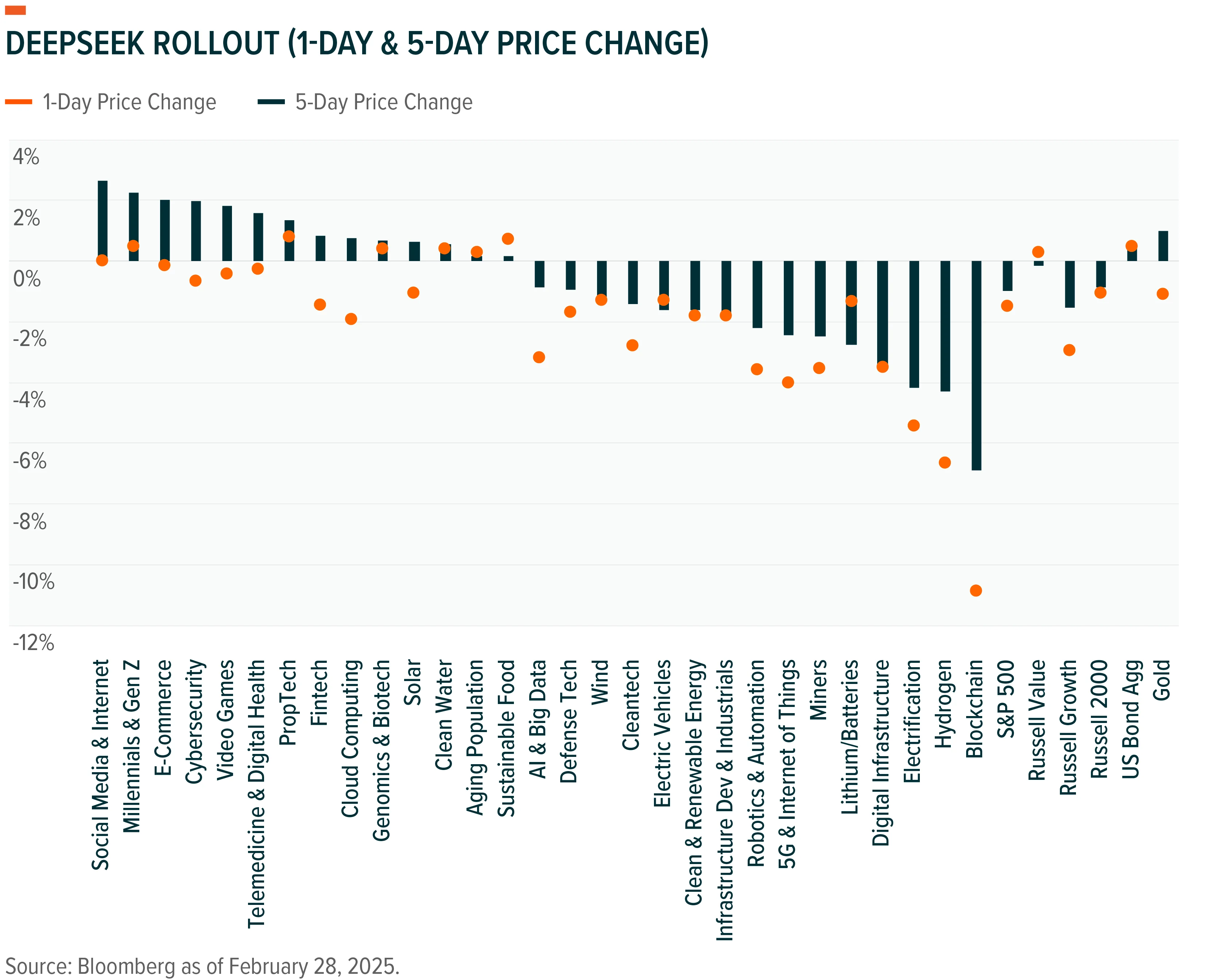
DeepSeek’s success may ultimately prove transitory. New releases of ChatGPT and Grok are generally considered to be an improvement on DeepSeek already, perhaps even incorporating some of the inference innovation. ChatGPT is back atop app store charts and Grok rounds out the top 5, while DeepSeek isn’t in the top 40.9 Over the past month, AI companies, data centers, and electrification players are beating the S&P 500.
More broadly, the DeepSeek-induced volatility can help investors understand that AI is more than just a couple big players—it’s an ecosystem spanning players in hardware, software, and data. It was also a reminder of the nonlinear path of innovation and the importance of maintaining a diversified approach to investing in new technology.
Multiple rounds of public policy game-on, game-off also sent market vol higher in recent weeks. The White House announced a freeze on almost all federal spending on January 28. Twenty-four hours later, a court ruled the spending freeze illegal, and the White House reversed course later that day.10 Days later, President Trump announced 25% tariffs on Canada and Mexico, and then 36 hours later delayed them after calls with respective foreign counterparts.11 Now, those tariffs appear to be back on, but policy communique and implementation is clearly fluid.
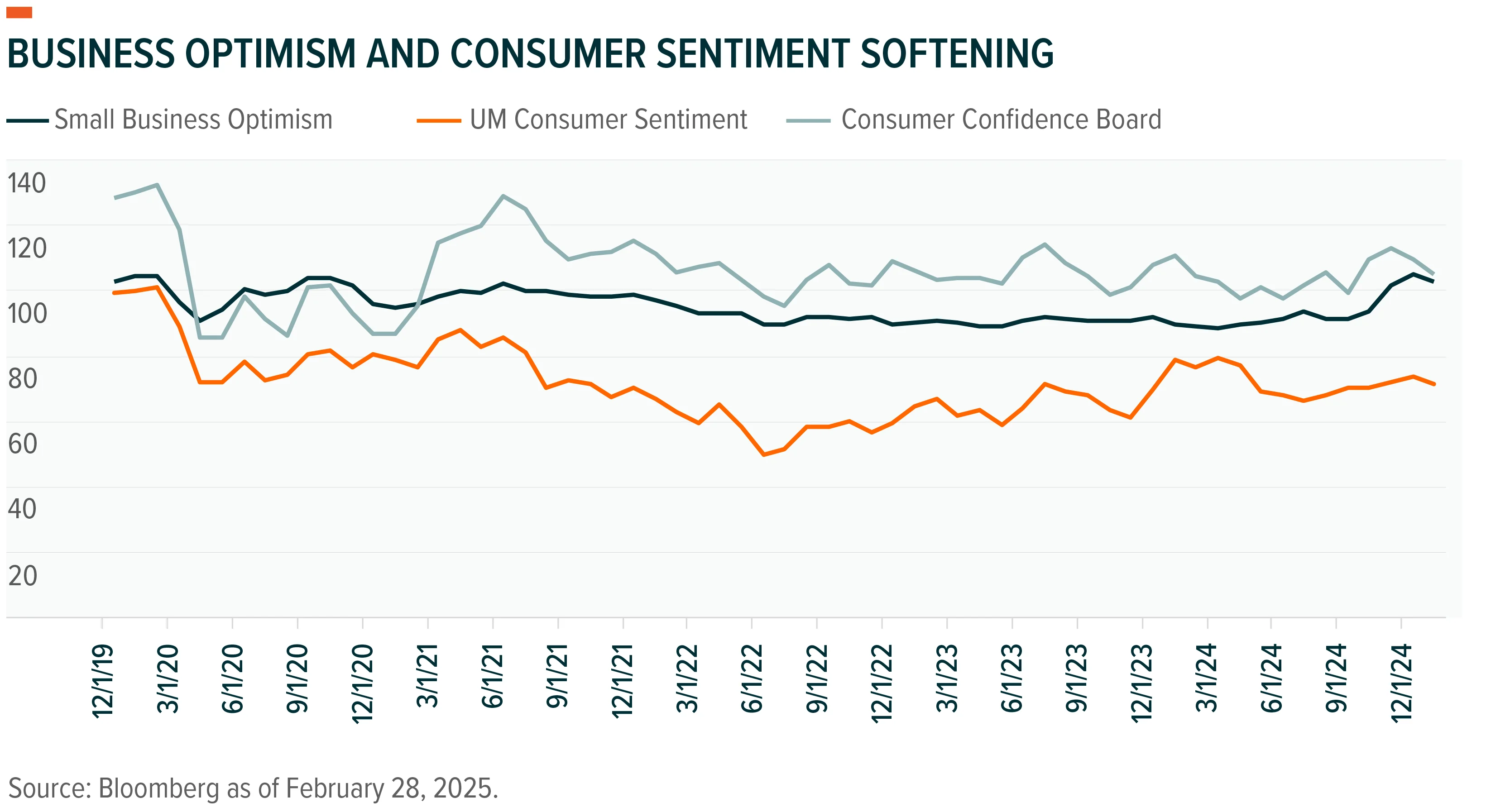
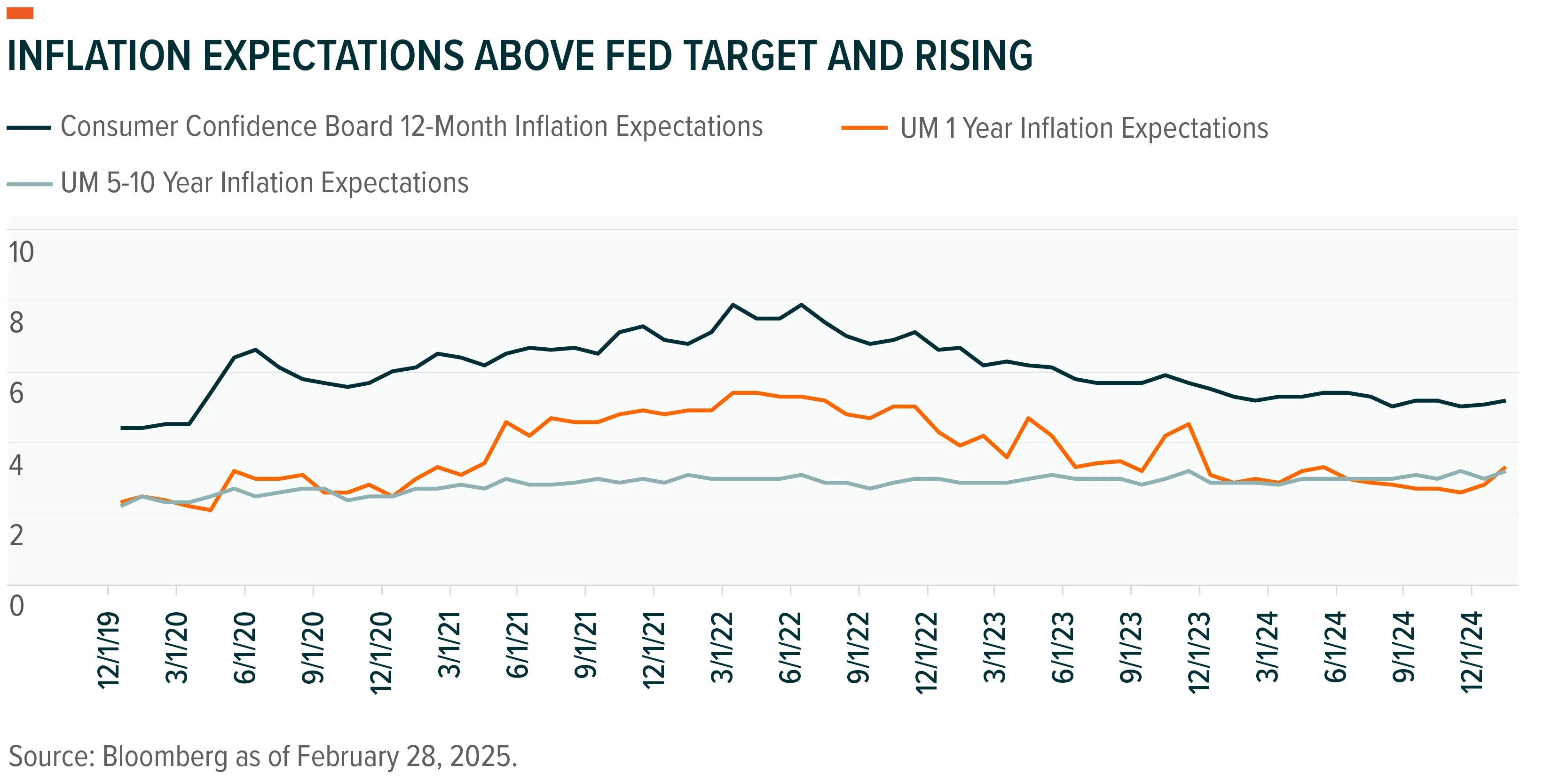
The endless shifts in discourse and follow-through seem to be taking a toll on businesses and consumers.11 Small business optimism and consumer sentiment hit cycle highs when President Trump took office, but those trends reversed rather quickly. Small businesses are growing more cautious and the consumer confidence board dropped the most it has since 2021 amid government layoffs, spending cuts, and potential tariffs. Consumer inflation expectations also jumped, complicating matters for a Federal Reserve that might otherwise be inclined to stimulate growth.
The market impact of policy announcements and reversals was somewhat more muted than the initial DeepSeek response and recovery.12 The announcement of a government spending freeze, which coincided with the bounce back from DeepSeek, sent tech themes like AI, Cybersecurity, and Cloud Computing meaningfully higher. Industrial-related themes like Robotics, Defense Tech, and 5G & Internet of Things advanced modestly, while consumer themes like Social Media, Video Games, and Fintech moved higher. Most of those themes sustained their gains over the next five days. Cleantech, Healthcare, and Infrastructure Development broadly moved lower on the spending cuts and stayed lower.
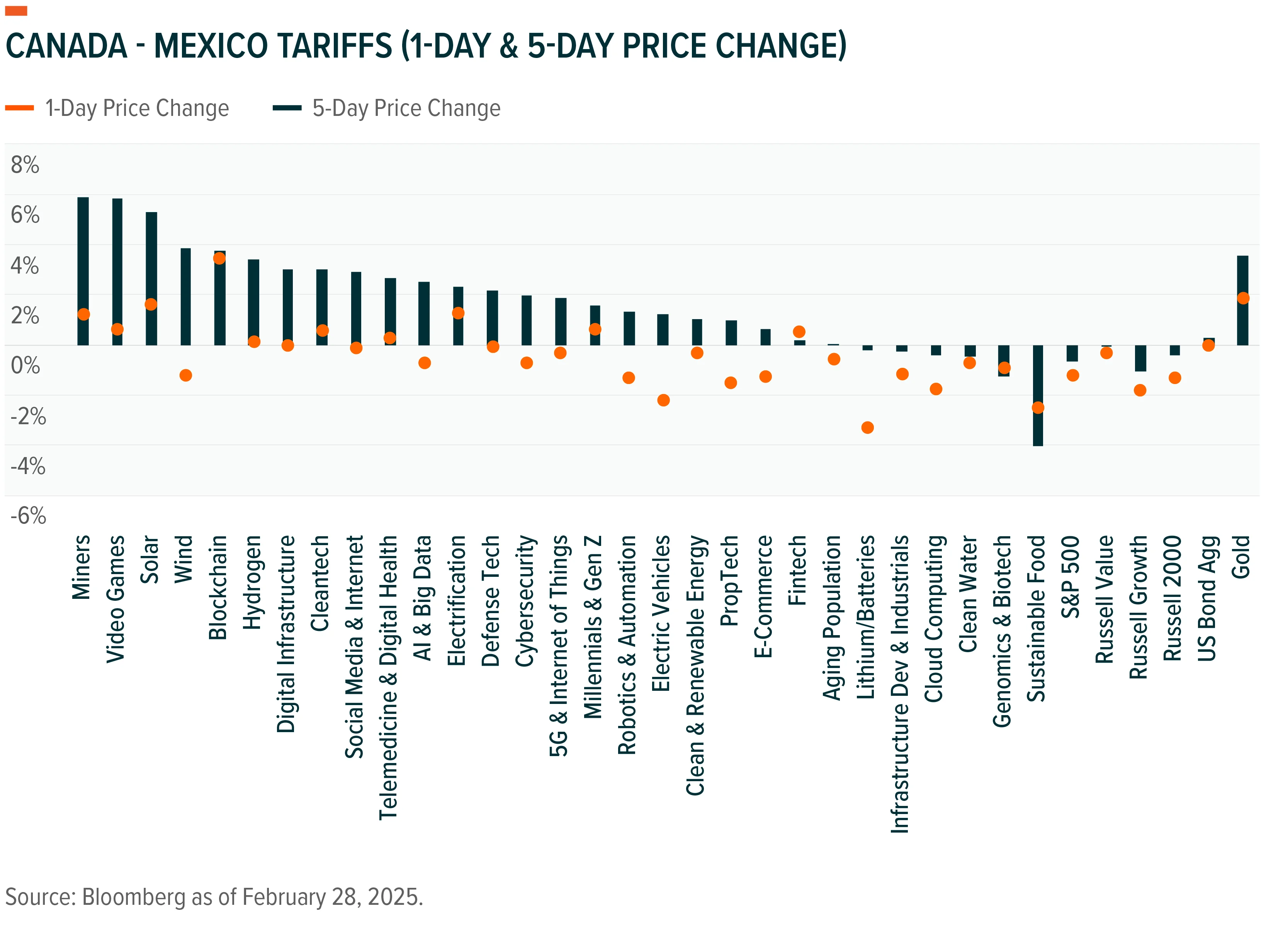
The on-off tariffs delivered a different set of winners and losers. Commodities, Miners, Electrification, and energy-related themes initially moved higher on the potential tariffs and continued that trend even after the delay.14 Tech, Healthcare, and Clean Energy moved lower on the news. Disruptive technology themes around AI, data centers, and cybersecurity reversed and ended the week higher. Healthcare and Clean Energy remained somewhat stifled, and consumer sectors drifted along largely unchanged.
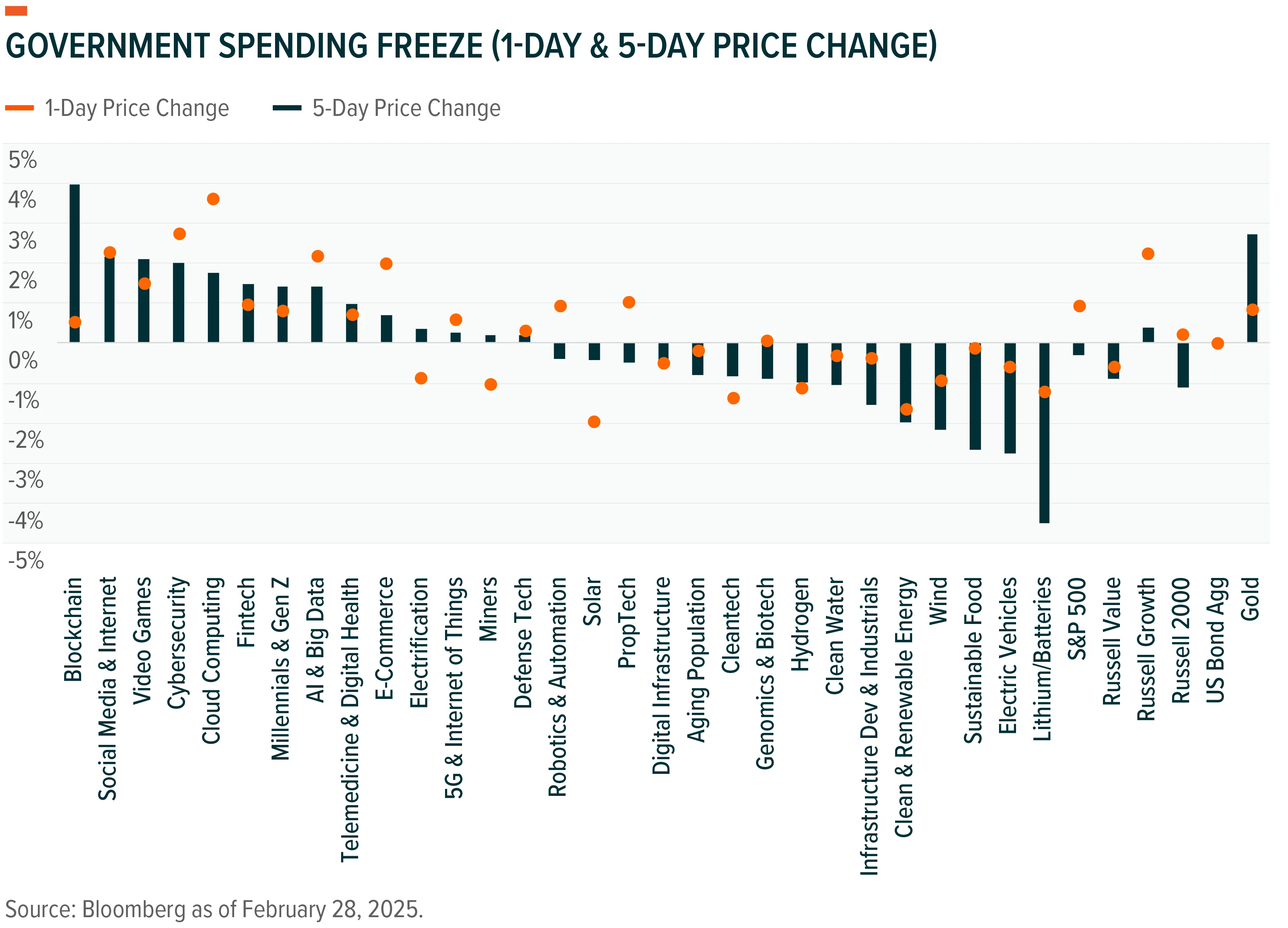
Not surprisingly, industries that the market discounts as impacted by the spending freeze differed from industries vulnerable to tariffs. The reversal of price action was more acute for the tariff about-face than the spending freeze, with most themes ending higher five days later.15 Part of the explanation may by familiarity. Markets have grappled with tariff escalation on and off since 2016, while the government spending freeze is less charted. The closest comparison is perhaps a government shutdown. Disruptive tech themes like AI, Cloud Computing, and Cybersecurity sold off on the initial news, but quickly recovered given the long-term growth prospects. Consumer areas like Fintech and Social Media were largely immune to the events. Clean Tech themes tied to imports and government funding lagged in both cases.
High volatility shines a spotlight on behavioral economics, which examines how psychological and social factors affect economic decisions. For most long-term investors, the biggest risks are selling out of fear or remaining underinvested for long periods of time. For example, buying into the S&P 500 at the 2007 peak—the single worst time before the Global Financial Crisis—still returned around 380%, or 8.6% annually.16 That was a major financial crisis compared to the constant churn of small disruptions today. Eventually, the cumulative effect could trigger a larger selloff, but even then, underinvesting is a risk.
Rather than sell and go away, investors can incorporate strategies and themes that help reduce volatility or provide exposure to long-term trends likely to weather short-lived storms. Hedged strategies like covered calls can help reduce sensitivity to equity and interest rate sensitivity. A strategy that owns an underlying index like the S&P 500 and sells calls on the entire holdings to generate income can bring down variation or beta to market by around 40%.17 Strategies that sell calls on part of the underlying index can offer market appreciation and income while still lowering overall market risk and vol susceptibility.
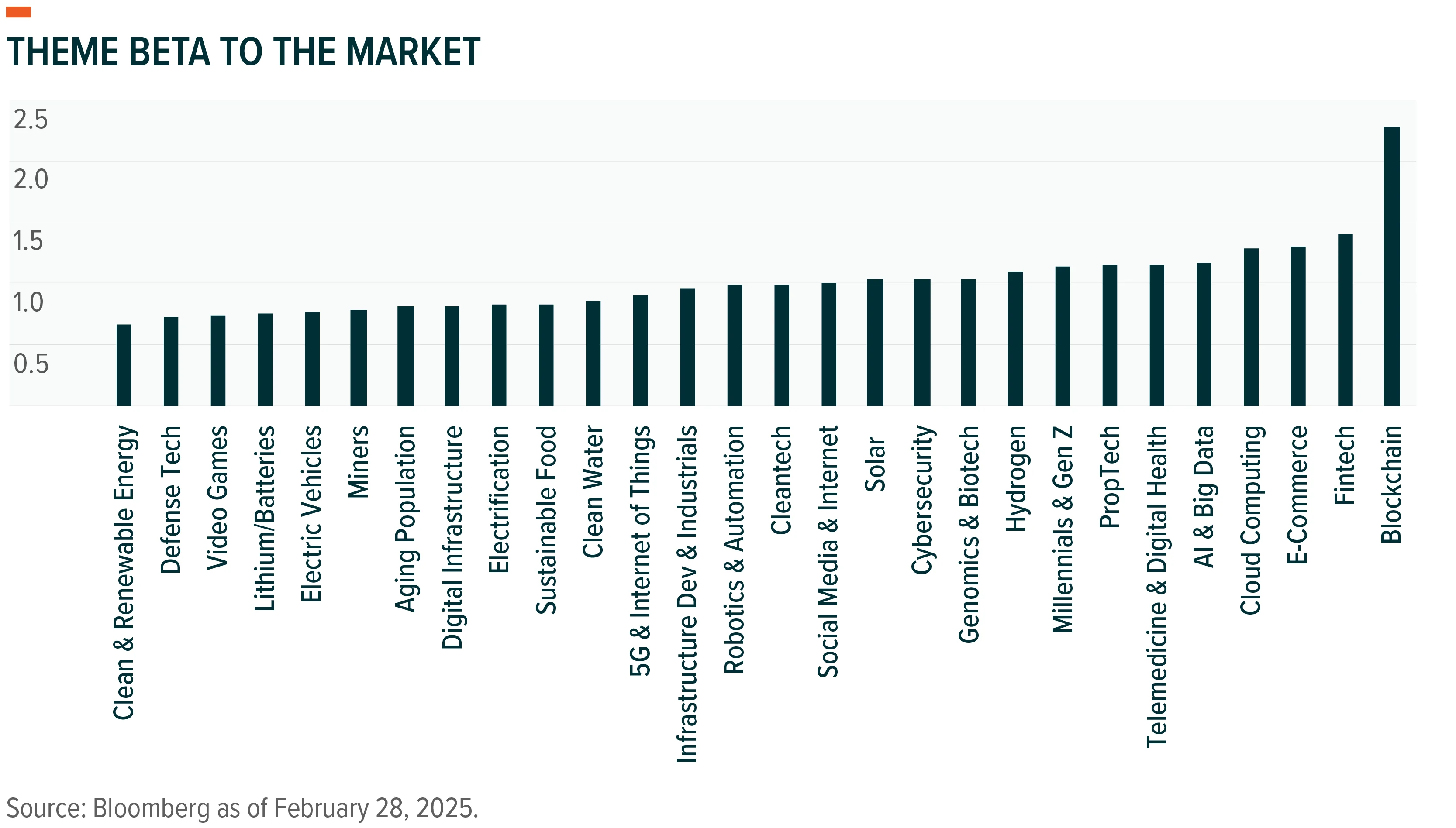
Themes that rely on multi-year contracts with stable cash flows like Defense Tech and Infrastructure Development typically have lower beta to the market, but they still have strong secular tailwinds tied to geopolitical challenges and increasing economic competition.18 Also, despite their high growth, long-term trends in disruptive technology like robotics, data centers, digital infrastructure, and internet of things are typically less volatile than the broad market, with two-year annualized forecasted earnings growth above 20%.19 Finally, certain commodity and energy themes like Uranium Mining, Electrification, and Clean & Renewable Energy can also help reduce volatility.
Helfstein, S. (2024, December 9). Global X 2025 Outlook. Global X. https://www.globalxetfs.com/global-x-2025-outlook/.
Thaler, R.H. (2016, July). Behavioral Economics: Past, Present, and Future. American Economic Review. Vol. 106, No. 7. https://www.aeaweb.org/articles?id=10.1257/aer.106.7.1577.
Global X analysis with information derived from: Bloomberg L.P. (n.d.) [Data set]. Retrieved on February 28, 2025.
Hirooka, M. (2005). Nonlinear dynamism of innovation and business cycles. Conference of the International J.A. Schumpeter Society. https://link.springer.com/chapter/10.1007/3-540-26994-0_16.
Apple App Store. (2025, February). Top Free Apps. https://apps.apple.com/us/charts/iphone/top-free-apps/36.
Field, H. (2025, January 31). DeepSeek’s hardware spend could be as high as $500 million, new report estimates. CNBC. https://www.cnbc.com/2025/01/31/deepseeks-hardware-spend-could-be-as-high-as-500-million-report.html.
Global X analysis with information derived from: Bloomberg L.P. (n.d.) [Data set]. Retrieved on February 28, 2025.
Ibid.
Apple App Store. (2025, February). Top Free Apps. https://apps.apple.com/us/charts/iphone/top-free-apps/36.
Herb, J. et al. (2025, January 29). Inside 45 hours of chaos: The brief life and quick death of Trump’s federal spending freeze. CNN. https://www.cnn.com/2025/01/29/politics/inside-brief-life-trump-federal-spending-freeze/index.html.
Cui, J. (2025, March 11). The White House is using tariffs to restore manufacturing. Data suggests it will take time. NBC News. https://www.nbcnews.com/data-graphics/trump-tariffs-economics-manufacturing-jobs-data-rcna195011.
Global X analysis with information derived from: Bloomberg L.P. (n.d.) [Data set]. Retrieved on February 28, 2025.
Ibid.
Ibid.
Ibid.
Ibid.
Scrudato, R. (2025, February 6). Covered Call ETFs and Taxes: What You Need to Know. Global X.
Global X analysis with information derived from: Bloomberg L.P. (n.d.) [Data set]. Retrieved on February 28, 2025.
Ibid.
* Thematic category indexes available upon request.
Investors may consider beyond short-term tactical investing to focus on themes with strategic implications like defense, cybersecurity, and U.S. energy.
Investors may consider beyond short-term tactical investing to focus on themes with strategic implications like defense, cybersecurity, and U.S. energy.
Kevin Warsh’s nomination as the next Fed Chair rattled markets, but we believe simply labeling him an inflation hawk is too simplistic.
Kevin Warsh’s nomination as the next Fed Chair rattled markets, but we believe simply labeling him an inflation hawk is too simplistic.
The Global X 2026 Outlook is presented in two parts: Macroeconomic by Scott Helfstein and International by Malcolm Dorson.
The Global X 2026 Outlook is presented in two parts: Macroeconomic by Scott Helfstein and International by Malcolm Dorson.