

Years of elevated munitions use, intensified most recently by the Iran conflict, have made stockpile replenishment a central driver of defense procurement.1 Emergency backfilling is accelerating, while multi-year contracts and a reshaped procurement framework are giving suppliers greater visibility into future demand.
In our view, the market continues to underestimate the scale and durability of this strengthening procurement cycle. Production is being reset at structurally higher levels, while capacity constraints are turning today’s demand into multi-year backlogs and extending the earnings runway for Defense Tech suppliers well beyond current conflicts.
Key Takeaways
The Iran war has consumed an estimated 65% of U.S. Patriot interceptors, at least 38% of THAAD interceptors, and a third of the Tomahawk inventory, pushing several critical stockpiles to multiyear lows.2
The Pentagon is locking in replenishment demand through seven-year procurement contracts, giving Defense Tech suppliers record backlogs and years of revenue visibility while requesting faster production.3
With budgets largely moving higher, industrial capacity is now the binding constraint. Supply can take years to expand, extending the durability of the cycle.4
Munitions Depletion Is Reshaping Procurement
Modern conflicts can consume missiles and air-defense interceptors much faster than the industrial base can replace them. The Iran conflict has brought that imbalance into focus, with the U.S. currently expending multi-million-dollar interceptors to defend against sporadic, persistent waves of lower-cost drones and missiles.5
Although stockpile data is classified, estimates suggest over 1,500 Patriot air-defense interceptors have been fired so far, leaving fewer than 830 in the entire U.S. inventory.6 Roughly 40% of the 452 THAAD ballistic missile interceptors available at the Iran war's start have been expended, with fewer than 280 remaining in the arsenal today.7 Tomahawk inventories have fallen by about one-third, from roughly 3,000 missiles to 2,000.8 Nearly 25% of the MQ-9 Reaper Drones in U.S. inventory have likely been shot down or lost.9
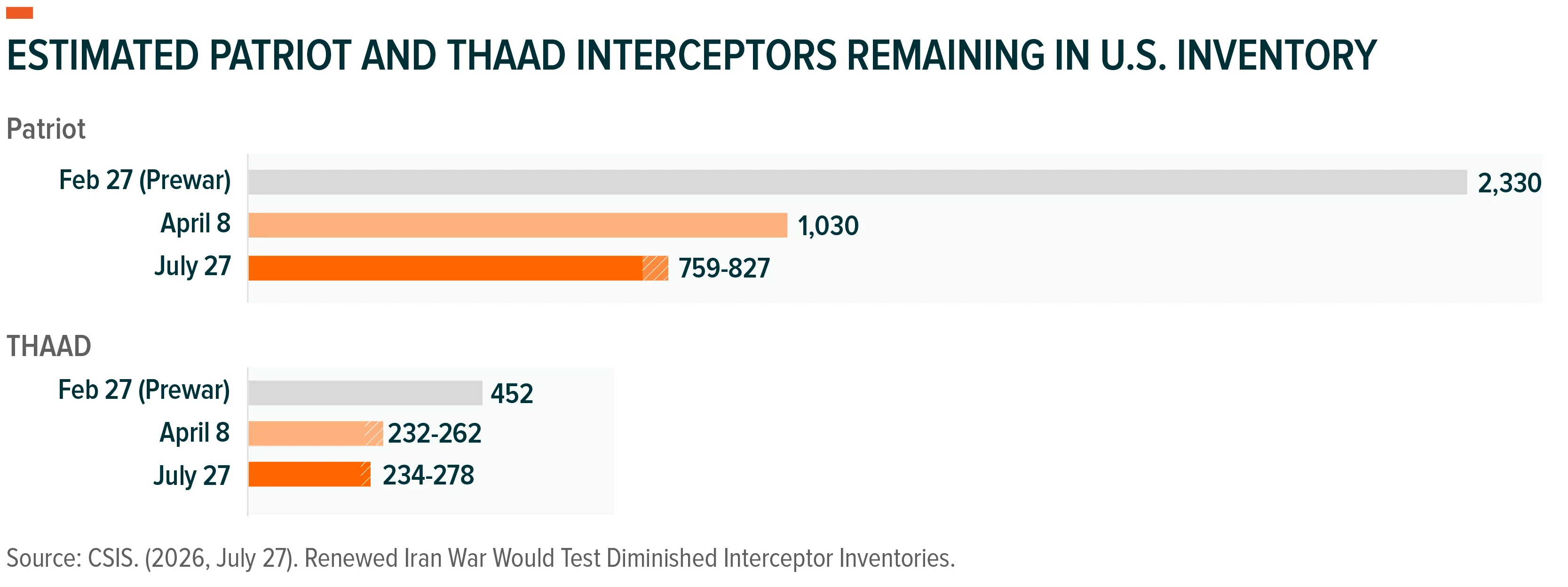
Months of combat have consumed years of production, while replacement capacity will take years to build.10 For example, U.S. manufacturers currently produce only about 850 Patriot interceptors annually, highlighting imbalance in production capacity and recent consumption.11,12
In fact, the inventory strain predates the current conflict. Ongoing support for Ukraine, as well as the 12-day Israel-Iran war in mid-2025 had already exposed the limits of a procurement system built around short-term orders and modest production volumes.13
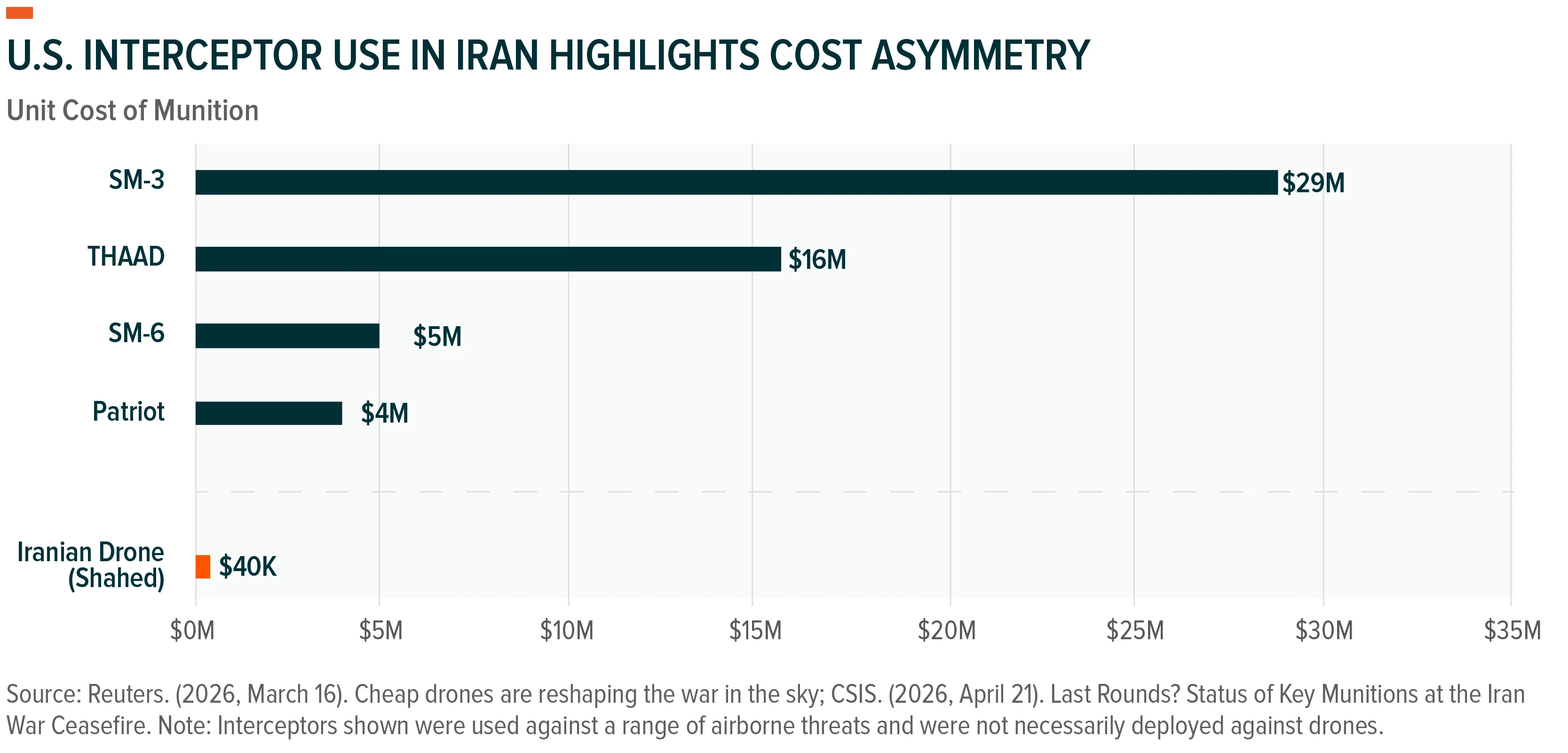
The widening gap between battlefield consumption and replacement capacity is now forcing the Pentagon toward longer-term purchasing commitments to ensure supply security. The final FY2026 defense spending bill authorized multi-year procurement contracts for eight critical munitions – spanning air and missile defense, long-range strike, and anti-ship capabilities.14 The Pentagon's Munitions Acceleration Council, created in 2025, has since designated 14 critical munitions for fast-tracked production, offering multi-year deals stretching as long as seven years in exchange for industry commitments on cost, capacity, and timelines.15
Earlier this month, the Pentagon asked leading suppliers to submit plans, within 21 days, for significantly faster and more aggressive delivery schedules, while supporting increased production volumes for critical capabilities.16 In other words, procurement is shifting from episodic replenishment and backfilling to sustained production.
Replenishment Urgency Is Showing Up in Record Backlogs
The second quarter of 2026 provided the first full look at incremental demand following the start of Operation Epic Fury, and bookings accelerated across major U.S. defense primes. Lockheed Martin secured $65 billion in new orders, more than three times quarterly sales, lifting its backlog to a record $230 billion.17 Northrop Grumman recorded $20 billion of net awards, pushing its backlog to $105 billion, while General Dynamics booked $14.7 billion of defense orders and reported a 1.4x defense book-to-bill ratio.18,19 Across the top four U.S. defense contractors, combined backlogs grew roughly 27% year over year (YoY).
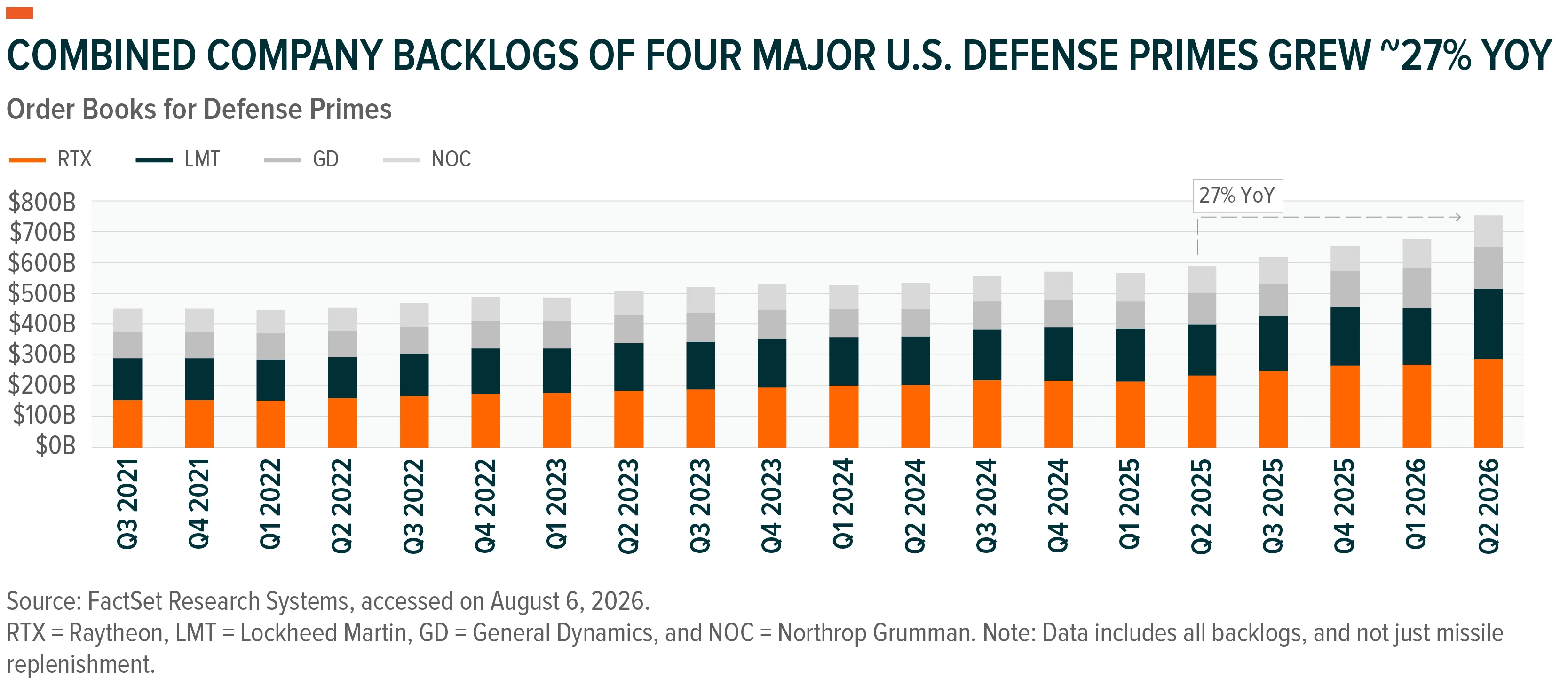
Missile replenishment is one contributor to this growth. During the quarter, Lockheed Martin secured a multi-year THAAD contract worth up to $35 billion that is intended to quadruple interceptor production.20 The Army subsequently converted a $4.7 billion single-year PAC-3 award into a seven-year agreement with a ceiling of up to $58.6 billion through fiscal 2032.21 Against that demand backdrop, sales in Lockheed Martin’s Missiles and Fire Control segment grew 19% YoY.22 Raytheon also booked a $442 million U.S. production order for GEM-T Patriot interceptors, the first domestic order for that interceptor class in more than 30 years.23
Drone systems procurement shows a similar dynamic. AeroVironment’s funded backlog rose nearly 65% YoY to $1.2 billion, with autonomous systems revenue coming in 22% ahead of expectations in the quarter ended in April 2026.24 Management pointed to “catch-up” procurement as a driver of order activity.25 Notably, the first U.S. use of one-way attack drones in the Iran conflict could prove an inflection point, accelerating the shift toward more systematic, large-scale procurement of these systems.26
Domestic replenishment is only one layer of demand. Alongside replenishing its own stocks, the United States must also fulfill interceptor orders from allies and partners. Raytheon’s quarter reflected that demand, with more than $5 billion of Patriot (GEM-T) orders driven primarily by international customers.27 In total, 19 nations worldwide operate Patriot air and missile defense systems.28
The result is greater pressure on an already constrained supply base. That scarcity may also push allies to expand regional production, diversify suppliers, and accelerate the development of their own defense capabilities. In fact, order books for European defense companies show how broad demand is spreading. In the first half of 2026, BAE Systems reports a record £84 billion backlog, Leonardo’s orders grew 45% YoY, Saab’s bookings reached 2.7x sales, and Rheinmetall’s backlog climbed to €80.5 billion. 29,30,31,32
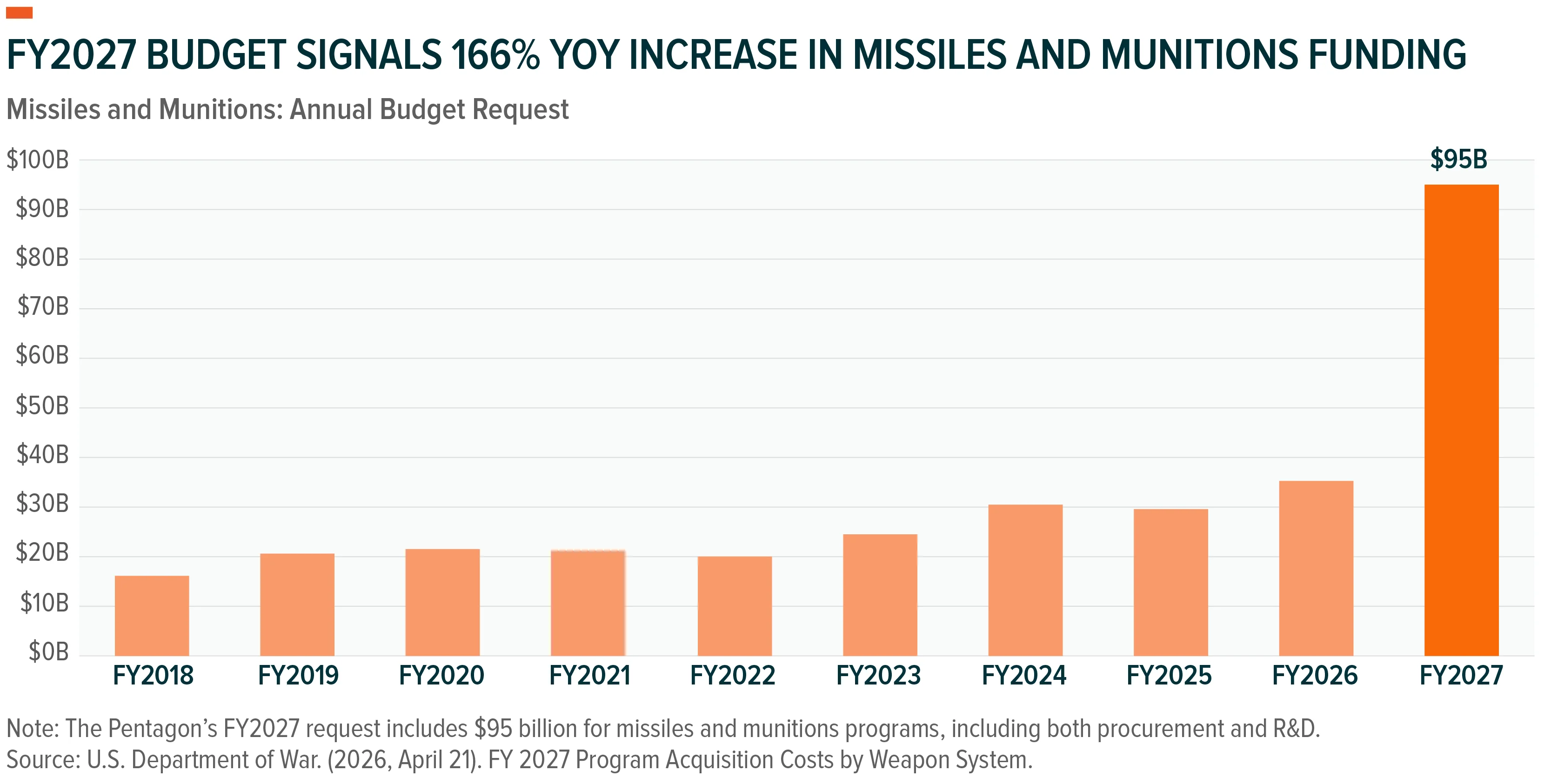
The funding backdrop reinforces the trend. The United States is considering a $1.5 trillion military budget for FY2027, including a 166% increase in missile defense program funding to $95 billion, while NATO members are targeting defense spending equal to 5% of GDP.33 Together, domestic replenishment, allied orders, and rising budgets support a multi-year expansion in global defense backlogs.
Industrial Capacity Constraints Extend the Cycle
Contracts for new ammunition can be signed in a quarter, but the factories, materials, and skilled labor behind them take years to add.
For example, replenishing the reported Patriot interceptor missile drawdown would take roughly three years at current production.34 This lead time is reinforced by multiple components and suppliers across the value chain.35 One such bottleneck is the solid rocket motor – used by almost every U.S. missile program – and a component the Pentagon has repeatedly flagged as a critical vulnerability.36 In fact, since 1995, consolidation reduced the domestic solid-rocket-motor industry from six manufacturers to just two incumbents, leaving numerous missile programs dependent on the same narrow supplier base, with limited surge capacity.
The constraints extend upstream. U.S. production of aerospace-grade ammonium perchlorate – the oxidizer used in most high-performance solid rocket motors – is highly concentrated, with American Pacific serving as the only domestic Pentagon approved supplier.37 Rare-earth supply chains are similarly concentrated, with China controlling over 90% of heavy rare-earth refining and producing more than 94% of the world’s rare-earth magnets.38 Aging factories built largely during World War II, limited curing and inspection capacity, and constrained supplies of specialized chips, sensors, and electronics add further friction.
Another bottleneck is skilled labor. Less than half of aerospace and defense executives were confident their companies could double production within 18 months, and 74% named skilled labor shortages as a major constraint in a recent survey.39
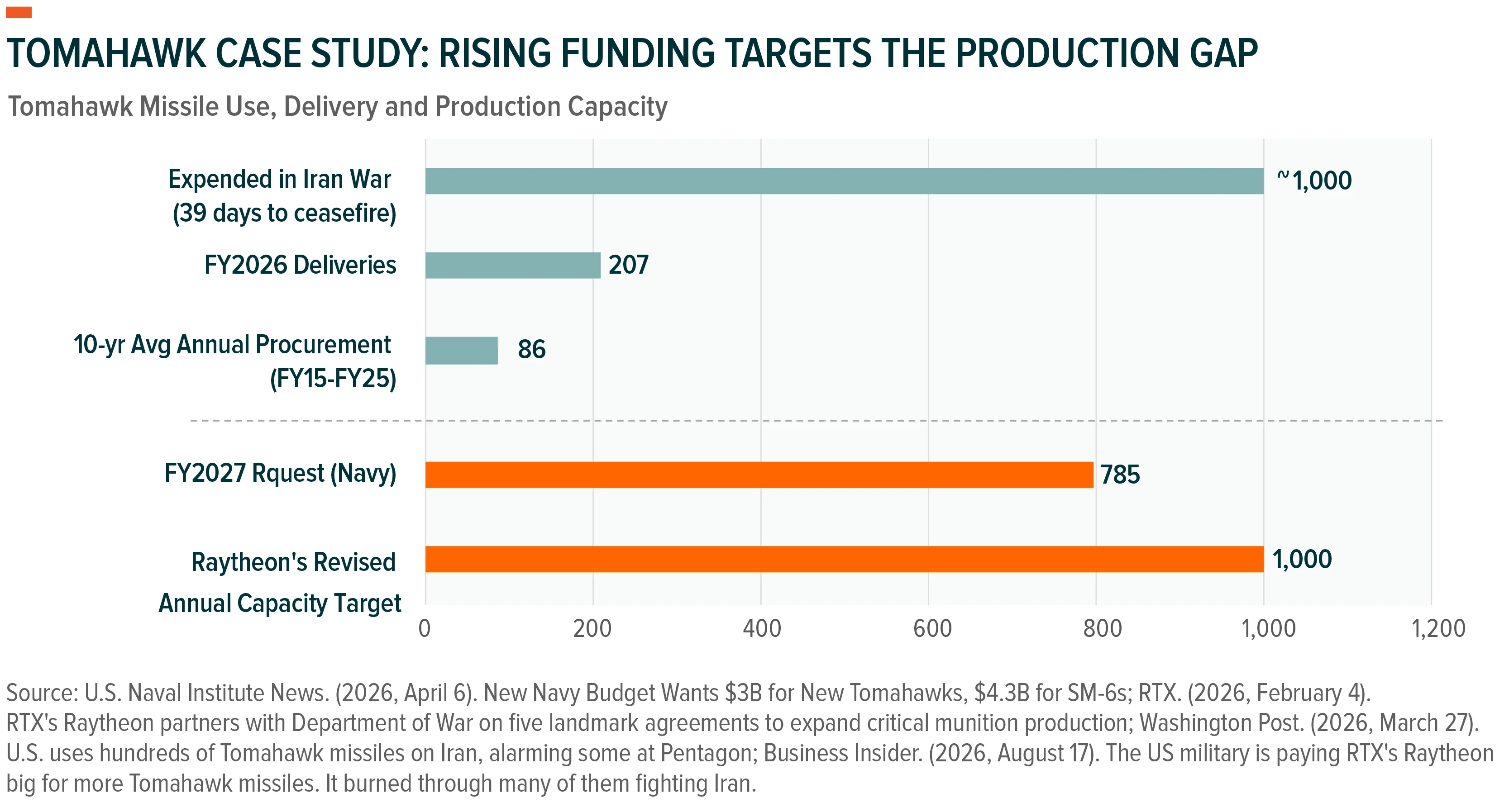
Investment is beginning to address these bottlenecks, but new capacity will take years to reach full output. For example, the Pentagon made a rare $1 billion direct investment to expand solid rocket motor capacity at L3Harris earlier this year.40 A new source for motors for PAC-3 missiles was qualified at Northrop Grumman in August 2026.41 New entrants are also widening the supplier base. Anduril, for example, is opening a solid rocket motor plant in Mississippi.42 In another instance of resolving a separate bottleneck, the Pentagon committed $400 million in equity and $150 million in debt to MP Materials, backed by a 10-year offtake agreement.43
For investors, these constraints are also what give the cycle durability. Record backlogs cannot be converted into revenue overnight, turning replenishment from a short-term spending surge into a multi-year production cycle sustaining earnings power.
Conclusion: Replenishment Resets the Production Baseline
Stockpile depletion is resetting defense procurement. Newly disclosed multi-year contracts, prioritized munitions, and direct industrial investment are raising production baselines across the supply chain. With U.S. and allied orders already queued and new capacity years away, replenishment should support defense earnings through the end of the decade. In our view, the durability of replenishment demand and the earnings opportunity it creates for large Defense Tech suppliers remain underappreciated.
Related ETFs
SHLD – Global X Defense Tech ETF
Click the fund name above to view current performance and holdings. Holdings are subject to change. Current and future holdings are subject to risk.