This piece is part of a series that dives deeper into the most prevalent themes of this year’s iteration of our flagship research piece, Charting Disruption. This feature focuses on defense technology, as part of a larger section on Paradigm-Shifting Technologies, exploring a variety of innovations in this space. For additional insights from the project, please click here.
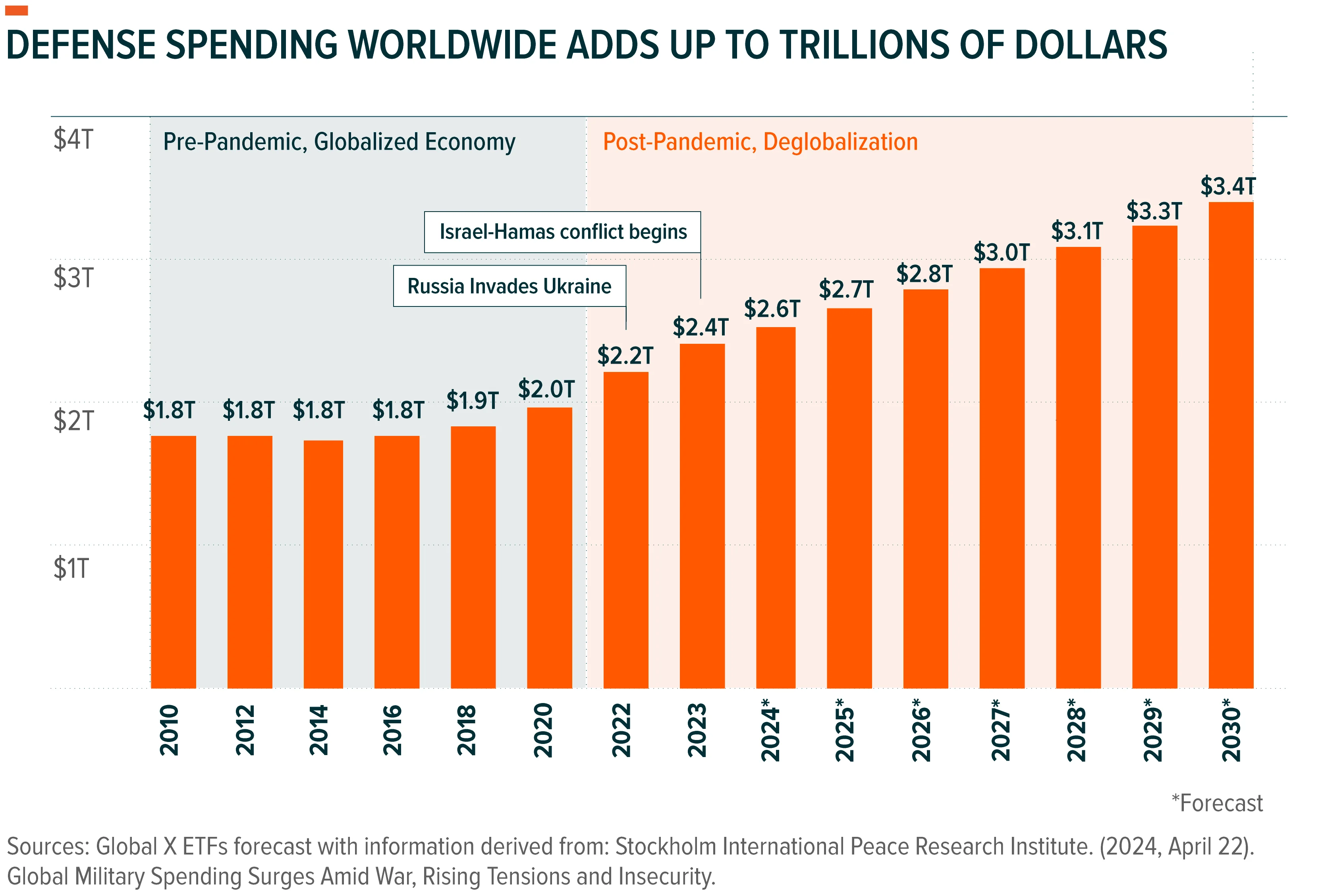
Rising geopolitical tensions, accelerating deglobalization, and the increasing integration of next-generation technologies into defense and national security are driving a significant rise in military and defense spending. By 2030, global defense expenditures are expected to surge roughly 40% from 2023 levels, surpassing $3.4 trillion, with a growing portion allocated to artificial intelligence (AI), cybersecurity, and other advanced defense technologies.1
AI-enabled systems are at the forefront of this transformation. The global drone market, for example, is expected to become a $33 billion industry by 2030, transforming the economics of war.2 Beyond drones, AI-powered platforms in unmanned ground vehicles (UGVs) and robotic combat vehicles (RCVs) are gaining momentum. Additionally, investments in foundational data platforms and IT infrastructure are accelerating to support these advancements.
Key Takeaways
Global military spending has risen consistently over the last two decades with further growth anticipated, driven by rising geopolitical tensions, deglobalization, and increasing investments in advanced technologies like AI and cybersecurity.
Technological innovations, including AI, robotics, and drone technology are reshaping the nature of warfare, enabling smaller, less-resourced militaries to effectively challenge larger forces.
Defense software and IT infrastructure investments are expected to grow significantly as militaries increasingly rely on data analytics and AI-driven solutions, creating substantial opportunities for defense technology providers.
Intensifying Defense Investments and Commitments Are a Global Phenomenon
Global military spending has steadily increased over the last two decades, with further growth expected. Fueled by the ongoing wars in Ukraine and the Middle East, world military expenditure hit an all-time high of $2.4 trillion in 2023, and it is expected to approach $2.6 trillion for fiscal year (FY) 2024.3,4 By decade end, defense spending in the U.S. alone will likely top $1 trillion, according to the Congressional Budget Office.5
These trends extend beyond the U.S. and are evident worldwide. As of October 2024, the Council on Foreign Relations listed over 30 ongoing conflicts worldwide.6 As a result, major global economies and conflict-prone regions continue to bolster their defense spending. For example, in 2024, 72% of the North Atlantic Treaty Organization (NATO) allies are on track to meet or exceed their target investment of at least 2% of gross domestic product (GDP) on defense, up from only 11% in 2014.7 Estimated spending among this cohort for 2024 is expected to surpass $400 billion.8 Globally, military burden–a measure of the relative economic cost of the military for the country–also rose to an average of 2.3% in 2023, up from 2.2% in 2022.9
Spending Growth May Help Digital Solutions, Cybersecurity, and Aerospace and Defense Contractors
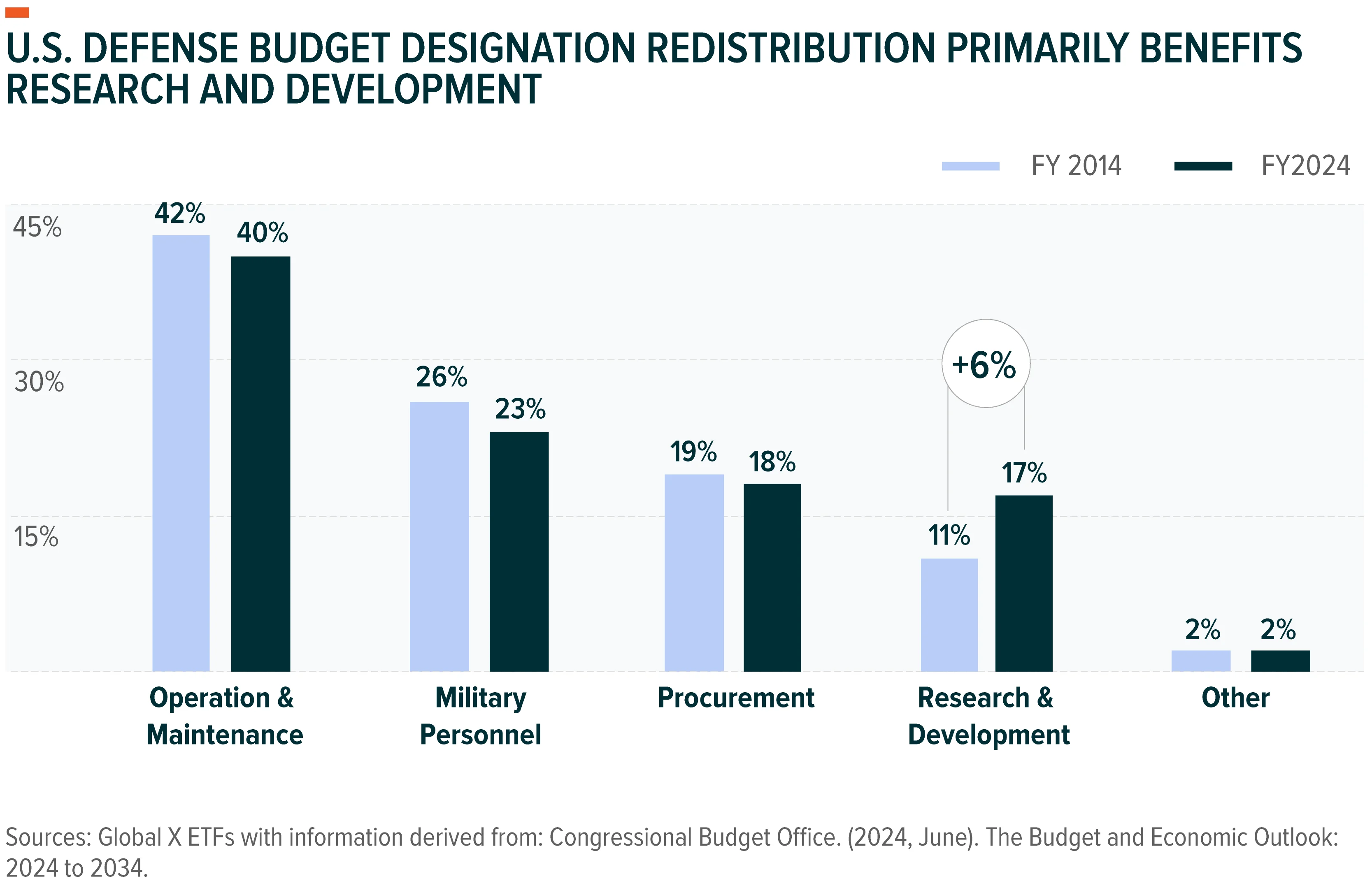
In the past, military spending primarily revolved around acquiring conventional hardware and ensuring uninterrupted ammunition supplies. Today, this remains true, as defense contractors continue to report accelerating sales growth and raise guidance, driven by traditional munitions refreshes and increasing military spending. However, budgets now reflect the shift towards digitization, with increases in defense spending showing support for technology-based solutions. Innovations in technology are reshaping modern warfare by introducing new capabilities and altering traditional strategies. As a result, AI, robotics, and cybersecurity increasingly play pivotal roles in revolutionizing the nature of conflict.
Visualizing these trends, the U.S. defense budget for cyber activities for fiscal year 2025 increased 15% from fiscal year 2023.10 Similarly, the U.S. Pentagon’s budgetary request for AI funds grew 105% from 2022 to 2024.11 On a global scale, spending on AI military solutions is projected to grow at an 11% compound annual growth rate (CAGR), rising from $8.8 billion in 2023 to $22.6 billion by 2032.12
Defense Tech Innovation Provides a Target Market for Software and Drone Companies
Government spending on technological solutions necessitates investments in modern, nimble, foundational software infrastructure, benefiting a wide range of platforms and specialized defense IT providers. Moreso, despite recent surges in defense spending, software still only accounts for less than 1% of U.S. Department of Defense spending.13 As defense increasingly relies on AI and data analytics, the military will likely need to boost its software investments meaningfully, potentially positioning defense software companies with a significant runway for growth in the years ahead.
For example, Palantir, a company that helps organizations and governments analyze complex data, has experienced strong revenue growth in recent years, driven by major government contracts focused on advancing U.S. defense capabilities with AI. In Q3 2024, the company’s U.S. government revenues grew 40% YoY to $329 million. Given this surge, FY 2024 revenue guidance was raised to $2.81 billion, up from $1.1 billion in 2020.14
Unmanned aerial vehicles (UAVs) and drones are also becoming increasingly vital on the battlefield, with global military drone spending forecasted to grow at a 13% CAGR to over $34 billion by 2030.15 Advances in autonomy and affordability have significantly expanded UAVs’ applications, allowing them to rival costlier defense systems like tanks.
This shift potentially changes the economics of war, enabling less financially resourced armies to effectively challenge larger, wealthier militaries. Today, drones costing as little as $500 can neutralize artillery or tanks worth millions of dollars, which can also reduce physical human presence and casualties on the battlefield.16 Long-range drone systems have also proven economically advantageous. While unit costs range from thousands to hundreds of thousands of dollars, they demonstrate strong cost-efficiency compared to the conventional air defense systems required to counter them.
Conclusion: Defense Technology Is Shaping the Future of Warfare
The global defense landscape is undergoing a profound transformation, driven by heightened geopolitical tensions, rising military budgets, and the rapid integration of advanced technologies. Traditional defense systems continue to play a pivotal role, but the growing emphasis on AI, cybersecurity, and autonomous technologies signals a shift toward more agile and cost-effective solutions. These developments are reshaping the economics of warfare, enabling smaller nations to compete with major powers while creating significant opportunities for innovation and growth across the defense industry. With global defense spending projected to surpass $3.4 trillion by 2030, the sector is set to experience sustained expansion, redefining the future of national and global security.