Skip to Main Content
Subscribe to Newsletters
Global X Logo
Search
Content loaded

Subscribe to our newsletter

Get the latest news and updates from our team.

Subscribe

Explore

Our ETFs

Investment Insights

Product ResearchCharting DisruptionMidyear Outlook 2026

Investor Resources

EducationHow to InvestTax Resources

About Us

About Global XNewsroomCareersContact Us

Follow Us

socaial media icon for LinkedInLinkedInSocial media icon for X (twitter)XSocial media icon for FacebookFacebookSocial media icon for InstagramInstagramSocial media icon for Youtube

Copyright © 2026 Global X. All rights reserved.

Privacy PolicyAccessibility Statement
YouTube

SEI Investments Distribution Co. (1 Freedom Valley Drive, Oaks, PA, 19456) is the distributor for the Global X Funds.

Check the background of SIDCO and Global X's Registered Representatives on FINRA's BrokerCheck.

Content
Product ResearchConstruction and EngineeringInfrastructure Investment

An Infrastructure Plan for the 21st Century (Part 1): US Infrastructure Investment Falls Far Short of Needs

x
G
Global X ResearchGlobal X Research Team
Jan 13, 2020·4 min read
191227-US_Infrastructure-04-2

Related articles

1of2
Product ResearchU.S. InfrastructureConstruction and Engineering

The Movement to Rebuild America’s Infrastructure

On March 8th, 2017, we launched the Global X U.S. Infrastructure Development ETF (PAVE), which invests in companies that potentially stand to benefit from an

G

Global X Research

Mar 8, 20175 min read
Product ResearchConstruction and EngineeringInfrastructure Investment

Four Companies That Could Help Develop Infrastructure in the United States

Product ResearchU.S. InfrastructureConstruction and Engineering

The Movement to Rebuild America’s Infrastructure

On March 8th, 2017, we launched the Global X U.S. Infrastructure Development ETF (PAVE), which invests in companies that potentially stand to benefit from an

Related funds
Thematic
PAVEU.S. Infrastructure Development ETF
Thematic
SNSRInternet of Things ETF
Thematic
DRIVAutonomous & Electric Vehicles ETF
Explore All ETFs
Footnotes

1. American Society of Civil Engineers Infrastructure, “2017 Infrastructure Report Card,” 2017.

2. American Society of Civil Engineers, “Failure to Act: Closing the Infrastructure Investment Gap for America’s Economic Future,” 2016.

3. US Census Bureau Data, 2019.

4. United Nations DESA Population Division, “World Population Prospects: 2019,” 2019.

5. Federal Highway Administration, “State Motor Vehicle Registrations, By Years, 1900-1995,” 1995.

6. Federal Highway Administration, “State-Motor Vehicle Registrations – 2017,” January, 2019.

7. American Society of Civil Engineers Infrastructure, “2017 Infrastructure Report Card,” 2017.

8. United Nations DESA Population Division, “World Urbanization Prospects: 2018,” 2018.

The following is part 1 in a 3-part blog series that explores the future of infrastructure in the United States. This section discusses the current state of the US’ infrastructure and the importance of improving it. In part 2, we consider what future infrastructure could entail and which industries could benefit from building it. In part 3, we theorize on what a 21st century infrastructure plan could look like. 

Click to navigate: Part 2, Part 3; Full Report (PDF).

An Infrastructure Plan for the 21st Century

America’s outdated infrastructure is in dire need of a 21st century overhaul – a D+ grade from the American Society of Civil Engineers’ (ASCE) says as much. Deteriorating roads, waterways, airports and seaports more than just inconvenience the American people; they are liabilities to the country’s economic future, affecting employment, productivity, public health, and the average quality of life. While some progress has been made at the state and local levels, support at the federal level remains muted. But the 2020 presidential election should bring the infrastructure debate into the spotlight. Candidates across the political spectrum are articulating their infrastructure development plans. Presidential hopefuls, policymakers and investors alike should look beyond headline dollar amounts, which will be in the trillions of dollars, and focus on more nuanced details around what tomorrow’s infrastructure ought to look like. Infrastructure encompasses a wide range of structures; must cover vast geographic areas in the US; consider changing technology, demographics, and economic realities; and requires responsible financing. In this piece, we aim to avoid the politics and offer pragmatic ideas on what we believe a 21st century infrastructure plan should look like.

Mind the Gap: US Infrastructure Investment Falls Far Short of Needs

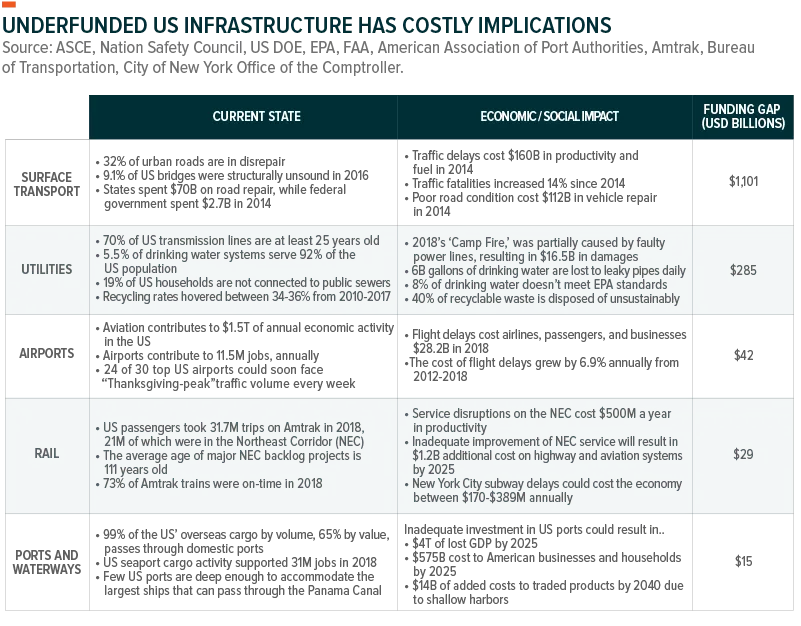
The US requires $2T of additional investment over the next 10 years to adequately repair and replace existing infrastructure.1 Funding needs to span myriad segments (see table) from physical infrastructure to the systems that enable commerce, transportation, and a functional society, representing possible investment across many sectors, industries, and end-markets. Without any major funding packages, the gap will only widen, but more concerningly, rising costs extend all the way to the economy’s bottom line. Absent the necessary investment, the country risks losing $3.8T in GDP, $7T in business sales, and 2.5 million jobs by 2025. The effects will trickle down to American households, too, as the economic overhang could reduce household disposable income by $3,400 annually.2


Infrastructure degrades with use and loses its utility through obsolescence. In a vacuum, such inevitabilities are easy to plan for, but reality introduces unanticipated variables. Secular trends like urbanization and population growth are straining America’s infrastructure beyond its intended functionality and capacity. The US population is 80% larger today than it was in 1960, when most of the major highways were built, and could grow another 22% by 2050.3,4

The ways the population utilizes infrastructure differs from the past, as well, further exacerbating the issue. For example, there are 1.2 registered vehicles per person on the road today versus 0.4 per person in 1960.5,6 More people and more cars per person take their toll without proper reinvestment – 20% of the country’s highways are in poor condition and more than 2 in 5 miles of urban interstates are congested.7 And with urbanization trending upward – some project 87.4% of the population will live in cities by 2050 versus 82% today – critical roads will face more concentrated wear and tear and further congestion.8 Roads are the simplest illustration of this strain, but the complex interconnected systems that make up the US’ infrastructure assets face a host of challenges that require politicians at all levels, investors, and engineers to work together in building infrastructure that is fitting of the future.

Continue reading with Part 2 and Part 3, or click here to view the full report (PDF). 

Related ETFs

PAVE: The Global X U.S. Infrastructure Development ETF (PAVE) seeks to invest in companies that stand to benefit from a potential increase in infrastructure activity in the United States, including those involved in the production of raw materials, heavy equipment, engineering, and construction.

SNSR: The Global X Internet of Things ETF (SNSR) seeks to invest in companies that stand to potentially benefit from the broader adoption of the Internet of Things (IoT), as enabled by technologies such as WiFi, 5G telecommunications infrastructure, and fiber optics. This includes the development and manufacturing of semiconductors and sensors, integrated products and solutions, and applications serving smart grids, smart homes, connected cars, and the industrial internet.

DRIV: The Global X Autonomous & Electric Vehicles ETF (DRIV) seeks to invest in companies involved in the development of autonomous vehicle technology, electric vehicles (“EVs”), and EV components and materials.  This includes companies involved in the development of autonomous vehicle software and hardware, as well as companies that produce EVs, EV components such as lithium batteries, and critical EV materials such as lithium and cobalt.


These four companies could play a role in developing U.S. infrastructure.

G

Global X Research

Jun 17, 20217 min read
G

Global X Research

Mar 8, 20175 min read
Product ResearchConstruction and EngineeringInfrastructure Investment

Four Companies That Could Help Develop Infrastructure in the United States

These four companies could play a role in developing U.S. infrastructure.

G

Global X Research

Jun 17, 20217 min read