
Get the latest news and updates from our team.
SEI Investments Distribution Co. (1 Freedom Valley Drive, Oaks, PA, 19456) is the distributor for the Global X Funds.
Check the background of SIDCO and Global X's Registered Representatives on FINRA's BrokerCheck.
1. INRIX, “Congestion Costs Each American 97 hours, $1,348 A Year,” February 11, 2019.
2. IOP Publishing LTD., “Quantifying the total cost of infrastructure to enable environmentally preferable decisions: the case of urban roadway design,” March 7, 2013.
3. New York City Department of Transportation, “Protected Bicycle Lanes in NYC,” September, 2014.
4. CNN, “New York City announces new cargo bike program to ease traffic congestion,” December 5, 2019.
5. Rice Kinder Institute for Urban Research, “A Year After Bus Redesign, METRO Houston Ridership is Up,” August 16, 2019.
6. Citylab, “NYC Finally Gets On Board With the Subway Car of the Future,” February 1, 2016.
7. AECOM, “RIGHT HERE, RIGHT NOW: THE FUTURE IS MOBILITY AS A SERVICE,” 2019.
8. Chalmers University of Technology, “Travelers’ Motives for Adopting a New, Innovative Travel Service: Insights from the UbiGo Field Operational Test in Gothenburg, Sweden,” September, 2014.
9. SpaceX, “Hyperloop,” August 12, 2013.
10. The Atlantic, “The Bridge That Bans Cars,” October, 2015.
11. Car and Driver, “1000 Future Residents of Arizona Neighborhood Can’t Drive Their Cars Home,” November 22, 2019.
12. Foreign Affairs, “The Fourth Industrial Revolution: What It Means and How to Respond,” December 12, 2015.
13. CTIA, “The Wireless Industry, 5G & Its Infrastructure Needs,” January 31, 2017.
14. Singularity Hub, “The Smart Cities of the Future Are Already Taking Off,” March 8, 2019.
15. CIO, “Singapore to spend US$1 billion in smart city initiative during 2019,” February 11, 2019.
16. Singapore Ministry of Foreign Affairs, “ASEAN Smart Cities Network,” 2018.
17. World Economic Forum, “Addressing E-Payment Challenges in Global E-Commerce,” May, 2018.
18. Airlines for America, 2019.
19. Federal Aviation Administration, “Modernization of US Airspace: NextGen,” August 26, 2019.
20. Logistics Management, “U.S. Port Update Part 1: Infrastructure Shortfalls Driving Innovation,” January 8, 2019.
21. National Centers for Environmental Information, “Billion Dollar Weather and Climate Disasters,” Oct 8, 2019.
22. US Government Accountability Office, “CLIMATE CHANGE: Opportunities to Reduce Federal Fiscal Exposure,” June 11, 2019.
23. Moody’s, “Largest US cities take proactive steps to mitigate credit risk from climate change,” January 17, 2019.
24. TRX, “SMART Tunnel Stands The Test of Time,” September 3, 2019.
25. Phys.org, “Japanese companies develop quake damping pendulums for tall buildings,” August 2, 2013.
26. ITU, “Disruptive technologies and their use in disaster risk reduction and management,” 2019.
27. Lazard, “Levelized Cost of Energy and Levelized Cost of Storage 2018,” November 8, 2018.
28. International Energy Agency, “Global EV Outlook 2019,” May, 2019.
29. International Finance Corporation, “Panama Canal Expansion—Key to Global Trade,” June, 2016.
30. US Environmental Protection Agency, “Ports Primer: 2.1 The Role of Ports,” August 18, 2018.
31. American Society of Civil Engineers Infrastructure, “2017 Infrastructure Report Card,” 2017.
32. NACE International, “Legislative Agenda.”
33. Stanford University School of Earth, Energy, and Environmental Sciences, “Q&A: Shortages amidst abundance: The paradox of natural gas,” October 24, 2019.
34. Ibid.
The following is part 2 in a 3-part blog series that explores the future of infrastructure in the United States. In this section, we consider what future infrastructure could entail and which industries could benefit from building it. In part 1, we discuss the current state of the US’ infrastructure and the importance of improving it. In part 3, we theorize on what a 21st century infrastructure plan could look like.
Click to navigate: Part 1, Part 3; Full Report (PDF).
More roads and pipes may have been yesterday’s solution to congestion, but today’s densely populated urban areas require a more nuanced approach. 21st century infrastructure needs to be robust enough to support the ever-growing requirements of complex local and global economies, but also lean and dynamic enough to evolve with new technologies and changing demographic trends. In the following, we identify key areas where infrastructure can be optimized for the future:
Encourage Efficient, Clean, Last Mile Transportation
Given the degree of urbanization in the US, we should start with city transportation. Urban environments facilitate the rapid flow of human capital and business activity, but this can only happen with the right infrastructure in place. Building new highways and wider roads is no longer a realistic option for older cities looking to accommodate growth. The average American spends 97 hours in traffic a year, costing a total $87B in lost income.1 America’s next era of infrastructure must facilitate better mobility on congested streets and unnavigable urban sprawls.
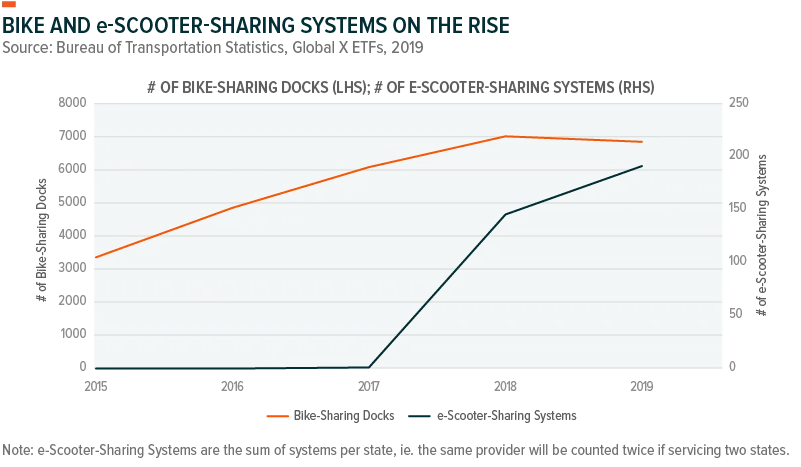
Protected bike lanes streamline non-automotive travel and should prove essential in increasing overall transportation volumes. Cities have seen an uptick of bicycle and scooter ridership in recent years, supported by the mass adoption of non-auto vehicle-sharing systems (see below chart). These transportation modes are compact, easily stored, and can get to places that cars can’t. But absent the necessary infrastructure, they can increase congestion and traffic accidents.2 Networks of protected bike lanes provide riders with dedicated, safe travel alternatives and do positively impact existing traffic flows, if implemented correctly. New York City, for example, made room for them by reducing the width of lanes for driving and parking. The results are compelling – bicycle volumes increased by as much as 160%, overall traffic accidents causing injury dropped by 20%, and overall travel speeds either stayed the same or increased.3 And bike lanes could more than just take single-passenger autos off the road, they make new developments like freight delivery bikes attractive, mobility-enhancing options for businesses and their customers.4
Public transportation systems should provide commuters with affordable and efficient means of traveling mid to long range distances, but in US cities, they are either overextended or nonexistent. The next generation of infrastructure should make them a viable option for urban and suburban mobility and promote their widespread adoption. Underutilized systems like high-speed water taxis should be built out, with new ports and routes adding to their feasibility. More popular, traditional systems need efficiency-generating redesigns. Limiting bus routes to grids and bus lanes, for instance, would minimize redundancies and associated traffic congestion. Houston, Texas, devised such a system in 2015 and saw ridership jump 6.8% over the following 12 months.5 Further, the advent of autonomous and battery-electric buses is supportive of expanded bus fleets that have lower operating costs and alleviate urban air pollution.
Subways and light rail, too, could see efficiency improvements without putting as much as a shovel in the ground. By installing open gangways and eliminating space between cars, as is the norm in most of the world, some estimates have subway capacity increasing by as much as 10%.6 All systems could be further enhanced by connected devices, big data, and artificial intelligence. For example, internet-connected buses could collect and transmit data to a central hub that uses artificial intelligence to optimize bus routes and respond to changing demand.
Transportation infrastructure should be assessed holistically. Optimized point-to-point travel requires interconnected transit systems to enable route efficiency assessment. Mobility as a Service (MaaS) addresses this idea, integrating public and private transportation options and presenting them to the public at a single endpoint – a smartphone. In a MaaS model, users can choose between affordability, speed, and comfort across the multitude of transport modes available. On the other side of this, cities can leverage user data to further optimize transport options or implement demand-responsive pricing, such as adjusting congestion taxes or parking rates.7 MaaS services are still in their infancy, but early trials of these revolutionary platforms in Sweden and Finland are encouraging. In the Swedish trials, 80% of customers said they wanted to continue using the service, though an assessment stressed that infrastructure improvements were needed for mass adoption.8
While more efficient use of roads, public transit systems, and bike lanes can help in the near term, innovation will need to constantly disrupt the way we travel and cities operate. New mediums of transportation may be these disruptors – hyperloop concepts describe transportation pods barreling through series of frictionless tubes at high velocity.9 Or, the way we think about cities’ physical infrastructure may completely change – developers in Arizona are building a community that will solely rely on non-auto transport and in Portland, Oregon, the Tilikum bridge only allows bikes, buses, and pedestrians.10,11 Regardless, future infrastructure should consider throwing out old norms in favor of testing and optimizing new approaches.
Where the Silicon Hits the Road: Technology and Infrastructure Converge
Infrastructure and technology are more intertwined today than ever before. Changes in the ways Americans connect with each other, travel from A to B, and conduct business require new kinds of infrastructure. And at the brink of a digital age coined ‘The Fourth Industrial Revolution,’ designers of tomorrow’s infrastructure must consider future technological advancement.12
The 21st century world is wireless and always connected. Satellites and cellular towers enable instantaneous internet access and communication, transmitting data that runs societies and economies. As new technology requires faster networks with more capacity, infrastructure needs to evolve in lockstep – enter 5G. 5G networks are faster, have greater bandwidth, and its physical imprint is a natural fit for a world that is running out of space. Instead of the fewer, large cellular towers that supported past generations’ networks, 5G networks are comprised of many more small towers that have shorter range, but are more powerful. Adequate 5G implementation entails deploying hundreds of thousands of cells across the country and requires significant public and private sector partnership for installation and maintenance.13 5G networks provide the bandwidth necessary for millions of internet of things (IoT) devices to simultaneously connect without issue.
In our daily lives, IoT devices are our smartphones, wearables, and virtual assistants that, for the most part, make us more productive. Increasingly, they are also data-collecting sensors embedded throughout cities. Imagine traffic lights that precisely time traffic flows, vehicles that communicate with each other and infrastructure, and engineers knowing exactly when physical infrastructure needs repair. This revolution is already taking place in Nanjing, China, where sensor-equipped taxis, buses, and private vehicles transmit data to a central hub that sends smartphone notifications to commuters.14
IoT infrastructure will also be crucial in mainstreaming autonomous vehicles which rely on low latency data transmission to make split second driving decisions. Utilities services, too, will benefit as smart meters monitor water and electricity usage, efficiently distributing resources across entire cities. Cities like Singapore, Tokyo and New York City pledged to spend more than $1B on smart city planning in 2019 and such efforts will need to continue and expand across the continental US.15
Commerce-facilitating infrastructure also needs an upgrade. This could include standardizing a national electronic payment system, an effort that global infrastructure leaders see as vital. Singapore, which many rank as having the world’s best infrastructure, named e-payments as a core tenet of its Smart Nation Initiative, and already launched government-backed B2B and P2P platforms.16 The World Bank identifies 7 infrastructure categories needed for such systems, including interbank gross settlement systems, communications technology infrastructure, and reliable electric grids.17 On a greater scale, infrastructure supporting commercial aviation, maritime shipping and trucking needs technological enhancement. Aviation contributes to $1.5T of economic activity in the US, and while stretched airport capacity necessitates additional physical infrastructure, airline efficiency technology like the FAA’s NextGen can limit congestion and should roll out nationally.18,19 Similar optimization should be brought to the shipping industry, where port authorities name automation, big data and analytics, IoT, and AI as key investment areas.20
Weathering the Storm: Building Resilient Infrastructure for an Unpredictable World
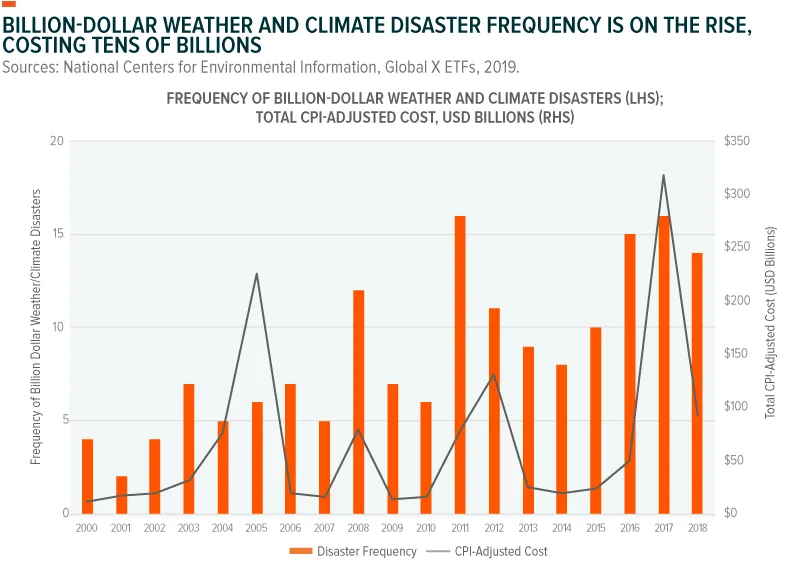
Mother nature is harsher than ever, with disaster events occurring at unprecedented rates (see below chart), destroying infrastructure along the way.21 With the opportunity to build trillions of dollars’ worth of new infrastructure, it is equally important to protect that investment against climate events.
Natural disasters cost the US $92B in 2018, an astonishing 20% of the federal funding afforded to disaster assistance over the past 14 years.22 More resilient infrastructure could vastly reduce these costs. For physical infrastructure, this means focusing on architecture, engineering, and planning. Traditional enhancements like raised roadbeds, proper drainage systems, and strengthened levies and sea walls, can all help protect infrastructure and property during extreme weather events. Some of these efforts are already underway: a recent survey of the 50 largest US cities found that 240 infrastructure resilience projects are in the pipeline, totaling $47B and 60% of which are for managing flood risk.23
Innovative engineering goes further and can make resilience a key design consideration in construction. Cognizant of Malaysia’s regular flooding during monsoon season, engineers in Kuala Lumpur built the city’s Expressway 38 tunnel to serve as stormwater drainage tunnel during flash floods, thus far having mitigated 45% of total flood risk since its 2007 opening.24 Innovation also makes retrofitting an option for protecting existing infrastructure. Years after the Great East Japan Earthquake of 2009, Japanese construction companies announced plans to install earthquake dampening pendulums atop the Shinjuku Mitsui building in downtown Tokyo.25 And finally, disruptive technology like disaster-detecting IoT sensors, camera-equipped unmanned drones, and artificial intelligence, can be used alongside more traditional technologies like geographic information systems and satellite imaging to better predict and plan for natural disasters before they occur.26
Sustainability considerations are also important in building resilient infrastructure. Mismanaged stormwater runoff, for example, can eventually end up in drinking water and in the ground below physical infrastructure. Sustainable infrastructure like the before-mentioned example in Kuala Lumpur, can mitigate these risks. Ironically, unsustainable infrastructure can accelerate weakening of structures and negatively impact public health. Infrastructure associated with pollutive emissions like coal-fired power plants and combustion engine public transportation contribute to rain acidification which can degrade physical infrastructure like buildings roads and parks. Investment in renewable energy sources like wind, solar, hydro, among others, could mitigate some of these risks. This might make economic sense too. The levelized cost of energy for onshore wind and thin-film solar is cheaper than that of coal – this means that utility providers can charge less for renewably-generated electricity for a project to breakeven over its lifetime.27 Electric vehicle infrastructure would also help to this end. More expansive charging station networks, especially in cities, might incentivize further EV adoption. The global stock of EVs is currently 5.1 million vehicles, but is expected to reach 130 million by 2030, representing a 34% CAGR.28
Resilience also means withstanding forces like obsolescence and population growth. While we have focused on keeping infrastructure lean, increased capacity is necessary in some cases. US ports, for example, are not deep enough to accommodate the growing size of containerships. Other maritime commerce hubs have kept pace: the Panama Canal, where $260B worth of cargo passes through annually, underwent recent expansion in anticipation of increased depth requirements.29 Considering that 99% of the US’ overseas cargo by volume passes through ports, creating $4.6T of economic activity, it would be incumbent for the US to modernize its ports to remain a competitive power in the global economy.30 The US’ utility infrastructure faces similar capacity constraints and obsolescence. 5.5% of the country’s drinking water systems serves more than 92% of the population, and while urbanization definitely strains infrastructure in concentrated areas, capacity must increase according to current and expected population distribution.31 Further, existing water systems need an immediate overhaul: 240,000 water main breaks occur each year, and even more concerningly, 2,000 water systems across all 50 states contain excessive amounts of led, 350 of those supplying water to schools or day cares.32 Natural gas infrastructure faces similar pressure. While oil-producing states make natural gas abundant and cheap on the whole, transportation pipelines are lacking in certain regions like the Northeast.33 This strains existing pipelines, inflates prices beyond what supply would suggest, and often results in oil producers burning surplus gas – also known as flaring – to affordably dispose of it.34
Infrastructure’s Impact on Industry
Associated spending for an infrastructure overhaul we describe would be in the many trillions, across the public and private sectors, and spanning countless industries. New and retrofitted physical infrastructure will require extensive raw materials including aluminum, for construction infrastructure and transportation; copper, for electrical transmission; cement, a key ingredient for making concrete; and steel. Further down the infrastructure value chain, companies exposed to the building process should benefit from increased spending, including those involved in construction and engineering for major structures, as well as those involved in the production of heavy equipment. IoT, 5G, and the other technological aspects of future infrastructure should also benefit these component manufacturers, as well as those involved in the development and production of integrated products and solutions, applications serving smart grids, smart homes, connected cars, and the industrial internet.
Continue reading with Part 3, start at the beginning with Part 1, or click here to view the full report (PDF).
Related ETFs
PAVE: The Global X U.S. Infrastructure Development ETF (PAVE) seeks to invest in companies that stand to benefit from a potential increase in infrastructure activity in the United States, including those involved in the production of raw materials, heavy equipment, engineering, and construction.
SNSR: The Global X Internet of Things ETF (SNSR) seeks to invest in companies that stand to potentially benefit from the broader adoption of the Internet of Things (IoT), as enabled by technologies such as WiFi, 5G telecommunications infrastructure, and fiber optics. This includes the development and manufacturing of semiconductors and sensors, integrated products and solutions, and applications serving smart grids, smart homes, connected cars, and the industrial internet.
DRIV: The Global X Autonomous & Electric Vehicles ETF (DRIV) seeks to invest in companies involved in the development of autonomous vehicle technology, electric vehicles (“EVs”), and EV components and materials. This includes companies involved in the development of autonomous vehicle software and hardware, as well as companies that produce EVs, EV components such as lithium batteries, and critical EV materials such as lithium and cobalt.
Part 3 of 3: In this section, we explore what a 21st century infrastructure plan could look like.
Global X Research
Global X Research