This piece originated our “A Decade of Change” series. Please see our mid-decade update published in July 2025, A Decade of Change: How Tech Evolved in the Last Five Years and Bold Bets for the Next Five, highlighting trends that have accelerated over the past five years, and trends to watch in the five years ahead.
Significant technological advancements and societal shifts occurred during the 2010s decade. Yet many of these developments became so quickly engrained in our daily lives that they often went relatively unnoticed, and their impact all but forgotten. Over this next decade, the 2020s, we expect similar rapid and meaningful advancements to occur. Moore’s law suggests that over a ten-year period, semiconductors will advance by 32 times, bringing about mesmerizing innovation in the digital age that should not only change technology, but society, as well. In this piece, we review the technological advancements over the last decade and anticipate what revolutionary changes may be in store for us over the next 10 years.
The 2010’s: A Decade of Disruption
Mobile upgraded from 3G to 4G networks
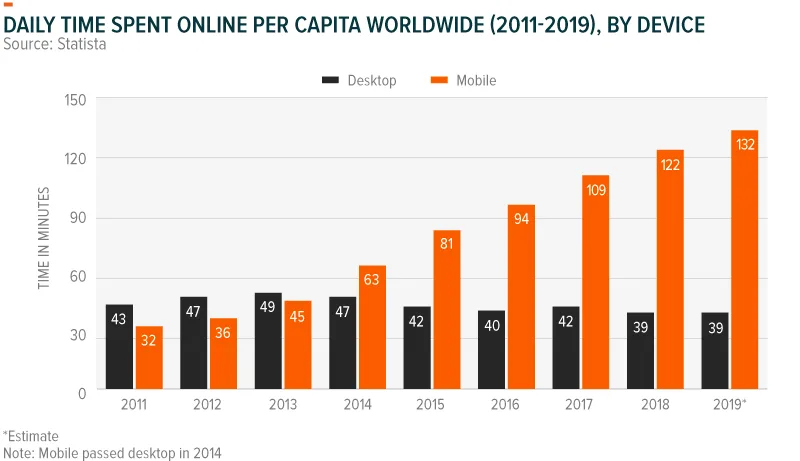
What changed? 3G networks introduced a new age of calling, texting, and internet connectivity for mobile devices. 4G offered 10x faster speed than 3G networks, increasing download speeds from 1.5 Mbit/s to 15 Mbit/s.1 For perspective, this reduced the download time for an 800MB movie from 5 hours to 43 seconds. This improvement made 4G a foundational technology for a range of mobile applications that pried users away from their desktops and let them stream music and videos, shop on e-commerce sites, and use social media, all on the go.
Industries that benefited: Smartphone manufacturers, social media, e-commerce, streaming media
Then and now stat: Daily time spent online on mobile devices increased from 32 minutes in 2011 to 132 minutes in 2019.
Social Media Brought Our Lives Online
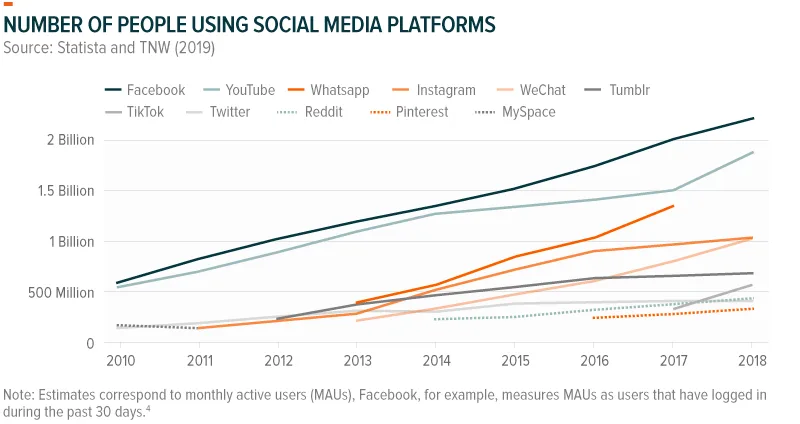
What changed? In the age of desktop computers, social media was a log of what happened in the past – a collection of experiences uploaded after the fact. As social media shift to the smartphone, however, it became an instantaneous broadcast of life experiences. And it’s not just individuals using these platforms anymore, companies, news organizations, and governments leverage them to rapidly communicate information in real time. In amalgamating these different types of content, social media platforms became one-stop-shops for information, capturing users’ attention and occupying significant amounts of their time. Advertisers took notice and continued to pour spending across social media platforms and search engines: in 2019, digital advertising spending surpassed that of traditional advertising mediums like TV and radio.2
Industries that benefited: Social media, online search platforms
Then and now stat: The number of global social media users increased from 970 million people in 2010 to 2.96 billion in 2020.3
The Dawn of Genomics and Precision Medicine
What changed? Precision medicine, also commonly referred to as personalized medicine, uses patients’ genetic information to determine the most suitable treatment option for illness and to proactively identify health risks. As genomic sequencing costs rapidly fell, computing power increased, and biotech research advanced, precision medicine transitioned from an idea to a reality. Developments like the CRISPR-Cas9 approach to gene-editing introduced new efficient and reliable ways to make precise, targeted changes to the genome of living cells. In practice, this means editing or removing portions of DNA that present health issues. In 2019, such technology showed promise in treating blood disorders like sickle-cell and other genetic conditions like muscular dystrophy. According to some, CRISPR technology could correct up to 89% of disease-causing genetic variations in the future.5
Industries that benefited: Biotechnology, gene editing, genetic diagnostics
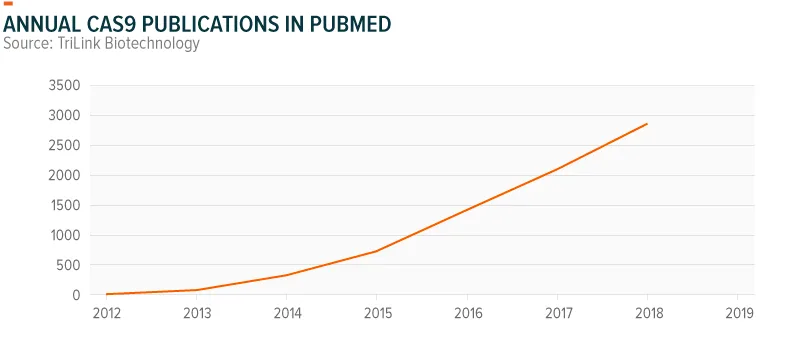
Then and now stat: Since CRISPR-Cas9’s 2012 discovery, the genetic editing technology became an intensive research field as is evident by the upward trend of medical journals discussing Cas9.
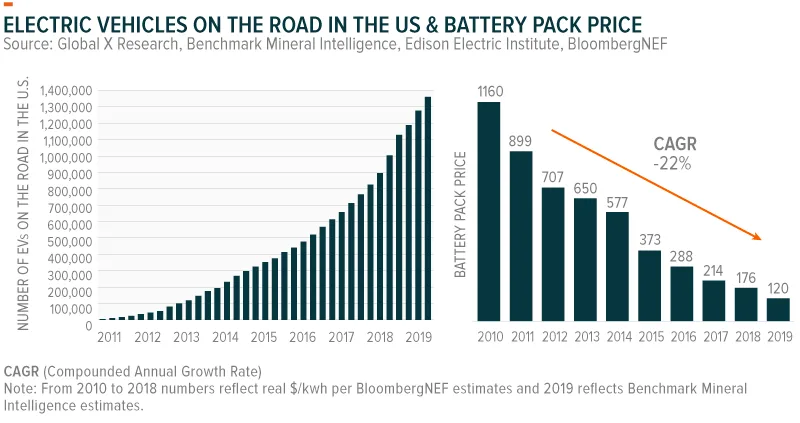
Electric vehicles (EVs) became competitive with internal combustion engine (ICE) vehicles
AI and Big Data Took Off
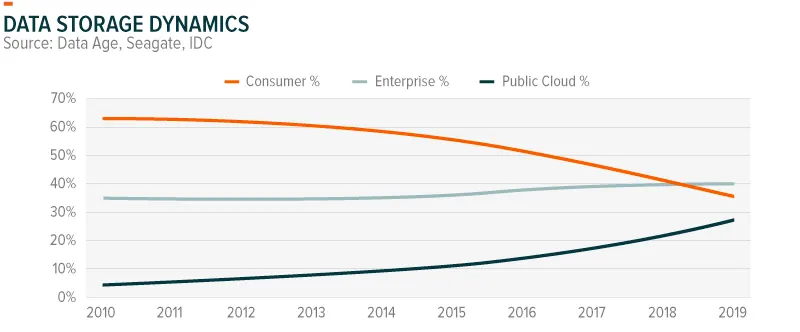
Data storage moved to the cloud

What to expect for the 2020s
5G becomes the new wireless standard
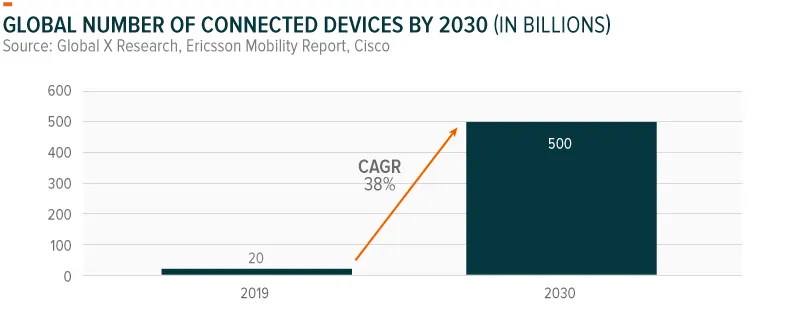
5G’s means more than just a faster internet. It proliferates the mass-adoption of connected devices in homes, cities and enterprises, including those involved in agriculture, health care, manufacturing, and infrastructure. Increasingly, these industries rely on connected devices to gather and analyze data, making processes more efficient, reducing downtime, and freeing up time to focus on new products and initiatives.
Cloud moves to the edge
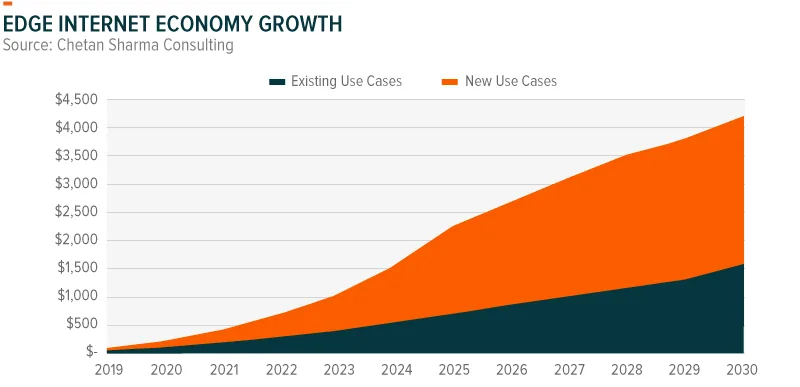
The continued decline of computing costs and improvements in network infrastructure and artificial intelligence are key drivers of the emergence of edge computing – data processing conducted locally without transmission across a large network. Some technologies require instantaneous data interpretation and can’t rely on networks with higher latency. Autonomous vehicles, robotic surgery, gaming, and smart factories, for example, can require near simultaneous data transmission. Edge computing reduces latency to 5-10 milliseconds from 25-35 milliseconds for early deployed 5G devices.10 A study estimates the economic impact of edge computing to reach $4.1 trillion by 2030.11
Transportation goes electric, autonomous, and shared
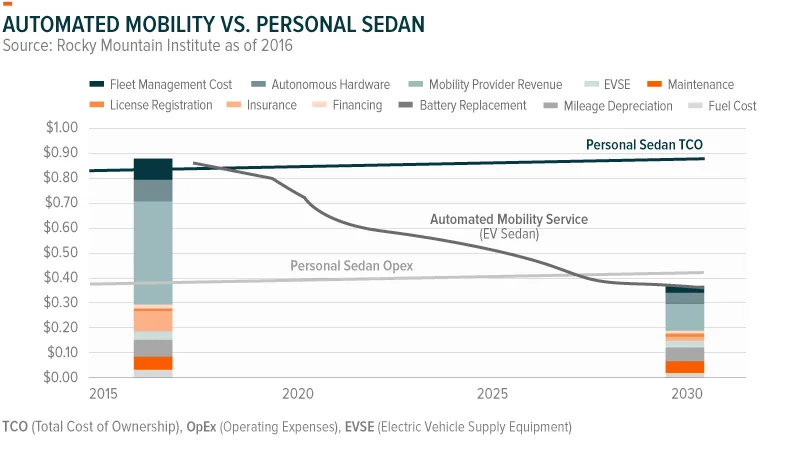
Shared autonomous and electric vehicles are expected to cost $0.35 per mile by 2030, less than half the cost of owning a personal sedan ($0.88 per mile).12 By 2030, new car models equipped with self-driving technology are expected to be commonplace. This transition will allow drivers to take their hands off the wheel while their vehicles drive autonomously, or to hail driverless shared robotaxis. Considering that the average American spends 18 days-worth of time driving each year, greater than the average number of vacation days per year (10 days), the productivity and leisure benefits of autonomous vehicles could be enormous.
Robotics enters new industries
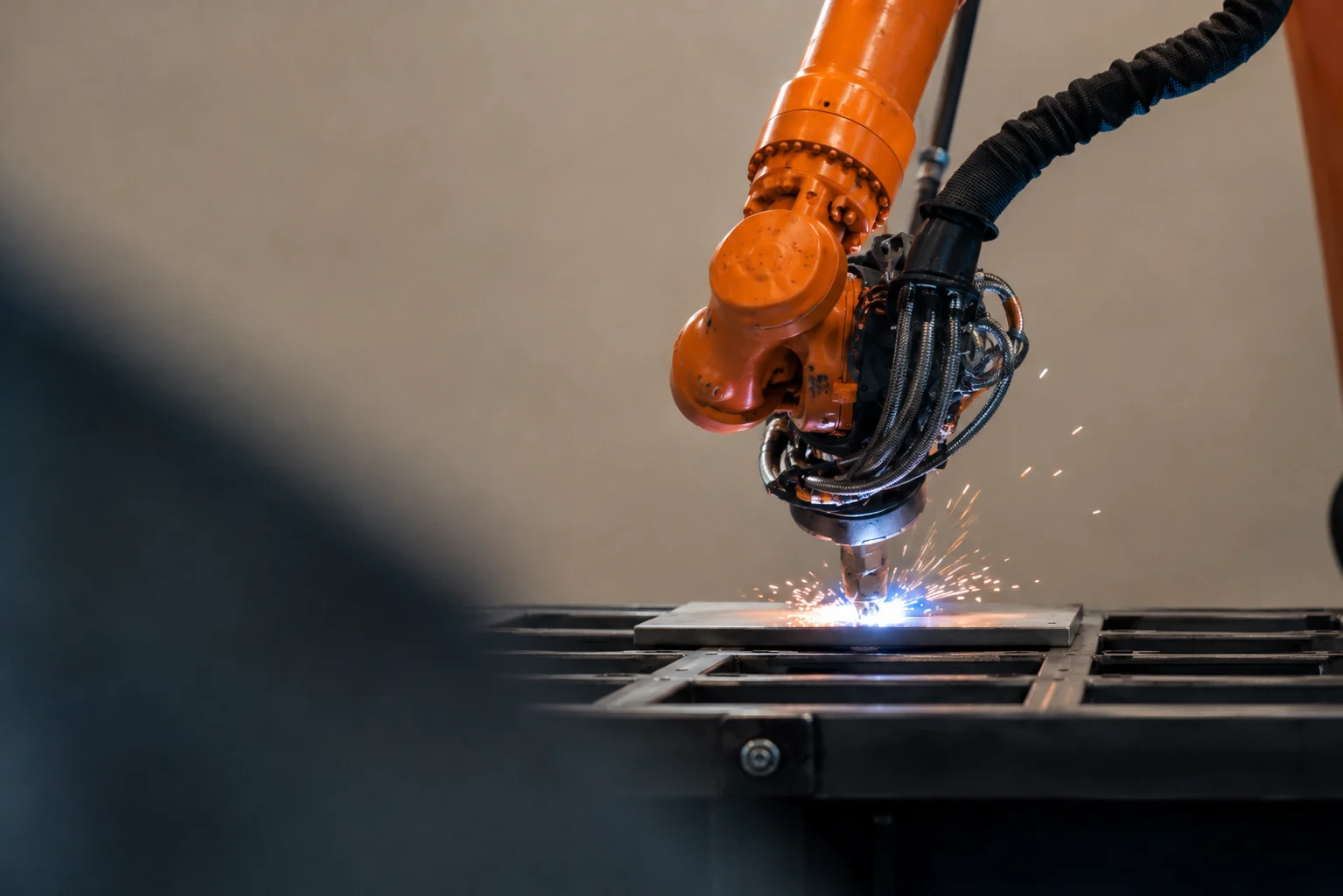
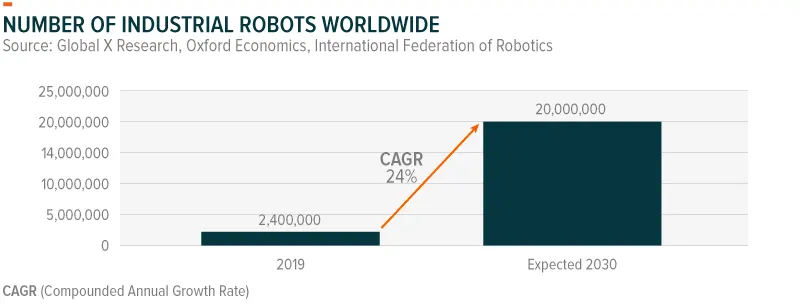
Improvements in artificial intelligence and dexterity are the result of advanced 3D vision capabilities and end-of-arm tooling for precise movements. While the auto manufacturing segment remains robotics’ largest end-market, emerging segments like healthcare and hospitality can benefit from smarter, more capable robots that can conduct surgery, check on patients, cook food, or deliver items to hotel rooms. Agriculture will also see a robotics-driven revolution with automated spraying, monitoring, and picking likely resulting in reduced costs and improved crop yields. The global stock of industrial robots is expected to reach 20 million by 2030, representing a 24% CAGR as robots enter more industries.13
Omnichannel-commerce: Not a zero-sum game between e-commerce and brick-and-mortar
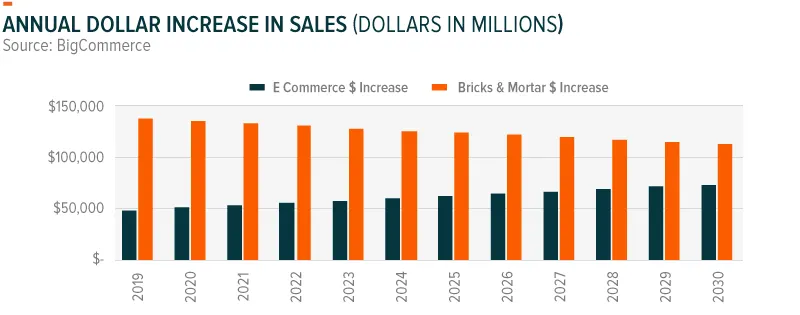
The separation between e-commerce and brick and mortar retail will blur as digital and physical shopping experiences become one in the same. Augmented reality will give consumers the ability to try on and order clothes from the comfort of their homes, but physical stores with reduced footprints will feature unique consumer experiences, immediate purchases, and try-before-you-buy optionality. Coupled with IoT technologies that track consumer behavior and build datasets around it, and advances in AI, retailers could be able to predict consumer behavior at almost 100% accuracy. We also expect to see e-commerce as a value add for small and mid-sized businesses, providing a medium for them to sell products outside of their locality and giving a means of accessing global consumer-bases.
Health care goes digital: AI diagnoses and telemedicine
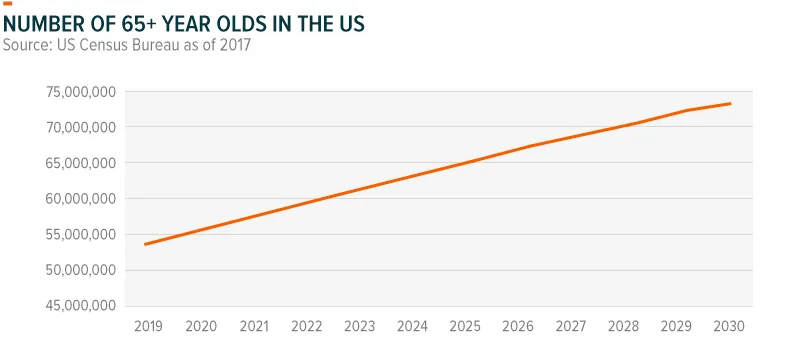
As the population ages, there will be increasing pressure to reduce costs, improve patient outcomes, and optimize physicians’ time. All of this is possible by leveraging telemedicine and artificial intelligence – two technologies that are set to disrupt health care. Telemedicine offers an alternative solution to in-person doctor visits, providing diagnostic and clinical services to patients around-the-clock, from the convenience of one’s home or workplace. Currently, telemedicine utilization rates remain below 10% in the U.S., but penetration is likely to grow as technology reduces costs and adds convenience.14 Further digitalization of health care will also enable new use cases for AI. Recent developments like AI-driven, real-time MRI interpretation could mean enhanced diagnoses and treatments across other health care verticals, in addition to its use in telemedicine as an AI chatbot for triage or basic medical advice.
Genomics: The potential to cure the previously incurable
Advances in genomics could offer the first realistic opportunity to cure certain illnesses previously deemed fatal. Scientists have identified more than 50,000 genetic diseases caused by a single gene mutation in humans, known as Mendelian diseases. These are likely to be the first diseases treated through gene editing techniques.15 As the medical and scientific communities’ understanding of gene expression and protein pathways improves and genomic sequencing costs continue to fall, we expect a vast increase in the number of tested and proven genomic therapies.
Conclusion
The 2010s were a decade of phenomenal innovation, led largely by the transition to mobile and the rise of data, which accelerated the growth of AI, e-commerce, social media, and biotechnology. In the 2020s, additional foundational changes will take place as data latency shortens and AI algorithms improve. Such progress should enable new technologies to flourish, including autonomous vehicles, conversational AI, the massive internet of things, and augmented and virtual reality. As new technologies are introduced to the market place, they will have a profound impact on our lives, workplaces, and even investments as they reshape the economy.