
SEI Investments Distribution Co. (1 Freedom Valley Drive, Oaks, PA, 19456) is the distributor for the Global X Funds.
Check the background of SIDCO and Global X's Registered Representatives on FINRA's BrokerCheck.
Get the latest news and updates from our team.
1. US Census Bureau, “Quarterly Retail e-commerce sales 1st quarter 2019,” May 17, 2019.
2. Ibid.
3. McKinsey&Company, “Digital China: Powering the economy to global competitiveness,” Dec 2017.
4. Shopify, “The Global Ecommerce Playbook.”
5. China Chain Store & Franchise Association.
6. Fung Business Intelligence, “Top 100 retail chain operators in China, 2018 – Key findings and takeaways,” May 2019.
While there is a perception that online shopping has become virtually ubiquitous, in Q1 2019, penetration rates were still low, with e-commerce sales representing just 10.2% of the $1.34 trillion of total retail sales in the US.1 Of course, online sales are closing the gap, growing much more rapidly than traditional brick and mortar purchases. In the first quarter of 2019, e-commerce sales increased 12.4% year-on-year, while total retail sales increased just 2.7% during the same period.2
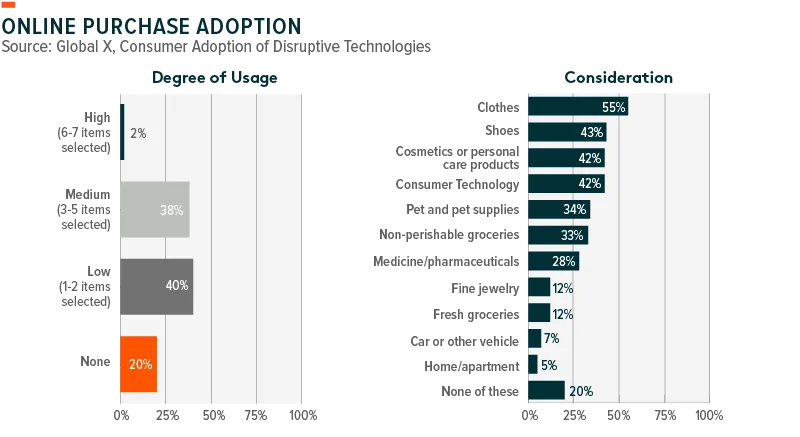
Yet while consumers spend an increasing amount online, we found that their comfort level with e-commerce depends on the products they intend to purchase. We recently conducted a survey and found out that while over 40% of the population is comfortable buying smaller-ticket items online, like clothes, shoes, cosmetics, and consumer electronics, less than 15% of the population is comfortable buying big-ticket items like fine jewelry, cars, or a home/apartment. And despite many attempts from leading e-commerce giants, buying perishables like fresh groceries online has largely failed to attract loyal customers.
As technology and logistics continue to improve, we believe these big-ticket categories and perishables are likely to follow the high growth path of established online industries like clothing and shoes. Imagine buying fresh produce from a farmer’s market and having it delivered by drone or test-driving a new car via virtual reality goggles from the comfort of your home.
Opportunities Outside the US
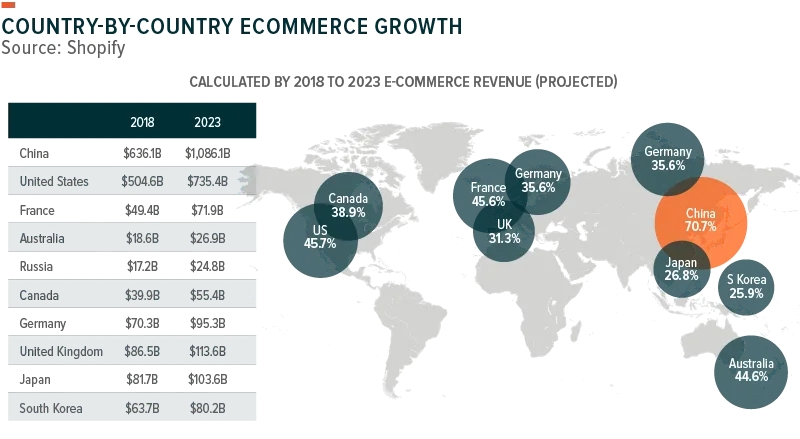
Outside of the US, e-commerce has shown even faster growth in certain areas. China, for example, has become the world’s largest e-commerce market representing more than 40% of the world’s online transactions.3 Nearly a quarter of total retail sales in China are made online as Chinese consumers benefit from rising wages, urbanization, and greater internet connectivity.4
E-commerce has emerged as a solution to many problems. Before the arrival of e-commerce, the China retail sector was extremely fragmented and had limited availability in rural areas. In 2001, the top 100 retail chain operators had a combined market share hovering around 4%.5 Thus, producers had little benefits of scale, brand recognition, or geographic coverage. Fast forward 18 years, producers and merchants are finally able to sell their products all around China with the help of e-commerce platforms. Last year, online sales growth of the top 100 retailers increased 55.5% year-on-year.6
Conclusion
Today, having a solid online presence is often the difference between successful retailers and those who are failing. While traditional retail sales grow at around the inflation rate, companies that are online first, or have well developed online capabilities, have the potential to experience strong growth fueled by the increasing adoption of online ordering by consumers around the world.
Related ETFs
EBIZ: The Global X E-commerce ETF seeks to track the Solactive E-commerce Index, which focuses on companies positioned to benefit from the increased adoption of e-commerce as a distribution model. This includes companies whose principal business is in operating e-commerce platforms, providing e-commerce software and services, and/or selling goods and services online.
Connected Themes
Social Media, Millennials, FinTech, Internet of Things, China Consumer, AI & Big Data (Future Analytics Tech)
The internet economy is thriving with e-commerce driving retail growth, fueled by omnichannel strategies, digital ads, and FinTech integration.
Tejas Dessai
Multiple authors