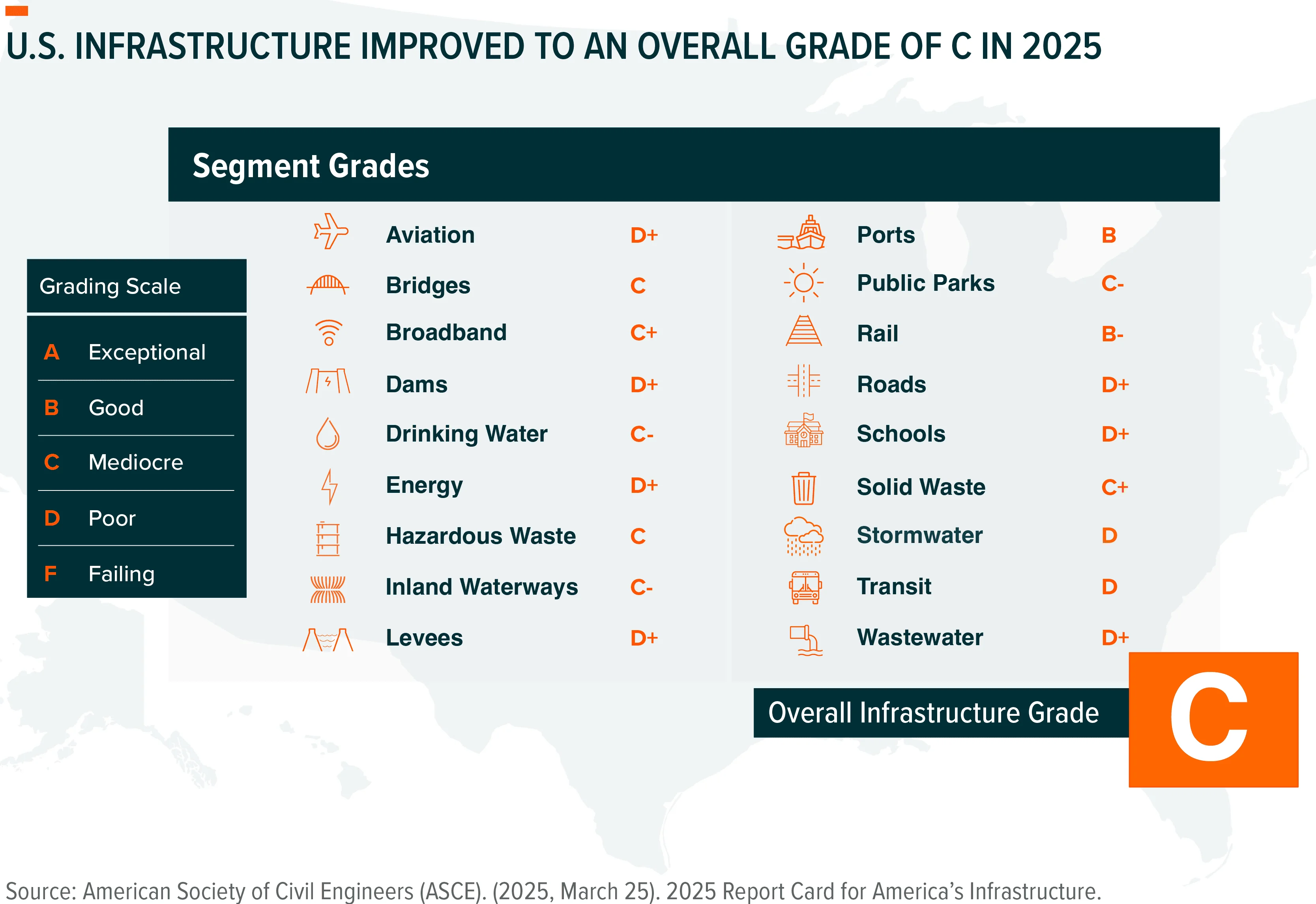
In late March, the American Society of Civil Engineers (ASCE) released its 2025 Report Card for America’s Infrastructure. In the latest version of this quadrennial report, the United States earned an overall grade of C, improving from a C- in 2021.1 While this marks some progress, it underscores a deeper challenge: without continued investment, aging infrastructure assets, including roads and energy infrastructure, could become a drag on economic growth. A surge in federal and state funding has improved several key infrastructure categories, but the ASCE estimates that $9.1 trillion in investments are still needed over the next decade to further improve, modernize, and maintain critical systems. The Report Card indicates a funding gap of at least $3.6 trillion currently exists which, in our view, points to sizeable opportunities for developers and investors alike.
Key Takeaways
Many infrastructure segments within the United States have benefitted from higher levels of funding and investments over the past four years, causing the overall grade to rise from a C- in 2021 to a C in 2025.2
Nearly half of the assessed categories, including energy, aviation, and transit, still received a grade in the D range, pointing to the need for significant and sustained investment into U.S. infrastructure development. The ASCE estimates $9.1 trillion over the next decade will be needed to improve and maintain the performance of U.S. infrastructure.3
Improving policies, including the federal permitting process and prioritizing resilience, can help further minimize disruptions and risks to U.S. infrastructure assets.
U.S. Infrastructure Has Improved Over the Past Four Years
The 2025 Infrastructure Report Card marks a milestone for U.S. infrastructure. Not only is a C the highest overall grade received since the report began in 1988, but for the first time ever none of the assessed infrastructure asset categories received a D- or lower.4 The grades take into account criteria related to current and future capacity, conditions, funding, resilience, operation and maintenance, and safety. The assessment considers key questions, such as whether the infrastructure system’s capacity meets current and future demands, the infrastructure systems existing and near-future physical condition, the costs to improve the infrastructure, and whether an infrastructure system has the capability to prevent, protect, or quickly recover from multi-hazard threats and incidents.5
Improvements in both the overall grade and many segment grades are generally the result of increased federal and state funding for infrastructure development over the past few years. The Infrastructure Investment and Jobs Act (IIJA), which was enacted into law in November 2021, allotted $1.2 trillion in total funding, including hundreds of billions in new direct funding towards the modernization and expansion of U.S. infrastructure assets.6 As of November 2024, more than $568 billion in funding from the IIJA had been allocated towards 66,000 state-level projects, spanning a range of assets from bridges to roads, airports, and electric vehicle (EV) charging stations.7
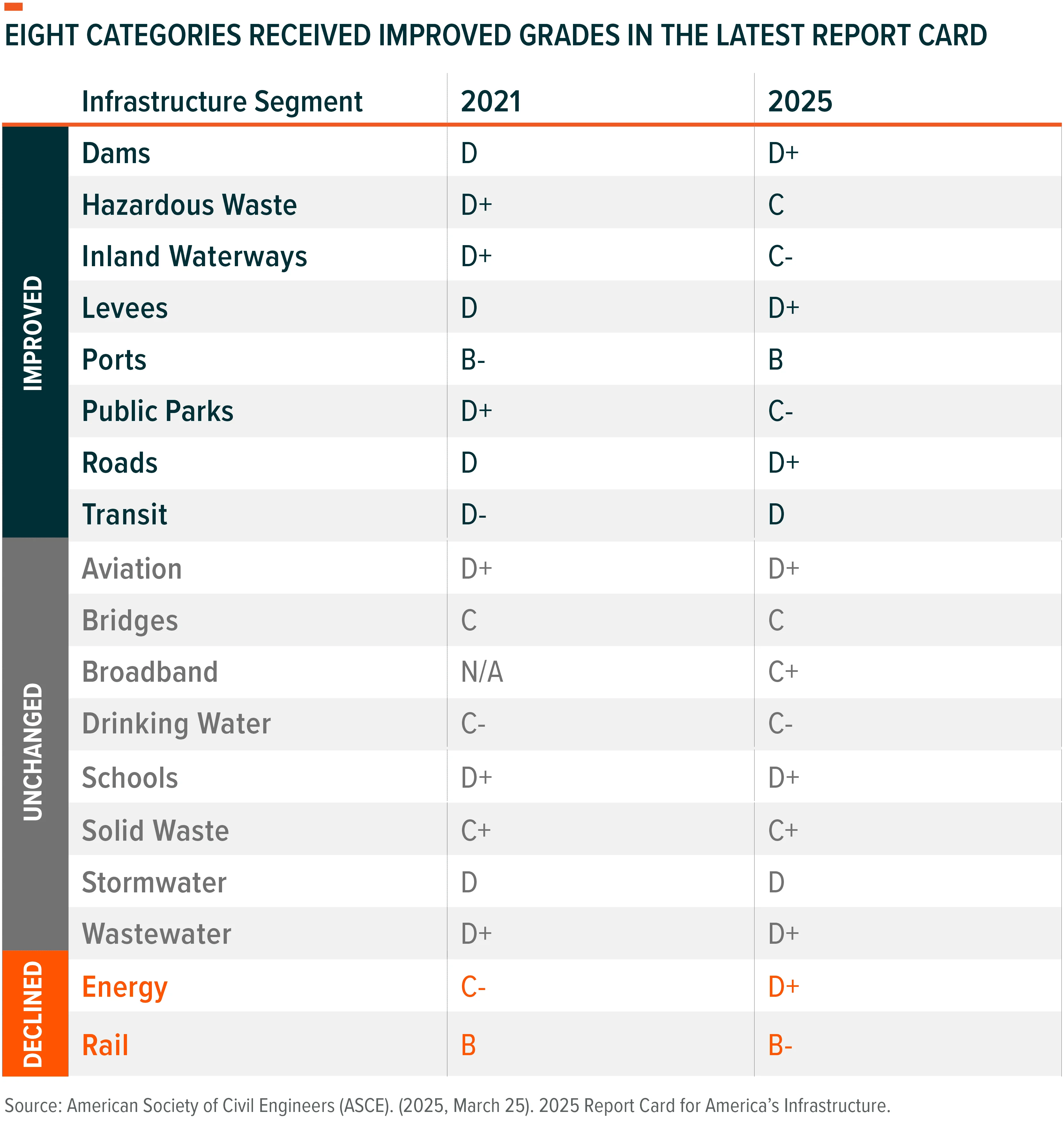
In total, almost half of the 18 assessed categories saw an improvement from the 2021 report, including transit, roads, dams, levees, ports, inland waterways, hazardous waste, and public parks.8 For example, while the average age of U.S. dams is still greater than the average lifespan, billions of dollars in federal funding helped boost dam safety and rehabilitation. For U.S. ports, a near-doubling in annual funding levels in recent years has resulted in more than 1,060 port and waterways projects and a better ability to assess and address demand levels. The IIJA provided $108 billion in support for U.S. transit systems, which helped accelerate long-sought projects, like the Hudson Tunnel Project.9
Sustained Investment Is Necessary to Maintain Momentum and Yield Further Improvements
Despite the improvements, the ASCE’s latest report emphasizes that there is still significant work to be done in improving and maintaining infrastructure across the United States. Although the improved overall grade shows progress, a C grade stands for “Mediocre, Requires Attention,” meaning that there are still widespread signs of deterioration and some elements exhibiting significant deficiencies and increased risks.10 Additionally, nine categories, including aviation, transit, dams, energy, roads, and wastewater, received either a D or D+, translating to “Poor, At Risk” status. This means that these nationwide systems are in fair to poor condition and “mostly below standard, with many elements approaching the end of their service life.”11 In an era of intensifying demands on infrastructure and rising risks from extreme weather events, their conditions and capacities are “of serious concern with strong risk of failure.”12
While the IIJA and other policies have already begun to improve the performance of many segments, the full benefits will likely take years to be fully realized, and it is estimated that additional investment will be needed. In total, the ASCE estimates $9.1 trillion in investments into infrastructure development will be needed between 2024 and 2033 for the United States to keep improving the quality of its infrastructure assets.13 About $5.45 trillion in public and private investments have been outlined for infrastructure developments between 2024 and 2033.14 This means that there is a multi-trillion-dollar investment gap that will need to be filled by sustained, or in many cases increased, federal, state, and private investments.
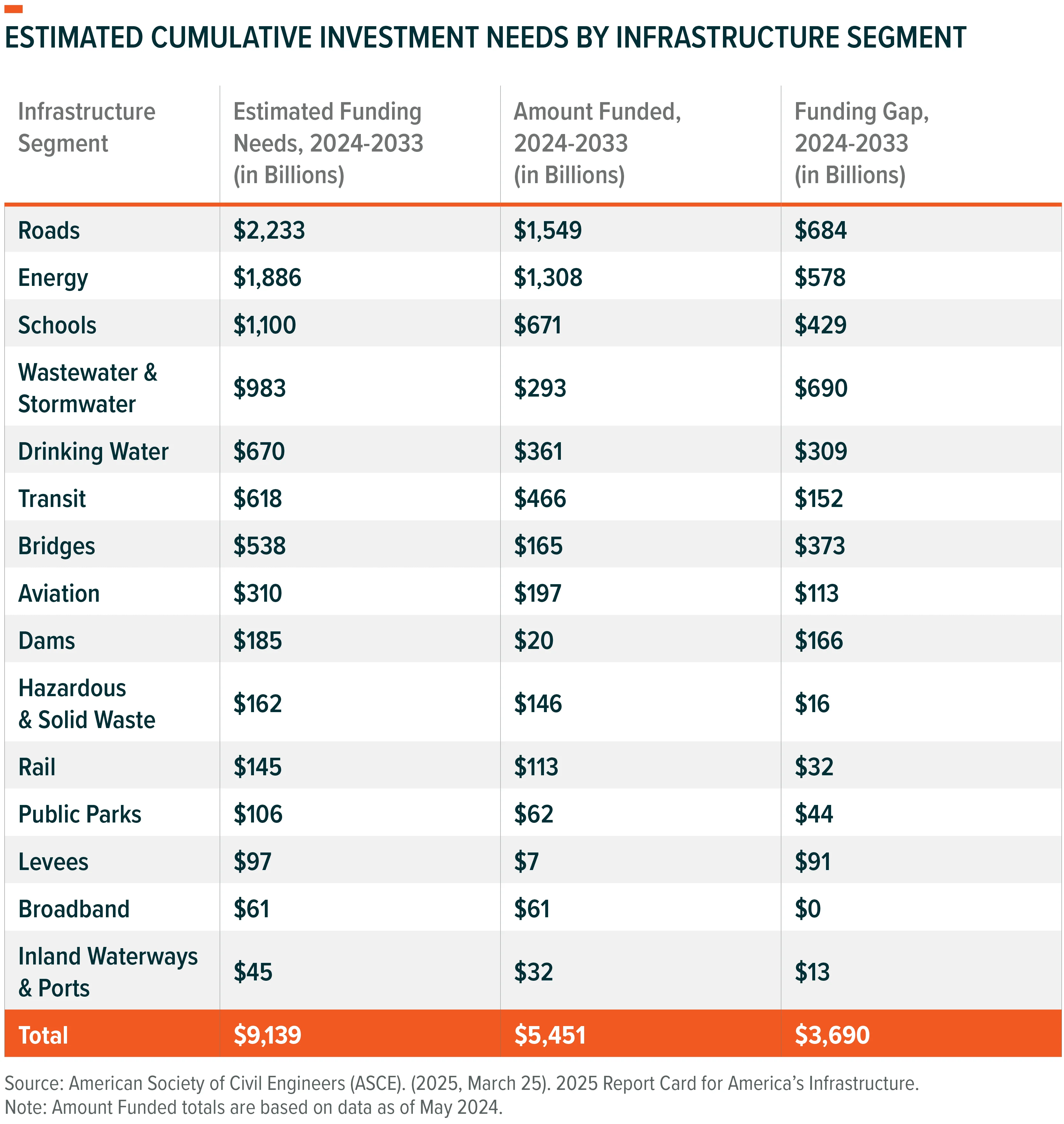
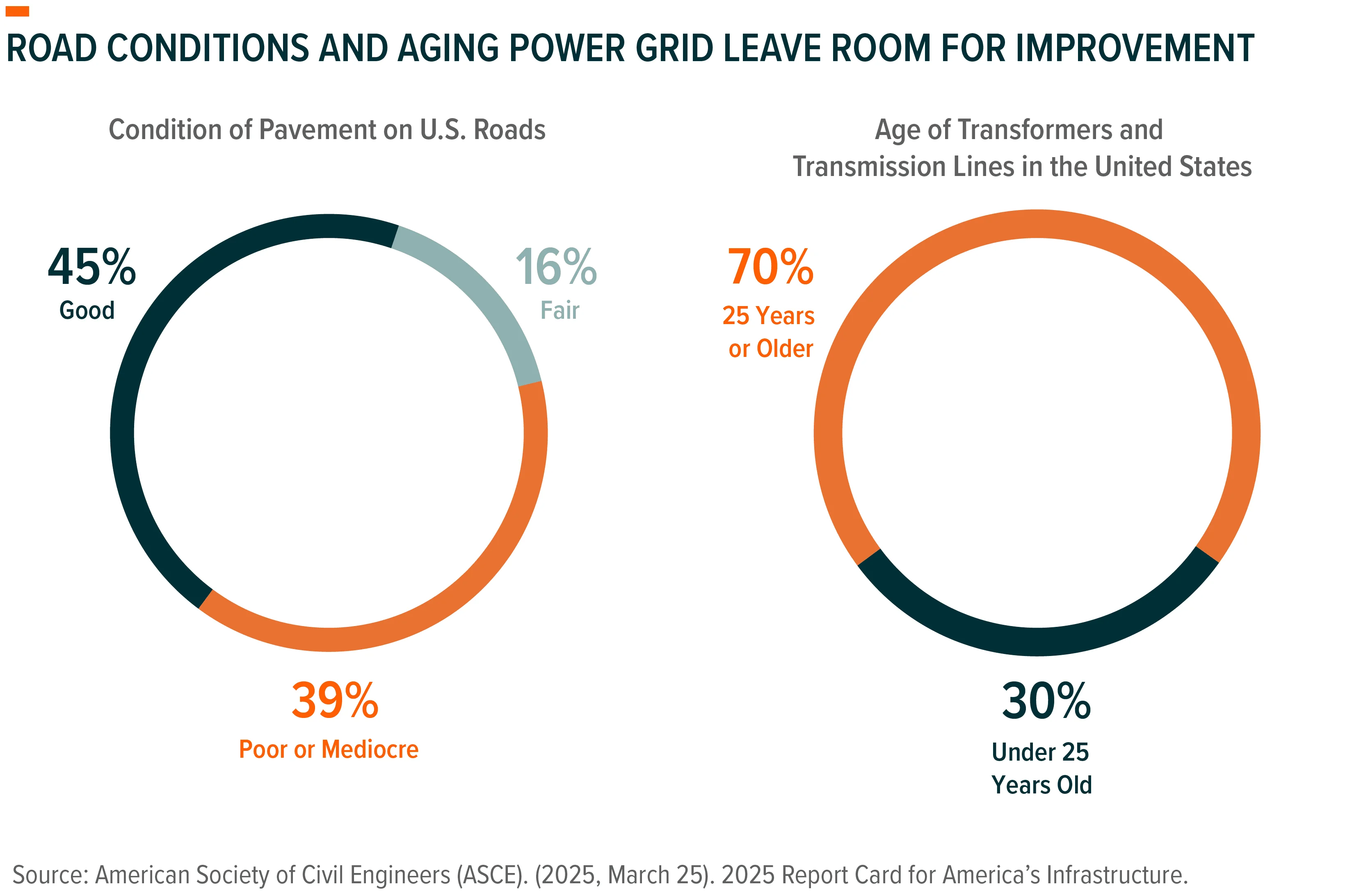
The Report Card indicates that the roads, energy, and schools segments are those with the highest estimated investment needs through 2033. The grade for the roads segment improved only slightly from a D in 2021 to a D+ in 2025. Nearly 40% of major roads in the United States remain in poor or mediocre condition, while another 16% are in fair condition. Every year, the average U.S. driver incurs over $1,400 per year in operating costs and lost time from driving on deteriorated and congested roads. To improve the U.S. roadway network, it is estimated that over $2.2 trillion will need to be invested through 2033, and there is a projected $684 billion investment gap.15
The energy segment was downgraded from a C- in 2021 to a D+ in 2025, largely due to safety risks and concerns that electricity infrastructure capacity will not be able to keep up with future demands.16 Peak winter and summer electricity demand could increase by 18% and 15%, respectively, by 2034.17 By 2040, total U.S. annual electricity demand could increase by as much as 47% compared to 2023 levels.18,19 However, years of underinvestment into transmission and distribution infrastructure and lengthy and complex permitting processes have resulted in an aging grid that is increasingly at risk of disruptions. Expanding and modernizing the grid to keep up with future demand and minimize risks is estimated to require nearly $1.9 trillion through 2033.20
Even segments with higher grades, like bridges and ports, are estimated to need sizeable investments over the coming years in order to perform adequate maintenance, improve resilience, and meet anticipated levels of demand in the future. While U.S. bridges maintained a C grade between 2021 and 2025, the number of bridges in fair condition is surpassing those in good condition.21 Additionally, the average age of existing bridge assets is 47 years, compared to an average lifespan of 50 years. Of the 621,218 bridges in the United States, 6.8% are in poor condition, 49.1% are in fair condition, and 44.1% are in good condition.22 The ASCE estimates that bridges will require $538 billion in cumulative investment needs between 2024 and 2033.23
Improving Policies and Prioritizing Resilience Can Accelerate Developments and Reduce Risks
In addition to sustained investment in U.S. infrastructure, the ASCE outlines two additional suggested priorities for the next four years to continue improving the nation’s grades: 1) Prioritize Resilience and 2) Advance Policy and Innovation.
Prioritize Resilience
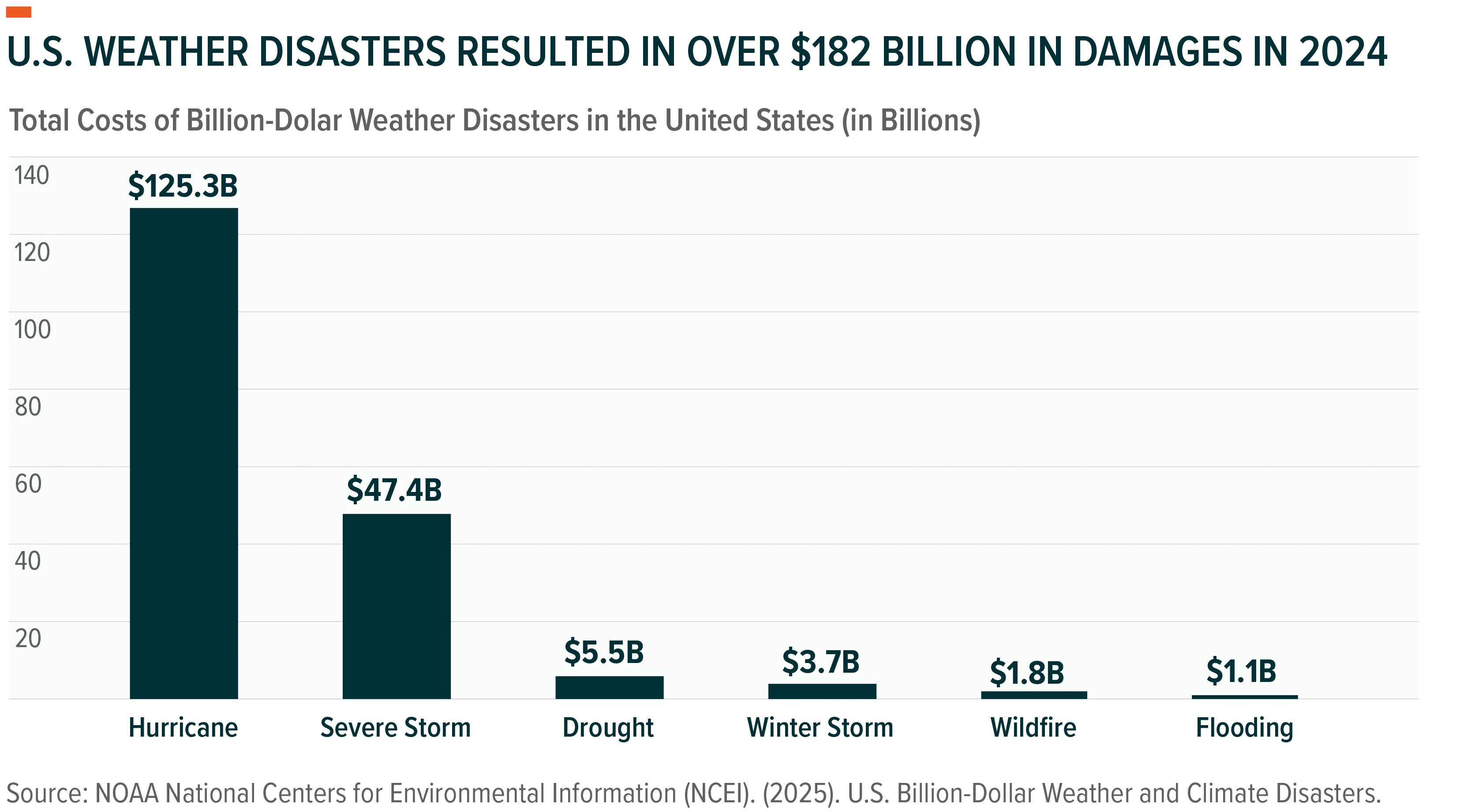
Resilience is becoming increasingly important given that the frequency and severity of extreme weather events is likely to increase. In 2024, 27 extreme weather events within the United States resulted in over $182 billion in economic damages.24
Going forward, building stronger infrastructure assets, adhering to the most up-to-date codes that mitigate risks to events such as floods and fires, implementing better risks analyses, and centering resilience in project planning could be beneficial to the country’s overall infrastructure quality. By one estimate, every dollar spent on resilience can save communities $13 in post-disaster costs.25 Companies that offer services such as risk management and resilience planning, critical infrastructure protection, power management solutions, and disaster risk reduction could benefit from an increased focus on resilience. This includes companies like AECOM, Jacobs, Quanta Services, Trane Technologies, Emerson Electric, and Eaton Corp.
Advance Policy and Innovation
The ASCE also suggests recognizing and addressing the need to reduce delays from project permitting processes. Complex and slow permitting processes remain one of the greatest headwinds for developers within many infrastructure segments. Despite reform efforts in 2023, 61% of reviews for Environmental Impact Statements, a key step for receiving environmental approval, still exceed the two-year review deadline.26
Transmission and distribution (T&D) projects are particularly impacted by permitting given the need to obtain approval at several government levels and across state lines. For example, it took 17 years for the SunZia transmission line project to gain full approval from 10 federal agencies, five state agencies, and nine local authorities.27 The U.S. Department of Energy estimates that transmission systems will need to expand 60% by 2030 in order to support power capacity growth and the transition towards more renewables.28
Improved permitting policies could therefore help accelerate improvements and increase the number of development opportunities in many U.S. infrastructure networks. Companies throughout the U.S. infrastructure development value chain could potentially benefit, including those involved in the buildout of transmission and distribution infrastructure, manufacturing facilities, data centers, and transit assets.
Conclusion: Aging Infrastructure Remains a Considerable Tailwind for U.S. Infrastructure Development
The United States’ interconnected system of infrastructure networks lies at the center of its national economy. While many of these systems have improved over the past four years, significantly more work, and investments, are needed to support future demand and ensure public safety. The bottom line is, U.S. infrastructure remains largely outdated, and there are rising risks associated with growing demand, shifting extreme weather patterns, and the adoption of advanced technologies. In our view, U.S. infrastructure development will remain a focus of both public and private investment, which could create compelling opportunities for investors.
Related ETFs
PAVE – Global X U.S. Infrastructure Development ETF
ZAP – Global X U.S. Electrification ETF
Click the fund name above to view current performance and holdings. Holdings are subject to change. Current and future holdings are subject to risk.