
Since late 2022, when OpenAI’s ChatGPT exploded onto the scene, the generative artificial intelligence (AI) platform has experienced exponential adoption in a way that is extremely rare for new technologies. ChatGPT was estimated to have reached 100 million users in just two months.1 It took Netflix 10 years to reach 100 million users; six and half years for Google Translate; roughly two and a half years for Instagram; and about nine months for TikTok.2,3 Given this backdrop, it is not surprising that expectations regarding generative AI’s potential to create lucrative new business models and nurture new technology companies have surged.
Key Takeaways
The rapid adoption of generative AI platforms like ChatGPT has raised investors’ expectations about the technology’s potential to create lucrative new business models.
US-based tech companies have largely dominated the conversation around generative AI thus far, but that could change as Chinese heavyweights like Baidu enter the fray.
China appears well positioned to benefit from the AI trend, due to the country’s massive amounts of data, skilled workforce, supportive government policies, and advanced manufacturing base.
What Is Generative Artificial Intelligence?
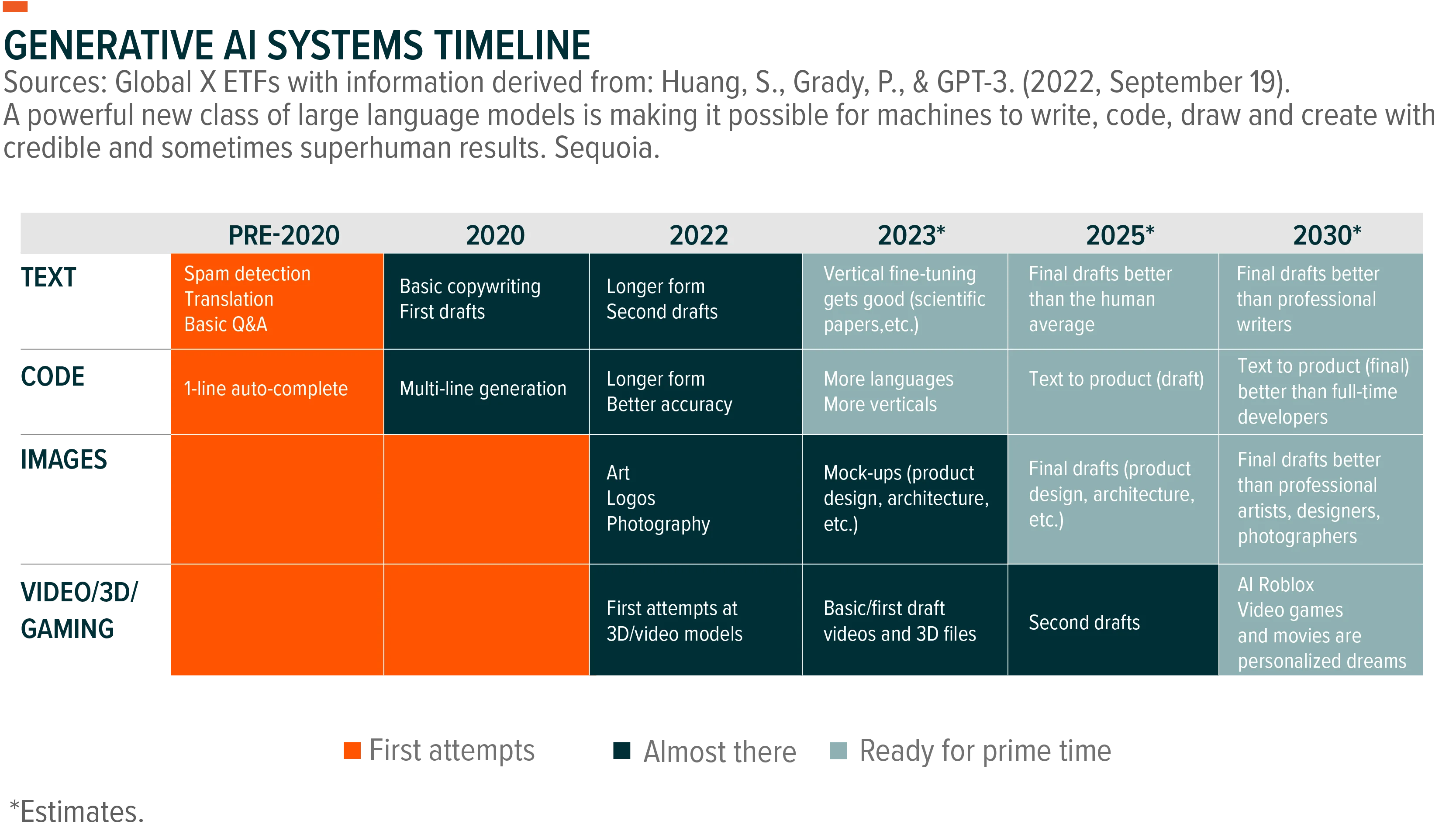
Generative AI refers to artificial intelligence systems that are designed to create new and original content based on the data they are trained on. This can include generating text, images, music, computer code, and even 3D models. Unlike discriminative AI, which is used to classify and categorize data, generative AI creates new data by using probabilistic models to produce outputs based on patterns it has learned from the input data.
China Has a Strong Foundation Based on Research
In the past decade, China has built a solid foundation to support its AI economy and made significant contributions to AI globally. In 2021, China produced the largest share of the world’s AI conference publications at 27.6%, versus 16.9% produced by the US.4 AI research often leads to real-world applications, which have grown rapidly in China. Today, AI adoption has ramped up in many industries beyond tech to include finance, retail, government, and telecommunications. The Chinese government has already released supportive policy guidelines to foster investments in AI-related fields.5
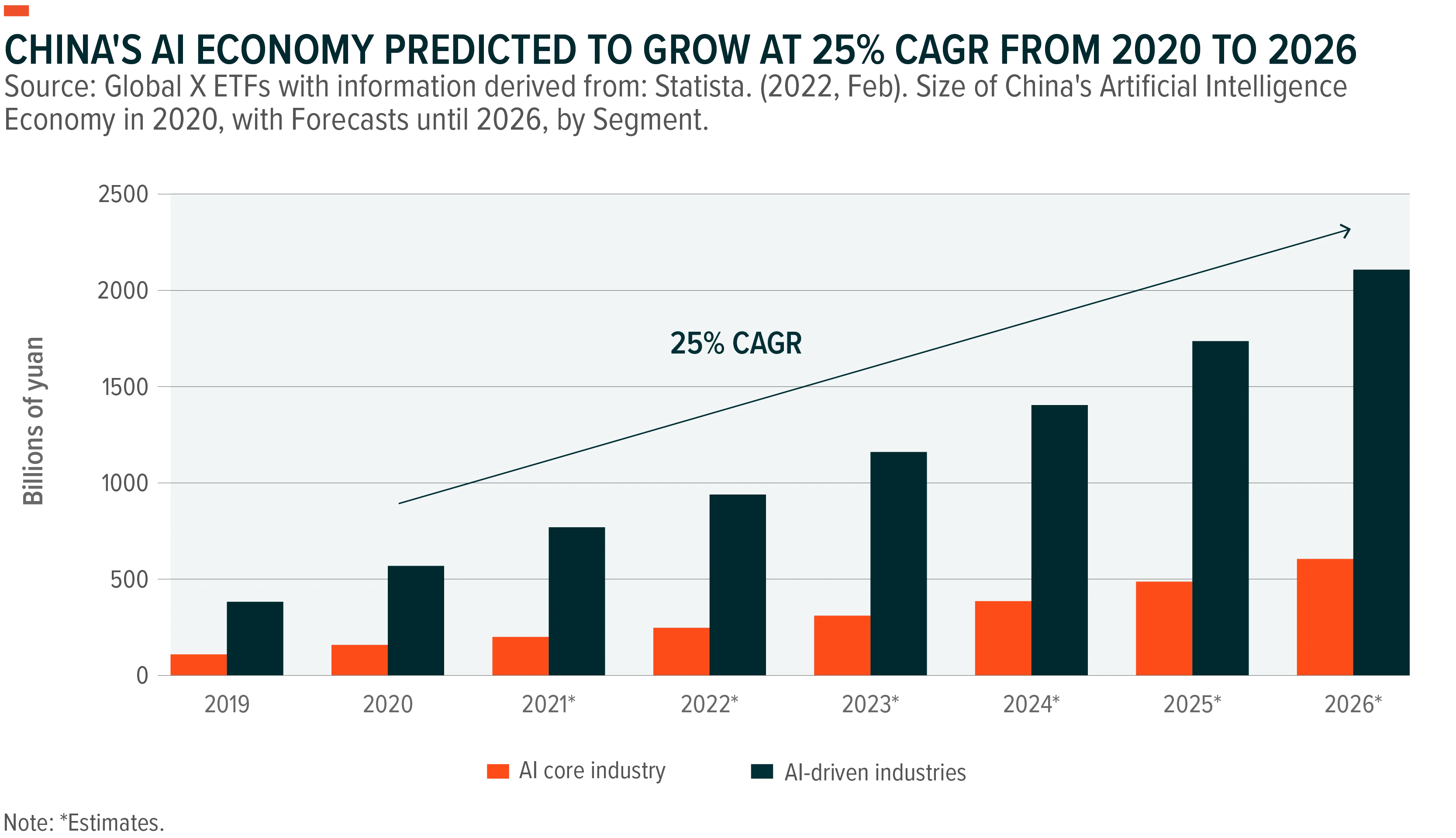
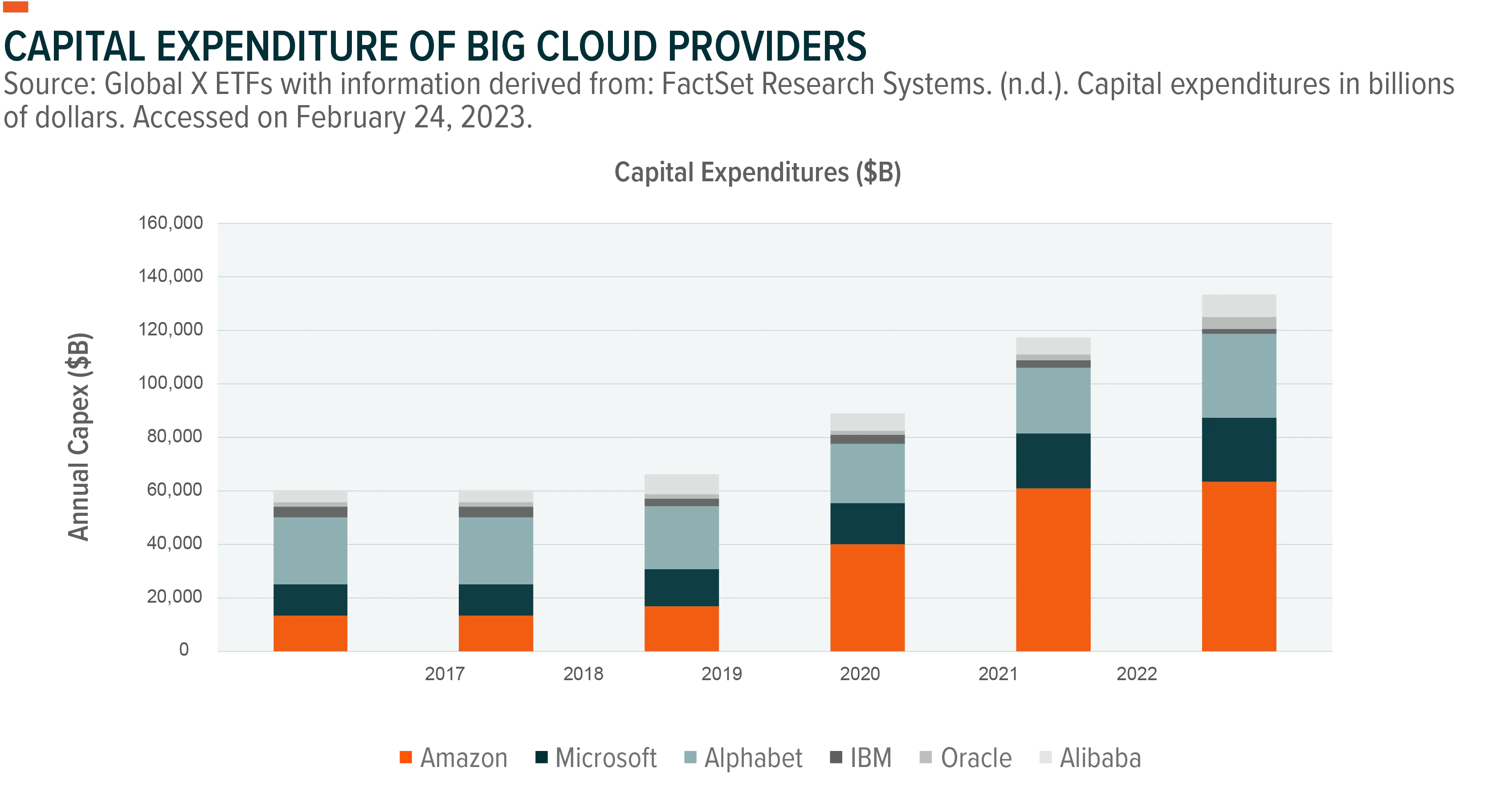
Most of the AI applications that have been widely adopted in China to date have been in consumer-facing industries like internet, propelled by the world’s largest internet user base. Internet platforms have seen phenomenal growth over the past decade, underpinning a strong investment cycle for cloud computing-related infrastructure. This has set a good foundation in terms of the computing power, data, and training models required for AI development.
China has a competitive advantage in its huge engineering talent pool. Over the next five years, 50 million graduates are set to enter the workforce in China, more than the US, Germany, Japan, Korea, and Southeast Asian countries combined.6 The share of the population with a university degree exceeded 15% in 2020, up more than 65% from 10 years ago, with many of those graduates in science, technology, engineering, and math (STEM) fields.7 A large pool of engineers, especially software engineers, could continue to support strong growth in AI development.
Numerous Companies and Industries Appear Poised to Benefit
Baidu, which runs China’s most popular internet search engine, is positioned to be one of the leaders in generative AI in China. Baidu has had an early start on AI technology, particularly on natural language processing (NLP), given the close synergy to its core search business. Baidu’s own generative AI product, ERNIE Bot, is expected to complete beta testing and be open to the public in March, 2023.8
Besides Baidu, other technology companies like ByteDance, Alibaba, and Tencent also have the potential, and have shown ambition, to develop generative AI models, given the sheer amount of data these companies possess. ByteDance has always utilized algorithms to analyze user preferences in its popular TikTok app. Therefore, content generation using AI technology, whether for text, images, or videos, could blend in naturally with its existing business. Additionally, the development of generative AI could help improve the overall monetization/pricing opportunities for Baidu, Alibaba, and Tencent’s cloud services.
China’s semiconductor industries could benefit from the infrastructure investment required for generative AI. The development of advanced AI models and the ensuing blossom of new products will likely require significant investments in computing power to support operations. This would probably benefit China’s (and Asia’s) high-performance computing-related semiconductor supply chains. Specifically, an increase in demand for AI accelerators, such as graphics processing units (GPUs) and application-specific integrated circuits (ASICs), could benefit the foundry industry, as most AI accelerators are produced via fabless business models, which rely on foundries to make their chips. Asian foundries have over 90% market share globally.9 Design service and integrated circuit companies also stand to benefit. There are a number of companies in Asia that provide design services for ASIC chips in AI accelerators. Taiwan-based MediaTek, for example, has an ASIC division focusing on high-performance computing. Additionally, AI and machine learning (ML) applications will likely demand better memory performance and more bits, while equipment makers could benefit from strength in semiconductor demand driven by increasing AI-related workloads.
Conclusion
Recently, US-based tech companies, such as OpenAI, Microsoft, and Alphabet, have dominated the AI conversation. However, that may well change, given developments from the likes of Baidu, as well as China’s strong foundation for continued AI development. Massive amounts of data, a skilled workforce, government support, and an advanced manufacturing base all augur well for the long-term development of China’s AI capabilities.
Related ETFs
AIQ - Global X Artificial Intelligence & Technology ETF
Click the fund name above to view current holdings. Holdings are subject to change. Current and future holdings are subject to risk.