Four Companies Supporting America’s Electrification
Growing power demand and shifting grid dynamics in the United States are creating opportunities for companies across the electric value chain.
Multiple authors
Get the latest news and updates from our team.
SEI Investments Distribution Co. (1 Freedom Valley Drive, Oaks, PA, 19456) is the distributor for the Global X Funds.
Check the background of SIDCO and Global X's Registered Representatives on FINRA's BrokerCheck.

1. International Renewable Energy Agency (IRENA). (2023, March). World Energy Transitions Outlook 2023: 1.5°C Pathway; Preview.
2. Ibid.
3. Global X ETFs Analysis from variety of sources. See ‘Power Sector Analysis Derived from the Following Sources’ footnote below for the full list.
4. Ibid.
5. Ibid.
6. Ibid.
7. Ibid.
8. Ibid.
9. Net Zero Tracker. (n.d.). Net Zero Numbers. Accessed on January 20, 2024.
10. U.S. Congress. (2022, August 16). H.R.5376 – Inflation Reduction Act of 2022.
11. White House Breifing Room. (2023, December 19). Building a Thriving Clean Energy Economy in 2023 and Beyond.
12. Clean Energy Buyers Association (CEBA). (2023, August). CEBA Deal Tracker 2016 through Q2 2023.
13. Google. (2022). The CFE Manager: A New Model for Driving Decarbonization Impact.
14. S&P Global. (2023, October 17). Power of AI: Surging datacenter load has Dominion bracing for AI’s added demand.
15. MIT Technology Review. (2024, January 15). The race to get next-generation solar technology on the market.
16. JinkoSolar. (2023, November 10). Three-Peat Victory! JinkoSolar Sets New Records for Cell, Module, and Tandem Efficiency Successively.
17. Rho Motion. (2023, August). Battery Energy Stationary Storage Quarterly Outlook, Q3 2023 – Highlights Presentation.
18. Ibid.
19. Energy Storage News. (2023, September 5). India Requires 74GW/411GWh of Energy Storage by 2032, According to National Electricity Plan.
20. South China Morning Post. (2023, February 5). China’s Energy Storage Sector Set for Strong Growth in 2023 as Electric Cars, clean Energy Projects Boost Demand.
Power Sector Analysis Derived from the Following Sources
1. ABEEolica. (2023). Annual wind energy report 2022.
2. Absolar. (2023, October 16). Solar Photovoltaic Energy in Brazil: Absolar’s Infographic.
3. AK&M. (2023, August 19). The volume of electric generation in Russia in January-June 2023 has not changed.
4. Canada Energy Regulator. (2023). Canada’s Energy Future 2023.
5. Carbon Brief. (2023, November 11). Analysis: China’s emissions set to fall in 2024 after record growth in clean energy.
6. Central electricity Authority – Government of India. (n.d.). Installed Capacity Report: October 2023. Accessed November 12, 2023.
7. Climate Cooperation China. (2023, February 1). 2022 Energy Statistics Show Rapid Development of Renewable Energy in China.
8. Ember. (2023, October 3). Solar adoption in India entering “accelerating growth” phase.
9. Empresa de Pesquisa Energética (EPE). (n.d.). Pde 2031 – English version. Accessed November 11, 2023.
10. EnergyWorld.com. (2023, September 16). India may add up to 30GW more thermal power capacity, says R K Singh.
11. Fraunhofer Institute for Solar Energy Systems ISE. (2023, January 3). Net Electricity Generation in Germany in 2022: Significant Increase in Generation from Wind and PV.
12. Fraunhofer Institute for Solar Energy Systems ISE. (2023, July 3). German Net Power Generation in First Half of 2023: Record Renewable Energy Share of 57.7 Percent.
13. Government of India Ministry of Power. (n.d.). Generation. Accessed on November 13, 2023.
14. International Energy Agency (IEA). (2023, July 19). Declining electricity consumption in advanced economies is weighing on global demand growth this year.
15. International Energy Agency (IEA). (2023, October). World Energy Outlook 2023.
16. International Energy Agency (IEA). (2023, June). Renewable Energy Market Update: Outlook for 2023 and 2024.
17. Ministry of Economy, Trade and Industry (METI). (2021, November 26). Outline of strategic energy plan. Agency for Natural Resources and Energy.
18. PVTech. (2023, July 31). China’s installed solar capacity reaches 470GW as of H1 2023.
19. Renewable Energy Institute. (2023, June 16). How Electricity Supply and Demand Changed Amid Soaring Fossil Fuel Prices.
20. Reuters. (2023, November 2). German power mix may get dirtier for 1st non-nuclear winter.
21. U.S. Office of Energy Efficiency and Renewable Energy. (2023, August 24). Offshore Wind Market Report: 2023 Edition.
22. U.S. Office of Energy Efficiency and Renewable Energy. (2023, August 24). Land-Based Wind Market Report: 2023 Edition.
23. U.S. Energy Information Administration (EIA). (n.d.). International: Data. Accessed on November 15, 2023.
24. U.S. Energy Information Administration (EIA). (2023, October 24). Electricity: Preliminary
The International Renewable Energy Agency (IRENA) projects that trillions of dollars need to be invested annually into CleanTech for the world to have a chance at limiting the effects of climate change to 1.5°C to 2°C.1 Reducing emissions in the power sector represents a significant portion of the projected investment needs, and the clean energy transition is already well underway.2 We forecast that non-hydro renewables could account for nearly 40% of global power generation by 2033.3 As the energy transition continues to gain speed, we expect that companies throughout the renewable energy value chain can potentially benefit.
This piece is part of a series that dives deeper into this year’s iteration of our flagship research piece, Charting Disruption.
Non-hydro renewables are forecast to account for 94% of global net power capacity additions from 2023 to 2033, pointing to significant potential growth opportunities for companies throughout the renewable energy value chain.4
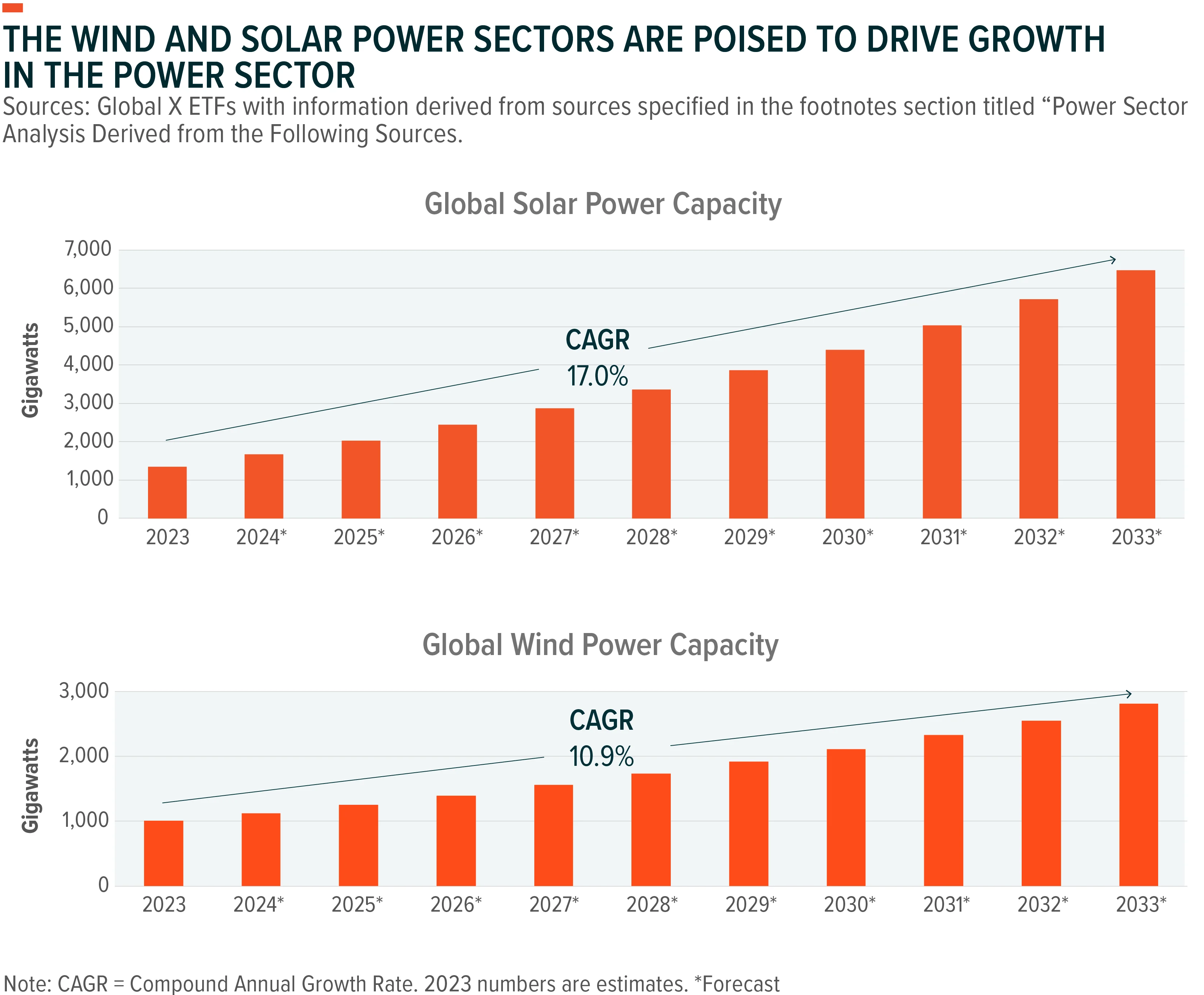
The wind and solar power sectors are forecast to drive growth in the power sector, aided by tailwinds such as robust policy support, corporate sustainability efforts, and ongoing technology improvements.5
The energy storage industry is also experiencing strong growth, further bolstering the positive outlook for the clean energy transition.
Global non-hydro renewable electricity capacity, including wind, solar, geothermal, and biomass-fired power, is forecast to increase from around 2,500GW in 2023 to nearly 9,5000GW in 2033.7 Over the same timeframe, non-hydro renewables electricity generation is forecast to increase 3.2x to reach nearly a 40% share of global power generation by 2033.8 We feel there are mostly upside risks to these forecasts, despite challenges throughout the industry in recent years.
There are several structural tailwinds that support the strong long-term growth outlook, including a robust policy landscape. Over 150 countries have announced economy-wide net-zero emissions targets, and many have set specific renewable energy targets.9 In order to meet these goals, many countries are using measures such as tax credits, project tenders, streamlined permitting procedures, and grant programs to encourage renewable energy growth. In the United States, for example, the Inflation Reduction Act (IRA) creates a wide range of tax credits that provide financial incentives for wind and solar power equipment producers and renewables project developers through at least 2032.10 These tax credits have created the potential for hundreds of gigawatts of additional wind and solar power growth in the United States over the coming decades, when compared to pre-IRA forecasts.11 Notably, over the short term, these tax credits could be helpful in negating some of the headwinds caused by elevated costs throughout the wind and solar power value chains.
Additionally, many corporations continue to expand the use of renewable energy to reduce operational emissions. In the United States alone, 66.5GW of renewable power purchase agreements (PPA) were announced between 2016 and H1 2023.12 While corporate clean energy buyers span a range of sectors, major technology companies such as Amazon, Google, and Meta are some of the largest buyers that are creating new corporate power purchase opportunities. For example, Google is working with renewable energy partners to create new clean power purchase methods that could allow them to reach their goal of operating 24/7 on carbon-free energy by 2030.13 Additionally, one of the largest potential growth opportunities for corporate clean power purchases could come from the rapidly evolving AI landscape. By one estimate, energy demand could be 5x to 7x higher from the server racks that are involved in the training and use of generative AI.14
Furthermore, wind turbine and solar module manufacturers are making tech improvements that can improve system performance and expand project suitability ranges. These advancements could also cut project costs to make renewables even more cost-competitive with traditional power sources. For example, in the solar power sector, leading manufacturers like JinkoSolar, First Solar, and Hanwha Q Cells are working towards the commercialization of tandem perovskite-silicon panels, which could offer much higher efficiencies and lower manufacturing costs relative to traditional panels.15,16 Solar tech advancements could also expand the use of more niche solar applications, such as floating solar projects and agrivoltaic systems that can be used in land-constrained areas.
The growing momentum for energy storage is another key component of the robust long-term growth potential throughout the renewable energy industry. This is because energy storage is essential for integrating intermittent wind and solar power resources into power grids. Annual global battery energy storage system (ESS) installations have grown rapidly in recent years, from 22.2GWh in 2020 to an estimated 138GWh in 2023.17 Between 2022 and 2023, ESS installations were estimated to have grown 80% y-o-y.18 Looking forward, ESS installations are likely to increase further, due to cost declines, energy storage tech advancements, and expanding project pipelines for standalone storage and renewables-plus-storage projects.
Policies in major renewables markets like the United States, European Union, China and India also support positive ESS outlooks. For example, in August 2023, India's government published its National Electricity Plan, which targets 74GW/411GWh of energy storage by 2032.19 To reach these targets, the government is planning to expand measures to encourage ESS growth over the coming years. In China, there are policies in place that require renewables projects to be paired with ESS technologies. This could help energy storage capacity in the country grow to over 50GW by 2025.20
The renewable energy industry experienced strong growth in 2023, despite weaker-than-expected demand in major markets due to high interest rates and elevated project costs. Looking forward, structural tailwinds remain in place that could create significant investment opportunities over the long term. As investments into renewable energy pick up, we expect significant opportunities to emerge for companies throughout the renewable energy value chain, from solar and wind power equipment manufacturers to project developers.
As AI data centers and EVs drive up electricity demand, opportunities could emerge across the renewable energy value chain. Charting Disruption.
Madeline Ruid
The Global X U.S. Electrification ETF seeks to offer exposure to companies that may benefit from increased electricity demand in the U.S.
Madeline Ruid
Multiple authors