
Get the latest news and updates from our team.
SEI Investments Distribution Co. (1 Freedom Valley Drive, Oaks, PA, 19456) is the distributor for the Global X Funds.
Check the background of SIDCO and Global X's Registered Representatives on FINRA's BrokerCheck.
Definitions
Variable rate debt: variable rate debt is where the coupon may change during the life of the bond, possibly in the form of a fixed rate coupon to a floating rate coupon or two different fixed rate coupons. The date when this change occurs is pre-defined.
Floating rate debt: floating rate debt is where the coupon is usually referenced against an interest rate benchmark such as LIBOR (London Interbank Offering Rate) and includes an additional pre-defined interest spread on top of that reference rate.
As the Federal Reserve continues along its path of raising interest rates, many MLP investors have asked how these actions will impact MLPs. We believe there are two key considerations when assessing this question:
At the entity-level, how will rising rates affect the ability of MLPs to cheaply borrow money to fund capital expenditures (capex)?
At the investor level, how does higher rates impact investor demand for MLPs?
In this piece we will focus on addressing question 1 by analyzing the nature of the debt issued by midstream MLPs.
Given that MLPs distribute a significant portion of their cash flows to their unitholders, MLPs have historically been dependent on funding growth by raising capital either through equity or debt issuances. Recently, this has been changing, with a number of MLPs seeking to move to a self-funding model by retaining more cash flow to pay down debt and fund future growth opportunities. Given the recency of this shift, however, many MLPs still have leverage ratios (debt-to-EBITDA—Earnings before Interest, Taxes, Depreciation, & Amortization) between 4x and 5x, meaning debt continues to be an important part of their capital structure.
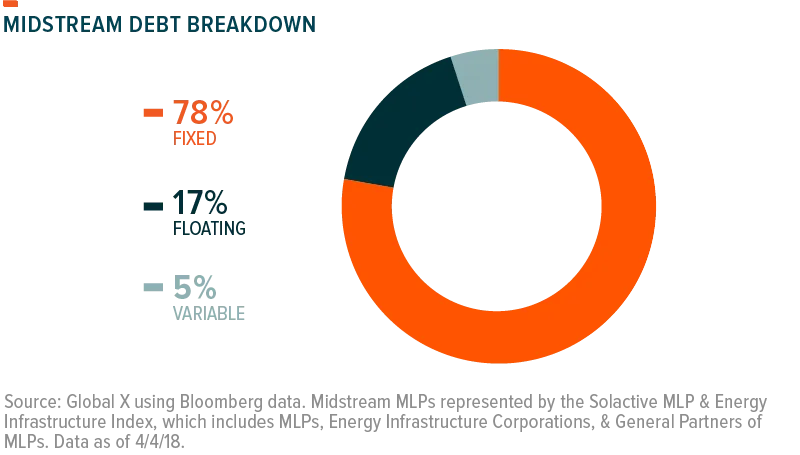
According to our research, 78% of midstream MLP debt is fixed-rate in nature, meaning coupon payments will remain the same throughout the life of the bond regardless of the rate environment. Of the remaining debt in the MLP space, 17% is floating rate that is expected to experience increasing service costs as rates rise. The remaining 5% is structured as variable rate debt, usually in the form of fixed-to-float, where the bond pays a fixed rate for a specific period and then converts to a floating rate in the future.
At the entity level, the fact that over 3/4s of MLP debt is fixed helps insulate those MLPs from rising rates because the cost of servicing existing debt will not change even as rates rise. It is important to note however that debt that reaches maturity and is rolled over may need to be issued at a higher rate. In addition, new debt offerings, such as those to finance future capex projects, could require higher rates than existing debt.
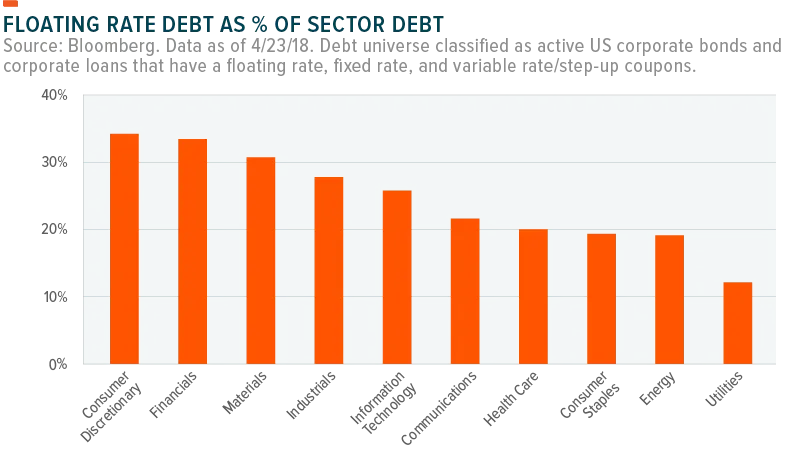
For comparison’s sake, midstream MLPs have a relatively low amount of floating rate debt compared to various sectors. In the chart below, we show that more cyclical sectors like Consumer Discretionary and Financials currently have higher amounts of floating rate debt. Energy and Utilities, which have some similar properties as MLPs, tend to have the lowest percentages of floating rate debt.
As rates move higher, investors may want to begin evaluating which sectors could have the most sensitivity to rising rates. We believe that cash flows for the midstream MLP sector should be well insulated from rising rates given that the majority of their debt is fixed-rate. As rates move higher, we believe it makes an even stronger case for MLPs to self-fund growth in an effort to avoid seeing increased costs of capital in the debt markets.
Related ETFs
MLPA: The Global X MLP ETF invests in some of the largest, most liquid midstream master limited partnerships (MLPs)
MLPX: The Global X MLP & Energy Infrastructure ETF is a tax-efficient vehicle for gaining access to MLPs and similar entities, such as the general partners of MLPs and energy infrastructure corporations.
The War in Iran could impair energy output and thus reshape supply chains. It also highlights the growing importance of North American energy infrastructure.
The War in Iran could impair energy output and thus reshape supply chains. It also highlights the growing importance of North American energy infrastructure.
With diversification potential and inflation pass-through capabilities, midstream equities may provide unique energy exposure to investor portfolios.
Rohan Reddy
Kenny Zhu
