This piece is part of a series that dives deeper into the most prevalent themes of this year’s iteration of our flagship research piece, Charting Disruption. The Medical Breakthroughs section focuses on genomics, therapeutics, and digital health.
The healthcare industry has seen huge leaps in innovation in recent years, helping provide greater insight into human health and driving improved patient care. New technological applications, however, offer to disrupt the industry as we know it and prioritize prevention of illnesses over ineffective symptomatic care. We are now at an inflection point with increasing adoption and regulatory acceptance for these new technologies.
Key Takeaways
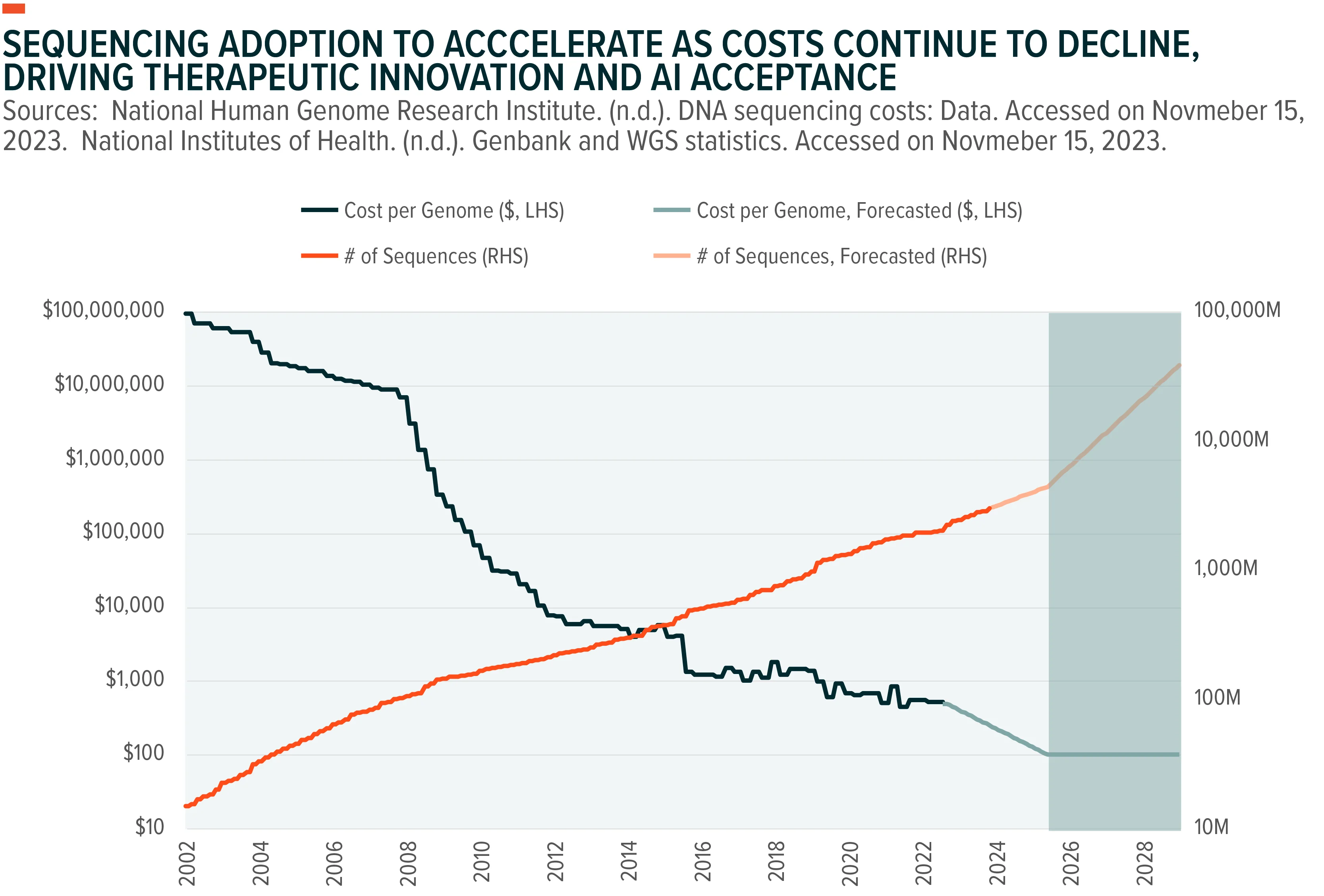
Genomic sequencing technology has already revolutionized the healthcare industry, though more accessible price points are expected to accelerate adoption of genomic technologies. We expect the price per genome to decrease to $100 by 2025.1
Empowered by greater biological understanding, new therapeutic categories like cell therapy and gene editing can offer near-cures for illnesses. We forecast the genomic medicines industry will be worth $50 billion by 2028.2,3,4,5
Digitization efforts in the healthcare industry now empower artificial intelligence (AI) models to help improve patient care and drive significant operational efficiencies. Across all applications, AI has the potential to improve medical outcomes by 30-40%.6
Decoding the Human Genome: Secrets of Our Genetic Blueprint
The healthcare industry has made meaningful strides in expanding current technological capabilities to strengthen our understanding of human biology. New technological applications, however, can provide a comprehensive toolkit of genomic diagnostics and treatments, painting a clearer picture of biology than ever before.
Genomic sequencing stands at the center of this innovation, and recent efforts to make this technology more accessible are poised to unlock its full potential. DNA sequencing requires tens of millions of individuals’ sequences to enable a comprehensive and unbiased study of the human genome. To date, 0.07% of the world’s population has had their genome sequenced, largely because of the associated price.7 We forecast the industry will achieve the milestone price of $100 per genome by 2025, helping drive increased adoption and improved insights.8,9
Therapeutics: Shaping Personalized Medicine
Genomic technologies have opened the door for a new era of drug discovery. Historically, the medical community has been limited in how it can address diseases. With an increased understanding of illnesses and new therapeutic technologies, the medical community now has additional opportunities for improved treatments across virtually all disease categories.
Newer genomic treatments like gene therapies and genomic editing offer near-cures for highly cumbersome illnesses. We believe 2023 will mark a breakout year in the genomic medicines space and the beginning of the gene editing market, which is expected to be worth $4.2 billion by 2028.10 Across all technologies, we believe the genomic medicine industry will be worth $50 billion by 2028, up from just $5 billion in 2022.11,12,13,14
Digitizing Medicine: AI, Surgical Robots, & More
The only thing more complex than human biology may be the systems used to facilitate patient care. The healthcare industry is now the greatest data-generating industry in the world, and the industry’s ability to sequence DNA has outpaced its ability to decipher the information it contains.15
Increasing digitization in the industry, driven by adoption of technologies like electronic health records (EHRs), wearable technology, and automatic pharmacy dispensing, provide a wealth of information that can be leveraged to improve patient care. Levering this data, artificial intelligence (AI) can help support improved drug discovery, automate cumbersome operational procedures, and launch new innovations like wearable technology and surgical robots. In the healthcare sector, AI has the potential to save the United States as much as 10% of annual healthcare spending and improve medical outcomes by 30-40%.16,17
Conclusion
The genomic revolution is driving innovation in every subsegment of the healthcare sector and has the potential to transform the healthcare industry as we know it. New applications, such as novel blood-based diagnostic tests for cancer and Alzheimer’s, revolutionary preventative medicines like Ozempic and Mounjaro, and enhanced wearable technology to help diagnose and monitor illnesses, are already a reality. Across the care continuum, we see limitless potential to help further improve patient outcomes and drive efficiencies in the sector to make care more effective and accessible for everyone.