Skip to Main Content
Subscribe to Newsletters
Global X Logo
Search
Content loaded

Explore

Our ETFs

Investment Insights

Product ResearchCharting DisruptionMidyear Outlook 2026

Investor Resources

EducationHow to InvestTax Resources

About Us

About Global XNewsroomCareersContact Us

Follow Us

socaial media icon for LinkedInLinkedInSocial media icon for X (twitter)XSocial media icon for FacebookFacebookSocial media icon for InstagramInstagramSocial media icon for Youtube

Copyright © 2026 Global X. All rights reserved.

Privacy PolicyAccessibility Statement
YouTube

Subscribe to our newsletter

Get the latest news and updates from our team.

Subscribe

SEI Investments Distribution Co. (1 Freedom Valley Drive, Oaks, PA, 19456) is the distributor for the Global X Funds.

Check the background of SIDCO and Global X's Registered Representatives on FINRA's BrokerCheck.

Content
Product ResearchCharting DisruptionArtificial Intelligence

Tech-Enabled Health: Revolutionizing the Standard of Care

x
A
Arelis AgostoDirector of Research & Strategy
Jan 23, 2025·6 min read

This piece is part of a series that dives deeper into the most prevalent themes of this year’s iteration of our flagship research piece, Charting Disruption. This feature focuses on the aging population, as part of a larger Advancing Healthcare section exploring a variety of innovations in the space. For additional insights from the project, please click here.

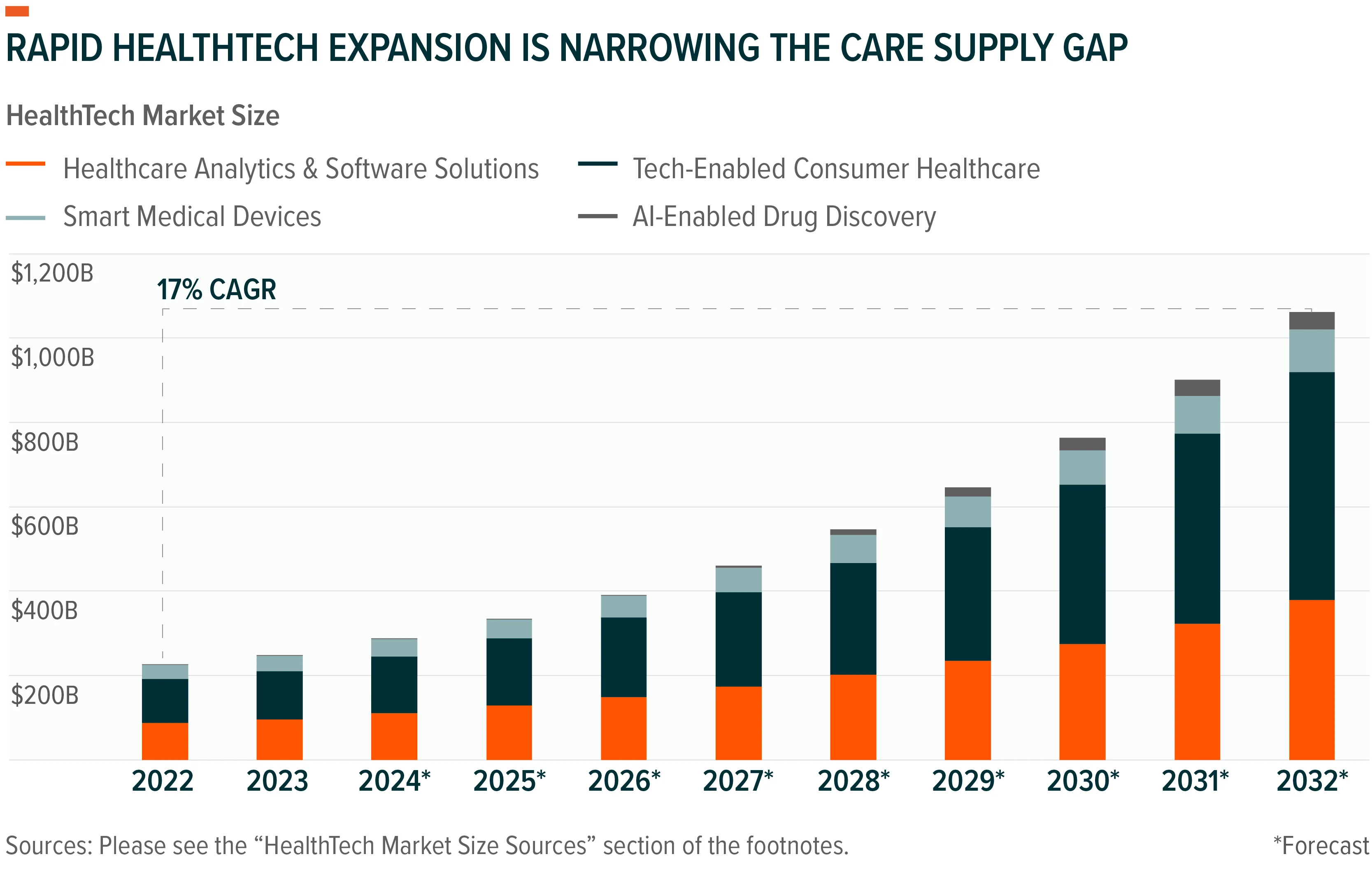
The healthcare industry stands at a critical inflection point where traditional care delivery models can no longer keep pace with soaring demand. While preventative care approaches have shown promise in managing chronic conditions and improving patient outcomes, the fundamental gap between healthcare supply and demand continues to widen. Technology is emerging as the crucial bridge across this divide, with the healthtech market projected to more than quadruple from approximately $225 billion in 2022 to over $1 trillion by 2032.1

This growth spans four key segments: healthcare analytics and software solutions, tech-enabled consumer healthcare, smart medical devices, and AI-enabled drug discovery. Each of these sectors represents a distinct approach to augmenting provider capacity and streamlining care delivery. While healthcare has historically been cautious in adopting new technologies, mounting pressure to serve an aging population, manage chronic conditions, and improve access to care is accelerating digital transformation across the industry.
250102-Tech-Enabled-Health_01

Key Takeaways

  • The healthtech market is on track to quadruple from $225 billion in 2022 to over $1 trillion by 2032, driven by critical needs in provider capacity, aging populations, and chronic disease management.2

  • Artificial Intelligence is transforming healthcare across multiple fronts, from reducing administrative burdens to accelerating drug discovery.

  • The healthcare industry is rapidly adopting intelligent devices, exemplified by the dramatic increase in FDA-approved, AI-enabled medical devices from 6 to 950 over the past decade, fundamentally changing both clinical practice and home-based care delivery.3

AI-Enabled Drug Discovery: From Code to Cure


Despite technological advancements, developing a new medicine still takes 10-15 years and costs $1.3 billion on average.4,5 Only one in ten investigational drugs, however, makes it to market.6 By running millions of scenarios, AI software could reduce the cost of preclinical drug development by 20-40% as well as accelerate design and validation of drug candidates up to 15-fold.7,8

The drug development process is complex, requiring careful validation at each stage to ensure that only the most promising candidates advance to clinical trials and FDA review. A flawed assumption or connection made in the early stages can result in years of wasted development time and resources on a drug that ultimately proves ineffective for patients. AI technology offers a solution by enabling researchers to leverage vast amounts of health data to make more informed decisions from the very beginning of the drug development process. This data-driven approach helps identify potential issues earlier and increases the likelihood of selecting successful drug candidates.

The adoption of AI software for drug development promises to benefit three key stakeholders:

  • Pharmaceutical Companies: The integration of AI could fundamentally improve the economics of drug development. Currently, pharmaceutical companies must invest in hundreds of drug candidates knowing that only a small fraction will reach the market. This means approved drug prices must account for both successful and failed development costs. With AI-enhanced success rates, companies could develop more drugs more efficiently, potentially leading to better returns on investment and more affordable medicines.

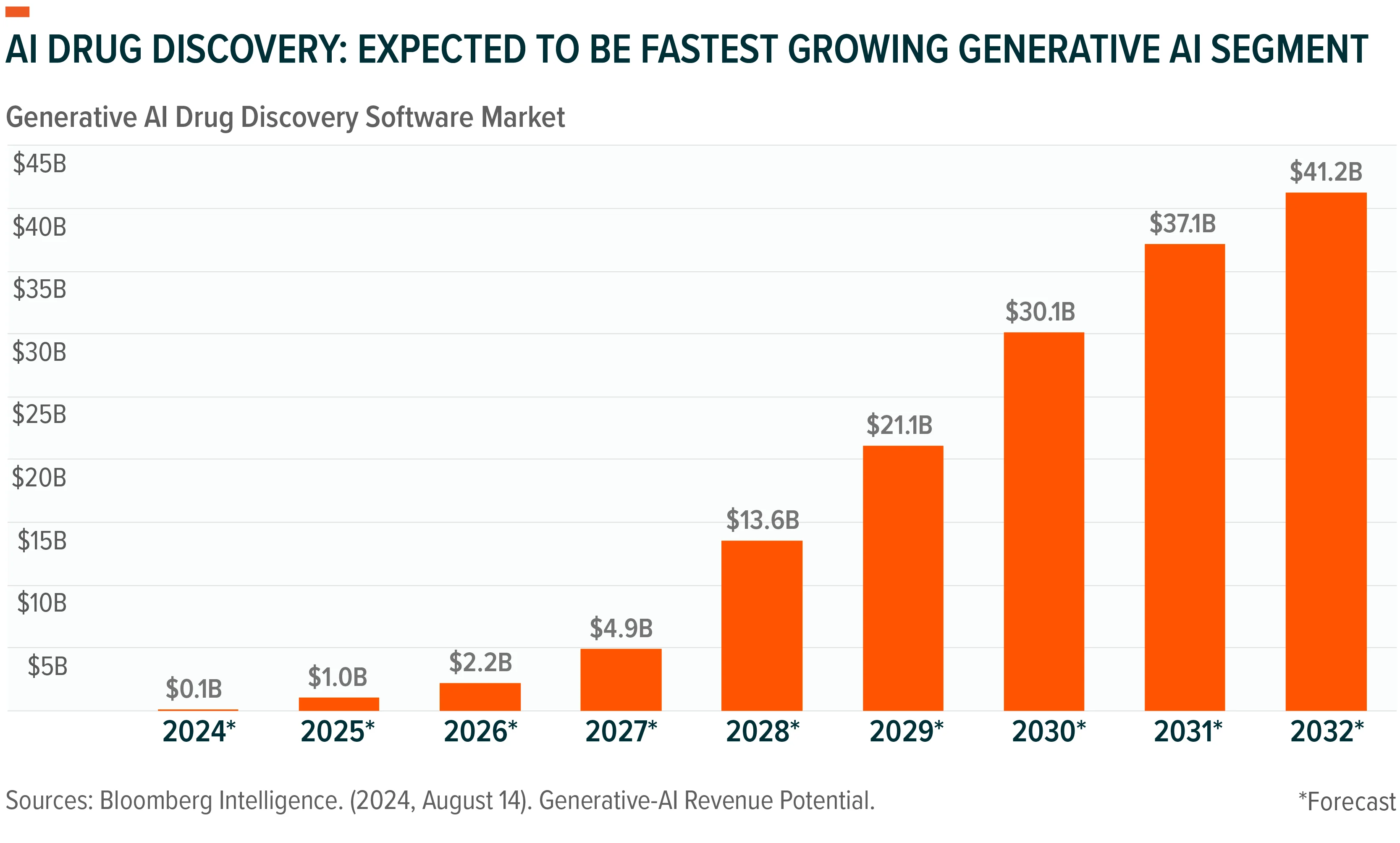
  • AI Drug Discovery Software Providers: These companies are pioneering a rapidly expanding industry. The AI-enabled drug discovery software sector is projected to be the fastest-growing generative AI segment through 2032, with a compound annual growth rate of 121%.9
250102-Tech-Enabled-Health_04

Smart Medical Devices: Where Hardware Meets Healthcare Innovation


Devices are being deployed across the healthcare system to help scale up supply. These often apply novel software and AI applications to innovative hardware to help fill gaps in care. The FDA has approved approximately 950 AI-enabled medical devices in the United States, a dramatic increase from just 6 approved devices a decade ago.11
250102-Tech-Enabled-Health_03

Healthcare Analytics & Software Solutions: Breaking Free from the Paper Chase


While medical technology advances rapidly in areas like genomics and surgical robots, fundamental administrative processes remain surprisingly analog. An estimated 80% of U.S. healthcare documentation still travels via fax and traditional mail.20 This disconnect between advanced medical capabilities and outdated administrative processes creates significant challenges for healthcare providers and patients alike:


AI-powered solutions are now bridging this divide through intelligent workflow automation. Advanced natural language processing helps generate clinical documentation, from progress notes to discharge summaries. Smart scheduling systems optimize patient flow while automated pre-authorization tools streamline insurance processes. These innovations extend beyond mere efficiency - they're reshaping how healthcare providers interact with information.

The impact reaches beyond individual practices. By aggregating de-identified clinical data across diverse populations, these platforms create a living knowledge network. Providers can access insights from millions of patient encounters, stay current with emerging research, and make evidence-based decisions aligned with the latest standards of care. This collective intelligence, delivered through privacy-preserving analytics, is establishing a new foundation for medical decision-making.

Tech-Enabled Consumer Healthcare: Healthcare at Your Fingertips


The rise of digital health solutions is fundamentally reshaping how patients access and experience healthcare. The global telemedicine market is projected to reach $280 billion by 2032, reflecting growing demand for convenient, accessible care options.25 While virtual care adoption accelerated during the COVID-19 pandemic, the sector has evolved far beyond basic video consultations.

Digital pharmacies are revolutionizing medication management, with platforms like Hims & Hers now serving over 2 million subscribers.26 These services combine home delivery with AI-powered medication management systems, reducing errors and improving adherence. Meanwhile, online healthcare marketplaces are streamlining how patients find and book care, significantly reducing wait times for specialist appointments.

Emerging hybrid care models blend virtual and in-person services, with a majority of healthcare organizations now offering some form of hybrid care delivery. These solutions particularly benefit chronic condition management, where continuous monitoring and regular provider check-ins can significantly improve outcomes. Remote patient monitoring programs have shown 50% reduction in hospital readmissions for conditions like heart failure and diabetes.27

Conclusion


The convergence of AI, smart devices, and digital platforms is ushering in a new era of healthcare delivery. As these technologies mature, they address fundamental challenges in healthcare access, efficiency, and quality. The healthtech market's projected growth to $1 trillion by 2032 reflects both the scale of current healthcare challenges and the transformative potential of technological solutions.28

This transformation stands to benefit all stakeholders: providers gain efficiency, patients receive more accessible and personalized care, and the healthcare system overall becomes more resilient and adaptable. As these technologies continue to evolve, they will likely reveal new possibilities for improving healthcare delivery that we are only beginning to imagine.

Technology Infrastructure Providers: The tech industry is making significant investments in healthcare AI capabilities. Chip manufacturers, in particular, are prioritizing healthcare development to meet growing drug discovery demands. For example, Nvidia has established partnerships with hundreds of pharmaceutical and genomic firms, with their healthcare division now generating an estimated $1 billion in annual revenue.10

Wearable Sensors: While only 7% of FDA-approved AI-enabled medical devices are designed for patient use outside clinical settings, these wearable systems are transforming continuous health monitoring.12 Diabetic monitoring devices lead this category, establishing a foundation for expanded monitoring of cardiovascular and neurological conditions. These devices are particularly valuable for senior patients managing chronic conditions, as they enable consistent health tracking without disrupting daily activities.

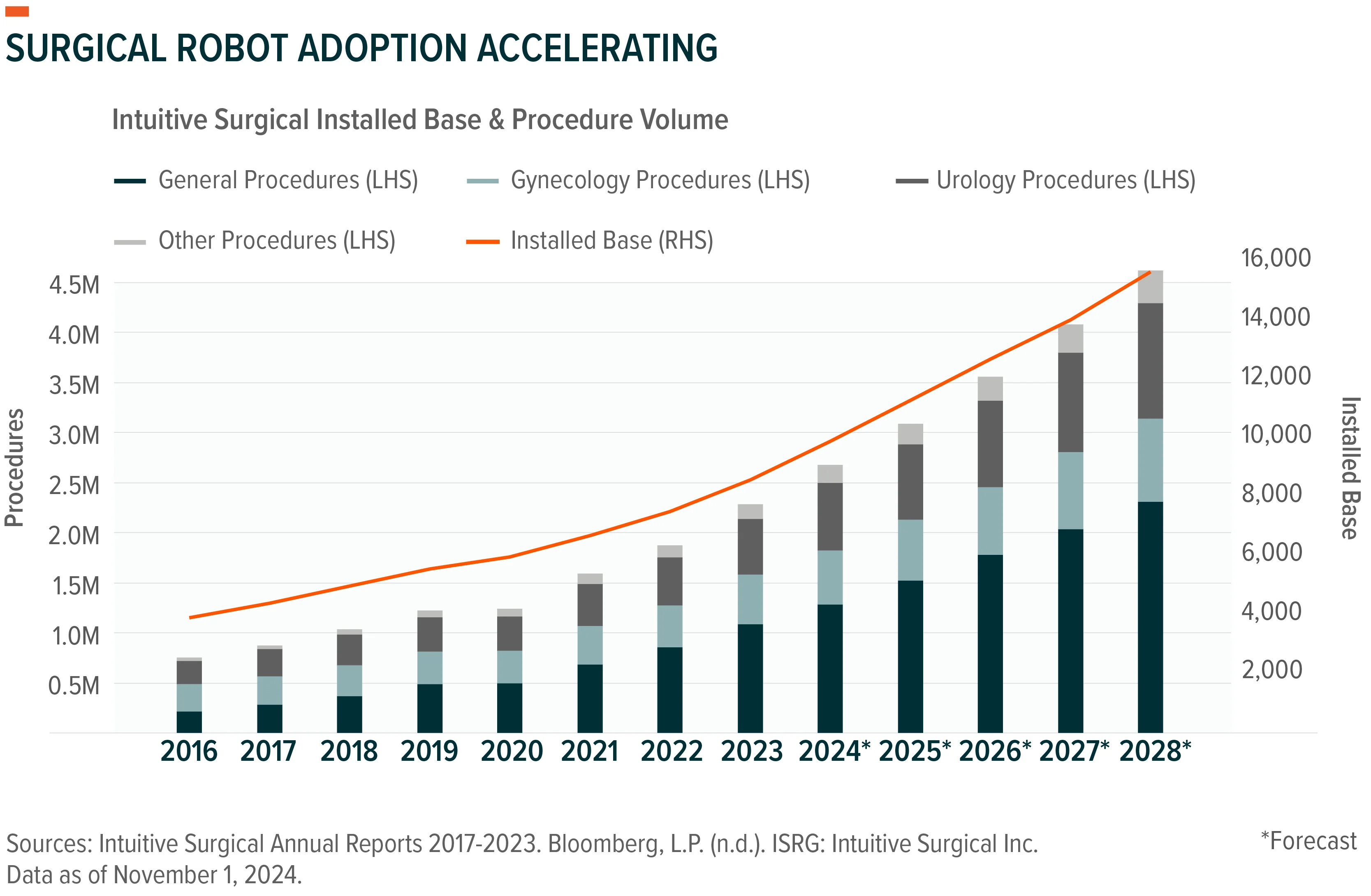
Surgical Robots: Though surgical robots have been in use for over two decades, advances in technology and software integration now enable more complex procedures. Benefits include reduced hospital stays, minimal scarring, lower infection risks, and decreased post-operative pain.13 Accessibility has improved through alternative financing options, with leasing arrangements accounting for approximately 60% of placements by industry leader Intuitive Surgical.14 Since receiving the first surgical robot approval in 2000, Intuitive Surgical has expanded to nearly 10,000 installations and facilitates over 2.6 million annual procedures.15,16

Back-End Automation: Healthcare facilities are rapidly adopting behind-the-scenes automation technologies. In the expanding $90 billion pharmacy automation market, integrated dispensing systems are revolutionizing medication management. These systems address critical needs as 85% of U.S. hospitals face pharmacy technician shortages.17 Modern solutions, such as Omnicell's automated dispensing systems, deliver significant improvements - increasing inventory capacity by 30% and reducing pharmacist workload by 75%.18,19

Physicians spend nearly 40% of their time on documentation rather than patient care.21

Three-quarters of medical staff report that documentation requirements actively interfere with patient care.22

More than three-quarters of physicians complete their documentation outside of regular hours.23

Nearly 80% of doctors experience burnout related to healthcare IT systems.24

Related articles

1of2
Product ResearchHealthTechHealthcare

Four Digital Health Companies Transforming the Healthcare Industry

Inefficiencies in the healthcare space could potentially create a large opportunity for companies using modern tech to cut costs and improve patient outcomes.

A

Arelis Agosto

Jun 22, 202314 min read
Product ResearchRoboticsArtificial Intelligence

Robotics: AI Moves into the Physical Economy

Product ResearchHealthTechHealthcare

Four Digital Health Companies Transforming the Healthcare Industry

Inefficiencies in the healthcare space could potentially create a large opportunity for companies using modern tech to cut costs and improve patient outcomes.

Footnotes

1. Global X ETFs analysis based on information derived from: Evaluate Pharma. (n.d.). Cardiovascular Monitoring & Diagnostic Devices WW Consensus Sales Forecasts. Accessed November 1, 2024.; Evaluate Pharma. (n.d.). Diabetic Care WW Consensus Sales Forecasts. Accessed November 1, 2024.; Evaluate Pharma. (n.d.). Non-Invasive Monitoring Devices WW Consensus Sales Forecasts. Accessed November 1, 2024.; Grand View Research. (2023). Clinical Trial Management Services Market Size, Share & Trends Analysis Report by Services (Regulatory submissions, Medical Writing), by Indication (Oncology, Diabetes), by End-use, by Region, and Segment Forecasts, 2024 – 2030. Report ID: GVR-4-68039-993-8.; Grand View Research. (2023). Insurtech Market Size, Share & Trends Analysis Report by Type (Auto, Business, Health, Home, Specialty, Travel), by Service (Consulting, Support & Maintenance, Managed Services), by Technology, by End Use, by Region, and Segment Forecasts, 2023 – 2030. Report ID: GVR-4-68038-093-4.; Grand View Research. (2024). Telemedicine Market Size, Share & Trends Analysis Report by Component (Products, Services), By Modality, By Application (Teleradiology, Telepsychiatry), By Delivery Mode, By Facility, By End User, By Region, And Segment Forecasts, 2024 – 2030. Report ID: GVR-1-68038-313-3.; Insight Partners. (2023). Medical Scheduling Software Market Size & Share: Report 2028. Report Code: TIPHE100001414; Markets and Markets. (2022, May). Pharmacy Automation Market by Product (Automated Medication Dispensing & Storage Systems, Table-Top Counters, Retrieval Systems, Medication Compounding), End User (Inpatient, Outpatient (Fast-Track Clinics), Retail Pharmacies) & Region – Global Forecast to 2027. Report Code: MD 2624.; Markets and Markets. (2024, August). Surgical Robots Market by Product (Instruments & Accessories, Systems, Services), Application (Urological Surgery, Gynecological Surgery, Orthopedic Surgery, Neurosurgery), End User (Hospitals, Ambulatory Surgery Centers) & Region – Global Forecast to 2029. Report Code: MD 6781.; Precedence Research. (2024, September). Electronic Health Records Market Size, Share, and Trends 2024 to 2034. Report Code: 1379.; Precedence Research. (2024, September). U.S. Revenue Cycle Management Market Size, Share and Trends 2024 to 2034. Report Code: 2431.

2. Ibid.

3. Global X ETFs analysis based on information derived from: FDA. (August 7, 2024). Artificial Intelligence and Machine Learning (AI/ML)-Enabled Medical Devices.

4. PhRMA. (2021, September 20). Industry Profile 2021.

5. Wouters, O. J., McKee, M., & Luyten, J. (2020, March 3). Estimated Research and Development Investment Needed to Bring a New Medicine to Market, 2009-2018. Journal of the American Medical Association, Volume 323, Issue 9: pp. 844-853.

6. Van Norman, G. A. (2019, June 24). Phase II Trials in Drug Development and Adaptive Trial Design. JACC: Basic to Translational Science, Volume 4, Issue 3: pp. 428-437.

7. Colangelo, M. (2019, September 3). For the First Time, AI Designs and Validates New Drug Candidate in Days. LinkedIn.8. Morgan Stanley. (2022, September 9). Why Artificial Intelligence Could Speed Drug Discovery.9. Bloomberg Intelligence. (2024, August 14). Generative-AI Revenue Potential.10. NVIDIA. (2024, March 5). TD Cowen’s 44th Annual Health Care Conference.11. Global X ETFs analysis based on information derived from: FDA. (August 7, 2024). Artificial Intelligence and Machine Learning (AI/ML)-Enabled Medical Devices.12. Ibid.13. Cleveland Clinic. (2024, April 30). Robotic Surgery.14. Intuitive Surgical. (2024, October 18). Quarterly Report, 2024 Q3.15. Intuitive Surgical Annual Reports 2017-2023.16. Bloomberg, L.P. (n.d.). ISRG: Intuitive Surgical Inc. Data as of November 1, 2024.17. Omnicell. (2022, September 20). Omnicell Investor Day Presentation.18. Omnicell. (2024, October 30). Investor Presentation.19. Omnicell. (n.d.). ADC Efficiency by the Numbers: XT #1 Nurse-Recommended Brand. Accessed November 1, 2024.20. Doximity. (2023, June 6). Investor Day 2023 [Presentation].21. Cass, A. (2023, April 19). The Hours 23 Physician Specialties Spend on Paperwork, Administration. Becker’s Hospital Review.22. Melnick, E. R., Dyrbye, L. N., Sinsky, C. A., Trockel, M., West, C. P., Nedelec, L., Tutty, M. A., & Shanafelt, T. (2020, March). The Association Between Perceived Electronic Health Record Usability and Professional Burnout Among US Physicians. Mayo Clinic Proceedings, Volume 95, Issue 3: pp. 476-487.23. Ibid.24. Ibid.25. Global X ETFs analysis based on information derived from: Evaluate Pharma. (n.d.). Cardiovascular Monitoring & Diagnostic Devices WW Consensus Sales Forecasts. Accessed November 1, 2024.; Evaluate Pharma. (n.d.). Diabetic Care WW Consensus Sales Forecasts. Accessed November 1, 2024.; Evaluate Pharma. (n.d.). Non-Invasive Monitoring Devices WW Consensus Sales Forecasts. Accessed November 1, 2024.; Grand View Research. (2023). Clinical Trial Management Services Market Size, Share & Trends Analysis Report by Services (Regulatory submissions, Medical Writing), by Indication (Oncology, Diabetes), by End-use, by Region, and Segment Forecasts, 2024 – 2030. Report ID: GVR-4-68039-993-8.; Grand View Research. (2023). Insurtech Market Size, Share & Trends Analysis Report by Type (Auto, Business, Health, Home, Specialty, Travel), by Service (Consulting, Support & Maintenance, Managed Services), by Technology, by End Use, by Region, and Segment Forecasts, 2023 – 2030. Report ID: GVR-4-68038-093-4.; Grand View Research. (2024). Telemedicine Market Size, Share & Trends Analysis Report by Component (Products, Services), By Modality, By Application (Teleradiology, Telepsychiatry), By Delivery Mode, By Facility, By End User, by Region, And Segment Forecasts, 2024 – 2030. Report ID: GVR-1-68038-313-3.; Insight Partners. (2023). Medical Scheduling Software Market Size & Share: Report 2028. Report Code: TIPHE100001414; Markets and Markets. (2022, May). Pharmacy Automation Market by Product (Automated Medication Dispensing & Storage Systems, Table-Top Counters, Retrieval Systems, Medication Compounding), End User (Inpatient, Outpatient (Fast-Track Clinics), Retail Pharmacies) & Region – Global Forecast to 2027. Report Code: MD 2624.; Markets and Markets. (2024, August). Surgical Robots Market by Product (Instruments & Accessories, Systems, Services), Application (Urological Surgery, Gynecological Surgery, Orthopedic Surgery, Neurosurgery), End User (Hospitals, Ambulatory Surgery Centers) & Region – Global Forecast to 2029. Report Code: MD 6781.; Precedence Research. (2024, September). Electronic Health Records Market Size, Share, and Trends 2024 to 2034. Report Code: 1379.; Precedence Research. (2024, September). U.S. Revenue Cycle Management Market Size, Share and Trends 2024 to 2034. Report Code: 2431.26. Hims & Hers. (2024, November 15). Q3 Earnings.27. The American Journal of Managed Care. (2024, October 11). Remote Monitoring Program Cuts Heart Failure Readmissions in Half.28. Global X ETFs analysis based on information derived from: Evaluate Pharma. (n.d.). Cardiovascular Monitoring & Diagnostic Devices WW Consensus Sales Forecasts. Accessed November 1, 2024.; Evaluate Pharma. (n.d.). Diabetic Care WW Consensus Sales Forecasts. Accessed November 1, 2024.; Evaluate Pharma. (n.d.). Non-Invasive Monitoring Devices WW Consensus Sales Forecasts. Accessed November 1, 2024.; Grand View Research. (2023). Clinical Trial Management Services Market Size, Share & Trends Analysis Report by Services (Regulatory submissions, Medical Writing), by Indication (Oncology, Diabetes), by End-use, by Region, and Segment Forecasts, 2024 – 2030. Report ID: GVR-4-68039-993-8.; Grand View Research. (2023). Insurtech Market Size, Share & Trends Analysis Report by Type (Auto, Business, Health, Home, Specialty, Travel), by Service (Consulting, Support & Maintenance, Managed Services), by Technology, by End Use, by Region, and Segment Forecasts, 2023 – 2030. Report ID: GVR-4-68038-093-4.; Grand View Research. (2024). Telemedicine Market Size, Share & Trends Analysis Report By Component (Products, Services), By Modality, By Application (Teleradiology, Telepsychiatry), By Delivery Mode, By Facility, By End User, By Region, And Segment Forecasts, 2024 – 2030. Report ID: GVR-1-68038-313-3.; Insight Partners. (2023). Medical Scheduling Software Market Size & Share: Report 2028. Report Code: TIPHE100001414; Markets and Markets. (2022, May). Pharmacy Automation Market by Product (Automated Medication Dispensing & Storage Systems, Table-Top Counters, Retrieval Systems, Medication Compounding), End User (Inpatient, Outpatient (Fast-Track Clinics), Retail Pharmacies) & Region – Global Forecast to 2027. Report Code: MD 2624.; Markets and Markets. (2024, August). Surgical Robots Market by Product (Instruments & Accessories, Systems, Services), Application (Urological Surgery, Gynecological Surgery, Orthopedic Surgery, Neurosurgery), End User (Hospitals, Ambulatory Surgery Centers) & Region – Global Forecast to 2029. Report Code: MD 6781.; Precedence Research. (2024, September). Electronic Health Records Market Size, Share, and Trends 2024 to 2034. Report Code: 1379.; Precedence Research. (2024, September). U.S. Revenue Cycle Management Market Size, Share and Trends 2024 to 2034. Report Code: 2431.

HealthTech Market Size Sources

1. Global X ETFs analysis based on information derived from: Evaluate Pharma. (n.d.). Cardiovascular Monitoring & Diagnostic Devices WW Consensus Sales Forecasts. Accessed November 1, 2024.; Evaluate Pharma. (n.d.). Diabetic Care WW Consensus Sales Forecasts. Accessed November 1, 2024.; Evaluate Pharma. (n.d.). Non-Invasive Monitoring Devices WW Consensus Sales Forecasts. Accessed November 1, 2024.; Grand View Research. (2023). Clinical Trial Management Services Market Size, Share & Trends Analysis Report by Services (Regulatory submissions, Medical Writing), by Indication (Oncology, Diabetes), by End-use, by Region, and Segment Forecasts, 2024 – 2030. Report ID: GVR-4-68039-993-8.; Grand View Research. (2023). Insurtech Market Size, Share & Trends Analysis Report by Type (Auto, Business, Health, Home, Specialty, Travel), by Service (Consulting, Support & Maintenance, Managed Services), by Technology, by End Use, by Region, and Segment Forecasts, 2023 – 2030. Report ID: GVR-4-68038-093-4.; Grand View Research. (2024). Telemedicine Market Size, Share & Trends Analysis Report by Component (Products, Services), By Modality, By Application (Teleradiology, Telepsychiatry), By Delivery Mode, By Facility, By End User, By Region, And Segment Forecasts, 2024 – 2030. Report ID: GVR-1-68038-313-3.; Insight Partners. (2023). Medical Scheduling Software Market Size & Share: Report 2028. Report Code: TIPHE100001414; Markets and Markets. (2022, May). Pharmacy Automation Market by Product (Automated Medication Dispensing & Storage Systems, Table-Top Counters, Retrieval Systems, Medication Compounding), End User (Inpatient, Outpatient (Fast-Track Clinics), Retail Pharmacies) & Region – Global Forecast to 2027. Report Code: MD 2624.; Markets and Markets. (2024, August). Surgical Robots Market by Product (Instruments & Accessories, Systems, Services), Application (Urological Surgery, Gynecological Surgery, Orthopedic Surgery, Neurosurgery), End User (Hospitals, Ambulatory Surgery Centers) & Region – Global Forecast to 2029. Report Code: MD 6781.; Precedence Research. (2024, September). Electronic Health Records Market Size, Share, and Trends 2024 to 2034. Report Code: 1379.; Precedence Research. (2024, September). U.S. Revenue Cycle Management Market Size, Share and Trends 2024 to 2034. Report Code: 2431.

We believe falling costs, rapid technological improvement, and a supportive policy backdrop are converging to push robotics toward an inflection point in 2026.

T

Tejas Dessai

Mar 17, 202610 min read
A

Arelis Agosto

Jun 22, 202314 min read
Product ResearchRoboticsArtificial Intelligence

Robotics: AI Moves into the Physical Economy

We believe falling costs, rapid technological improvement, and a supportive policy backdrop are converging to push robotics toward an inflection point in 2026.

T

Tejas Dessai

Mar 17, 202610 min read