
Skip to Main Content
Subscribe to Newsletters
Global X Logo
Search
Content loaded

Explore

Our ETFs

Investment Insights

Product ResearchCharting DisruptionMidyear Outlook 2026

Investor Resources

EducationHow to InvestTax Resources

About Us

About Global XNewsroomCareersContact Us

Follow Us

socaial media icon for LinkedInLinkedInSocial media icon for X (twitter)XSocial media icon for FacebookFacebookSocial media icon for InstagramInstagramSocial media icon for Youtube

Copyright © 2026 Global X. All rights reserved.

Privacy PolicyAccessibility Statement
YouTube

Subscribe to our newsletter

Get the latest news and updates from our team.

Subscribe

SEI Investments Distribution Co. (1 Freedom Valley Drive, Oaks, PA, 19456) is the distributor for the Global X Funds.

Check the background of SIDCO and Global X's Registered Representatives on FINRA's BrokerCheck.

Content
Product ResearchAging PopulationHealthcare

HealthTech: Curing Inefficiencies in Care

x
A
Arelis AgostoDirector of Research & Strategy
Nov 3, 2025·4 min read
CD26-Articles%20Banner-Top-01

This piece is one in a series that delves further into the leading themes emerging from this year’s iteration of our flagship research project, Charting Disruption.

The healthcare industry faces a growing structural imbalance. As the population aged 65 and older expands nearly three times faster than younger cohorts, a global shortage of roughly 11 million healthcare workers is projected by 2030.1,2 Addressing this gap will require far more than incremental policy change – it will demand scalable, technology-driven solutions that enhance efficiency, reduce burnout, and allow clinicians to focus on patient care.

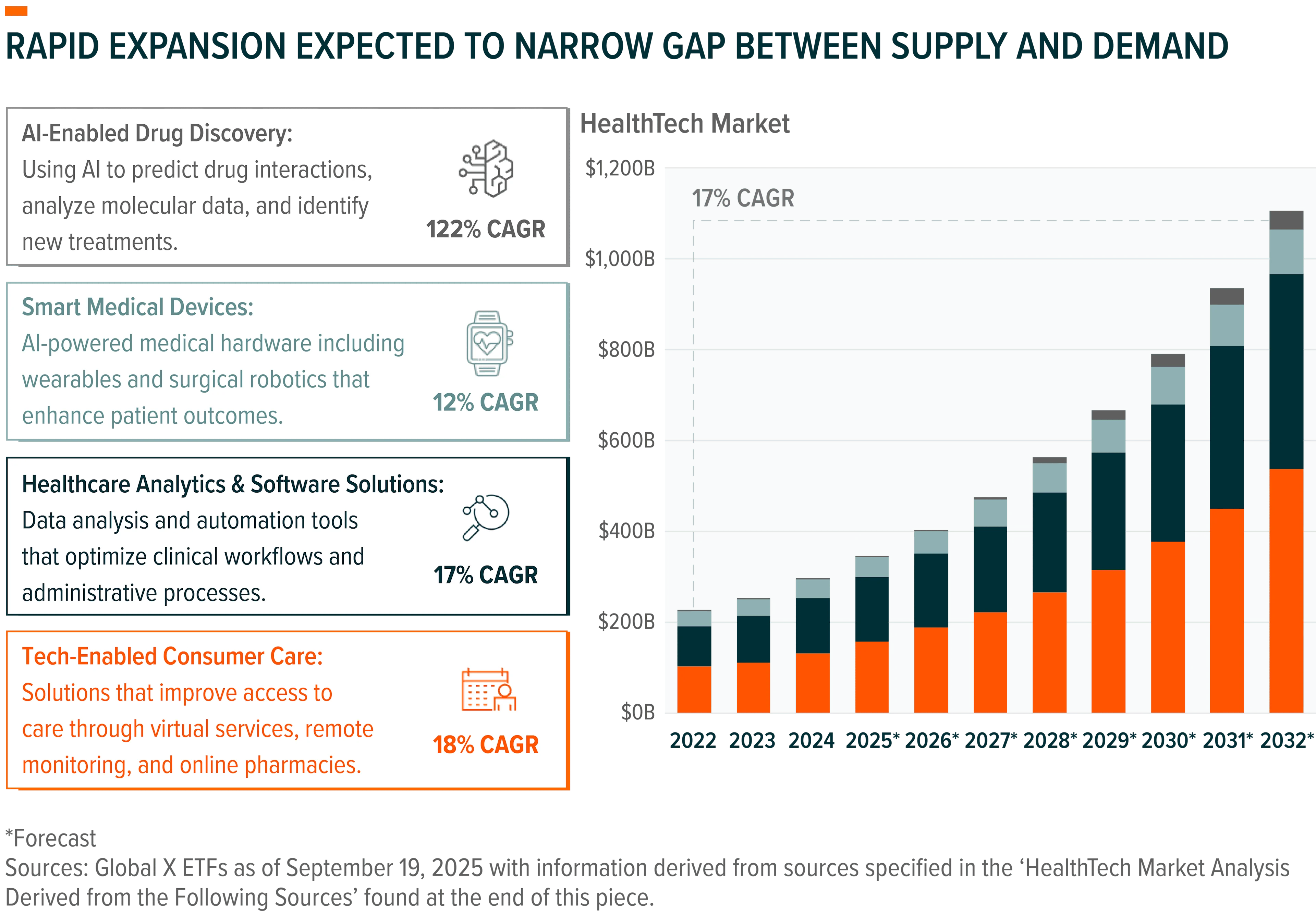
At the same time, technological innovation is accelerating across the healthcare ecosystem. Advances in data analytics, medical software, and smart devices are improving interoperability, usability, and privacy. Artificial intelligence (AI), in particular, is emerging as a connective force – linking data, diagnostics, and drug development into an increasingly integrated system. Together, these shifts are expanding the boundaries of what medicine can achieve, forming the foundation of a healthtech market expected to triple to $1.13 trillion by 2032.3

For investors, this convergence represents more than a technological evolution; it signals the rise of a scalable, data-driven model for global healthcare. The ability to identify where efficiency gains intersect with patient outcomes will define the next era of innovation-led growth in the sector.
251010 - Charting Disruption 01

Key Takeaways

  • The healthtech industry is on track to triple from $352 billion in 2025 to over $1.1 trillion by 2032, driven by critical needs in provider capacity, aging populations, and chronic disease management.4

  • Artificial intelligence is modernizing healthcare delivery, reducing administrative burdens, accelerating drug discovery, and enabling systems that can learn and improve at scale.

  • AI-enabled medical devices – from surgical robots to wearable sensors – are expanding precision and access, transforming both clinical practice and home-based care while driving efficiency across the healthcare ecosystem.

Artificial Intelligence and the Digital Transformation of Healthcare

While healthcare innovation has advanced rapidly in areas such as genomics and robotic surgery, many administrative workflows remain stubbornly analog. Nearly 80% of U.S. medical documentation still relies on fax or traditional mail, underscoring a widening gap between clinical advancement and operational efficiency.5 Existing systems often fail to help the industry scale, instead becoming bottlenecks that contribute to physician burnout. Doctors can spend up to 39% of their time documenting patient information in legacy electronic medical records (EMRs).6

Artificial intelligence is poised to change that dynamic, ushering in the next generation of healthcare software focused on usability, automation, and effectiveness over administrative burden. New solutions could recover more than 30% of physician time while meaningfully reducing burnout.7 As these technologies proliferate, up to 17% of staff tasks could be fully automated – allowing clinicians to redirect their time toward patient care.8

Greater digitalization and advanced analytics, in turn, enable healthcare systems to learn at scale. As data becomes more connected and interpretable, every diagnosis, treatment, and outcome can feed into a continuously improving model of care – advancing medicine not one patient at a time, but for everyone at once. Scalable learning represents the next inflection point in healthcare’s evolution, transforming disconnected records into shared intelligence. With AI accelerating that shift, medicine can move from reactive to predictive – improving efficiency, outcomes, and the long-term sustainability of the healthcare system.

AI and the Next Generation of Drug Development

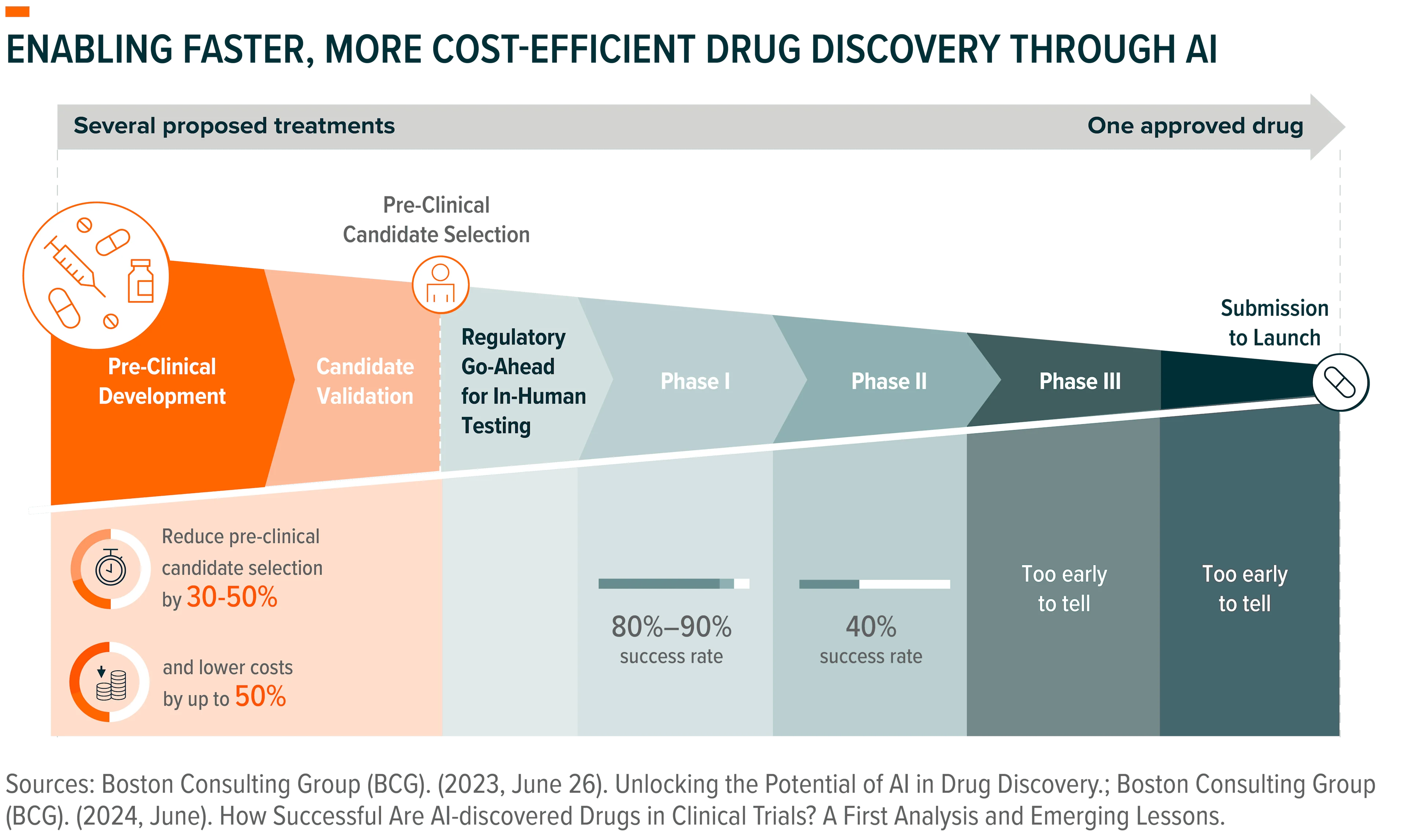
Artificial intelligence could fundamentally reshape the future of drug development. Bringing a new medicine to market still takes 10-15 years and costs an average of $1.6 billion, with only one in ten investigational drugs ultimately succeeding.9,10,11 By running millions of simulations, AI models can reduce preclinical development costs by 30–50% and help make drug design and validation 15 times faster.12,13

For pharmaceutical companies, these advances go beyond efficiency. AI enhances decision-making across the R&D process – from patient recruitment and trial design to predictive modeling, candidate selection, and diagnostics – ultimately improving success rates and personalizing treatments. An estimated 95% of pharmaceutical firms are already investing in AI, reflecting its growing role in reducing costs, compressing timelines, and improving outcomes.14

Drug discovery software is expected to be the fastest-growing generative AI segment, expanding from virtually zero in 2024 to an estimated $41 billion market.15 By improving efficiency and scalability, these tools could reshape the economics of R&D – allowing firms to pursue more drug candidates with greater precision and lower risk. Traditional technology players also stand to gain, with companies like Nvidia already generating over $1 billion in annual healthcare revenue.16
251010 - Charting Disruption 02-Alt

Conclusion: The Future of Scalable, Intelligent Healthcare

HealthTech is redefining how care is delivered, scaled, and sustained. Artificial intelligence is helping to close long-standing gaps between demand and capacity, enabling clinicians to focus on patients rather than paperwork, while generative models accelerate drug development and lower R&D costs. Beyond software, advances in surgical robotics and wearable sensors are extending the reach of technology from the operating room to the individual — improving precision, expanding access, and creating continuous feedback loops between treatment and data.

Together, these innovations are transforming healthcare from a system constrained by inefficiency into one powered by intelligence. As these technologies converge, we expect them to not only improve patient outcomes, but also support the development of a more scalable and resilient model for global healthcare – representing a potentially durable, long-term opportunity for thematic investors.

For additional insights, please view our full report, Charting Disruption: Outlook for 2026 and Beyond.

Related articles

1of2
Product ResearchDefense TechHealthTech

The Next Big Theme: December 2025

This month, we discuss disruptive trends in U.S. Electrification, AI, Defense Tech, AI Semiconductors, HealthTech and E-commerce.

I

Ido Caspi

Dec 18, 20255 min read
Product ResearchCharting DisruptionThematic Growth

Introducing Charting Disruption: Outlook for 2026 and Beyond

Product ResearchDefense TechHealthTech

The Next Big Theme: December 2025

This month, we discuss disruptive trends in U.S. Electrification, AI, Defense Tech, AI Semiconductors, HealthTech and E-commerce.

Footnotes
  1. United Nations, Department of Economic and Social Affairs, Population Division (UN DESA). (2024). World Population Prospects 2024, Online Edition.

  2. World Health Organization (WHO). (n.d.). Health Workforce. Accessed on September 19, 2025.

  3. Global X ETFs forecast as of Sep 19, 2025 based on information derived from: Bloomberg Intelligence. (2025, May 6). Artificial Intelligence Dashboard, Industry Forecast. Evaluate Pharma. (n.d.). Cardiovascular Monitoring & Diagnostic Devices WW Consensus Sales Forecasts. Accessed September 19, 2025. Evaluate Pharma. (n.d.). Diabetic Care WW Consensus Sales Forecasts. Accessed September 19, 2025. Evaluate Pharma. (n.d.). Non-Invasive Monitoring Devices WW Consensus Sales Forecasts. Accessed September 19, 2025. Grand View Research. (2023a). Clinical Trial Management Systems Market Size, Share & Trends Analysis Report. Report ID: GVR-1-68038-150-4.                  Grand View Research. (2023b). Insurtech Market Size, Share & Trends Analysis Report. Report ID: GVR-4-68038-093-4. Grand View Research. (2024). Telemedicine Market Size, Share & Trends Analysis Report. Report ID: GVR-1-68038-313-3. Insight Partners. (2023, February). Medical Scheduling Software Market Size. Report Code: TIPHE100001414. Markets and Markets. (2024, August). Surgical Robots Market: Growth, Size, Share, and Trends. Report Code: MD 6781. Markets and Markets. (2025, March). Pharmacy Automation Market: Growth, Size, Share, and Trends. Report Code: HIT 9363. Precedence Research. (2025, April 2). Revenue Cycle Management Market Size, Share, and Trends 2025 to 2034. Report Code: 1065. Precedence Research. (2025, August 13). Electronic Health Records Market Growth Driven by Rising Adoption of Digital Healthcare Systems. Report Code: 1379. Statista. (2024). Online Pharmacy.

  4. Ibid.

  5. Doximity. (2023, June 6). Investor Day 2023 [Presentation].

  6. Cass, A. (2023, April 19). The Hours 23 Physician Specialties Spend on Paperwork, Administration. Becker’s Hospital Review.

  7. Melnick, E. R., Dyrbye, L. N., Sinsky, C. A., Trockel, M., West, C. P., Nedelec, L., Tutty, M. A., & Shanafelt, T. (2020, March). The Association Between Perceived Electronic Health Record Usability and Professional Burnout Among US Physicians. Mayo Clinic Proceedings, 95(3): 476-487.

  8. Safavi, K., Shah, T. (2025, March 10). Gen AI Amplified: Scaling Productivity for Healthcare Providers. Accenture.

  9. PhRMA. (2021, September 20). 2021 Profile: Biopharmaceutical Research Industry.

  10. Wouters, O.J., McKee, M., Luyten, J. (2020, March 3). Estimated Research and Development Investment Needed to Bring a New Medicine to Market, 2009-2018. Journal of the American Medical Association, 323(9): 844-853.

  11. Van Norman, G.A. (2019, June 24). Phase II Trials in Drug Development and Adaptive Trial Design. Journal of the American College of Cardiology: Basic to Translational Science, Volume 4, Issue 3: pp. 428-437.

  12. Rodriguez, A., Meier, C., Serazin, E., Gooch, J., Aggarwal, P., Steene, A., Jayatunga, M., Nayak, S., Randall, W. (2023, June 26). Unlocking the Potential of AI in Drug Discovery. Boston Consulting Group (BCG).

  13. Morgan Stanley. (2022, September 9). Why Artificial Intelligence Could Speed Drug Discovery.

  14. Foley, P. (2025, April 29). $25B Potential in Accelerating AI s Impact and Value in Pharma. PharmExec.com.

  15. Bloomberg Intelligence. (2025, May 6). Artificial Intelligence Dashboard, Industry Forecast.

  16. Nvidia. (2024, March 5). TD Cowen’s 44th Annual Health Care Conference.

HealthTech Market Analysis Derived from the Following Sources

  1. Bloomberg Intelligence. (2025, May 6). Artificial Intelligence Dashboard, Industry Forecast.

  2. Evaluate Pharma. (n.d.). Cardiovascular Monitoring & Diagnostic Devices WW Consensus Sales Forecasts. Accessed September 19, 2025.

  3. Evaluate Pharma. (n.d.). Diabetic Care WW Consensus Sales Forecasts. Accessed September 19, 2025.

  4. Evaluate Pharma. (n.d.). Non-Invasive Monitoring Devices WW Consensus Sales Forecasts. Accessed September 19, 2025.

  5. Grand View Research. (2023a). Clinical Trial Management Systems Market Size, Share & Trends Analysis Report. Report ID: GVR-1-68038-150-4.

  6. Grand View Research. (2023b). Insurtech Market Size, Share & Trends Analysis Report. Report ID: GVR-4-68038-093-4.

  7. Grand View Research. (2024). Telemedicine Market Size, Share & Trends Analysis Report. Report ID: GVR-1-68038-313-3.

  8. Insight Partners. (2023, February). Medical Scheduling Software Market Size. Report Code: TIPHE100001414.

  9. Markets and Markets. (2024, August). Surgical Robots Market: Growth, Size, Share, and Trends. Report Code: MD 6781.

  10. Markets and Markets. (2025, March). Pharmacy Automation Market: Growth, Size, Share, and Trends. Report Code: HIT 9363.

  11. Precedence Research. (2025, April 2). Revenue Cycle Management Market Size, Share, and Trends 2025 to 2034. Report Code: 1065.

  12. Precedence Research. (2025, August 13). Electronic Health Records Market Growth Driven by Rising Adoption of Digital Healthcare Systems. Report Code: 1379.       

  13. Statista. (2024). Online Pharmacy.

This year’s iteration of our flagship research project, Charting Disruption 2026, aims to shed a quantifiable light on what the future may hold.

A

Arelis Agosto

Nov 3, 20256 min read
I

Ido Caspi

Dec 18, 20255 min read
Product ResearchCharting DisruptionThematic Growth

Introducing Charting Disruption: Outlook for 2026 and Beyond

This year’s iteration of our flagship research project, Charting Disruption 2026, aims to shed a quantifiable light on what the future may hold.

A

Arelis Agosto

Nov 3, 20256 min read