


Product ResearchCharting DisruptionArtificial Intelligence
Introducing Charting Disruption: Outlook for 2025 and Beyond
P
Pedro Palandrani
Dec 16, 20245 min read
Get the latest news and updates from our team.
Copyright © 2026 Global X. All rights reserved.
SEI Investments Distribution Co. (1 Freedom Valley Drive, Oaks, PA, 19456) is the distributor for the Global X Funds.
Check the background of SIDCO and Global X's Registered Representatives on FINRA's BrokerCheck.
Arelis Agosto
Tejas Dessai
Pedro Palandrani

This piece is part of a series that dives deeper into the most prevalent themes of this year’s iteration of our flagship research piece, Charting Disruption. The Advancing Healthcare section focuses on the aging population, tech-enabled health, and genomics. For additional insights from the project, please click here.
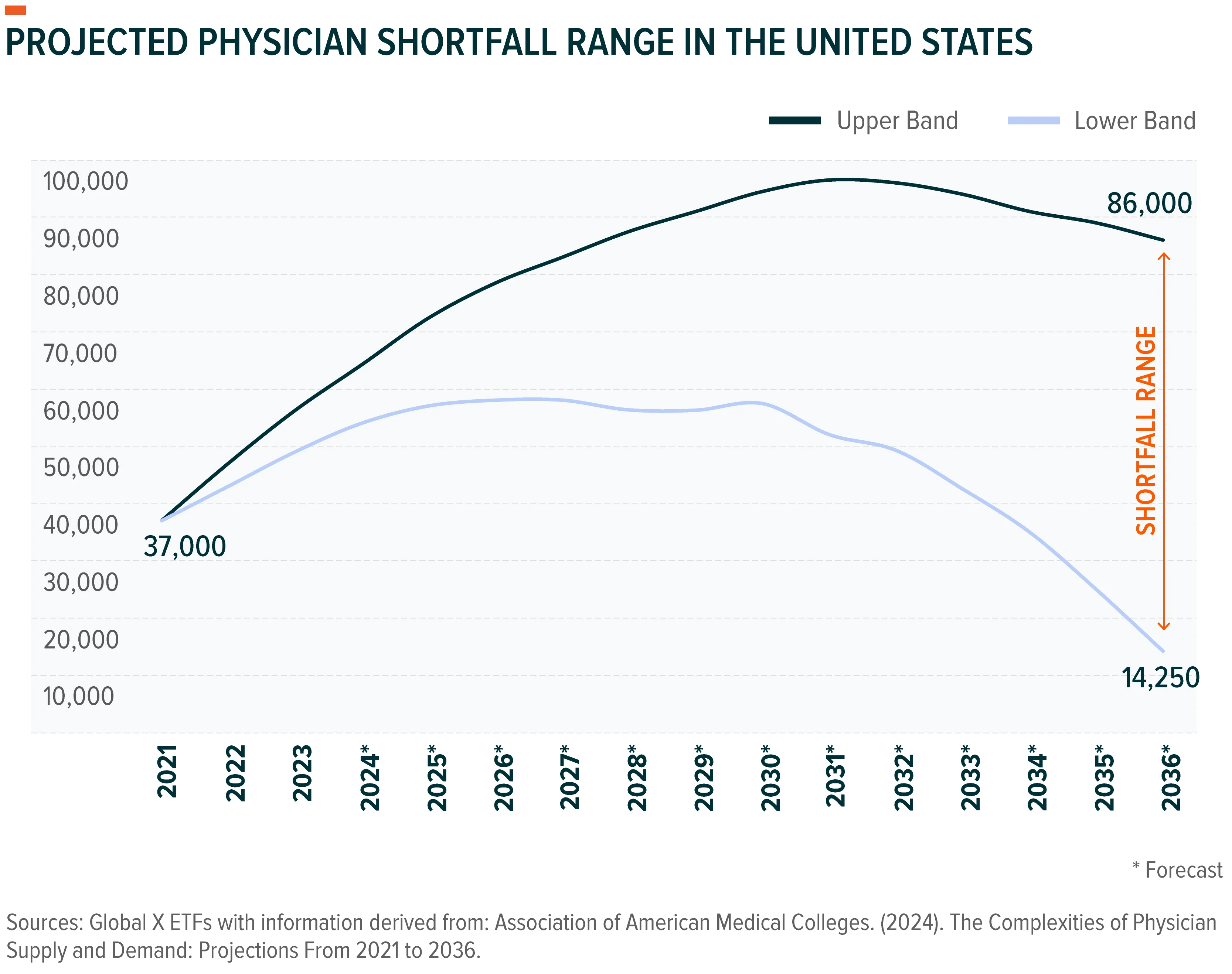
The United States healthcare system is undergoing rapid transformation as projections indicate the physician gap could reach up to 86,000 doctors by 2036.1 This trend is prompting unprecedented innovation across the healthcare sector. Three key areas - aging population management, tech-enabled health services, and genomic medicines - are emerging as powerful solutions to bridge this gap. The scale of innovation is substantial: the health tech market alone is projected to reach $1.1 trillion by 2030, while genomic medicines are expected to capture a record-breaking 6.5% of the $1.47 trillion pharmaceutical market in the same period.2,3
These advances come at an important time. Demographic shifts are increasing both healthcare utilization and treatment complexity. These changes are accelerating the adoption of more efficient care delivery models. From AI-enabled drug discovery to surgical robots, healthcare innovation is expanding provider capabilities while improving patient outcomes.
The aging global population is driving increased healthcare demand, highlighting the need for innovative solutions like GLP-1 treatments and advanced technologies to aid in senior care.
Technological advancements are reducing administrative burdens, enhancing efficiency, and improving patient outcomes through innovations like AI, wearable sensors, and surgical robotics.
Genomic medicines are transforming healthcare with curative treatments that improve outcomes, reduce long-term care costs, and expand therapeutic options across major diseases.
The global population is rapidly aging, with adults aged 65 and older expected to double to 1.7 billion by 2053.4 This demographic shift is driving disproportionate healthcare utilization. In the United States, adults 65 and older represent 16% of the population but account for 37% of all healthcare spending.5,6 The disparity reflects high rates of chronic conditions among older adults – an estimated 95% of individuals 60 and older have at least one chronic condition, while 79% have two or more.7
The medical industry is advancing treatments addressing multiple chronic conditions simultaneously. GLP-1s – one such solution –are projected to grow from under $20 billion in 2022 to over $150 billion by 2030.8 High co-morbidity rates between obesity and conditions like sleep apnea (84%), type 2 diabetes (83%), and chronic kidney disease (65%) highlight GLP-1s’ broad therapeutic potential.9 The entire GLP-1 category is often colloquially referred to as Ozempic, given the drug’s widespread popularity. The category, however, has 13 total approved drugs, and 17 others are expected to be approved through 2030.10 Market leaders like Eli Lilly (Mounjaro and Zepbound) and Novo Nordisk (Ozempic and Cagrisema) expect annual revenues per treatment to exceed $20 billion by 2030.11
Beyond therapeutics, broader healthcare innovation is needed to address growing demand. Senior living facilities represent a critical need, with 70% of adults 65 and older requiring long-term care in their lifetime.12 However, new unit development consistently lags absorption rates, highlighting short-term opportunities for senior living providers. Wearable medical devices are helping bridge this gap. These devices can monitor patient vitals, automate medication delivery, and alert emergency services when needed.
Given doctors can spend up to 39% of their time on administrative tasks, technology is dramatically expanding healthcare providers' ability to deliver quality care at scale.13 The health tech market is projected to grow from $286 billion in 2024 to $1.1 trillion by 2030, reflecting rapid adoption of efficient solutions.14
This growth spans multiple sectors.
The wearable sensor market for general non-invasive devices, including those targeted to cardiovascular and diabetes monitoring, is expected to reach $40 billion by 2030, enabling continuous patient monitoring and early intervention.15
Surgical robotics demonstrate similar momentum. This category is projected to grow from $8.5 billion in 2022 to $27.7 billion by 2030.16 By 2030, two out of three hip replacements are expected to be performed robotically, offering benefits of shorter hospital stays and lower complication rates.17
Healthcare analytics and software solutions are further transforming care delivery. Automated pharmacy systems have shown a 75% reduction in pharmacist time requirements, for example.18
Across all applications, AI could reduce U.S. annual healthcare spending by 10% while improving medical outcomes by 30-40%.19,20 Specifically for drug discovery, generative AI tools can add $41 billion in software revenue by 2033 and reduce a new drug’s time to market.21 This is expected to be the fastest growing generative AI segment in this period.22
Genomic medicine represents another powerful solution to bridge the provider gap. Expected to grow from 1.6% of the $927 billion pharmaceutical market in 2024 to 6.5% of the projected $1.47 trillion market in 2030, these treatments often provide long-lasting or curative effects.23
The field's rapid evolution is evident in its expanding therapeutic reach. While early genomic medicines focused primarily on rare diseases and blood disorders, development now spans multiple major disease areas. Currently, 78% of genomic revenues come from the treatment of only six illnesses.24 By 2030, revenues are expected to diversify significantly, with 75+ new diseases comprising 49% of the market.25
To help patients access these treatments, the industry now seeks to further improve the manufacturing of genomic medicines. Donor-derived models could reduce manufacturing costs by up to 95%, while a growing network of certified treatment centers is improving access.26 The economic benefits are compelling: in hemophilia A treatment, for example, gene therapy can reduce lifetime care costs to $13.7M compared to $21.6M for conventional treatments.27 Such efficiencies, combined with expanding therapeutic applications, suggest genomic medicine will play an increasingly important role in routine healthcare delivery.
The convergence of solutions in aging population management, technology-enabled services, and genomic medicine reflects the innovative responses to the growing provider gap in healthcare. These advancements are reshaping care delivery, with technologies like AI, wearable devices, and surgical robotics streamlining processes and improving patient care. Furthermore, genomic medicines offer transformative treatments for complex diseases, reducing long-term care costs and enhancing patient quality of life.
Collectively, these solutions signal a new era in healthcare innovation. As they scale, these solutions hold promise of creating a more efficient, accessible, and effective healthcare system capable of delivering better care to a larger, aging population.
1. Association of American Medical Colleges. (2024, March). The Complexities of Physician Supply and Demand: Projections from 2021 to 2036.
2. Global X ETFs analysis with information derived from: Evaluate Pharma. (n.d.). Cardiovascular Monitoring & Diagnostic Devices WW Consensus Sales Forecasts. Accessed November 1, 2024.; Evaluate Pharma. (n.d.). Diabetic Care WW Consensus Sales Forecasts. Accessed November 1, 2024.; Evaluate Pharma. (n.d.). Non-Invasive Monitoring Devices WW Consensus Sales Forecasts. Accessed November 1, 2024.; Grand View Research. (2023). Clinical Trial Management Services Market Size, Share & Trends Analysis Report by Services (Regulatory submissions, Medical Writing), by Indication (Oncology, Diabetes), by End-use, by Region, and Segment Forecasts, 2024 – 2030. Report ID: GVR-4-68039-993-8.; Grand View Research. (2023). Insurtech Market Size, Share & Trends Analysis Report by Type (Auto, Business, Health, Home, Specialty, Travel), by Service (Consulting, Support & Maintenance, Managed Services), by Technology, by End Use, by Region, and Segment Forecasts, 2023 – 2030. Report ID: GVR-4-68038-093-4.; Grand View Research. (2024). Telemedicine Market Size, Share & Trends Analysis Report By Component (Products, Services), By Modality, By Application (Teleradiology, Telepsychiatry), By Delivery Mode, By Facility, By End User, By Region, And Segment Forecasts, 2024 – 2030. Report ID: GVR-1-68038-313-3.; Insight Partners. (2023). Medical Scheduling Software Market Size & Share: Report 2028. Report Code: TIPHE100001414.; Markets and Markets. (2022, May). Pharmacy Automation Market by Product (Automated Medication Dispensing & Storage Systems, Table-Top Counters, Retrieval Systems, Medication Compounding), End User (Inpatient, Outpatient (Fast-Track Clinics), Retail Pharmacies) & Region – Global Forecast to 2027. Report Code: MD 2624.; Markets and Markets. (2024, August). Surgical Robots Market by Product (Instruments & Accessories, Systems, Services), Application (Urological Surgery, Gynecological Surgery, Orthopedic Surgery, Neurosurgery), End User (Hospitals, Ambulatory Surgery Centers) & Region – Global Forecast to 2029. Report Code: MD 6781.; Precedence Research. (2024, September). Electronic Health Records Market Size, Share, and Trends 2024 to 2034. Report Code: 1379.; Precedence Research. (2024, September). U.S. Revenue Cycle Management Market Size, Share and Trends 2024 to 2034. Report Code: 2431.; Statista. (2024, September). Online Pharmacy – Worldwide.
3. Global X ETFs analysis with information derived from: Evaluate Pharma. (n.d.). Cell Therapy: Technology Overview. Accessed November 1, 2024.; Evaluate Pharma. (n.d.). DNA & RNA Therapy: Technology Overview. Accessed November 1, 2024.; Evaluate Pharma. (n.d.). Gene Therapy: Technology Overview. Accessed November 1, 2024.; Evaluate Pharma. (n.d.). Gene-Modified Cell Therapy: Technology Overview. Accessed November 1, 2024.; Evaluate Pharma. (n.d.). Genome Editing: Technology Overview. Accessed November 1, 2024.; Evaluate Pharma. (n.d.). Market Explorer | Sales by Indication. Accessed November 1, 2024.4. Department of Economic and Social Affairs / Population Division. (2024, July). World Population Prospects 2024. United Nations.5. Ibid.6. Centers for Medicare & Medicaid Services (CMS). (2024, September 10). National Health Expenditures by Age and Sex.7. National Council on Aging. (2024, May 30). The Top 10 Most Common Chronic Conditions in Older Adults.8. Evaluate Pharma. (n.d.). GLP-1 Sales by Indication. Accessed November 1, 2024.9. Evaluate Pharma. (2024, August 5). Obesity: The Next Questions.10. Evaluate Pharma. (n.d.). GLP-1 Sales by Indication. Accessed November 1, 2024.11. Global X ETFs analysis with information derived from: Evaluate Pharma. (n.d.). Cagrisema: Product Overview. Accessed November 1, 2024.; Evaluate Pharma. (n.d.). Mounjaro: Product Overview. Accessed November 1, 2024.; Evaluate Pharma. (n.d.). Ozempic: Product Overview. Accessed November 1, 2024.; Evaluate Pharma. (n.d.). Zepbound: Product Overview. Accessed November 1, 2024.12. Johnson, R. W. (2019, April 3). What Is the Lifetime Risk of Needing and Receiving Long-Term Services and Supports? U.S. Department of Health and Human Services (HHS), Office of Disability, Aging and Long-Term Care Policy (DALTCP) and the Urban Institute.13. Cass, A. (2023, April 19). The Hours 23 Physician Specialties Spend on Paperwork, Administration. Becker’s Hospital Review.14. Global X ETFs analysis with information derived from: Evaluate Pharma. (n.d.). Cardiovascular Monitoring & Diagnostic Devices WW Consensus Sales Forecasts. Accessed November 1, 2024.; Evaluate Pharma. (n.d.). Diabetic Care WW Consensus Sales Forecasts. Accessed November 1, 2024.; Evaluate Pharma. (n.d.). Non-Invasive Monitoring Devices WW Consensus Sales Forecasts. Accessed November 1, 2024.; Grand View Research. (2023). Clinical Trial Management Services Market Size, Share & Trends Analysis Report by Services (Regulatory submissions, Medical Writing), by Indication (Oncology, Diabetes), by End-use, by Region, and Segment Forecasts, 2024 – 2030. Report ID: GVR-4-68039-993-8.; Grand View Research. (2023). Insurtech Market Size, Share & Trends Analysis Report by Type (Auto, Business, Health, Home, Specialty, Travel), by Service (Consulting, Support & Maintenance, Managed Services), by Technology, by End Use, by Region, and Segment Forecasts, 2023 – 2030. Report ID: GVR-4-68038-093-4.; Grand View Research. (2024). Telemedicine Market Size, Share & Trends Analysis Report By Component (Products, Services), By Modality, By Application (Teleradiology, Telepsychiatry), By Delivery Mode, By Facility, By End User, By Region, And Segment Forecasts, 2024 – 2030. Report ID: GVR-1-68038-313-3.; Insight Partners. (2023). Medical Scheduling Software Market Size & Share: Report 2028. Report Code: TIPHE100001414; Markets and Markets. (2022, May). Pharmacy Automation Market by Product (Automated Medication Dispensing & Storage Systems, Table-Top Counters, Retrieval Systems, Medication Compounding), End User (Inpatient, Outpatient (Fast-Track Clinics), Retail Pharmacies) & Region – Global Forecast to 2027. Report Code: MD 2624.; Markets and Markets. (2024, August). Surgical Robots Market by Product (Instruments & Accessories, Systems, Services), Application (Urological Surgery, Gynecological Surgery, Orthopedic Surgery, Neurosurgery), End User (Hospitals, Ambulatory Surgery Centers) & Region – Global Forecast to 2029. Report Code: MD 6781.; Precedence Research. (2024, September). Electronic Health Records Market Size, Share, and Trends 2024 to 2034. Report Code: 1379.; Precedence Research. (2024, September). U.S. Revenue Cycle Management Market Size, Share and Trends 2024 to 2034. Report Code: 2431.; Statista. (2024, September). Online Pharmacy – Worldwide.15. Global X ETFs analysis with information derived from: Evaluate Pharma. (n.d.). Cardiovascular Monitoring & Diagnostic Devices WW Consensus Sales Forecasts. Accessed November 1, 2024.; Evaluate Pharma. (n.d.). Diabetic Care WW Consensus Sales Forecasts. Accessed November 1, 2024.; Evaluate Pharma. (n.d.). Non-Invasive Monitoring Devices WW Consensus Sales Forecasts. Accessed November 1, 2024.16. Markets and Markets. (2024, August). Surgical Robots Market Revenue Trends and Growth Drivers. Report Code: MD6781.17. Cleveland Clinic. (2023, November 29). What We’ve Learned From 10,000 Robot-Assisted Total Joint Replacements.18. Omnicell. (2024, October 30). Investor Presentation.19. Frost & Sullivan. (2016, January). From $600 M to $6 Billion, Artificial Intelligence Systems Poised for Dramatic Market Expansion in Healthcare.20. National Bureau of Economic Research. (2023, January). The Potential Impact of Artificial Intelligence on Healthcare Spending.21. Bloomberg Intelligence. (2024, August 14). Generative-AI Revenue Potential.22. Ibid.23. Global X ETFs analysis with information derived from: Evaluate Pharma. (n.d.). Cell Therapy: Technology Overview. Accessed November 1, 2024.; Evaluate Pharma. (n.d.). DNA & RNA Therapy: Technology Overview. Accessed November 1, 2024.; Evaluate Pharma. (n.d.). Gene Therapy: Technology Overview. Accessed November 1, 2024.; Evaluate Pharma. (n.d.). Gene-Modified Cell Therapy: Technology Overview. Accessed November 1, 2024.; Evaluate Pharma. (n.d.). Genome Editing: Technology Overview. Accessed November 1, 2024.; Evaluate Pharma. (n.d.). Market Explorer | Sales by Indication. Accessed November 1, 2024.24. Global X ETFs analysis with information derived from: Evaluate Pharma. (n.d.). Cell Therapy: Technology Overview. Accessed November 1, 2024.; Evaluate Pharma. (n.d.). DNA & RNA Therapy: Technology Overview. Accessed November 1, 2024.; Evaluate Pharma. (n.d.). Gene Therapy: Technology Overview. Accessed November 1, 2024.; Evaluate Pharma. (n.d.). Gene-Modified Cell Therapy: Technology Overview. Accessed November 1, 2024.; Evaluate Pharma. (n.d.). Genome Editing: Technology Overview. Accessed November 1, 2024.25. Ibid.26. Harrison, R. P., Zylberberg, E., Ellison, S., & Levine, B. L. (2019, February 12). Chimeric Antigen Receptor – T Cell Therapy Manufacturing: Modelling the Effect of Offshore Production on Aggregate Cost of Goods. International Society for Cell & Gene Therapy, Volume 21, Issue 2: pp. 224-233.27. Garrison, L. P., Jiao, B., & Dabbous, O. (2021, May). Gene Therapy May Not Be as Expensive as People Think: Challenges in Assessing the Value of Single and Short-term Therapies. Journal of Managed Care & Specialty Pharmacy, Volume 27, Issue 5.
This year’s iteration of our flagship research project, Charting Disruption 2025, aims to shed a quantifiable light on what the future may hold.
This year’s iteration of our flagship research project, Charting Disruption 2025, aims to shed a quantifiable light on what the future may hold.
This year’s iteration of our flagship research project, Charting Disruption 2026, aims to shed a quantifiable light on what the future may hold.
This year’s iteration of our flagship research project, Charting Disruption 2026, aims to shed a quantifiable light on what the future may hold.
AI’s rise is fueling a substantial buildout in centralized infrastructure that could cut compute costs and potentially unleash value through new applications.
AI’s rise is fueling a substantial buildout in centralized infrastructure that could cut compute costs and potentially unleash value through new applications.