
On January 13th, we introduced the Global X Adaptive U.S. Risk Management ETF (ONOF) on NYSE. ONOF seeks to provide a risk management solution by employing four technical indicators to dictate whether the Fund is participating in the U.S. equity markets or in a defensive stance in short term treasuries.
In this post, we interviewed Patrick Bobbins, Director of Investments & Research at Adaptive Wealth Strategies, about the Adaptive Wealth Strategies U.S. Risk Management Index (AWSRSK), which ONOF tracks.
What is the U.S. Risk Management Index’s strategy and how does it work?
The core goal of the strategy is focused on risk management, while a secondary goal is to remain invested in equities as much as possible. The strategy is designed to maintain exposure to the equity markets when the trending environment is positive, and then move to a risk off position when that trend reverses. Determination of the trending environment utilizes four different indicators. Our concept employs a moving average, drawdown, moving average convergence divergence (MACD), and volatility as indicators to move between equity and fixed income (“risk-off”) exposure. The end goals of the strategy are to remain invested in equities as much as possible, achieve a low tracking-error, have minimal internal expenses, provide significant risk mitigation, while still producing alpha generation.
What are the four signals that determine whether the strategy holds equities or not?
The strategy uses four indicators, incorporating two somewhat shorter-term and two somewhat longer-term indicators. The two short-term indicators are MACD and Volatility. The two longer-term indicators are the 200-day moving average and drawdown.
Longer Term Indicators:
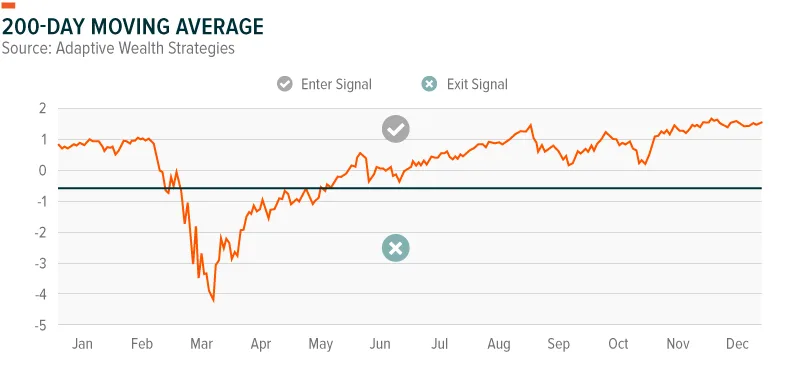
The 200-day average is designed to detect longer-term trends in the market and used to provide stability, as this trend doesn’t change significantly from day to day.
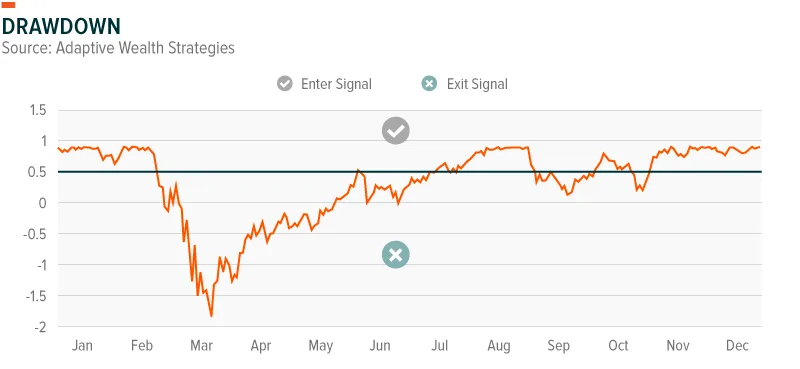
Drawdown has its roots in the behavioral side of investing. We measure the absolute drawdown from the prior high-point in the market as an indicator. This indicator potentially indicates the market is headed toward a longer-term trend downward.
Shorter Term Indicators:
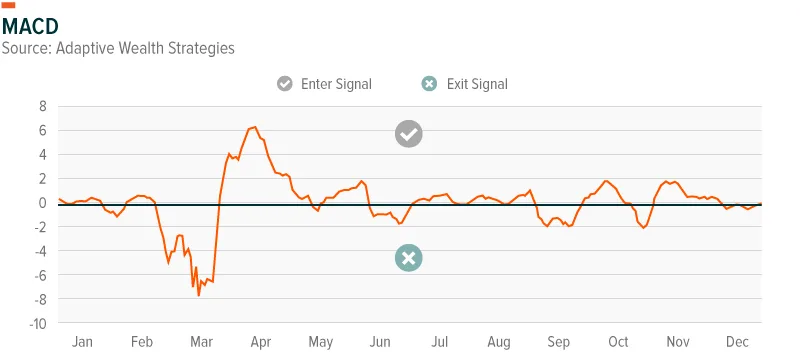
MACD is designed to capture short-turning points in the market both up and down. The MACD can be one of the first technical indicators to signal a risk-off environment. MACD is a momentum indicator, reflecting the spread between the 12-period exponential moving average (EMA) and the 26-period EMA. A positive spread between the two EMAs indicates upward momentum, while a negative spread indicates downward momentum.
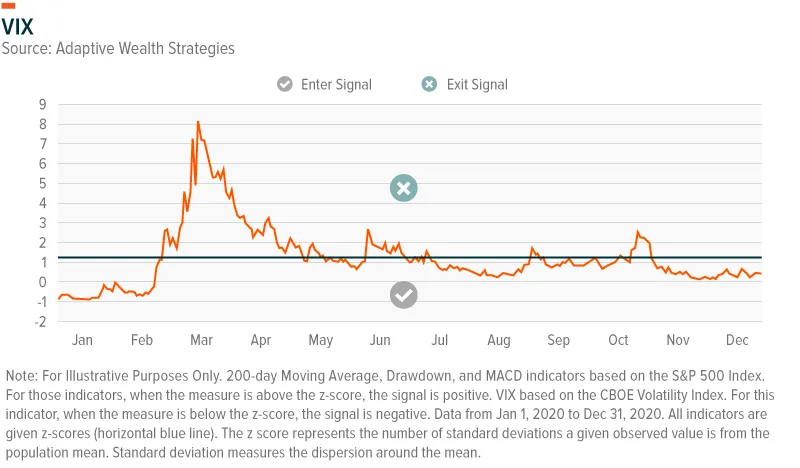
Volatility is also short-term in nature and can signal heightened uncertainty in the markets which tends to favor a risk off approach.
Why utilize four signals instead of just one or two?
One of the alternative goals in the strategy is to avoid a whipsaw effect caused by false-signals as much as possible. As with any trend-following models, the potential to exit and enter the markets at the wrong time certainly exists. The strategy relies on a confirmation of signals instead of relying on just one indicator. We feel this has two main positives compared to strategies which rely on just one indicator. The first positive is the potential ability to exit the equity market earlier in a risk-off environment. The second positive is the potential ability to remain invested more of the time. As the strategy relies on a confirmation of three out of the four indicators to exit the equity markets, there is a higher hurdle to be reached to make a risk-off decision. It will also be quicker to react to a positive changing environment as two of the exit indicators turn back to positive.
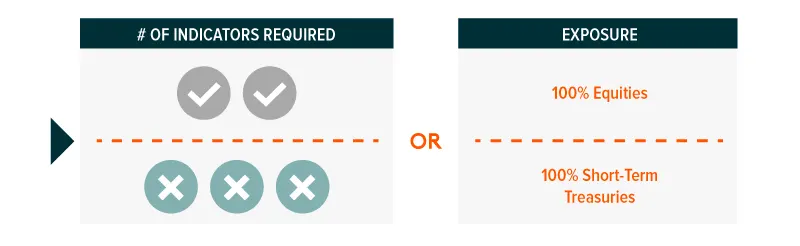
Three out of Four to Exit, Two out of Four to Enter
Which market environments do you expect this strategy to work well in?
We believe this strategy should work well in three environments and potentially struggle in one.
How does the strategy fit in a portfolio?
This strategy could fit well into the part of the portfolio where the manager would ordinarily look to trim equity exposure during risk-off environments. As this strategy is housed inside an ETF, the tax implications of selling equities to move to treasuries are potentially reduced. This helps the manger both reduce risk and potentially limit taxable gains. This is a great complement to broad core allocations, as this will act as a risk reduction tool inside the portfolio.
Definitions:
Related ETFs
ONOF: The Global X Adaptive U.S. Risk Management ETF (ONOF) seeks to provide a risk management solution by employing four technical indicators to dictate whether the Fund is participating in the U.S. equity markets or in a defensive stance in short term treasuries.
Click the fund name above to view the fund’s current holdings. Holdings subject to change. Current and future holdings subject to risk.


