On October 5th, we listed the Global X Russell 2000 Covered Call & Growth ETF (RYLG) on the New York Stock Exchange (NYSE). RYLG is the latest addition to Global X’s covered call ETF suite, which is designed to offer investors both income potential and upside opportunities (though some may cap that potential). RYLG is the third fund in the Global X covered call & growth suite, which also has the Global X Nasdaq 100 Covered Call & Growth ETF (QYLG) and the Global X S&P 500 Covered Call & Growth ETF (XYLG). RYLG now brings Global X’s options-based ETF suite to 15 funds in total.
With interest rates sitting at ultra-low levels for the past decade, income investors have struggled to find diversified sources of income for their portfolios. Traditional sources of income like equity and fixed income are still exhibiting yields well below inflationary levels, making it hard for these investors to generate real (inflation-adjusted) income. To combat this environment, investors have increasingly sought alternatives such as options strategies like covered calls that can offer income potential and long-term growth opportunities.
RYLG: A Russell 2000 Covered Call ETF Designed for Income Potential and Growth Opportunities
The Global X Russell 2000 Covered Call & Growth ETF (RYLG) buys Global X Russell 2000 ETF and/or the securities in the Russell 2000 Index.
Each month, the ETF writes at-the-money (ATM) index call options on the Russell 2000 Index in an attempt to capture premiums
The options written cover 50% of the value of the stocks held in the fund. This means the fund retains roughly half of the upside potential of the index
RYLG employs a covered call writing strategy in an effort to capture both premiums and growth. The fund is passively managed and follows a rules-based approach. The fund also uses European style options which cannot be exercised until expiration and are also cash settled.
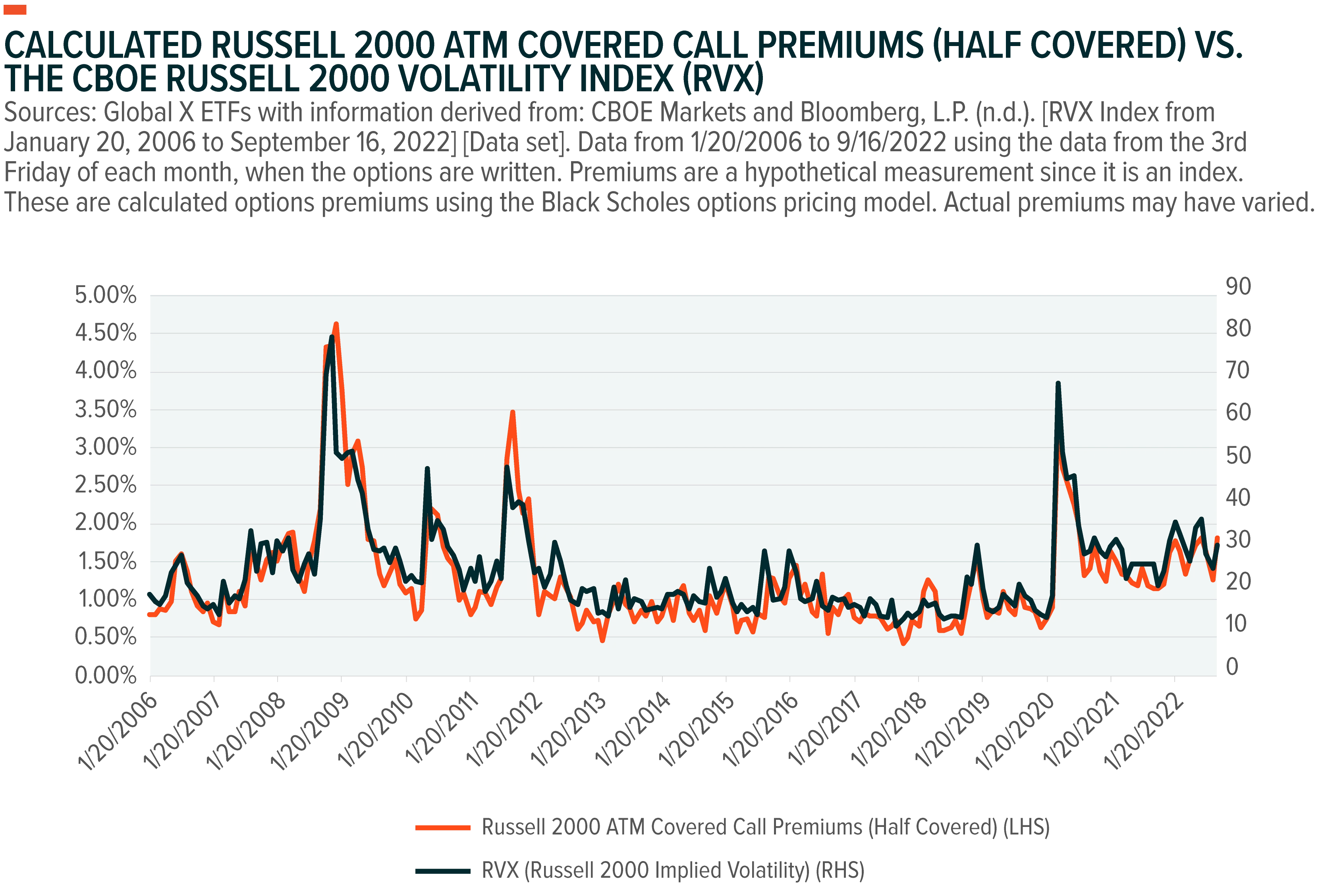
In the data tables included below, using a Black-Scholes options pricing model, we can see what the potential premiums on a strategy like this looks like using a 50% covered call Russell 2000 strategy going back the last 16 years, which includes periods like the global financial crisis.1 In addition, we can also see the modeled premiums relative to the Russell 2000’s implied volatility levels, which as expected, it closely tracks.
For context, Global X also runs two other Covered Call & Growth strategies similar in nature to RYLG, but instead on the Nasdaq 100 & S&P 500. Those funds are QYLG and XYLG, respectively. Below we can see the live premiums history since those funds have been available in the market.
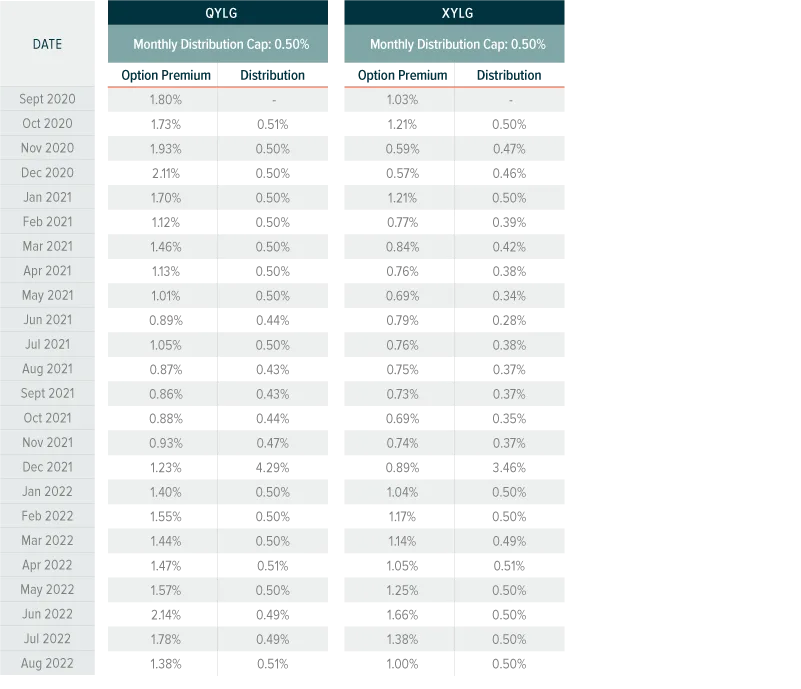
For performance data current to the most recent month- or quarter-end and a copy of the Fund prospectus, please click on the fund name: QYLG, XYLG.
1As a general guideline, the monthly distribution of the funds is approximately capped at the lower of a) half of premiums received, or b) 1% of net asset value (NAV). The excess amount of option premiums received, if applicable, is reinvested into the fund. Year-end distributions can exceed the general guideline due to capital gains that are paid out at the end of the year. A portion of the distribution is estimated to include a return of capital. For information on the breakdown of the distributions, please see the 19a notices for QYLG and XYLG.
However, each index has its own respective attributes, meaning it may be more relevant to consider the Global X Russell 2000 Covered Call ETF (RYLD), which employs a 100% ATM covered call writing strategy on the Russell 2000. These premiums are also put side by side relative to two funds using 100% ATM covered call writing strategies on the Nasdaq 100 and S&P 500 as well, QYLD and XYLD, respectively.
Although this may not be exactly the case in practice, we expect the premiums received by RYLG to be approximately half of what RYLD generates, given the 50% versus 100% call writing on the portfolio of underlying securities.
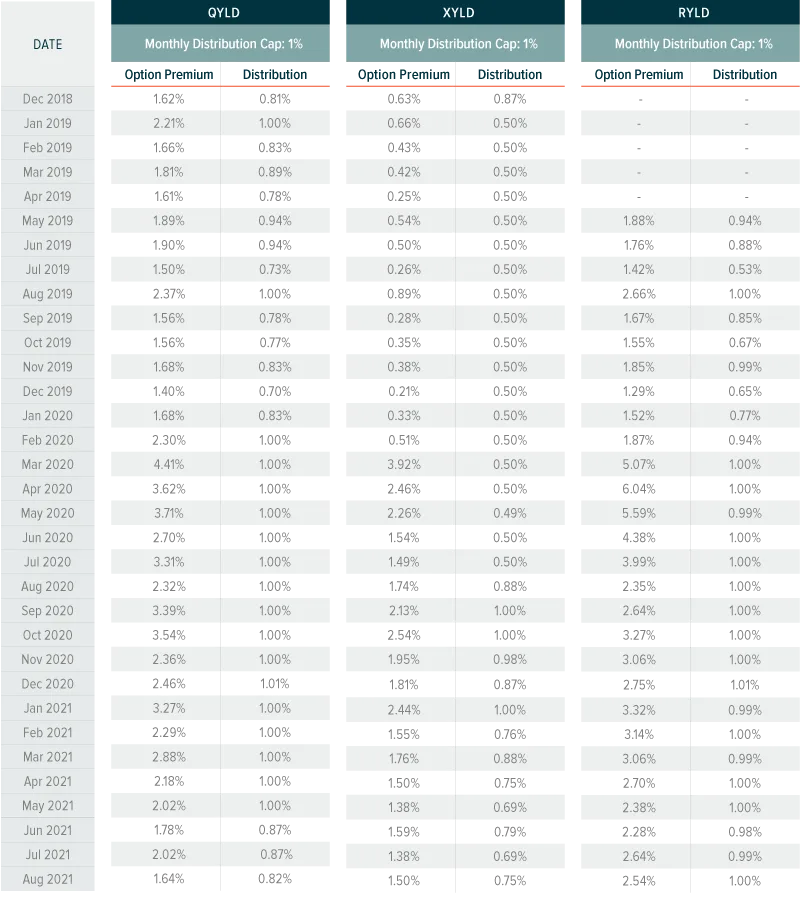
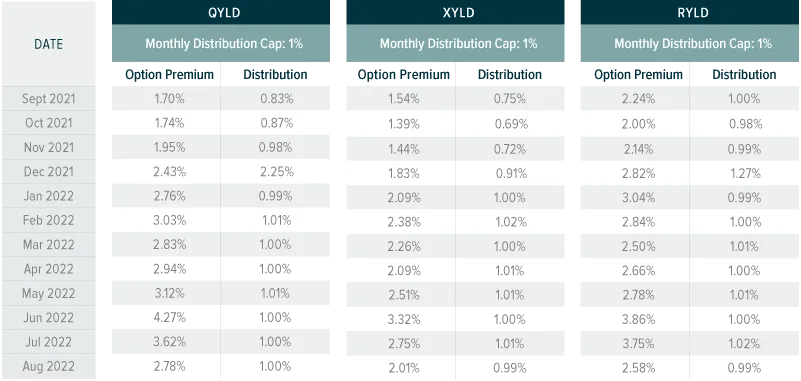
For performance data current to the most recent month- or quarter-end and a copy of the Fund prospectus, please click on the fund name: QYLD, XYLD, RYLD.
1As a general guideline, the monthly distribution of the fund is capped at the lower of: a) half of premiums received, or b) 1% of net asset value (NAV). The excess amount of option premiums received, if applicable, is reinvested into the fund. Year-end distributions can exceed the general guideline due to capital gains that are paid out at the end of the year. A portion of the distribution is estimated to include a return of capital. For information on the breakdown of the distributions, please see the 19a notices for QYLD, XYLD and RYLD.
Covered Call ETFs Designed for Income Potential and Growth Opportunities
RYLG uses covered call writing on half of its portfolio in an effort to achieve both income and growth. RYLG has a similar strategy to the other covered call and growth strategies in our suite, QYLG and XYLG, just focused on a different index. Similarly, our covered call and growth strategies are similar to our covered call strategies in that they write covered calls in an effort to provide income. The primary difference between RYLG and RYLD is that RYLG writes options to cover 50% of its stock holdings, whereas RYLD covers 100%. Accordingly, RYLG may generate approximately 50% of the income of RYLD.
RYLG Coverage Percentage: Tradeoff between Growth and Income
Investors must consider multiple factors in deciding the specifics of a covered call strategy. One primary topic to consider is the amount of the portfolio that will covered by call options.
An investor must choose whether to fully cover or only partially cover their underlying position. If the underlying position experiences a 1% gain:
On the opposite side of this, if the underlying stock experiences a 1% decline:
In a fully covered portfolio, the investor has no upside participation if the options are written at the money. Fully covered portfolios have written calls on 100% of the value of the underlying securities owned in the portfolio. However, because it is selling options at the underlying price, a fully covered strategy will typically generate premiums, a portion of which may then be distributed to the end investor.
In an under covered portfolio, this means that the notional value of the written call options is less than that of the underlying portfolio. This allows the investor to participate in both some of the upside and some of the potential income. The tradeoff for the participation compared to the fully covered strategy is lower income potential. Thus, RYLG may be suited for investors who are looking for both growth and income potential.
Russell 2000 Characteristics & Performance
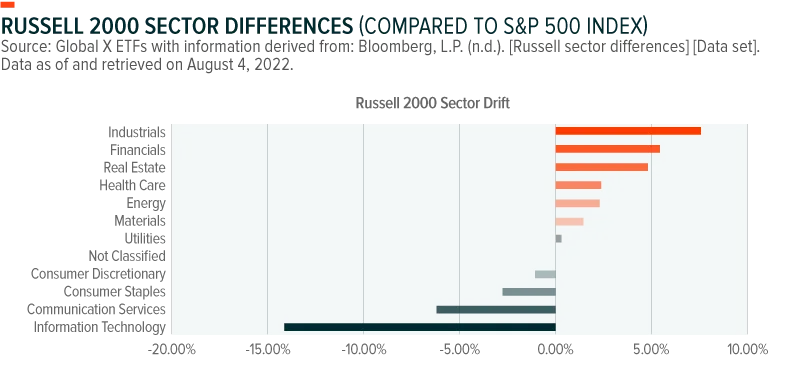
The Russell 2000 Index has performed well over the last decade due to the benefits of domestic revenue exposure, a strong dollar, US economic growth, and cheap financing conditions. The Russell 2000’s outperformance over the S&P 500 Index can be attributed to the index’s overweight towards value-oriented companies in the information technology and communication services sectors.
The Russell 2000 has a higher weight towards value oriented companies compared to the major US broad indices.The pure small cap exposure can also increase the overall volatility of index. This can be attributed to the fact that small cap companies are usually sensitive to rising rates for two main reasons. The first, being small cap companies tend to be considered a riskier investment leading to higher borrowing cost compared to the large cap counterpart. Second, many small cap companies are still in the early growth phase causing a higher need for debt and/or equity financing as they may not be producing sustainable cash flows, leading to a reinforced loop. However, small caps often have higher long term growth potential as they mature, which means investors may want to take part in some of that growth.
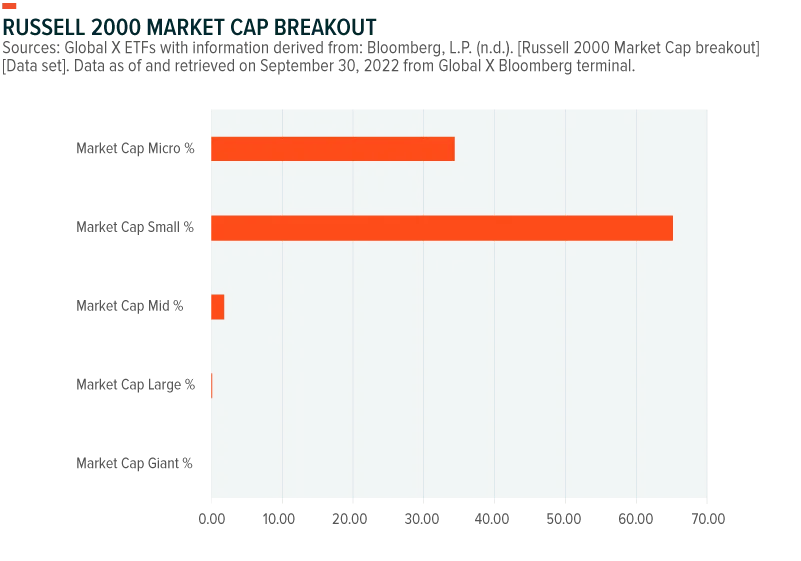
Higher rates reduce the present value of those distant cash flows which is something that is faced by technology and growth companies. While both segments have been negatively impacted, the decrease in price-to-earnings ratio associated with growth have been more pronounced compared to small caps, which have valuations that are more heavily based on near-term cash flows. The Russell 2000 Index has high exposure to Small-Cap Equities.
Using 50% Covered Call ETFs in a Portfolio
A 50% covered call strategy is designed to balance growth potential with income and allows investors to be aligned with both outcomes. Investors who are seeking to live off of their savings or are recently retired may want both current income and growth in an effort to fight off inflation. Investors who are more bullish and do not want to commit to a fully covered strategy could employ a 50% covered strategy to capture more upside potential.
Additionally, investors who are seeking greater diversification for their portfolios may also prefer to have greater exposure to value oriented sectors, such as those in the Russell 2000. Having exposure to RYLG may allow investors to have greater weightings to sectors such as industrials, financials, and real estate.
Implementing a Russell 2000 Covered Call and Growth Strategy
Covered call and growth strategies such as RYLG could be valuable in an uncertain environment. Higher volatility tends to increase the options premiums received from selling calls, which can enhance returns even in a trendless market.
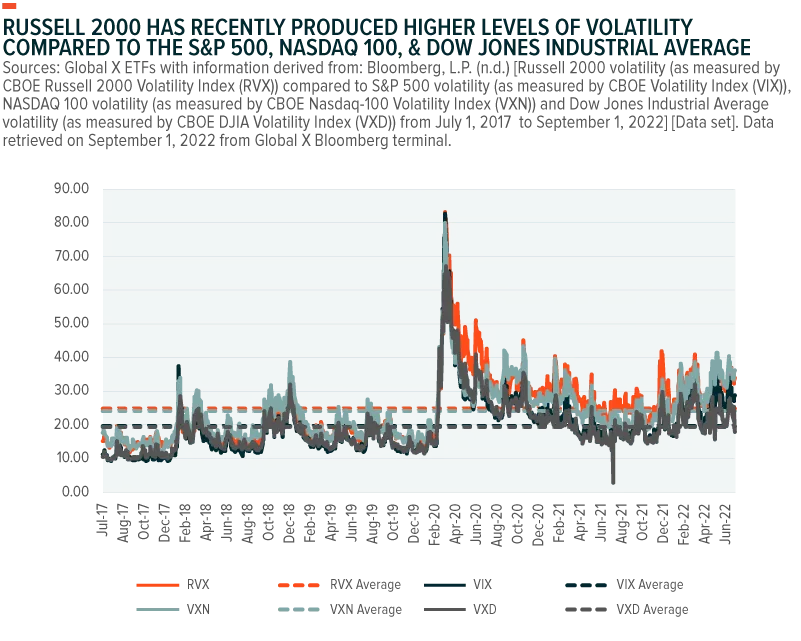
We can see above how the implied volatility of the Russell 2000 has been higher than the S&P 500, Nasdaq 100, and the Dow Jones Industrial Average, on average. This may result in higher relative premiums vs. large-cap indices signifying that harvesting small-cap premia may prove worthwhile for generating options income within a portfolio.
Using a 50% covered call strategy allows investors to express their bullish view on the market, while also getting half of the income as a fully covered call strategy on the same underlying assets. If options are appropriate for their portfolio, the decision for investors to choose between 100% covered and 50% covered depends on their investment objectives and current market views.
Investing in a covered call and growth fund may prove to be a more efficient option than individual investors implementing and managing covered call strategies on their own. An individual investor would need to buy the 2000 stocks in the Russell 2000 and then sell index call options each month. Buying the fund allows investors to outsource the responsibilities of managing the fund to a professional manager.
Today’s current macroeconomic environment may prove to be well-suited for the 50% covered call approach on the Russell 2000. As income is challenging to find in many asset classes and with significant interest rate volatility but improved equity market performance, allowing for half of RYLG exposure to upside potential and the other half of RYLG exposure for generating income could prove to be an appealing solution for this market environment.
Related ETFs
RYLG – Global X Russell 2000 Covered Call & Growth ETF
Click the fund name above to view current performance and holdings. Holdings are subject to change. Current and future holdings are subject to risk.