


Product ResearchCoreEquity Income Strategies
Introducing EGLE and FLAG: An Innovative Approach to U.S. Equity Investing
J
Jason Anderlik
Apr 16, 20257 min read
Get the latest news and updates from our team.
Copyright © 2026 Global X. All rights reserved.
SEI Investments Distribution Co. (1 Freedom Valley Drive, Oaks, PA, 19456) is the distributor for the Global X Funds.
Check the background of SIDCO and Global X's Registered Representatives on FINRA's BrokerCheck.
Jason Anderlik
Summary
The Global X U.S. Preferred ETF (PFFD) seeks to provide broad access to the US preferred asset class with an expense ratio of 0.23%, while the ETF.com category average for ‘Fixed Income: U.S. - Corporate Preferred Stock’ was 0.48% as of 8/31/2017.1
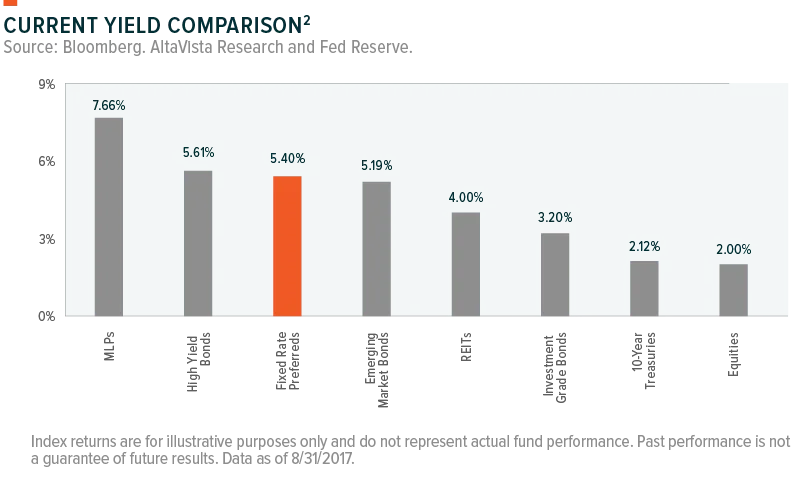
Preferreds offer high yield potential to investors, with the asset class currently yielding 5.40%
PFFD, with broad benchmark-like exposure, joins the high income-seeking Global X SuperIncome® Preferred ETF in Global X’s family of preferred funds
A Low Cost Preferred Stock ETF
On September 13th, Global X launched the Global X U.S. Preferred ETF (PFFD), the 12th ETF in our Income suite, and the second focused on preferred stocks. PFFD is designed to provide broad access to the US preferred market with an expense ratio of 0.23%, while the ETF.com category average for ‘Fixed Income: U.S. - Corporate Preferred Stock’ was 0.48% as of 8/31/2017. PFFD tracks the BofA Merrill Lynch Diversified Core U.S. Preferred Securities Index, which includes fixed, floating, and convertible, preferred securities. The index is market-capitalization weighted, while capping individual issuers at 10%.
In an environment where interest rates remain stubbornly low around the world, we believe that preferreds can help investors improve the yield of their portfolios. As of August 31, fixed rate preferreds, for example, yielded 5.40%, which is a higher yield figure than some traditional income generating asset classes like investment grade bonds and REITs. The income received from preferred stock can be particularly attractive because it is often classified as qualified dividend income (QDI), which is taxed at a lower rate than ordinary income.
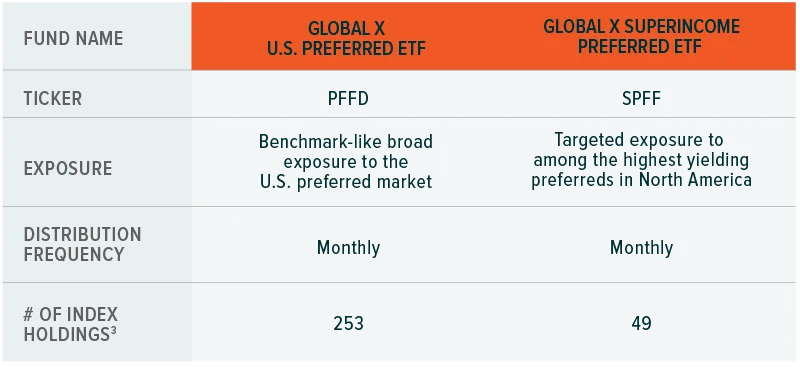
PFFD joins the five year old Global X SuperIncome® Preferred ETF (SPFF) in our family of preferred-focused ETFs. PFFD is intended to provide benchmark-like exposure to the preferred space, while SPFF targets the higher yielding segment of the preferred market. The table below provides additional information on the two funds.
More on Preferreds
Preferreds have unique characteristics that impact their yield, risks, and taxation. For more information on preferreds, please read this linked blog post.
In addition, we recently wrote about the bond markets and found that preferreds have been one of the best performing segments year to date (as of 8/14/2017).
Related Funds
PFFD: The Global X U.S. Preferred ETF invests in a broad basket of preferred securities in the United States.
SPFF: The Global X SuperIncome® Preferred ETF invests in 50 of the highest yielding preferred stocks in North America.
Performance for each fund as of the most recent month- and quarter-end is available by clicking the name above.
Footnotes
1. Average net expense ratio of ETF.com’s category “Fixed Income: U.S. – Corporate Preferred Stock.” (0.48%) as of 8/31/17.
2. Asset class representations are as follows, MLPs, Solactive MLP Infrastructure Index; High Yield Bonds, Bloomberg Barclays US Corporate High Yield Index; Preferreds, BofA Merrill Lynch Fixed Rate Preferred Securities Index; Emerging Market Bonds, J.P. Morgan EMBI Global Core Index; REITs, FTSE NAREIT All Equity REITS Index; Investment Grade Bonds, iBoxx USD Liquid Investment Grade Index; Equities, S&P 500 Index
3. Sources: BofA Merrill Lynch, S&P Dow Jones. Data as of 8/29/2017
Definitions
Solactive MLP Infrastructure Index: The Solactive MLP Infrastructure Index is intended to give investors a means of tracking the performance of the energy infrastructure MLP asset class in the United States. The index is composed of Midstream MLPs engaged in the transportation, storage, and processing of natural resources.
Bloomberg Barclays US Corporate High Yield Index: The Bloomberg Barclays US Corporate High Yield Bond Index measures the USD-denominated, high yield, fixed-rate corporate bond market. Securities are classified as high yield if the middle rating of Moody’s, Fitch and S&P is Ba1/BB+/BB+ or below. Bonds from issuers with an emerging markets country of risk, based on Barclays EM country definition, are excluded.
BofA Merrill Lynch Fixed Rate Preferred Securities Index: BofA Merrill Lynch Fixed Rate Preferred Securities Index tracks the performance of fixed-rate U.S. dollar-denominated preferred securities issued in the U.S. domestic market.
J.P. Morgan EMBI Global Core Index: J.P. Morgan EMBI Global Core Index is a broad, diverse U.S. dollar-denominated emerging markets debt benchmark that tracks the total return of actively traded external debt instruments in emerging market countries.
FTSE NAREIT All Equity REITS Index: FTSE NAREIT All Equity REITS Index is a free float adjusted market capitalization weighted index that includes all tax qualified equity REITs listed in the NYSE, AMEX, and NASDAQ National Market.
iBoxx USD Liquid Investment Grade Index: The iBoxx USD Liquid Investment Grade index measures the performance of 600 highly liquid investment grade corporate bonds.
S&P 500 Index: S&P 500 Index tracks the performance of 500 leading U.S. stocks and captures approximately 80% coverage of available U.S. market capitalization. It is widely regarded as the best single gauge of large-cap U.S. equities.
On April 16th, Global X listed two ETFs that may offer innovative ways to evolve core allocations and reflect a rapidly changing world.
On April 16th, Global X listed two ETFs that may offer innovative ways to evolve core allocations and reflect a rapidly changing world.