The growth in productivity across the U.S. oil & gas industry has been unprecedented, with record production of crude oil, natural gas, and natural gas liquids (NGLs) driving transport, storage, and processing volumes across the entire midstream sector. At this stage of the cycle, we think it’s natural to beg the question, “can the growth continue?” We believe it can. While it’s difficult to accurately forecast future consumption trends, we believe there remain a bevy of key opportunities to drive growth. These include themes such as the rise of U.S. liquefied natural gas (LNG) exports and the recent surge in AI-related power demand. We think midstream oil & gas remains aptly positioned to benefit from these trends for years to come.
Key Takeaways
U.S. power demand is projected to grow 47% by 20401; we believe natural gas will continue to maintain its position as the dominant energy source, supporting the continued growth of North American energy infrastructure.
Overseas natural gas demand gave rise to a booming export market for North American LNG, with export capacity projected to more than double by 2028.2 A supportive U.S. administration further enhances our outlook for the sector.
The influx of AI-driven data center expansions birthed an unexpected spike in demand growth, spurring a wave of new energy investments. Recent midstream earnings calls corroborate the ramp-up in natural gas demand.
Natural Gas: An Essential Component of the Power Grid
The United States is undergoing an unprecedented surge in power consumption. After three decades of nearly flat demand growth, U.S. electricity demand is forecast to grow by as much as 47% between now and 2040. This spike presents significant challenges for grid infrastructure and energy security, necessitating a comprehensive energy response— with natural gas playing a central role in meeting demand.
Among the primary energy sources, we believe that natural gas remains the most cost-efficient solution for addressing power needs. Its established distribution network, relative abundance, and reliability in power generation puts it among the most practical options. Natural gas serves as both a foundation for base load power and a complement to cheap yet intermittent renewable energy, providing versatile applications across various grid systems.
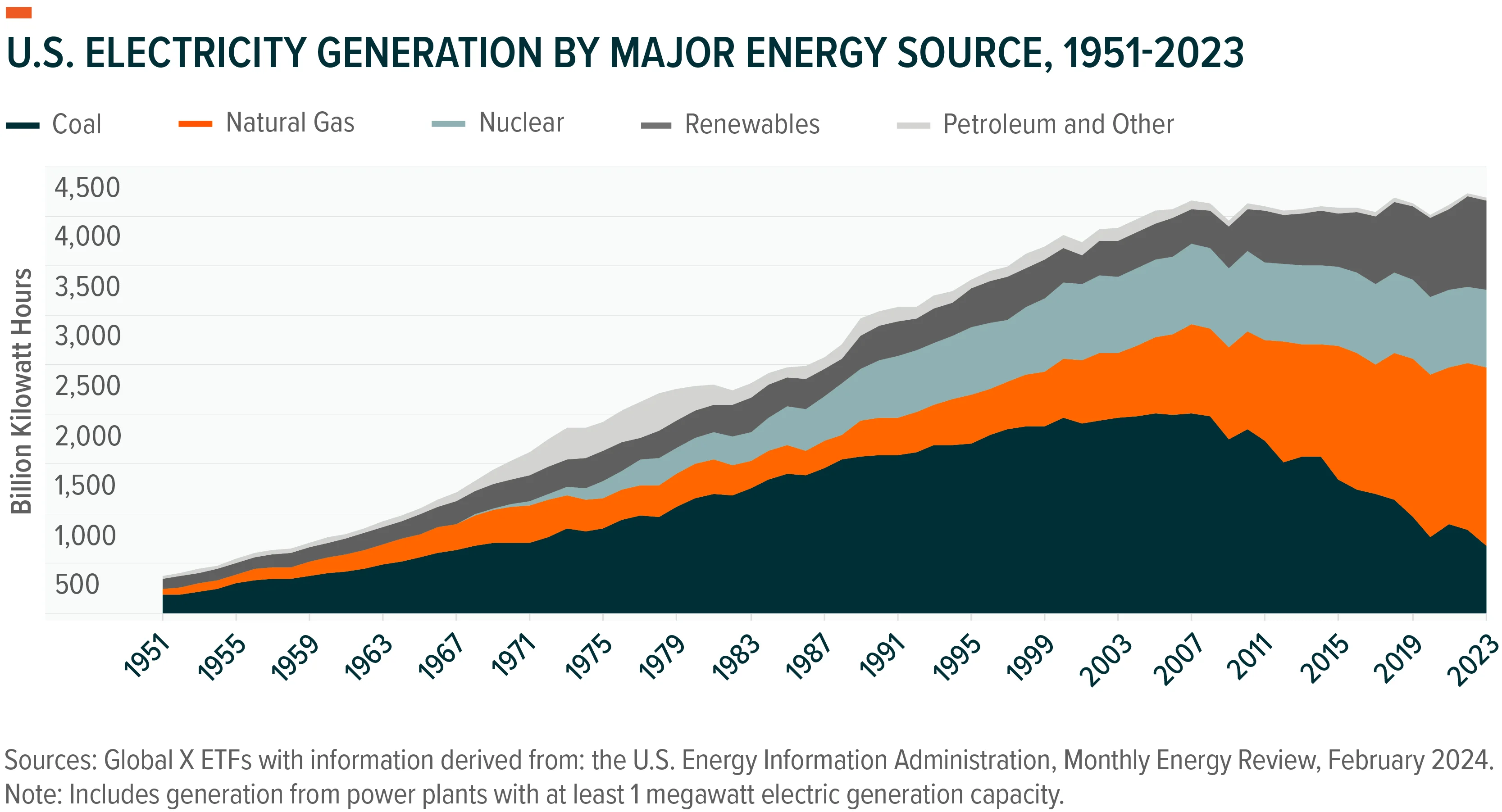
Over the past decade, natural gas captured the majority of incremental power demand growth. Its market share expanded from 28% in 2014 to 42.5% in 2024, primarily at the expense of retiring coal plants, which declined from nearly 50% of U.S. power generation capacity in 2008 to just 16.2% in 2023. From 2016-2023, natural gas accounted for roughly one-third of the incremental growth in power demand, capturing nearly 33.4% of all new power generation capacity.3
We believe the North American midstream industry is optimally positioned to capitalize on the recent surge in power consumption and the United States’ ascendance as the world’s largest LNG exporter. Over the past few years, the sector has generated substantial free cash flow, driven by record energy production. This cashflow has been returned to shareholders through share buybacks and distribution hikes, while also being reinvested in strategic growth opportunities, such as expanding processing and export capacity to meet rising demand for LNG and NGLs. Although midstream valuations have expanded in recent years, we think they remain justified by robust earnings, attractive distributions, and the promising growth opportunities we see ahead.
The Rise of LNG Bolsters U.S. Energy Dominance
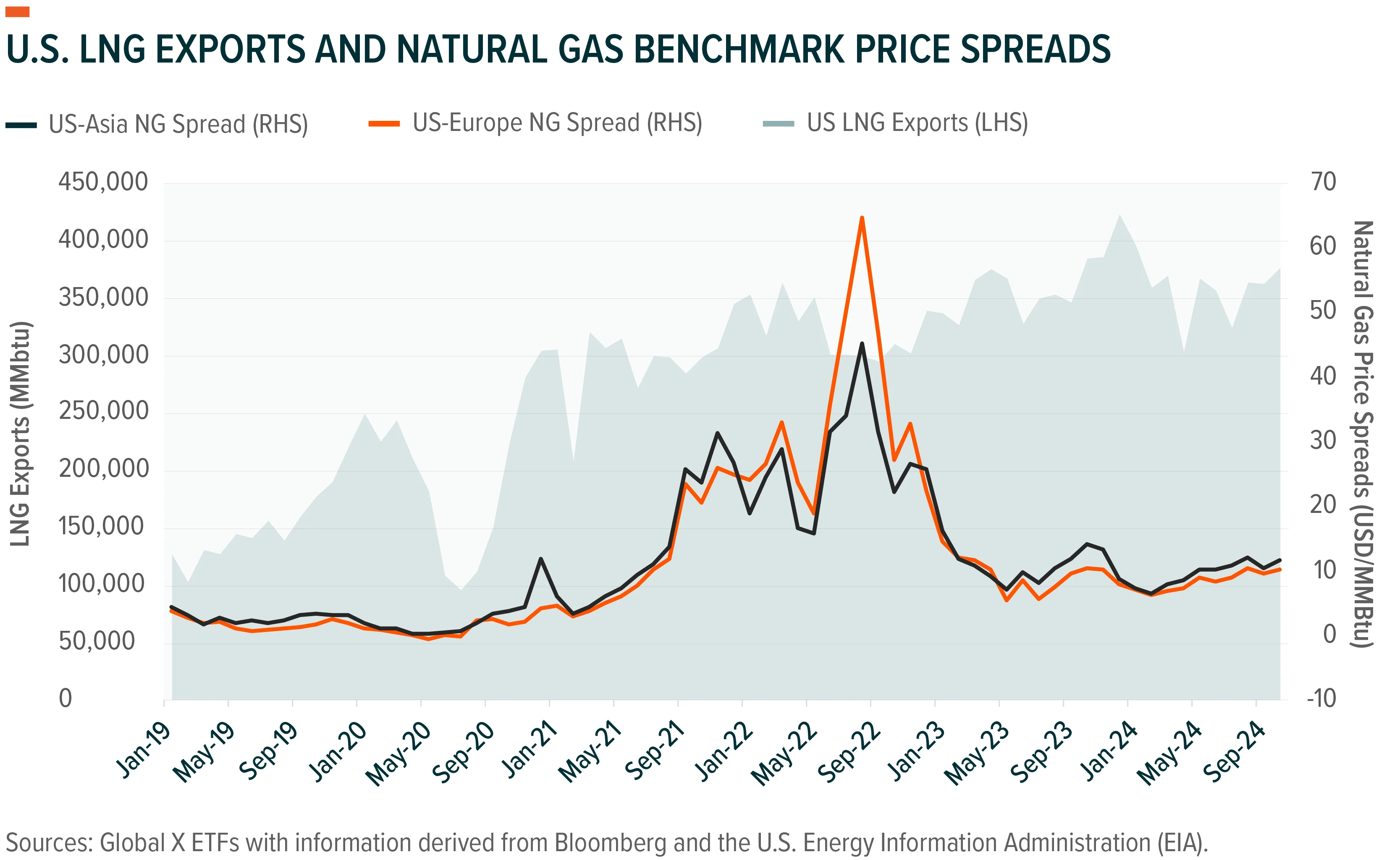
Global demand for LNG is projected to rise nearly 50% by 2040,4 driven by rising consumption among Asian markets, geopolitical shifts in Europe, and growing needs from key trading partners. Asia remains the largest consumer, accounting for roughly 70% of global LNG demand in 2024.5 In Europe, U.S. LNG exports offset nearly half the loss of Russian gas supplies in the immediate aftermath of the Russia-Ukraine invasion, underscoring its importance as a strategic component of U.S. policy. Regional supply shortages, combined with geographic and political constraints, have further amplified global demand for LNG.
We believe that the strong international demand for U.S. LNG exports is most clearly illustrated by the significant price spreads between the Title Transfer Facility (TTF) in Europe and Henry Hub in the United States, which serve as the primary price benchmarks for their respective regions. As of January 22, Dutch TTF prices remain substantially higher than U.S. Henry Hub prices, at $14.57 MMBtu versus $3.89.6 Similar price differentials can be observed across U.K. and Asian natural gas hubs, highlighting the lucrative profit opportunities for U.S. LNG players, which include notable midstream names like Cheniere Energy and Venture Global.
According to S&P Global’s base case forecast, more than 100 million metric tonnes per annum (MMtpa) of additional global LNG supply capacity will be required to meet growing global demand by 2040.7 The United States is well-positioned to address this surge in demand. Following the lifting of the previous administration’s pause on new LNG permitting, U.S. LNG projects are expected to advance, potentially doubling capacity by 2028. Among leading LNG exporters, which include Australia and Qatar, the U.S. is projected to account for nearly ~75% of LNG final investment decisions (FIDs) in 2025, potentially doubling its market share by 2030.8
Finally, we believe the inauguration of the new U.S. administration ushers in a new period of positivity for North American midstream. While new LNG projects take years to deploy, we believe the removal of the Biden-era caps on LNG permitting will allow existing applications to resume, thereby raising the industry’s overall growth outlook. The new administration’s permissive stance toward LNG presents management teams with greater certainty over the medium term, easing regulatory concerns that might otherwise impede project decisions; we believe this could introduce the potential for additional investments should demand growth persist.
Data Center Expansions Herald a New Source of Demand
Data centers may see their share of U.S. power demand rise from 3% to 8% by the end of the decade, equating to a compound annual growth rate (CAGR) of ~15% from 2023-2030.9 In our July 2024 post, we noted that primary data centers in the United States were expected to surpass 3,500 megawatts (MW) in construction activity for 2024,10 marking a record high. By the fourth quarter, this forecast was adjusted upward to between 3,800 and 5,000 MW,11 much of which is likely to be powered by natural gas.
Power utilities are well-versed in constructing natural gas plants and can readily tap existing distribution networks, directly supplied via pipeline networks operated by midstream corporations and master limited partnerships (MLPs). A conventional natural gas power plant can be constructed in as little as one year,12 a crucial consideration when faced with the relentless rise in power consumption.
We believe that the general trend for natural gas demand remains upward and that midstream pipelines are well-positioned to capitalize on an outsized portion of this demand. As hyperscalers prioritize reliability and scalability for their data center buildouts, there is a growing preference for behind-the-meter arrangements, where data centers are constructed near power sources. Midstream firms have increasingly cited short laterals connecting to existing pipelines as a cost-effective and easy to deploy strategy for meeting new demand.
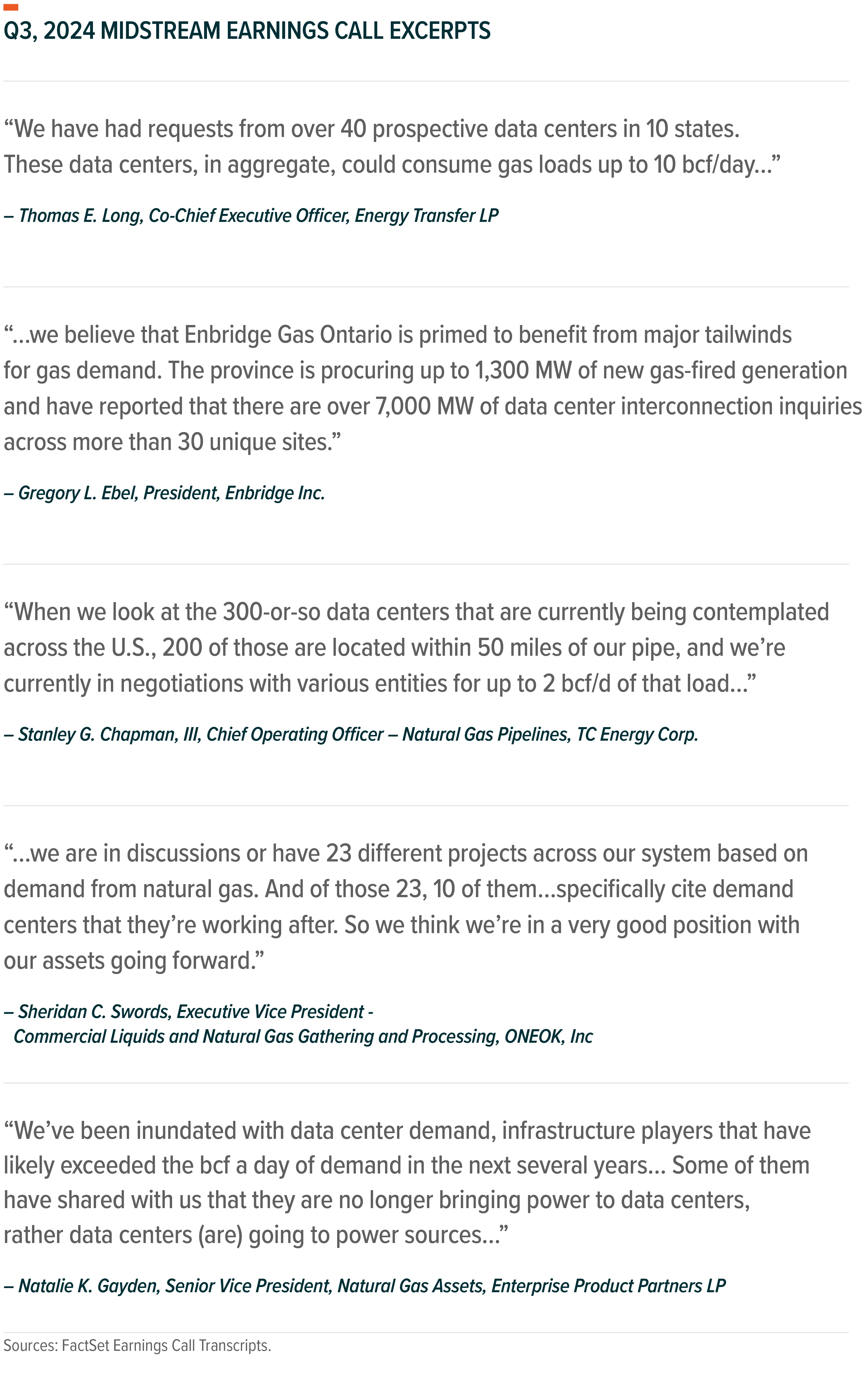
Supporting this point, TC Energy highlighted that nearly two-thirds of the data center projects being contemplated in the U.S. fall within 50 miles of their pipelines.13 Similarly, Enterprise Product Partners observed a notable shift in supply chain dynamics, with data center operators increasingly bypassing local gas distributors, acquiring their own natural gas capacity, and approaching pipeline providers directly for connection requests. We believe this substantiates an underlying trend in which data centers are opting for quick and scalable solutions to meet growing power needs.
Goldman Sachs predicts that nearly 60% of the ramp-up in data center power demand will be met by natural gas fired sources, which translates into nearly 3.3 billion cubic feet per day (bcf/d) of incremental demand by 2030.14 S&P Global Ratings puts that estimate between 3-6 bcf/d, leaning toward the higher end of that forecast.15 Midstream firms also noted rising demand from data centers in recent earnings calls. Energy Transfer (ET) reported receiving requests to connect 40 data center projects across 10 states, representing 10 bcf/d in potential natural gas consumption.16 Collectively, we believe these testimonies underscore the urgency of power needs from the tech sector.
Conclusion: The Many Sails Propelling Midstream
While some sectors live or die on a single theme; we believe North American midstream has the advantage of multiple tailwinds driving its performance. These include structural trends, such as the expansion of data centers, the electrification of energy grids globally, and the rise of U.S. LNG exports. Additionally, the continued growth of petrochemicals, along with increased U.S. oil and NGL export volumes, represents parallel drivers that will likely continue to boost demand for midstream services. With this confluence of supportive trends, we believe the North American sector is positioned for sustained growth and has plenty of momentum to fuel its performance.