
“I had to be withdrawn from tapioca pudding slowly. It was one of the few times I wasn’t committed to achieve withdrawal,” Oscar Levant, American comedian, composer, pianist and actor (1906-1972)
This month’s Through the Systematic Lens revisits a category of investing most likely associated with how your parents (or grandparents) invested: equity-income funds, akin to ordering tapioca pudding or baked Alaska under the desserts section of the supper club menu. Like tapioca pudding and baked Alaska, equity-income investing has largely gone out of style in a modern fund world populated by smart beta, thematics, derivative income, and liquid alternatives. Equity-income sits in the pantheon of legacy mutual fund categories from the 80s and 90s that also included aggressive growth, growth & income, capital appreciation and flexible income, language that still exists in fund prospectuses today but more likely included in the stated objective rather than the fund label (SEC’s 2001 Names Rule helped tighten language between what a prospectus states and what the fund actually holds).
The Equity-Income style has also fallen out of favor, with investment factors aligned with equity-income, such as high dividend yield and low volatility, having lagged pro-cyclical growth-focused themes that have captured investor attention and fund flows, whether cloud computing or artificial intelligence (AI). Equity-income, like tapioca pudding, isn’t just a passè investment style reflecting saver palates from the distant past. Like tapioca pudding, equity-income investing, with its focus on dividend-paying stocks, is among the plainest investment offerings, a dessert fashioned with humble ingredients and slow cooking akin to comfort food.
The upshot? With so much investor attention and capital fixed on the AI-driven growth story we examined in our September edition (“Alas, Free Cash Flow I Knew You Well”), income may be one of the less fashionable corners of the equity market, and ‘unfashionable’ can often be where overlooked opportunities hide. Of course, there is no such thing as a free dessert: payouts can be cut, real estate can be rate-sensitive, and a ‘high dividend yield’ can be a warning sign of financial stress. But where growth investing asks what a company might become, equity income asks the more old-fashioned question: what is it paying you today? Save room for dessert, especially after a spicy meal of aggressive growth investing.
Key Takeaways
Tapioca may be a past-tense dessert, but income is always present tense. Dividends and distributions are the part of equity total returns that investors may collect today, echoing our September theme of balancing the uncertain ‘future’ with the observable ‘present.’.
Equity-income Investing offers the prospects of current payouts while potentially participating in future growth, even if that growth may be slower than the broader equity market.
Global X offers thoughtful, methodical approaches for pursuing equity income, whether the more diversified Global X SuperDividend® U.S. ETF (DIV) that incorporates considerations around dividend consistency and market sensitivity, or more sector-focused, potentially higher yielding strategies such as the Global X SuperDividend® REIT ETF (SRET), concentrated in equity and mortgage Real Estate Investment Trusts (REITs).
“Yesterday is history and tomorrow is a mystery but today is a gift. That’s why it’s called the present.” (Master Oogway, Kung Fu Panda)
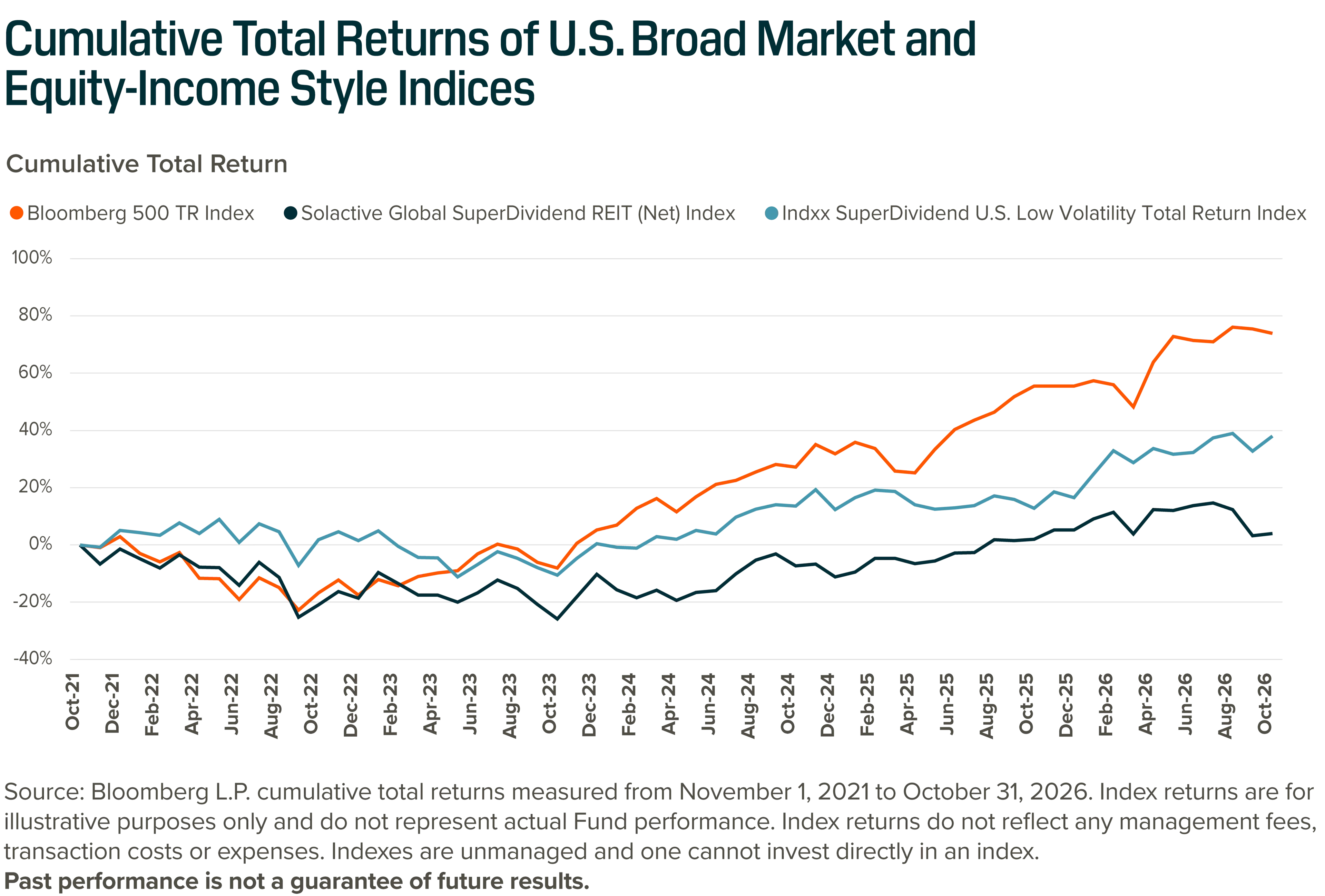
Admittedly, the ‘present’ has not been much of a gift for the equity-income style of investing. Over the past five years covering much of the post-COVID recovery period, the equity-income style, as proxied by the Indxx SuperDividend U.S. Low Volatility Total Return Index and the Solactive Global SuperDividend REIT (Net) Index , has significantly lagged the broad U.S. equity market, represented by the Bloomberg 500 Total Return Index.
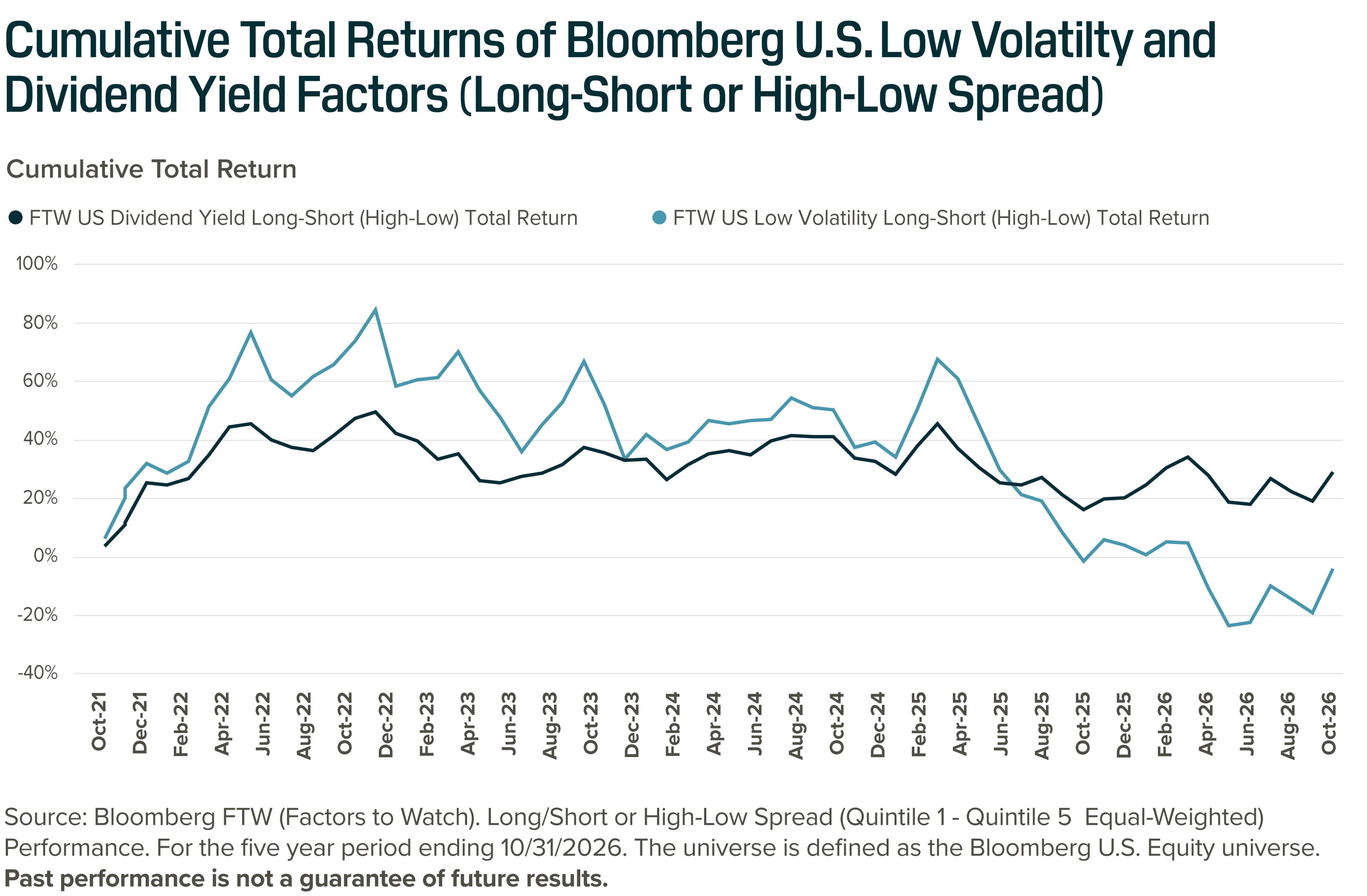
The equity-income style is generally a defensive style of investing focused on stocks with high dividend yields and/or low volatility (lower equity market sensitivity). These attributes can be captured through long-short (high-low) systematic factors such as Dividend Yield and Low Volatility shown below. Although the dividend yield factor has generally held up over the past five years ending 10/31/2026, most of its gains accrued in the earlier part of the period and has since lagged the more recent pro-cyclical growth-driven market advance. The low volatility factor has also fared worse, especially over the past two years, resulting in a negative cumulative return.
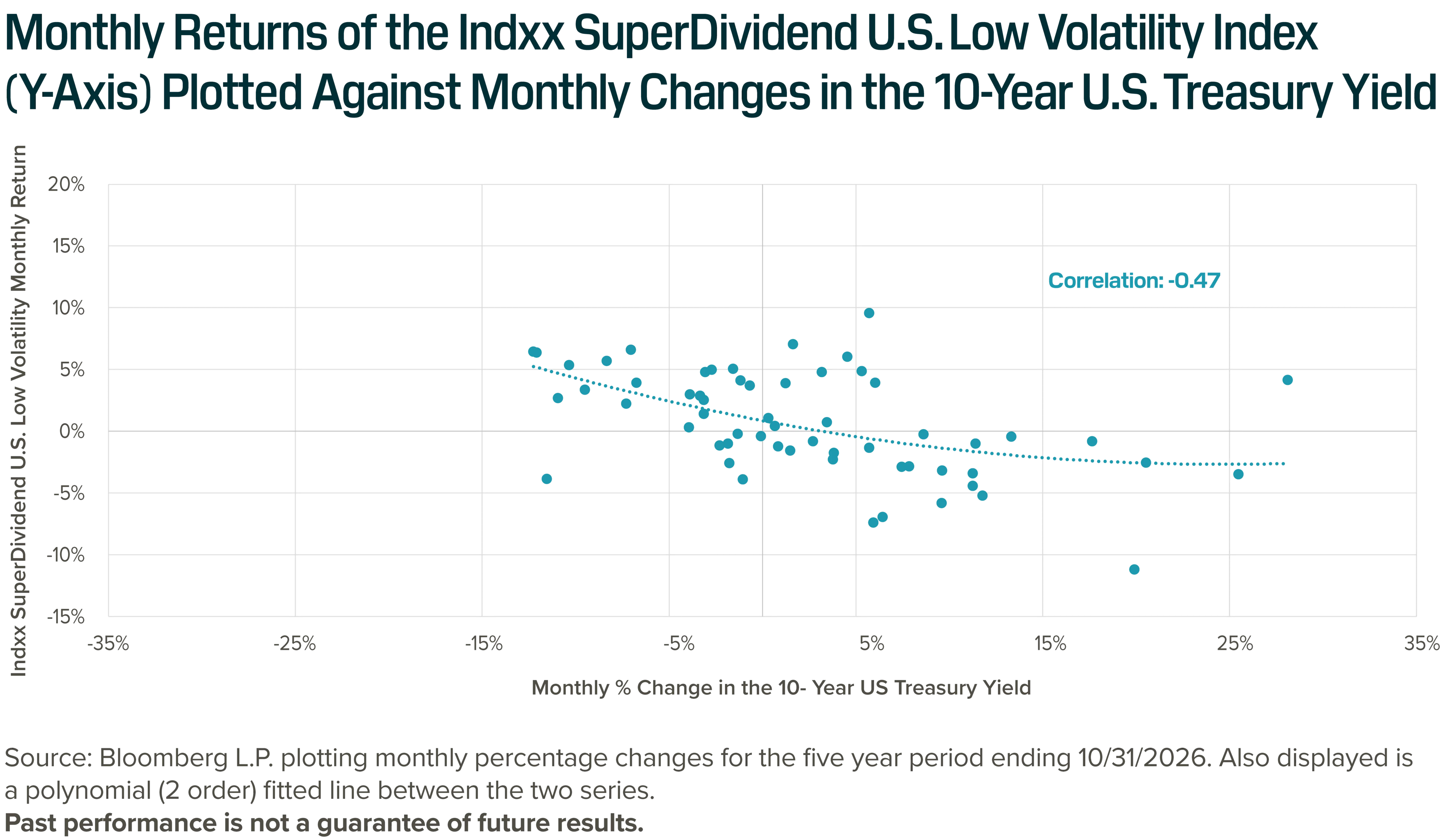
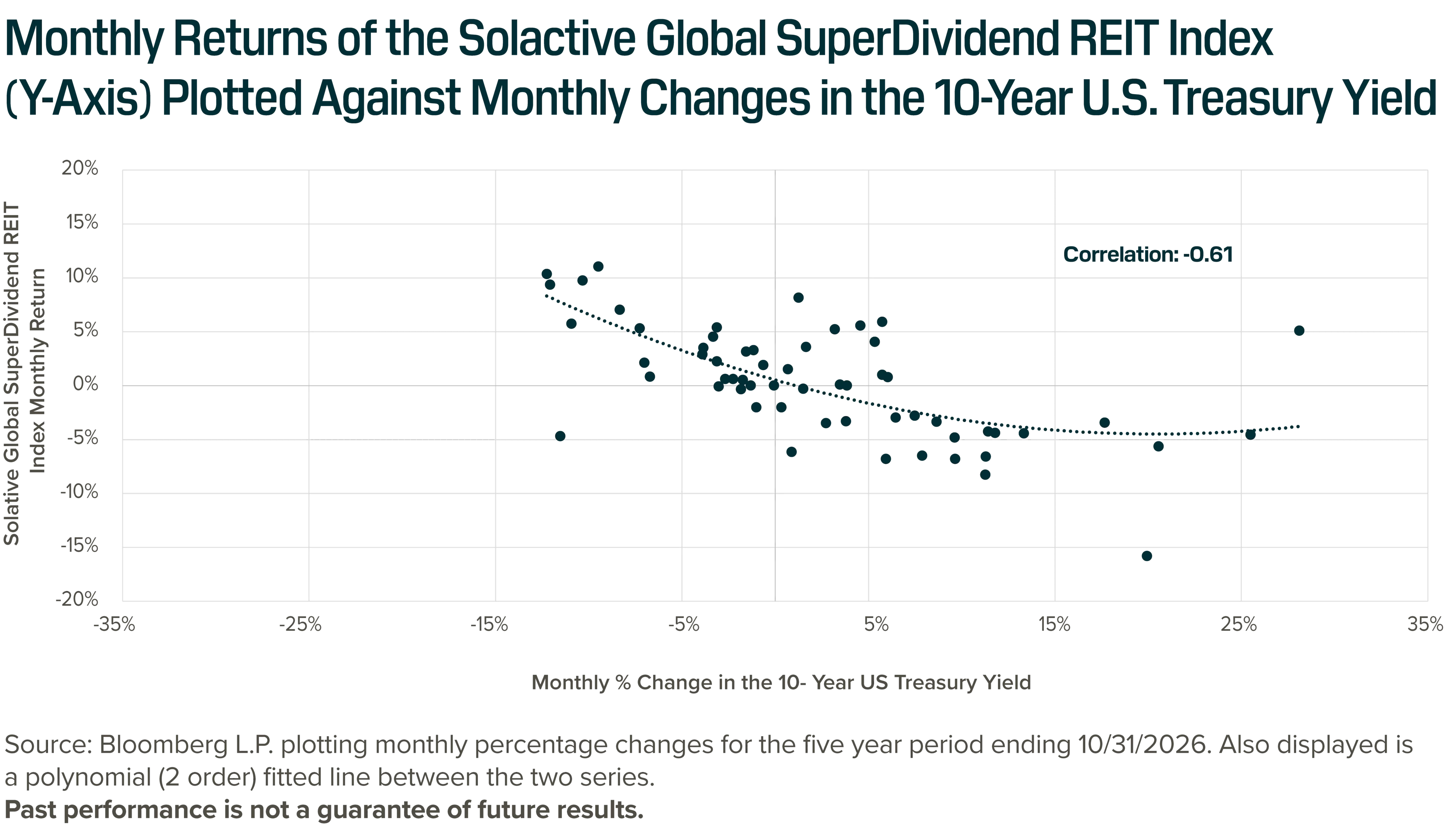
Higher interest rates, represented by positive changes in the 10-Year U.S. Treasury rate, have also proven to be a headwind for the equity-income investment style, as high yielding stocks compete with yields offered by the bond market. When rates rise, bond income generally competes better with dividend yield. The 10-Year U.S. Treasury rate rose from a low rate of 1.34% (12/3/2021) to a high rate 5.30% reached on 10/5/2026 before settling at 4.93% at month end over the 5-year period ending 10/31/2026 (source: Bloomberg) . The next two charts display the negative relationship between equity-income performance and monthly changes in the U.S. 10-Year Treasury rate, as REITs (equity and mortgage) tend to be more rate sensitive than the broader dividend-paying style.
However, market and macro-related headwinds for equity-income investing could be softening or turning around. Long-term interest rates (as represented by the 10-year U.S. Treasury rate) are down from peak levels throughout the post-COVID cycle, while investor appetite for financing the data center buildout is showing some signs of exhaustion, putting less pressure on government borrowing having to compete with corporate borrowing.1 The data center financing landscape appears to be at an inflection point, with sentiment bifurcating between sustained demand optimism and growing concern over leverage, speculative construction, and regulatory risk.2
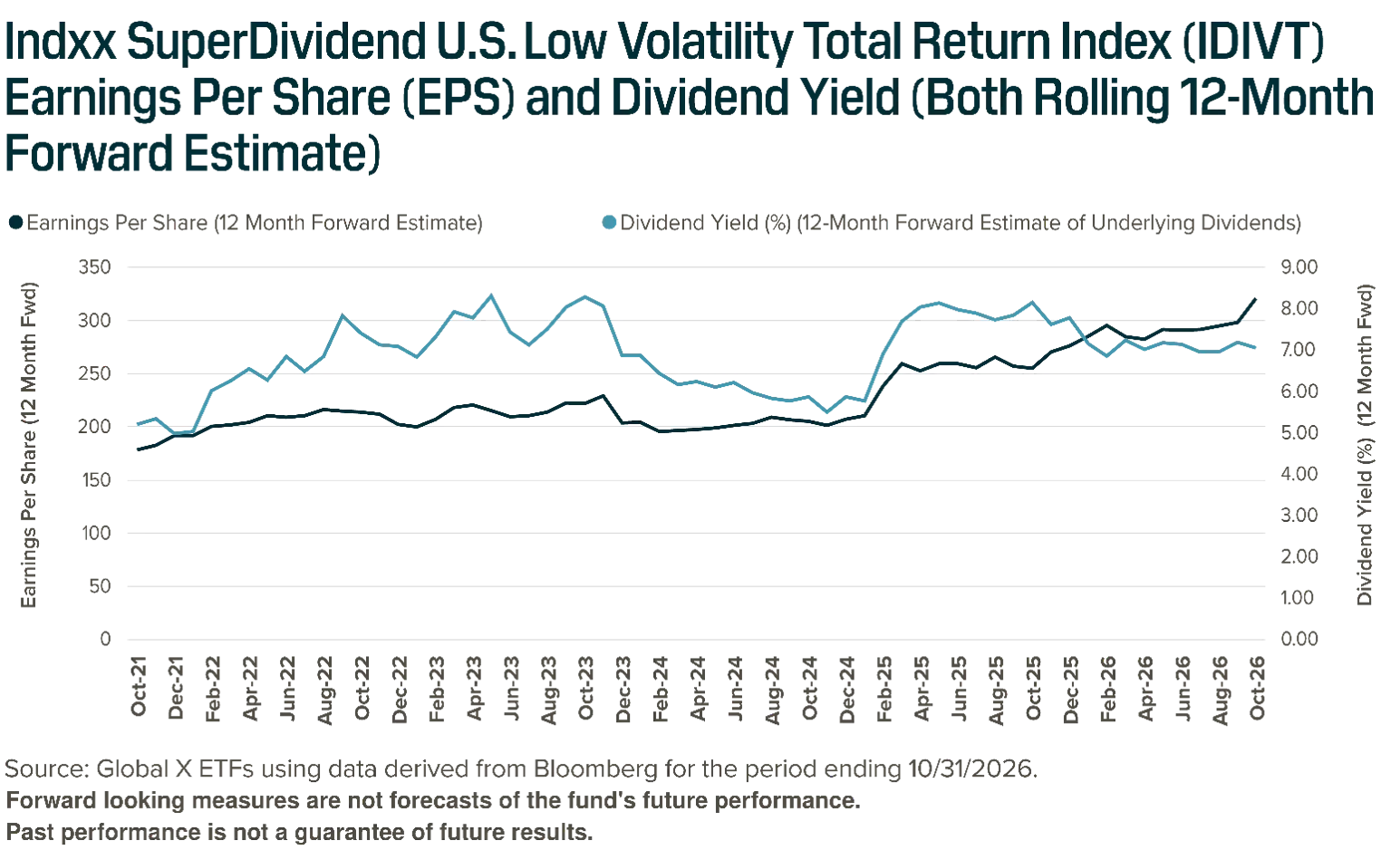
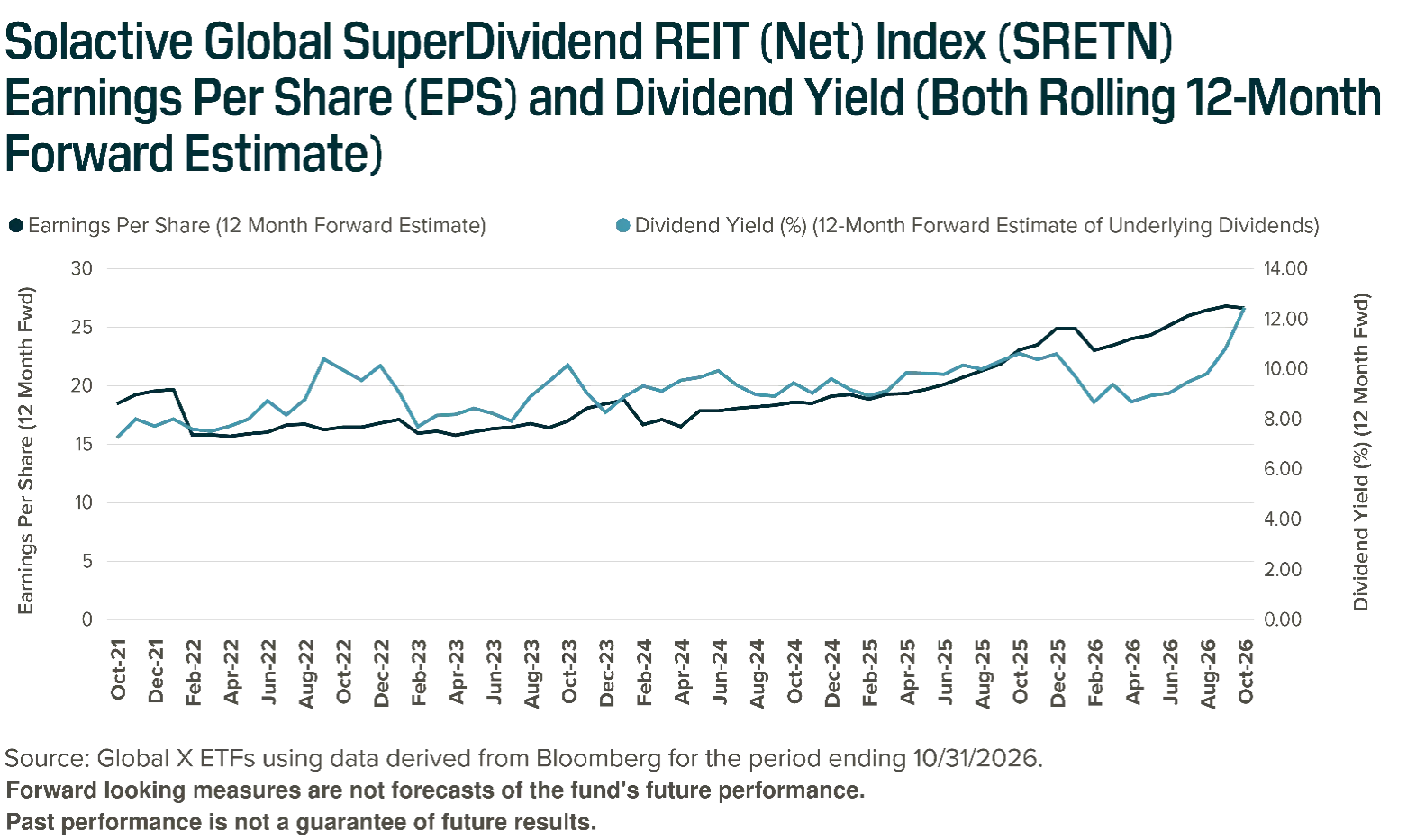
And equity-income investors wouldn’t necessarily have to sacrifice earnings growth for current income. The following charts display the expected aggregated earnings per share (EPS) for the Indxx SuperDividend U.S. Low Volatility Total Return Index and the Solactive Global SuperDividend REIT (Net) Index. EPS growth isn’t expected to blow the roof off, but the indices both have higher expected yields as well as the potential for dividend growth, presuming that dividend payout ratios remain consistent. Both indices have projected dividend yields ranging from 7-12% with EPS expected to inflect upward over the next 12 months (source: Bloomberg).
Conclusion: “I have the simplest tastes. I am always satisfied with the best,” Oscar Wilde
Equity-income investing could fit the bill should we see a more supportive rate backdrop as well as a renewed appetite to diversify risk away from the propulsion of the AI growth trade over the past few years. Tapioca pudding can still be a fulfilling dessert despite its simplicity, and investors could always add more spice in the form of higher projected yields and sector concentration.
The following data reference Bloomberg equity analytics as of 10/31/2026, except where noted.
Equity-Income: Investing In Pursuit of Dividends with the Potential for Growth
The Global X SuperDividend® U.S. ETF (Ticker: DIV) invests in 50 of the highest dividend-yielding U.S. equities. The fund seeks to track the Indxx SuperDividend® U.S. Low Volatility Index. To be eligible for index inclusion, companies must have consistently made dividend payments in the past two years, demonstrate a 12-month dividend yield between 1%-20%, a current-year dividend at least equal to 50% of the prior year's payout, alongside a low market sensitivity relative to the U.S. benchmark. This methodology tends to produce lower sensitivity to broad market volatility given the defensive nature of dividend paying stocks. The underlying index’s low-volatility screen helps reduce the "yield trap" risk common in pure high-dividend strategies, where a high indicated dividend yield may indicate financial stress that could result in an eventual cut to the dividend payout in order to restore financial stability. As of 10/31/2026, the fund had a trailing 12-month dividend yield of 6.50%.
The Global X SuperDividend® REIT ETF (Ticker: SRET) seeks to track the Solactive Global SuperDividend REIT Index, which comprises 30 of the highest-yielding real estate investment trusts (REITs) around the world. Eligible securities are REITs from developed and emerging markets that meet minimum size and trading-volume requirements and have no announced dividend cuts. The underlying index comprises the top 30 yielding REITs (based on trailing 12-month dividend yield) with the lowest recent price volatility, aiming to pair high income with relative stability. As of 10/31/2026, the fund had a trailing 12-month dividend yield of 9.54%.
Related ETFs
DIV – Global X SuperDividend® U.S. ETF
SRET – Global X SuperDividend® REIT ETF
Past performance is not a guarantee of future results. Click on the fund name above for the 30-day SEC yield, standard performance, and prospectus.