Product ResearchDisruptive MaterialsElectric Vehicles
Rare Earths: The Innovation Economy’s Critical Chokepoint
T
Tejas Dessai
Nov 10, 20255 min read
Copyright © 2026 Global X. All rights reserved.
SEI Investments Distribution Co. (1 Freedom Valley Drive, Oaks, PA, 19456) is the distributor for the Global X Funds.
Check the background of SIDCO and Global X's Registered Representatives on FINRA's BrokerCheck.
Get the latest news and updates from our team.

Madeline Ruid
Madeline Ruid
Tejas Dessai
Rare earth magnets are critical to modern technology, and yet most of the supply chain behind them is concentrated in a single country. That dependence came into focus in 2025, when new export controls prompted the U.S. and its partners to accelerate efforts to build supply elsewhere, which could create a multiyear growth opportunity for established rare earth elements ("rare earths") miners and processors. The market is already reflecting this, as rising magnet demand and limited capacity outside of China support firmer prices and new investment. Policy is adding to that momentum: price floors and long-term purchase commitments could improve revenue visibility for select producers. Given these structural shifts, we believe the theme is entering a durable phase of expansion at the intersection of technology innovation and supportive policies.
Export controls introduced in 2025, and the policy response since, including price floors, purchase commitments and critical minerals agreements, have accelerated efforts to build ex-China supply and could improve revenue visibility for producers.
Limited capacity outside China and long mine lead times have supported a price premium for ex-China supply, which could benefit companies that mine and process rare earths.1
Magnet rare earths are essential to AI data centers, defense technologies and electric vehicles, and demand for them is forecast to increase 80% between 2025 and 2050, creating tailwinds across the mining and processing value chain.2
The current global rare earths supply chain is highly concentrated and exposed to geopolitical risks. China currently controls 91% of refined rare earths production and 94% of rare earth permanent magnet manufacturing.3 In 2025, China began to introduce new export controls, leveraging its dominance as a negotiating tactic.4 Notably, the International Energy Agency estimates that up to $6.5 trillion of economic activity outside China could be at risk each year if China's export controls were fully implemented.5
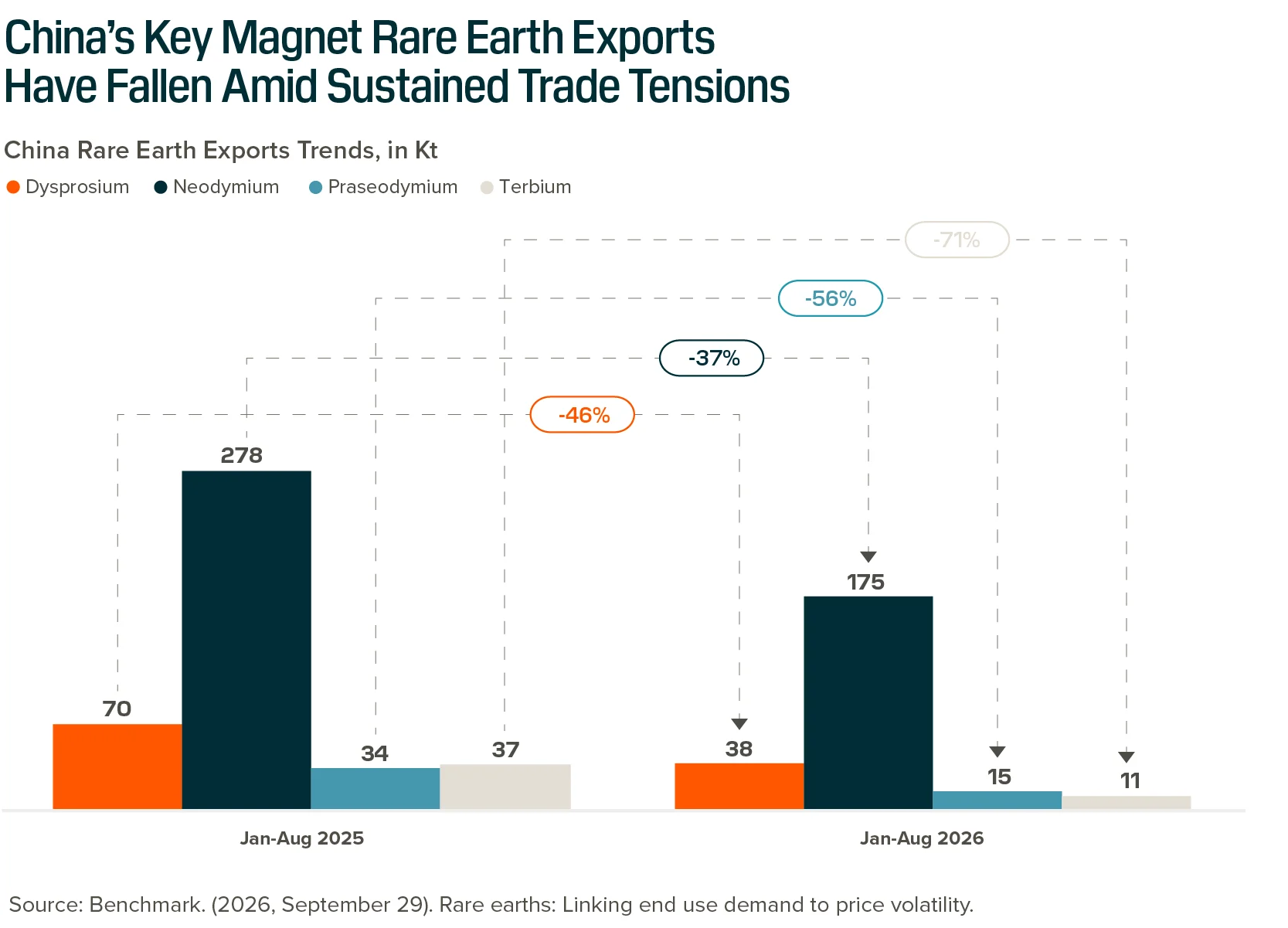
These elevated trade tensions have already led to supply disruptions, with China's exports of dysprosium, neodymium, praseodymium and terbium falling 37% to 71% between January and August 2026 when compared to the same time period in 2025.6 These market dynamics have accelerated efforts to diversify supply chains, creating potential opportunities for companies that mine and process rare earth elements in other countries such as the United States, Australia, and Malaysia.
Supply is also slow to respond. While rare earth elements are relatively abundant in the Earth's crust, economically viable deposits are much harder to find and develop. Even where suitable deposits exist, bringing a new mine online can take an average of 10 years.7 The challenges extend well beyond mining, as transforming raw materials into finished magnets involves several technically complex and capital-intensive stages, including chemical processing, oxide separation, metal refining, and magnet manufacturing.8 Together, these constraints limit how quickly supply can respond to rising demand, with the magnet rare earths market forecasted to face a 17% primary supply deficit by 2035.9
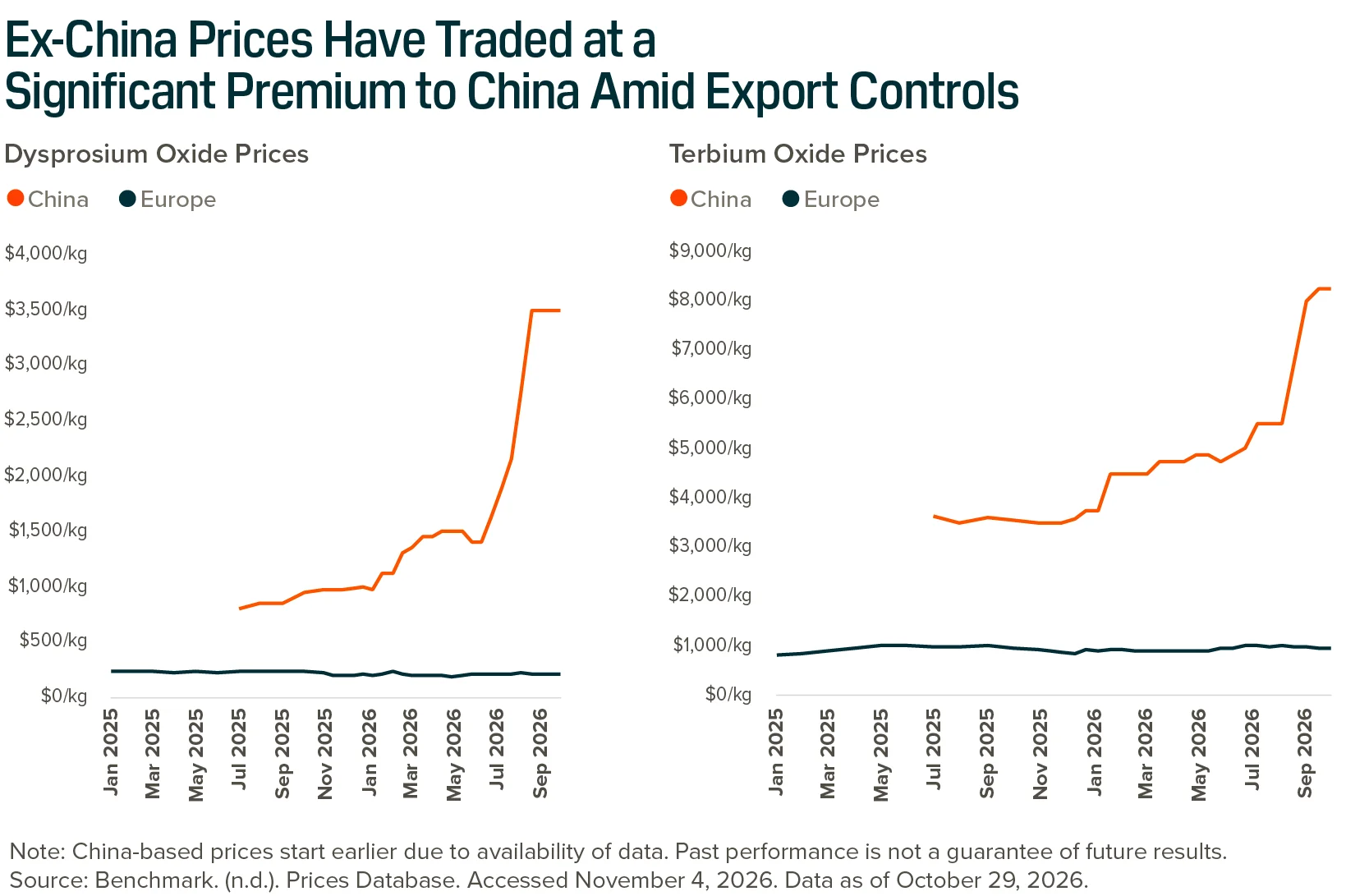
Supply challenges are particularly pronounced outside China, where efforts to establish independent supply chains are gaining momentum amid the heightened geopolitical tensions. Magnet rare earths, including terbium and dysprosium, sourced outside China already command a premium over Chinese alternatives, reflecting growing demand for diversified supply.10 As supply takes time to develop, we believe this premium could persist well into the next decade, creating a favorable backdrop for ex-China producers and processors.
Policy is reinforcing the increasingly favorable backdrop for ex-China rare earths producers. Recognizing supply vulnerabilities, the U.S. and its partners have ramped up policy efforts to support the expansion of rare earths production and processing capacity. We believe these moves signal that rare earths are now being treated more as a strategic asset than just a commodity. For producers, tools such as price floors, long-term offtake agreements, and equity stakes can mean more predictable revenue and easier financing for capital-intensive projects.
In the U.S., this approach is already taking shape through the Department of Defense's multi-billion public-private partnership with U.S.-based rare earths producer MP Materials, announced in July 2025. The DoD acquired a roughly 15% stake in the company, on an as-converted basis, through an agreement to purchase $400 million of the company's preferred stock.11 The investment is expected to go towards expanding rare earths separation, processing, and magnet production, with MP Materials building a new magnet production facility, called the 10X Facility, in Texas.12 Beyond the equity stake, the DoD also agreed to guarantee the purchase of 100% of the magnets produced at the 10X Facility for the 10 years following the beginning of operations, which could start as early as 2028. The agreement also includes a 10-year price floor commitment of $110/kilogram for Neodymium-Praseodymium products.13
Beyond direct investment, the United States has entered into critical mineral frameworks with Australia, Japan, Malaysia, and the European Union that include a focus on rare earths.14,15,16 For example, in October 2025, the United States and Japan signed an agreement to accelerate securing supplies of rare earths, invest in mining and processing, and set up a joint rapid response group to identify supply vulnerabilities and develop a coordinated plan to mitigate risks.17
More recently, in April 2026, the United States and European Union signed a Memorandum of Understanding (MOU) for a partnership on producing and securing critical minerals, including an agreement to collaborate on potentially setting price floors, subsidies, or other trade measures that can help support domestic rare earths miners.18
Australia's Lynas Rare Earths offers an early data point: its average selling price rose 88% year over year to a record A$102.1 per kilogram in the quarter ended September 30, 2026, and floor-price agreements cover more than half of its production.19
Beyond policy support, the opportunity rests on demand. Of the 17 rare earth elements, those used in permanent magnets, such as neodymium, praseodymium, terbium, and dysprosium, are the most consequential. They are vital to the motors, sensors, and radar systems behind electric vehicles, fighter jets, modern robotics, renewables, and AI server racks, technologies that are driving global innovation and supporting national security.20
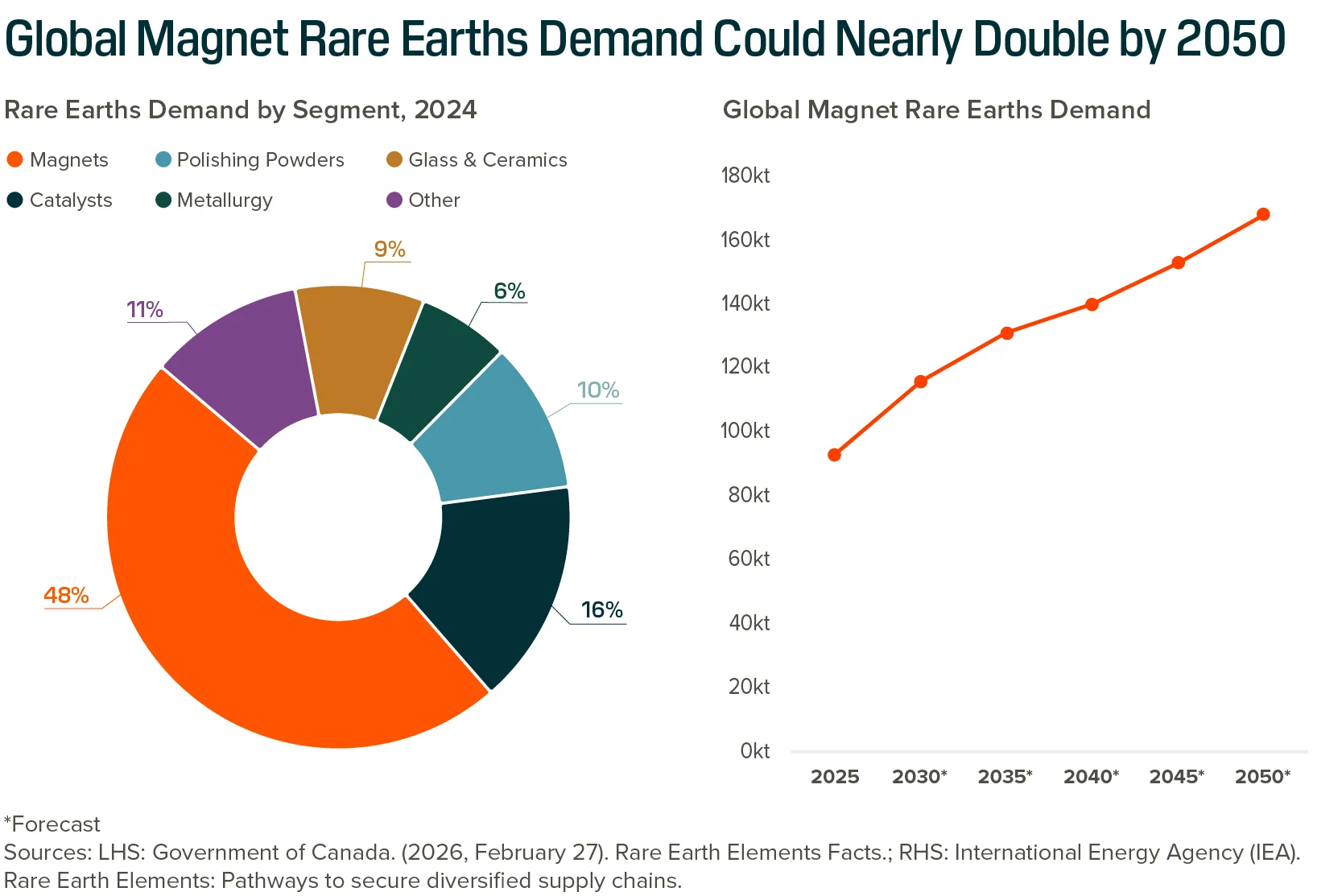
The importance of magnet rare earths also shows up in the economics. While magnet rare earths account for roughly half of total rare earths production by volume, they represent roughly 95% of the market value.21 As these technologies scale, global demand for magnet rare earths is projected to grow 80%, from 93,000 tonnes in 2025 to more than 170,000 tonnes by 2050.22 Given the long lead times for new mines, that growth could keep supply tight and support opportunities for miners and processors across the value chain, both in China as well as in other markets.
Export controls introduced in 2025 have heightened supply risks, and the policy response since indicates that supply security is a growing priority for the U.S. and its partners. Looking ahead, demand for magnet rare earths is projected to grow meaningfully, while those risks are likely to remain elevated due to slow mine development timelines, a concentrated supply chain, and rising trade tensions. Given these dynamics, we believe the race to diversify supply is still in its early stages, and that tailwinds for companies throughout the rare earths value chain could fuel growth over the next decade.
Benchmark. (2026, September 29). Rare earths: Linking end use demand to price volatility.
International Energy Agency (IEA). (2026, April 8). Rare Earth Elements: Pathways to secure diversified supply chains.
Ibid.
Ibid.
Ibid.
Benchmark. (2026, September 29). Rare earths: Linking end use demand to price volatility.
Aerospace Industries Association (AIA). (2026, September). Strengthening Critical Minerals Supply Chains: Aerospace and Defense (A&D) Industry Assessment and Recommendations.
International Energy Agency (IEA). (2026, April 8). Rare Earth Elements: Pathways to secure diversified supply chains.
Global X Forecast based on IEA. (2026, July 27). Critical Minerals Data Explorer.; Adamas Inside. (2022). Rare Earth Magnet Market Outlook to 2035.; Little, A. (2025). The Rare Earth Imperative.; S&P Global. (2026, August). NdPr Market Report.
Benchmark. (2026, September 29). Rare earths: Linking end use demand to price volatility.
MP Materials. (2025, July 10). MP Materials Announces Transformational Public-Private Partnership with the Department of Defense to Accelerate U.S. Rare Earth Magnet Independence.
Samora, S. (2026, March 2). MP Materials execs share next steps for $1.3B Texas rare earth magnet site. Manufacturing Dive.
MP Materials. (2025, July 10). MP Materials Announces Transformational Public-Private Partnership with the Department of Defense to Accelerate U.S. Rare Earth Magnet Independence.
The White House. (2025, October 27). United States-Japan Framework for Securing the Supply of Critical Minerals and Rare Earths through Mining and Processing.
The White House. (2025, October 20). United States-Australia Framework for Securing of Supply in the Mining and Processing of Critical Minerals and Rare Earths.
Rooper, H. (2026, July 23). Mapping U.S. Critical Mineral International Agreements. Climate Leadership Council.
The White House. (2025, October 27). United States-Japan Framework for Securing the Supply of Critical Minerals and Rare Earths through Mining and Processing.
Reuters. (2026, April 24). US, EU sign preliminary partnership deal on critical minerals.
Reuters. (2026, October 29). Lynas posts 55% revenue jump on record prices, flags plant shutdowns. Kitco News.
International Energy Agency (IEA). (2026, April 8). Rare Earth Elements: Pathways to secure diversified supply chains.
Ibid
Ibid.
Rare earth elements are in focus as geopolitics and innovation create dual pressures on global supply chains.
Rare earth elements are in focus as geopolitics and innovation create dual pressures on global supply chains.
Modern economies run on minerals, metals, and water – and demand is accelerating. With mines slow to build, supply chains concentrated, and water under strain, shortfalls could create opportunities for investors.
Modern economies run on minerals, metals, and water – and demand is accelerating. With mines slow to build, supply chains concentrated, and water under strain, shortfalls could create opportunities for investors.
Rare earth elements’ special properties make them essential to the digital and clean energy transitions. Here, we provide an overview of these metals.
Rare earth elements’ special properties make them essential to the digital and clean energy transitions. Here, we provide an overview of these metals.