Cybersecurity
Costly Breaches and AI Adoption Fortify Cybersecurity Demand
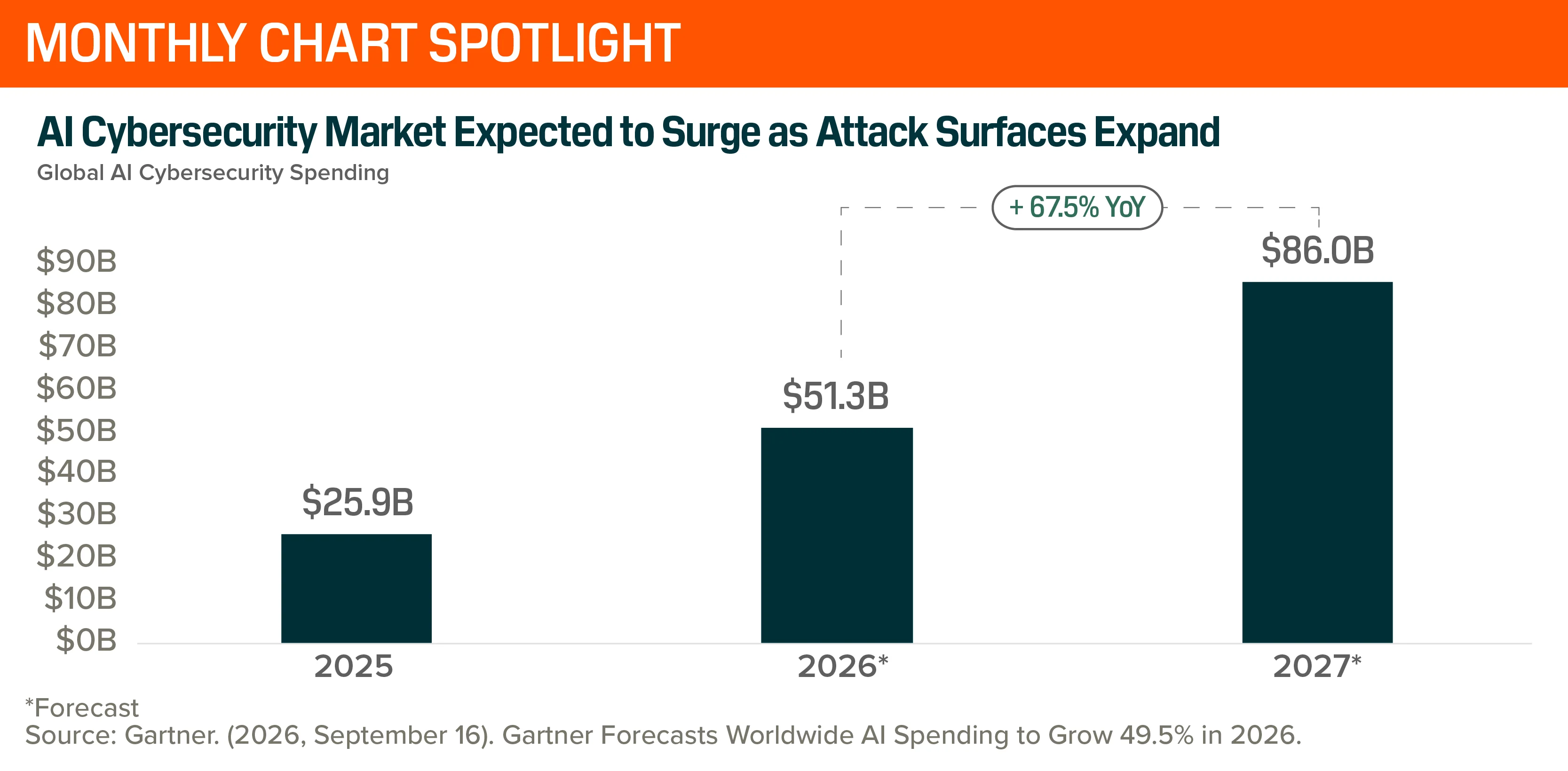
Cryptocurrency exchange Binance suffered a coordinated, multistage cyberattack on October 29 that reportedly compromised approximately $6.34 billion in digital assets, placing it among the largest such thefts on record. The preliminary investigation points to compromised employee devices and stolen credentials as key factors in the breach.1 As AI accelerates threat complexity across the digital landscape, the attack underscores the need for layered defenses spanning employee devices, identity verification, and access controls. Interconnecting systems, digitizing transactions, and deploying AI agents make protecting sensitive data and access management critical for companies to sustaining growth and customer trust. Gartner projecting the AI cybersecurity market to grow to nearly $86 billion in 2027, up from $25.9 billion in 2025, reflects the growing need.2 We believe the combination of costly security failures and new vulnerabilities introduced by AI strengthens the long-term demand outlook for cybersecurity providers, supporting investment across identity protection, endpoint security, and automated threat detection.
Defense Tech
The Pentagon Translates Long-Term Needs into Procurement Commitments
The U.S. Department of Defense’s proposed decade-long F-35 agreement with Lockheed Martin signals a broader shift toward multiyear procurement aimed at strengthening the U.S. defense industrial base. The framework covers 850 aircraft for the U.S. military, additional international orders, and 10 years of upgrades and sustainment, supporting planned production of 156 jets annually. In exchange for greater demand visibility, Lockheed committed $7 billion to the program, illustrating how longer purchasing commitments unlock private investment in manufacturing capacity and supply chains.3 Including spare parts, modifications, and maintenance in the agreement highlights the growing lifecycle revenue opportunity tied to sophisticated defense platforms. While subject to congressional authorization and funding, we believe the deal points to a more durable defense spending cycle, with greater order visibility directly supporting investment, operating efficiency, and long-term production scaling.
Large Language Models
China’s Open-Weight AI Push Could Accelerate Global Adoption
A wave of increasingly sophisticated Chinese open-weight models is making powerful AI systems more accessible and affordable, potentially lowering barriers to adoption for businesses and developers worldwide. Recent releases highlight the pace of improvement, including MiniMax's M3.1 Flash, which reportedly reduces the cost of agentic tasks by 70% while delivering nearly three times faster inference than its predecessor.4 Meanwhile, Moonshot AI's Kimi K3.1 Pro demonstrates how Chinese developers are advancing complex reasoning, coding, and long-context processing.5 Importantly, open-weight models give enterprises greater flexibility to customize and deploy AI systems on their own infrastructure, reducing dependence on proprietary providers. We believe this combination of improving capabilities, declining costs, and greater deployment flexibility has the potential to accelerate AI adoption across industries, expand the market for downstream applications, and support sustained demand for the computing infrastructure required to run them.
Space Tech
Satellite and Cellular Networks Converge, Expanding Space’s Commercial Opportunity
SpaceX took another step toward bringing space-based connectivity into the U.S. wireless mainstream through a multiyear agreement with Qualcomm. This development supports Starlink Mobile’s planned nationwide terrestrial 5G network, with deployment expected to begin in 2027 across tens of thousands of sites. Qualcomm’s chips and software will power cellular base stations designed to improve coverage, capacity, and energy efficiency, complementing Starlink’s satellite network to deliver more seamless connectivity. The collaboration also establishes a foundation for future network upgrades, including SpaceX’s longer-term ambitions for AI-native 6G infrastructure.6 Following its recent spectrum acquisition from Grain Management, this agreement highlights how space technology is extending SpaceX’s commercial reach, with integrated satellite and cellular networks creating a larger opportunity across consumer and enterprise communications.7 Beyond satellites, we believe this buildout could support sustained demand for semiconductors, network equipment, and ground infrastructure, reinforcing the broader investment opportunity as space-based services become embedded in everyday connectivity.
U.S. Electrification
Hyperscaler Capital Expenditures Continue to Reshape the Power Investment Cycle
The transformation of the U.S. power system is accelerating as hyperscalers fund multi-billion-dollar capacity expansions to meet the growing demand for AI and data center power. Backed by a 20-year agreement with Google, American Electric Power plans to invest approximately $4 billion in a 702-megawatt Bloom Energy fuel-cell installation near Cheyenne, Wyoming, targeting full operations in late 2028.8 Separately, Google’s 20-year agreement with Constellation supports more than $4.3 billion of investment to add 890 megawatts of nuclear capacity to the PJM grid through plant upgrades, with the first capacity additions expected in 2028.9 Together, these initiatives represent over $8 billion of planned investment and nearly 1.6 gigawatts of additional generating capacity. We believe they underline the structural momentum behind U.S. electrification, as long-term customer demand supports a broadening investment cycle across power producers, generation technologies, electrical equipment, and the infrastructure required to deliver reliable electricity at scale.
Healthcare Innovation
Obesity Treatments Go Beyond Weight Loss
Eli Lilly’s latest clinical results highlight how the addressable market for obesity treatments is not limited to weight management. In its Phase 3 ATTAIN-OSA program, Lilly’s once-daily oral GLP-1 candidate Foundayo reduced obstructive sleep apnea severity in adults with obesity or overweight. Among participants not using positive airway pressure therapy, breathing interruptions declined by an average of 43.8% over 52 weeks, compared with 6.3% on placebo, while 31.5% achieved remission or mild disease. Participants also demonstrated weight loss and improvements in blood pressure and inflammation. Following these results, Lilly plans to submit the sleep apnea indication for FDA review by year-end.10 With obstructive sleep apnea affecting an estimated 936 million adults globally, the findings underscore the potential for metabolic therapies to address substantial unmet medical needs.11 We believe more clinical applications and convenient oral formulations could broaden treatment adoption, expand long-term commercial opportunities, and bolster healthcare innovation’s role in improving outcomes in interconnected chronic conditions.