
Get the latest news and updates from our team.
SEI Investments Distribution Co. (1 Freedom Valley Drive, Oaks, PA, 19456) is the distributor for the Global X Funds.
Check the background of SIDCO and Global X's Registered Representatives on FINRA's BrokerCheck.
1. Source: Consumer Technology Association, “A Smartphone Surprise: US Ownership Hits Record Levels, Says CTA Research,” May 25, 2017.
2. Source: Consumer Technology Association, ‘Consumers Adopting Innovation: Wearables, Wireless Audio, Connected Devices Experience Largest Ownership Growth in 2016, says CTA,’ Apr 28, 2016.
3. Source: Statista, “Percentage of U.S. Population with a Social Media Profile,” 2017.
Our recent blog post on the differences between structural and cyclical themes discussed how those that are structural in nature tend to be one-off shifts that change existing paradigms, while cycle trends ebb and flow over time. In this post, we dig into how these disruptive one-off shifts tend to emerge and expand upon the characteristics of structural themes.
A Theory about Disruptive Technology
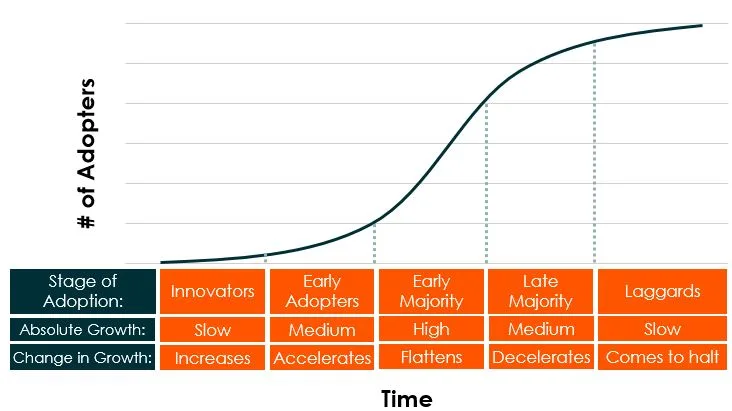
The Diffusion of Innovation Theory, developed by E.M. Rogers, holds that disruptive technologies, products, and ideas tend to follow an ‘S’ shaped adoption curve with five stages.
Adoption starts slowly, as only a small group of Innovators take a flier on a new technology before it is proven or widely accepted. Consider this group the buyers of the first Apple Watch, the original Tesla Roadster, or in a failed scenario, Google Glass.
The next stage is for the slightly larger group of Early Adopters to come in, who accelerate the technology’s growth and evangelize its value via word of mouth. This is often considered the tipping point in a technology’s acceptance, as the Early Adopters must convince the bulk of the population that a particularly technology is worthwhile. Currently, 4k TVs fall in this bucket, with approximately 16% adoption.1
Moving to the Early Majority, we reach the part of the Adoption S-curve where the slope is the steepest, and hence the rate of adoption is at its fastest. In this phase, sales growth tends to explode. At a 36% adoption rate, wireless headphones are likely in this category.2
Adoption continues growing at a solid pace as the Late Majority are convinced to participate, and the technology appears seemingly almost everywhere. With 81% adoption, social media is likely somewhere in the Late Majority stage.3
Finally, the Laggards, or the holdouts, begrudgingly acquiesce and accept/adopt a technology. We might remember this group as the Blackberry keyboard truthers who eventually caved and bought a full screen smart phone. By this point, however, sales growth has cooled off and virtually all of the potential market for a product has been captured.
This Theory in Practice
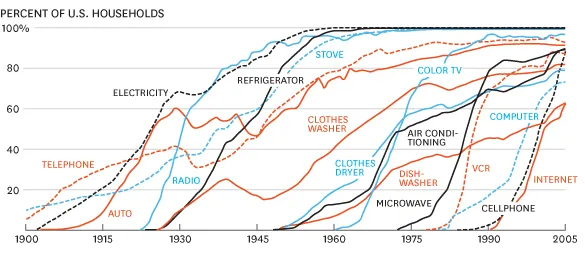
In practice, the ‘S’ curve prediction has held up fairly accurately. Not all products or new technologies follow the same ‘S’ shape, but by and large, historical adoption patterns for disruptive technologies and products have followed a general ‘S’ shape, as demonstrated in the chart below.
Source: Michael Felton, The New York Times and Harvard Business Review.
The shape of this ‘S’ can be influenced by a variety of factors, including the speed of technological advancements, cost curves, regulations, competition, or even social norms. Some may never experience an ‘S’ at all, as technologies often fail to make it past the Innovators or Early Adopters stages, even if it is a superior product (apologies to Betamax fans).
What Does this Mean for Investors?
The relationship between an adoption curve and stock prices is not always a direct one. Many factors can come into play that introduce differences, such as companies taking losses to build market share, intense competition, or unproven business models. In social media, for instance, firms tend to prioritize building their user base before inundating users with ads. Therefore, the adoption curve tends to noticeably precede revenue growth. Earnings can lag even further behind, as many high growth companies look to plow their cash flows back into their businesses.
Yet while there may not be a direct relationship, investors can certainly take certain cues from the adoption curve. For example, knowing where a product or technology is in its adoption can help signal general risks and characteristics of an investment. For example, if a technology is still clearly in its Innovators stage, an investment may likely resemble more of a venture capital-like risk and return profile, given high potential returns, but also a high possibility of failure. At the other end of the spectrum, a technology that is nearly ubiquitous in the Late Majority or Laggards phase is very well established, but has less upside.
For growth-seeking investors, we believe finding tech that is somewhere between the Early Adopters and Early Majority stages could prove to be a “sweet spot.” In this range, growth potential is still high and accelerating, but the technology has undergone some level of vetting and has proven itself to a meaningful portion of the population.
Related ETFs
LIT: The Global X Lithium & Battery Tech ETF invests in the full lithium cycle, from mining and refining the metal, through battery production.
FINX: The Global X FinTech ETF seeks to invest in companies on the leading edge of the emerging financial technology sector, which encompasses a range of innovations helping to transform established industries like insurance, investing, fundraising, and third-party lending through unique mobile and digital solutions.
BOTZ: The Global X Robotics & Artificial Intelligence ETF seeks to invest in companies that potentially stand to benefit from increased adoption and utilization of robotics and artificial intelligence (AI), including those involved with industrial robotics and automation, non-industrial robots, and autonomous vehicles.
SNSR: The Global X Internet of Things ETF seeks to invest in companies that stand to potentially benefit from the broader adoption of the Internet of Things (IoT). This includes the development and manufacturing of semiconductors and sensors, integrated products and solutions, and applications serving smart grids, smart homes, connected cars, and the industrial internet.
SOCL: The Global X Social Media ETF provides investors access to Social Media companies around the world.
The four companies highlighted here represent key aspects of the growing and evolving lithium and battery technology ecosystem.
Pedro Palandrani
Global X Research