Why Space Tech?
Launch: New Economics Are Reshaping the Industry
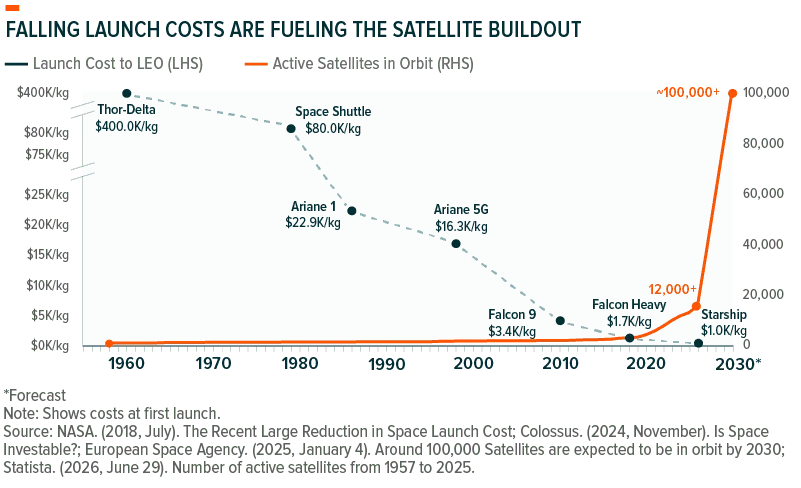
The average cost of delivering payloads to Low Earth Orbit (LEO) has fallen by over 95% since 1960s to under $3,000/kg on SpaceX’s Falcon 9 this decade, fundamentally changing the economics of operating in space. Reusable rocket boosters – which reduce hardware replacement costs and support higher cadence – underpin this shift.1
Improving economics have nearly quadrupled global orbital launch attempts over the past decade to roughly 325 in 2025. More importantly, commercial launches now account for 70% of activity, up from just 25% a decade ago, signaling the industry’s shift toward commercial scale.2 The commercial launch market is expected to grow at a 13.4% annual rate to $70 billion by 2035.3
Lower launch costs are also broadening the competitive landscape. SpaceX remains the dominant, but companies such as Rocket Lab are scaling capabilities and competing for a larger share of the launch market.
Satellites: Rising Orbital Density Creates Investable Infrastructure
As access to space improves, orbital infrastructure scale is compounding. Active satellites increased from ~1,000 in 2010 to more than 12,000 in 2025 and could approach 100,000 by 2030, transforming orbit from a collection of individual assets into a persistent infrastructure layer.4
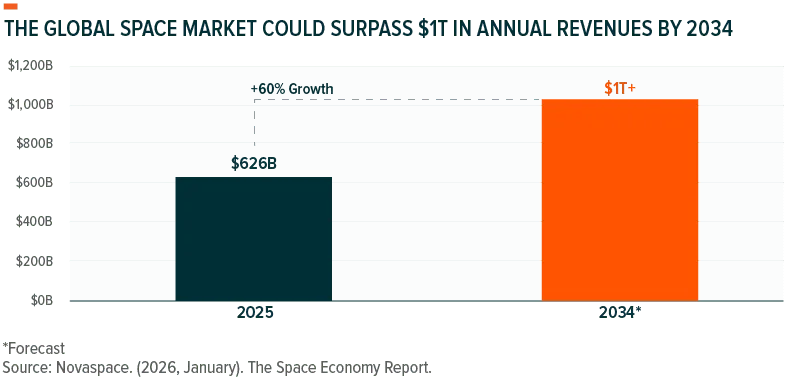
Satellite-enabled solutions could account for 63% of space revenues by 2034 as constellation density increases and services such as broadband connectivity expand.5 Satellite broadband revenue alone could reach $100 billion by 2035, roughly four times its 2025 level.6 This growth of satellite-services is shifting the economics of the industry from project-based hardware contracts toward recurring revenues for broadband and data services.