
This piece is one in a series that delves further into the leading themes emerging from this year’s iteration of our flagship research project, Charting Disruption.
Geopolitical fragmentation is fueling the ongoing global defense rearmament cycle with implications well beyond the battlefield. Rising threats across Europe, Asia, and escalating conflict in the Middle East are forcing governments around the world to prepare for simultaneous security challenges. Moreso, disruptions to energy supplies, trade routes, and semiconductor production also make deterrence an economic priority.
The resulting investment cycle combines an urgent need to rebuild weapons inventories with a longer-term push to modernize military capabilities. AI, autonomous systems, space-based intelligence, and cybersecurity are changing how countries establish deterrence and increasingly how defense companies generate revenue. We believe this combination could support sustained demand across established contractors and a growing group of technology providers.
Key Takeaways
A widening set of threats is supporting a multi-year defense rearmament cycle, with spending extending from weapons replenishment into domestic manufacturing and advanced technologies.
Drone warfare is exposing the cost and inventory pressures of relying on expensive legacy hardware systems, shifting modern defense towards low-cost, scalable systems.
Growing technology adoption could enhance the industry’s growth opportunity and valuation profile, combining long-term hardware backlogs with recurring software demand.
Global Rearmament Is Building a Durable Investment Cycle, Improving Revenue Visibility
Global military spending reached approximately $2.9 trillion in 2025, marking its twelfth consecutive year of growth, and is projected to exceed $3.8 trillion by 2030.1,2 Preparing for threats across multiple regions requires deeper stockpiles and the capacity to replace equipment faster. This creates spending needs that can persist beyond individual conflicts, supporting a longer investment cycle for the defense industry.
As it becomes more self-reliant, Europe has grown into a major contributor of defense outlays. NATO allies have committed to defense and security-related spending of 5% of GDP by 2035, including at least 3.5% for core defense requirements.3 Orders are already translating into substantial backlogs for European defense leaders, providing visibility into future activity. For example, as of August 2026, BAE Systems, Rheinmetall, Leonardo, Thales, and Saab held backlogs equivalent to roughly two to five times their projected 2026 revenues.4
The opportunity also extends across borders. European NATO members’ arms imports increased 143% between 2016-2020 and 2021–2025, while U.S. arms exports to Europe rose 217% over the same period.5 Shared platforms and integrated supply chains mean that higher European budgets can support suppliers across the alliance even as countries build more domestic capacity.
U.S. Budgets Target Innovation and Industrial Capacity Together
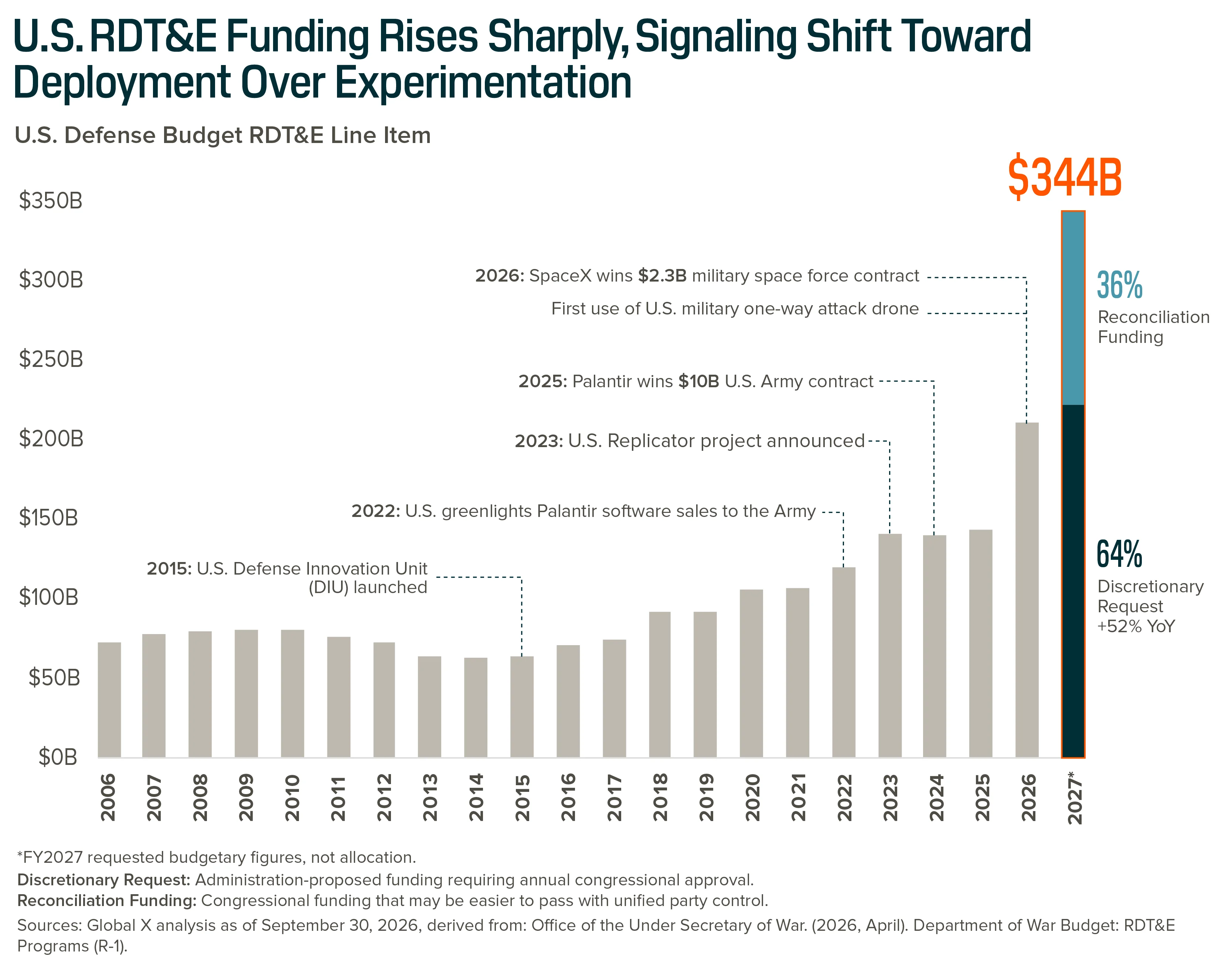
The proposed $1.5 trillion U.S. FY 2027 defense budget illustrates the scale of this response.6 Of this, it requests approximately $344 billion for research, development, test, and evaluation (RDT&E), up 63% from FY 2026 enacted funding, alongside $413 billion for procurement.7 The RDT&E proposal includes a $54.6 billion request for the Defense Autonomous Warfare Group, signaling the growing priority of autonomous capabilities.8
Inventory replenishment also adds urgency and opportunity. Recent conflicts have drawn down critical missile inventories, with estimates indicating that delivering newly ordered munitions can take over four years.9 For defense contractors, this creates demand for additional production lines and suppliers as well as finished weapons. The capacity to manufacture at scale becomes part of deterrence itself.
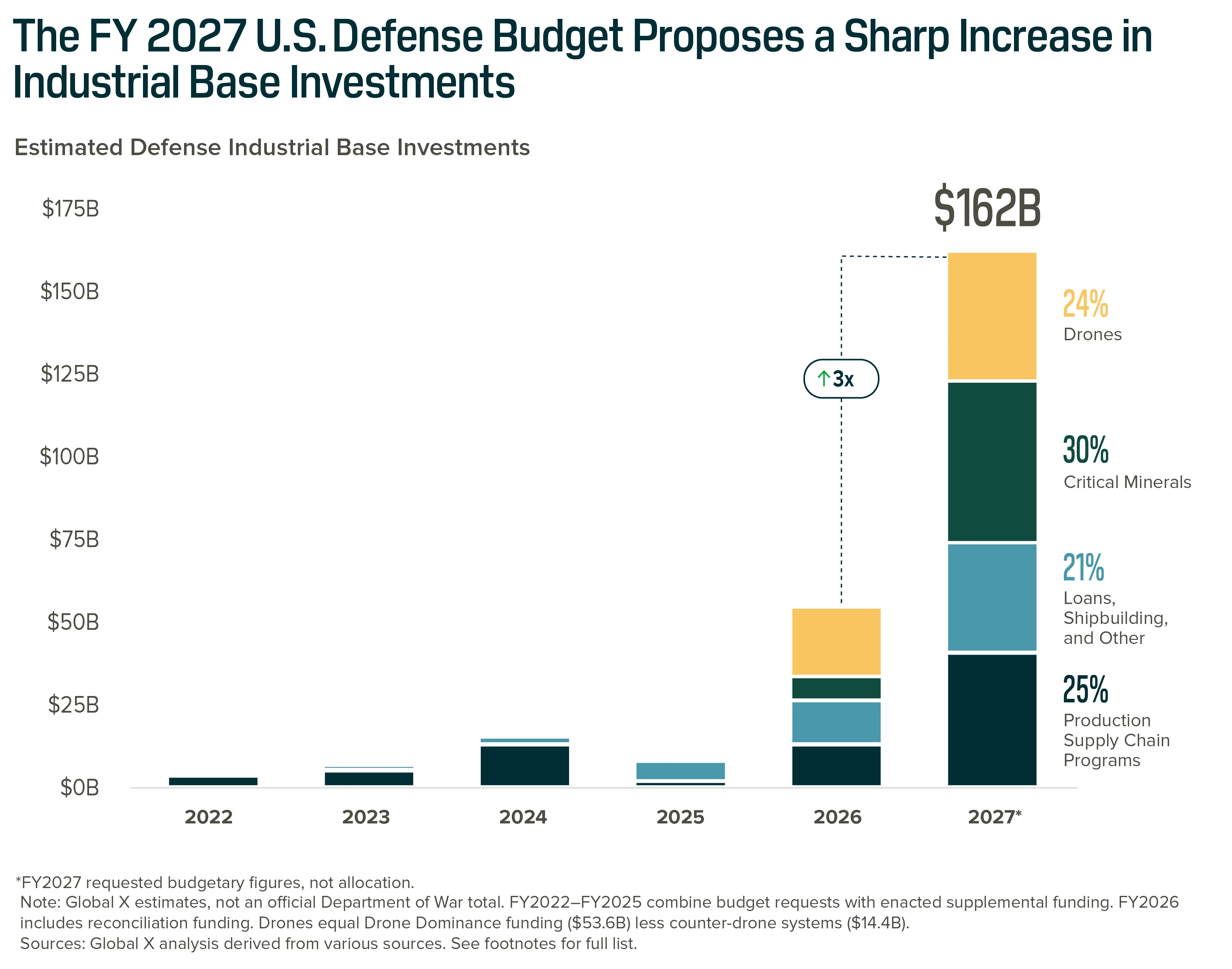
Moreso, the FY 2027 U.S. budget request specifically calls for a substantial expansion of the defense industrial base. We estimate defense industrial base-related investments will reach $161 billion in 2027, roughly 15 times FY 2026 levels, with the top three funding categories aimed at defense manufacturing, materials and magnetics, and munitions.10
Expanding access to materials, magnets, and manufacturing capacity can help reduce supply-chain vulnerabilities and support new programs. The investment opportunity therefore reaches beyond major defense platforms to the industrial base required to build them.
Drone Economics are Accelerating the Shift Toward Low-Cost, Scalable Systems
The economics of drone warfare help explain why the composition of spending is changing. Intercepting a $30,000 drone can cost defenders millions of dollars using conventional interceptors.11 Some intercepts in the Iran war specifically have required multiple Patriot interceptors per target, widening the cost ratio even further.12
Repeated attacks can impose substantial financial costs while depleting scarce defensive inventories. This strengthens demand for lower-cost interceptors, electronic warfare, and directed-energy systems that complement conventional missile defense.
Production scale is equally important, with the U.S., along with its NATO allies, moving quickly to close drone-technology budget gaps with China, which has long dominated in drone quantity.13 Building larger fleets requires dependable components and replacement capacity, creating opportunities across drone manufacturers and their suppliers.
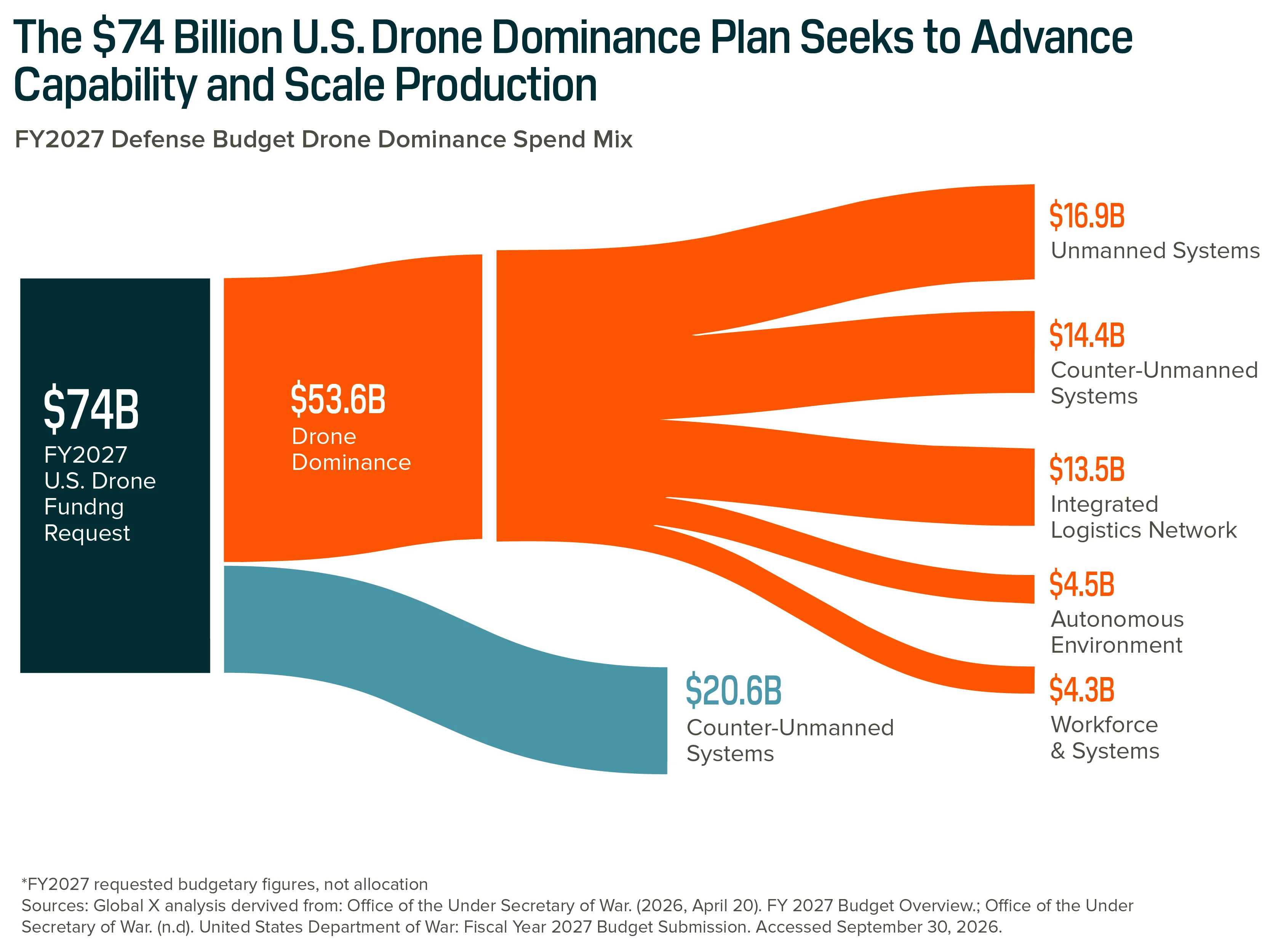
The FY 2027 U.S. defense budget request includes roughly $54 billion for autonomous and remotely operated systems under the drone dominance initiative and $20.6 billion for counter-unmanned systems.14 These investments recognize that larger drone fleets also need software to coordinate operations and infrastructure to sustain them. The commercial opportunity spans the aircraft, the systems that protect against them, and the technology required to deploy both at scale.
AI and Cybersecurity Grow Increasingly Integral to Military Readiness
AI is the link between military hardware and the intelligence needed to use it effectively. The Defense Innovation Unit (DIU) helps bring commercial technologies into this market, with projects spanning autonomous vehicles and drones to AI software and computing hardware for running AI on local devices.15
Recent awards, including Palantir’s $10 billion U.S. Army contract and Anduril’s $20 billion contract, illustrate the potential scale of this market.16 2026 marked the 11th year for the U.S. DIU. Its $979 million budget represents roughly four times growth from levels just five years ago and reflects its continued evolution from prototyping to mass deployment of defense tech.17
Greater digital defense dependence also expands the need for cybersecurity across military networks and civilian infrastructure, creating related opportunities in secure communications and threat detection. Global cybersecurity spending could reach $464 billion by 2030, with governments and military agencies contributing to this broader demand.18 The U.S. Cyber Command FY 2027 operations funding request of $2.2 billion marks a 35% YoY increase, supporting cyber readiness and force modernization.19
Tech Innovation and Integration Is Reshaping the Defense Industry’s Profile
AI, software, and autonomous systems are reshaping defense companies’ growth prospects, revenue models, and valuation profiles. Recurring software revenue and higher-margin digital services could complement long-term hardware contracts and substantial backlogs, supporting margin expansion and greater revenue visibility. As this mix evolves, traditional defense primes could increasingly warrant valuations that recognize both the stability of their industrial businesses and the growth potential of their expanding technology offerings.
Conclusion: A Broader Defense Opportunity Is Taking Shape
The global defense rearmament cycle is well underway, driven by ongoing geopolitical conflict, rising military budgets, and rapid tech advances. Conventional platforms and hardware arsenals remain essential, but AI, cybersecurity, and autonomous systems are expanding military capabilities and reshaping the economics of warfare, creating growth opportunities across defense manufacturing, software, and critical infrastructure.
With global defense spending projected to exceed $3.8 trillion by 2030, we believe the sector is positioned for a sustained investment cycle.20 Companies that can deliver manufacturing at scale, technological innovation, or a combination of the two could help define the next generation of defense capabilities and capture a growing share of military budgets.
For additional insights, please view our full report, Charting Disruption: Outlook for 2027 and Beyond.